Germany focuses on data protection and privacy

Americans may be tempted to think of EU data protection and privacy laws as being an obstacle deliberately placed in the way of conscientious US lawyers who are merely trying to do their job. That reaction is unsurprising, since that is the context in which they come across a set of laws which are remote from their domestic experience. It may help if I point you to four recent articles about Germany, only one of which has a direct connection with electronic discovery. The others may serve to provide a context. Continue reading

Posted in Data privacy, Data Protection, Discovery, eDisclosure, eDiscovery, EU | Leave a comment

Ofsted report was “beefed up” to remove Shoesmith

The Guardian newspaper is the first to carry a substantive report following the release today of papers relating to Ofsted’s late disclosure of documents in Sharon Shoesmith’s action against Haringey, Ofsted and Ed Balls – see Baby P report on Sharon Shoesmith ‘was beefed up to remove her’.

It does not appear that they have yet had the chance actually to read the newly-released documents, and most of the report is based on what Shoesmith’s lawyers have said about them. Continue reading

Posted in Discovery, eDisclosure, eDiscovery, Electronic disclosure | Leave a comment

Applied Discovery launches Reviewitter – a new review tool for e-Discovery

Today, 1 April, Applied Discovery announces the launch of a new review tool. Called Reviewitter, it is designed to allow the truncation and review of unstructured data into 140 character reviewable documents. The press release carriers an endorsement from Greg Bufithis of The Posse List, no less, who predicts that these “tweets” should “spur accelerated investment and uptake in similar tools that can help streamline the entire discovery process”.

Applied Discovery have helpfully provided a link which explains the choice of date. As technology advances, it becomes increasingly difficult to discriminate between real applications and those which do not (yet) exist. I have not seen today’s Times, but it has for many years carried advertisements for BMW on April 1st which sometimes take more than one reading to understand. Many years ago, for example, they had one for windscreen wipers which operate automatically when water landed on the windscreen. Ho, ho, we said, clever joke – but it did not take long for the technology actually to exist. Part of the joke, of course, is that Germans do not really understand joking as a social form. Continue reading

Posted in Discovery, eDisclosure, eDiscovery, Electronic disclosure, iCyte, Posse List, Recommind | Leave a comment

More coming on the Shoesmith – Ofsted – Balls e-Disclosure fiasco

We do not really do breaking news here, but rumour reaches me that we may hear more today about Ofsted’s disclosure failures in Sharon Shoesmith’s application for judicial review of the decision to dismiss her. Even as I write, apparently, journalists are ripping open packages with papers which may help us with all those unanswered questions.

My original article on it was called The Baby P case may be the disclosure story of the year, and you may care to refresh your memory about that whilst we wait to see what emerges.

Is this just routine incompetence of the kind we expect from our bloated public services (48% of GDP went on them last year)? Is it just ignorance of and disdain for the formal obligations of candour which the rules require and which apply particularly to disclosure? Perhaps it is that curious perception that electronic documents just don’t count somehow – we don’t understand them, so let’s just pretend they don’t exist or somehow fall outside the definition of a “document” in Rule 31.4 CPR – “anything in which information of any description is recorded” seems pretty clear to me, but I am not a civil servant. Were documents really “stuck in the photocopier”, or did someone use the shredder instead? Did they really print all the emails off and photocopy them?

And, even more interestingly, was there really an instruction to destroy documents which might have pointed to an earlier draft Ofsted report whose terms were not what Ed Balls, the ghastly and overbearing Children’s Minister, wanted? And if so, whence did those instructions come?

Bang on cue, here comes a Google alert to tell me that the papers have reached the media. Off to do some reading – more later.

Home

Posted in CPR, Discovery, eDisclosure, eDiscovery, Electronic disclosure, Part 31 CPR | Leave a comment

A week of positive opportunities in e-Disclosure

There are two reasons for running a week’s worth of reports and comments into a single article. The least meritorious of them is that I will not keep up with it all if I do not do a composite post. More positively, that is because a lot has been happening and I can better convey the sense of that in a single article. The overall message is one of positive steps forward, not merely defensiveness.

The previous week ended with a session run jointly with Andrew Haslam of Allvision at a medium-sized firm with a strong regional base and a London office. It is exactly the sort of firm which I have written about as holding the key to the future, at least in my own narrow ambit – agile, versatile, staffed with lawyers trained at the big city firms, and hungry for quality litigation work. It is the sort of firm which, if it makes alliances with the right providers of litigation services and invests in the skills, could take on much bigger firms at a cost lower than theirs, partly because their costs and charging rates are lower and partly because of the way they run their litigation. I will spend any amount of time with firms like this, because they get it, and could change client perceptions about how litigation should be managed.

I covered the background — the framework of rules and cases, the implications of the Jackson Report, and where we stand with the proposed new practice direction and ESI Questionnaire. Andrew Haslam spoke about the technology which is available and what a firm needs to have in place as processes and connections to be able to run with anything which comes along. In the pub afterwards, one of the solicitors told me frankly that he had come to the session expecting to be unconvinced but, having heard us on the subject of the ESI Questionnaire, intended to send it to his opponents in a particular case first thing on Monday morning. A result, I think. Continue reading

Posted in Court Rules, CPR, Data privacy, Discovery, eDisclosure, eDiscovery, Electronic disclosure, Litigation, Litigation costs, Lord Justice Jackson | Leave a comment

Reasonably accessible tapes in cartoon and Court of Appeal

I resist passing on all Tom Fishburne’s wonderful Case in Point cartoons which he does for CaseCentral – this is supposed to be a serious place, and I don’t want Fishburne eclipsing my own occasional forays into the lighter side of e-Discovery.

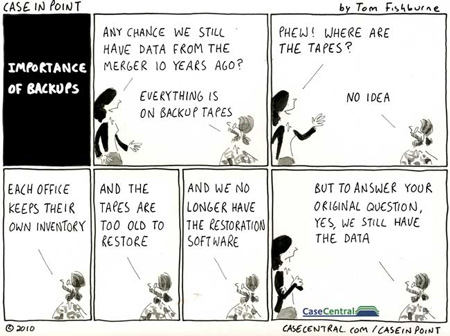
Like all the best cartoons, this week’s is both telling as well as funny:

Importance of backups

It is also, as it happens, very timely, coming in the week where the Court of Appeal has actually had to consider a point about reasonable accessibilty of back-up tapes – the case is Fiddes v Channel 4 and I will write about it as soon as I can find a public version of the original judgment. Briefly, the judge decided against ordering the disclosure of some hard-to-access tapes on grounds of proportionality and the Court of Appeal upheld his judgment.

It does not matter what it is which makes people think about the subject – a cartoon and a Court of Appeal judgment have equal weight at that level.

Home

Posted in Discovery, eDisclosure, eDiscovery, Electronic disclosure, Litigation costs, Litigation Support | Leave a comment

Using marketing to make people hate you

There is more to marketing than making yourself heard – that is just a process, achieved with money and effort. The objective, however, is to make people buy from you, not hate the sight and sound of your name. Bad marketing taints the water for everyone else.

My post Revolutionary video pillory for PR consultants drew attention to a video on Charles Christian’s Orange Rag which sounded more like a recording than the parody it was meant to be.

He has now put up a sequel The embargo has been broken which, unlike most film sequels, maintains the standard of the first.

Whilst on the subject of PR consultants, can I give a medal to whoever is responsible for the PR for a particular US translations company? I had never heard of them before the recent campaign began and, it is fair to say, I never want to hear of them again. The trick appears to be to place the same article about the company in as many places as possible, regardless of context — I came across one today on what appears to be a site for fatties and food faddists with tags like “burn fat fast” and “psychic powers” and “healthy foods to eat”. They are not, therefore, fussy about the company they keep, merely keen that you should see their bloody press release as often as possible. Continue reading

Posted in eDisclosure, eDiscovery, Electronic disclosure, Litigation Support, Marketing, SEO | Leave a comment

Gucci v Curveal: a blow for US interests – whichever way you understand that expression

British 19th Century “gunboat diplomacy” and the song The Wreck of the Old 97 are what came to mind when I read the latest Opinion of a US court about the relative importance of US interests and the laws of other countries restricting the discovery of private information. Carry on like this, USA, and you may well need a gunboat to support document collections.

The article by the respected US e-Discovery commentator Tom O’Connor Why the Rest of the World Thinks we are Crazy concerns an Opinion of the District Court of the Southern District of New York which orders a Malaysian bank, not party to the proceedings, to produce documents despite a Malaysian statute prohibiting them from doing so. I volunteer to speak on the half of “the Rest of the World” Continue reading

Posted in Data privacy, Data Protection, Discovery, eDisclosure, eDiscovery, Electronic disclosure, EU, Forensic data collections | Leave a comment

Legal Efficiency supplement in The Times today

Raconteur has produced an excellent supplement for today’s Times on Legal Efficiency which includes a report by Professor Dominic Regan of an interview with me. Having, as I do, the luxury of writing about anything I choose, it is good occasionally to have a discussion agenda set by someone else. Dominic is a skilled interviewer, and his questions picked out what matters.

That is true also of the others whose comments appear in the supplement, which is a very readable encapsulation of the issues which lawyers face in delivering affordable legal services to clients whilst preserving profitability.  The clients do not necessarily read articles aimed at lawyers, but they do read the Times.

This is just a quick mention to make sure you get a copy whilst it is still on the stands. I will do a fuller summary later.

Home

Posted in Discovery, eDisclosure, eDiscovery, Electronic disclosure, Legal Technology | Leave a comment

Talking rather than writing – normal service will be resumed soon

The relative silence on these pages recently does not imply that I have run out of things to say (sorry about that) merely that I have had a good run of being out and about, or making plans for future events here and abroad. All good, all interesting, and all indicative of a rise in interest in e-Disclosure / e-Discovery amongst those who need to know about it, but not consistent with much considered writing.

Gucci America v Curveal has not passed unnoticed, and there is an article coming up which invokes 19th Century British gun-boat diplomacy and The Wreck of the Old 97 as parallels for the US approach to trifles like the laws of other countries. Another article, consistent with my current theme about objectives being more important than processes, shows how a PR agency can be 100% successful in getting its client’s name out there, whilst making it deeply hated – the SEO is great, chaps, but the effect is wholly negative.

All this and more when I get back from the third in my sequence of post-Jackson talks in London. Tomorrow’s one is to ALPS, the Association of Litigation Professional Support Professionals, in company with Vince Neicho of Allen & Overy – an important and knowledgeable audience. There is one more after that, on Thursday, at which I am listening rather than speaking, and then I am back at my desk for a bit and can catch up.

Home

Posted in Data privacy, Data Protection, Discovery, eDisclosure, eDiscovery, Electronic disclosure, Litigation, Litigation costs, Lord Justice Jackson | Leave a comment

A flying visit to Edinburgh

The spate of blog posts last week-end was a clearing of the decks in the knowledge that I would not have much writing time for a bit. The Edinburgh trip which is the subject of this post is being followed by some in-house sessions for lawyers, and when there is a choice between talking to people and writing, the talking comes first. I also had to take every last stick of furniture and cabling, right down to the router, out of my office so that it could be  decorated and, after 11 years in the same room, that takes some reassembly.

I was in Edinburgh on Tuesday, speaking to the Scottish Society for Computers & Law with Ian Manning of Raposa Consulting and Nigel Murray of Trilantic. Trilantic organised it, and kindly invited me to take part. The law technology commentator Charles Christian of the Orange Rag has rather unfairly labeled me as the Ancient Mariner of air travel on the basis that I no sooner book a flight than either the prices plummet or the airline announces a strike. This is the first time, however, that an airline has actually ceased trading between my booking the ticket and take-off. Shortly after I was invited to go to Edinburgh, a small airline announced the opening of a route from Oxford to Edinburgh, and the price, the convenience, and the wish to support a local venture caused the suspension of my usual caution and my loyalty to British Airways. If someone ever offers to fly you from just up the road to where you need to be for £49 each way, then the offer is almost certainly too good to be true – and so it proved. The airline suspended flying in days, and I ended up as usual in my branch office, the BA Executive Lounge at Heathrow’s Terminal 5. Don’t even ask about the return journey.

In between, however, it was a good trip. Ian Manning and I went to see one law firm which gave us a feel for the climate and the context – you can read all you like about a jurisdiction, but you have to go there to begin to understand those things which are the same and those things which are different. Continue reading

Posted in Court Rules, CPR, Discovery, eDisclosure, eDiscovery, Electronic disclosure, Forensic data collections, LiST, Litigation, Litigation costs, Litigation Support, Scottish Courts, Trilantic | Leave a comment

7Safe eDiscovery networking event on 15 April

7Safe is holding an eDiscovery networking event on Thursday 15 April at The Hoxton Hotel, 81 Great Eastern Street, London EC2A 3HU at 6.30pm.

It is to mark the official launch of their hosting of Anacomp’s CaseLogistix, one of the document review tools which was used by Anton Valukas, the examiner responsible for the recent report into the collapse of Lehman Brothers (see my articles about the Lehman Report and about the alliance between 7Safe and Anacomp).

I have a two interests in going, since both 7Safe and Anacomp are sponsors of the eDisclosure Information Project, and a third if you count the fact that I am speaking at the event. I see that the invitation is careful to distinguish between that part of the evening and the “fun” which is to be provided along with the refreshments.

If “fun” slightly overstates the entertainment value to be derived from listening to me talking, these are certainly interesting times, as I hope I will make clear. It may be premature to suggest in March that Senior Master Whitaker’s judgment in Goodale & Ors v The Ministry of Justice & Ors [2009] EWHC B41 (QB) (05 November 2009) is the e-Disclosure judgment of the year, but it certainly puts pressure on those who think that they can simply ignore electronic documents as being too difficult or too expensive to handle. Continue reading

Posted in CaseLogistix, Discovery, eDisclosure, eDiscovery, Electronic disclosure, Litigation, Litigation costs, Litigation Support, Lord Justice Jackson | Leave a comment

Vector Investments: successful claimant made to pay for unhelpful disclosure

Is quite rare to come across UK cases where the quality and costs of disclosure become the subject of a reported judgment. In rare cases such as Digicel, Earles or Goodale, disclosure is either the primary subject-matter of the judgment or is a sufficiently important part of it that (if the judgment is reported at all) we get to hear of it.

Judgments must, in fact, be made every week which record adverse comment, or adverse costs orders, against a party which has failed to comply with its disclosure obligations. Whilst these are often to do with under-disclosure (that is, a failure to disclose that which ought to have been disclosed) it is just as important to know of cases where one party imposed an unnecessary burden on the other by over-disclosing or by the manner in which the documents were presented to the other side. The only reported case I have ever come across on this pre-dates the 1999 rules and, indeed, the days of electronic documents.

Vector Investments v Williams [2009] EWHC 3601 (TCC) (05 November 2009) is of the latter kind. I conclude from the references in it to “files” that disclosure was given on paper, which itself raises questions, but not those which came up between the parties. It is a judgment of Mr Justice Ramsey in the Technology and Construction Court. The main interest as to costs generally lies in the judge’s consideration of the liability for costs following a compromise and a Tomlin Order. The only outstanding point for determination was the assessment of costs, and the judge felt obliged to consider the whole subject of the principles applicable to assessment of costs. You can get the flavour of it from a sentence in paragraph 71 which reads “How should the court approach cases where a claimant has made offers which do not comply with Part 36 and which have been beaten by the claimant as a result of settlement?”. Continue reading

Posted in Case Management, CPR, Discovery, E-Discovery Suppliers, eDisclosure, eDiscovery, Electronic disclosure, Litigation, Litigation costs, Litigation Support, Lord Justice Jackson, Part 31 CPR | Leave a comment

New e-Disclosure articles on the SCL website

The website of the Society for Computers & Law has two new articles about electronic disclosure.

One is by barrister Clive Freedman of 3 Verulam Buildings and is called Disclosure: the Proposed Rule Changes. It summarises succinctly the elements in Lord Justice Jackson’s Final Report relating to disclosure and to electronic disclosure – I make that distinction because the labels serve to separate the principles which apply to the scope of disclosure and the court’s role in managing disclosure (on the one hand) from the elements which relate specifically to the disclosure of electronic documents (on the other). In practice, since the vast majority of documents to be disclosed are electronic, this distinction may seem unimportant. Lord Justice Jackson, however, treated them under separate headings and, for the moment at least, discrimination between the “what” and the “how” is a useful one, although they are, of course, interlinked – the third question “how much?” introduces cost into the equation, as proportionality demands that it must. Continue reading

Posted in Case Management, CPR, Discovery, eDisclosure, eDiscovery, Electronic disclosure, Litigation, Litigation costs, Lord Justice Jackson, Part 31 CPR | Leave a comment

Stratify and CaseLogistix manage e-Discovery for the Valukas report on Lehman collapse

I am reasonably sure that I will not find time to read the 2,200 page Valukas Report on the collapse of Lehman Brothers. Fortunately, Gregory Bufithis of The Posse List has extracted from it the description of the electronic discovery exercise which Anton Valukas, the examiner appointed by the U.S. Bankruptcy Trustee, undertook in the preparation of his report (see The Valukas Report on the Lehman Brothers collapse and e-discovery — Stratify and CaseLogistix win the day .

The chief interest to me, apart from the staggering volumes of documents involved (to say nothing of the 2600 software systems and applications in use at Lehmans) is that two of the e-Disclosure Information Project sponsors, Stratify and Anacomp’s CaseLogistix, emerged as the systems of choice for the investigation. More than 70 contract attorneys, in addition to lawyers from the retained law firms, conducted first first-pass reviews using these two systems. Continue reading

Posted in CaseLogistix, Discovery, eDisclosure, eDiscovery, Electronic disclosure, Litigation Support | Leave a comment

Welcome to Recommind as a sponsor of the e-Disclosure Information Project

It is very good to be able to extend a warm welcome to Recommind as a new sponsor of the e-Disclosure Information Project. As the focus for e-Discovery / e-Disclosure turns increasingly on to the way companies collect and manage data on their own systems, the addition of a provider who embraces enterprise search, e-mail management, records management e-Discovery and compliance is both appropriate and timely.

Recommind’s roots are in enterprise search. MindServer Search brings user-based relevancy tuning, that is, result sets which are boosted by input from the individual profile of the user. It also allows federated search, the ability to search across internal and external data sources with a single query. The result of indexing information from document management systems, intranets, contact management databases and websites are “concept models” which rank search results by relevance. Continue reading

Posted in Discovery, Document Retention, Early Case Assessment, eDisclosure, eDiscovery, Electronic disclosure, Litigation Readiness, Litigation Support, Recommind | Leave a comment

Welcome to H5 as a sponsor of the e-Disclosure Information Project

It is a great pleasure to be able to put up the logo of information retrieval company H5 as a new sponsor of the e-Disclosure Information Project. I described H5 in a recent article as “a cross between a commercial information consulting business and a research university” one which, I said, lays as much stress on its high-calibre people as it does on the services and software which comprise its offering to clients.

My connection with H5 goes back to my first foray into the US litigation world, at LegalTech in 2007. I went there because it had become obvious that a half-understanding of US e-discovery was acting as a brake on the UK use of electronic means to tackle electronic documents. The UK alternative was simply to ignore the fact that 90% of communication between businesses is electronic, and to take refuge in the assertion that electronic discovery was something Americans did, and did both extravagantly and expensively. Whilst we still suffer from that amongst the backwoodsmen of UK litigation, we are eroding it and replacing the image of US providers as all “Texans with tall hats” (as one of them once put it to me) with the reality of intelligent people trying to solve much the same problems as our own. Continue reading

Posted in Discovery, eDisclosure, eDiscovery, EDRM, Electronic disclosure, H5, Litigation Support | Leave a comment

Standards and outcomes: Hitler, the NHS, the police, social workers – and e-Disclosure

My heading, I appreciate, looks like the components of some random word game. There is in fact a connection, and it is to do with the supremacy of result over procedure and of destination over the journey. Hitler, the NHS and rest are called in aid as demonstrations because both came under my eye last week without their place in the jigsaw being immediately apparent to me. What really matters in disclosure / discovery is the outcome in terms of evidence considered by the parties and the court, not mere compliance with standards apparently imposed by the rules. The client is interested in the outcome, as are victims of crime, abused children and hospital patients. Rules matter, but they matter less than the end-result. Continue reading

Posted in Case Management, Civil justice, Court Rules, CPR, Discovery, eDisclosure, Electronic disclosure, Litigation, Litigation costs, Lord Justice Jackson, Part 31 CPR | Leave a comment

Free use of Equivio Early Case Assessment Software for up to one million documents

Equivio is offering to make its early case assessment application Equivio>Relevance available to a limited number of participants in what they call the Equivio>Relevance Challenge – see the press release and sign-up page for details.

Most lawyers can understand the basic concepts of keyword search, if only because they do it every day with Google. Because one can generally find something out of the mass with a Google search, it is tempting to assume that throwing a list of keywords at disclosure / discovery data will reduce the volumes of data to be reviewed – and so, of course, it will. Many lawyers will understand, or at least be aware of, the idea that a keyword search is flawed as an approach to identifying relevant documents, not least because “relevance” turns on many factors beyond the incidence of a particular word or words in a document – correspondence between fraudulent conspirators will contain neither “fraud” nor “conspiracy”, to take a trite example. Continue reading

Posted in Court Rules, CPR, Discovery, Early Case Assessment, eDisclosure, eDiscovery, Electronic disclosure, Equivio, Judges, Litigation, Litigation costs, Litigation Support, Lord Justice Jackson | Leave a comment

EDiscovery leads in March issue of American Legal Technology Insider

The March issue of Charles Christian’s American Legal Technology Insider is available here.

It leads with the headline Shake-up time for e-Discovery sector, with Iron Mountain’s acquisition of Mimosa Systems and the report that Marsh & McLennan Companies are putting the Kroll corporate investigations division on the market. Continue reading

Posted in eDisclosure, eDiscovery, Kroll, Legal Technology, Litigation Support | Leave a comment

Cloud Computing: Privacy, Disclosure and Discovery Considerations

There is a free webinar on 11 March callled Privacy, Disclosure and Discovery Considerations stemming from Cloud Computing. It is put on by Wave University and CT Summation and the speakers are Dan Regard of iDiscovery Solutions, Inc., eDiscovery Specialist Reza Alexander and Joseph Baker of Mayer Brown in Washington.

Wave University is an educational platform for legal professionals offering free webinars, ‘lunch and learn’ series and software training webinars.  Any US-based discussion about privacy needs an EU perspective and Reza Alexander, who was until recently the Litigation & Practice Support Manager for DLA Piper UK, will bring an authoritative viewpoint.

The webinar is at 10:00 – 11:00 Pacific Time, 1:00-2:00 Eastern Time, 18:00-19:00 GMT tomorrow 11 March 2010.

Home

Posted in Data privacy, Discovery, eDiscovery, Electronic disclosure, EU, Litigation Support, Summation | Leave a comment

Cats Legal partners with Digital Reef

I wrote recently about Cats Legal, the combination of established print solutions provider Cats Solutions and litigation support provider LDSI (see Cats Solutions combines with LDSI to become Cats Legal).  My planned meeting with Mark Wagstaff of Cats Legal had to be postponed, so I have yet to visit the new operation. What I have had, however, is a press release from Digital Reef announcing a partnership with Cats Legal.

Cats Legal obviously intends to hit the ground running if this deal is anything to go by. Digital Reef brings a range of solutions for handling data for e-Discovery / e-Disclosure. Apart from its scalability (it can apparently process as much as 10 TB per day in some cases), it can be brought into use very quickly, making data available to a company and its lawyers in the timescales imposed by regulatory investigations as well as for litigation and internal investigations. Continue reading

Posted in Discovery, eDisclosure, eDiscovery, Electronic disclosure, Litigation Support, Lord Justice Jackson | Leave a comment

Georgetown Law: who provides eDiscovery education?

Georgetown Law E-Discovery Law Blog carries an article by George Rudoy of Shearman & Sterling which moves away from the certification argument (see my post Rudoy on eDiscovery certification – reality or myth) and on to the question about who should actually provide eDisclosure education.

His new article is called Let’s hear it one more time for education.

The central problem boils down to this: the only people outside law schools with the combination of motive and money to provide free eDiscovery education are the suppliers. A supplier who became a monopoly or dominant provider of education is in a position to influence, by subliminal as well as tangible means, the ideas of the coming generation for its commercial advantage.

George Rudoy kindly gave me as an example of one way round this. He says: Continue reading

Posted in E-Discovery Suppliers, eDisclosure, eDiscovery, Electronic disclosure, Litigation Support | Leave a comment

Hitler and Cloud Computing Security

No film scenes can have received as many mashups as the extract from Downfall (Der Untergang) in which Bruno Ganz’s Hitler berates his generals and other clips in which Der Führer gets very cross. Variants include Hitler phones an Indian call centre, Hitler reviews Windows 1945 and the nicely circular Hitler is told he is not Hitler (“I’ve had enough of you morons telling me I’m Bruno Ganz”).

In Hitler and Cloud Computing, he learns that his customer database has been outsourced to Leningrad and that security has been compromised. It is not security standards which matter, he rants, but security outcomes.

My thanks to Gabe for pointing us to it.

Home

Posted in Litigation Support | Leave a comment

New web site for e.law Asia-Pacific

I can see why it has taken e.law some time to assemble their new website following the acquisition of CCH Workflow Solutions in November 2009. The integrated business now covers a very broad range of activities across a wide geographical area, and that alone must have taken some time to assemble in a website with a new corporate identity.

What they have done in addition, however, is taken a great deal of trouble to explain to site visitors what the purpose is of the activities undertaken by the integrated business. Each section – e.forensics, e-discovery, e.courts, bureau services etc – begins with a section called “what is …” where so many sites appear to take it for granted that their visitors understand these things. In basic marketing terms, the number of law firms and corporate clients who do not understand is greater than the number who do. All are affected by the same demands and pressures, not least those of the court rules. A provider who bothers to explain the purposes of the various functions is likely to be attractive to new clients as well as existing ones. Continue reading

Posted in Australian courts, Discovery, e.law, eDisclosure, eDiscovery, Electronic disclosure, FTI Technology, Litigation, Litigation costs, Nuix, RingTail | Leave a comment

EnCase Portable brings data collection to your desktop

The idea that a law firm might keep a copy of Guidance Software’s EnCase Portable in a drawer for on-the-spot collections leads into a discussion about how much a firm needs to know.

I will let Guidance Software speak for themselves about EnCase Portable via their web page about it, the descriptive information about EnCase Portable Version 2 and the press release which says that it is due to be released in late March 2010.

I am, as always, more interested in how new developments can help lawyers to understand what these applications can do as a technical matter, and to see how they might take control of parts of the eDiscovery process where it makes economic sense to do so. The point about EnCase Portable is that it allows lawyers and their clients to undertake rapid data collections without outside help. My general proposition that most lawyers do well to have a stable of experts – people whose skills, prices and individuals they know – on whom they can call quickly. This applies particularly for the collection stage which is both technical and the foundation for everything else – foul that up and what follows is inherently flawed. Continue reading

Posted in Discovery, eDisclosure, eDiscovery, Electronic disclosure, Forensic data collections, Guidance Software, Litigation, Litigation costs, Litigation Support | Leave a comment

First law firm commentary on Goodale v MoJ

Congratulations to Tim Constable of Matthew Arnold & Baldwin who seems to have been the first solicitor to get out some information to clients on Senior Master Whitaker’s judgment in Goodale v Ministry of Justice.

His article E-disclosure – the new questionnaire gets its first outing was published during Sunday morning. The judgment was published only at the end of last week.

There is a perception in some quarters that electronic disclosure is of relevance and interest only to very big City firms and their clients. It is important to get across to such people that nearly all commercial clients create, receive and keep their documents in electronic form. Solicitors who are on top of this, as Matthew Arnold & Baldwin appear to be, deserve to win clients as a result, and are entitled also to expect the courts to keep up with them.

As it happens. Matthew Arnold & Baldwin was the first law firm to whom I ever gave a legal technology presentation, in March 1993. They were ahead of their apparent peers then, and seem still to be so.

Home

Posted in Discovery, eDisclosure, eDiscovery, Electronic disclosure, Litigation, Litigation costs | Leave a comment

Legal Efficiency Supplement in the Times

I mentioned in passing in my post of last night that  I am to interviewed by Dominic Regan for a special report which Raconteur are publishing  on Thursday 25 March in The Times newspaper. Called Legal Efficiency,  it will look at, amongst other things, Lord Justice Jackson’s Report on the costs of Litigation, technology such as that required for e-disclosure, and litigation funding.

The report will consider how both law firms and general counsel can improve their efficiency to reduce costs, save time and improve results. It will discuss the way law firms bill their clients, the changing role of barristers chambers, alternative business structures and legal process outsourcing. The report will also look at the emergence of litigation funding to bring access to justice for smaller claimants/ defendants as well as increasing efficiency for larger companies. It will look at ATE and BTE insurance from the perspectives of the Jackson Report and those whom it affects. Finally, there will be specific treatment of e-disclosure, document review, early case assessment, business continuity, workflow management and other technology for law firms and corporate legal departments alike.

Going out on the same day as The Times’ legal section, it should be a very informative awareness piece, which will undoubtedly receive a lot of attention that is very timely indeed.

Home

Posted in eDisclosure, eDiscovery, Electronic disclosure, Legal Technology, Litigation, Litigation costs, Litigation Support, Lord Justice Jackson | Leave a comment

Spring Offensive in the eDisclosure War

It feels suddenly as if a new phase is opening up in the war to tackle the wasted costs of e-disclosure. If the Rule Committee’s recent failure to grasp the nettle seemed a rebuff, there is a new Spring Offensive coming. A busy week moved us forward on several fronts.

I would have been content for the week with the signing of a new sponsor (Nuix) and the publication of Senior Master Whitaker’s judgment in Goodale V MoJ which, as I said in my article on it Goodale v MoJ – a template judgment for active management of eDisclosure, is as important as a model for e-Disclosure case management as for the fact that our ESI questionnaire is annexed to it and thus made public. There has been more than that, however. Continue reading

Posted in Case Management, Court Rules, CPR, Data privacy, Discovery, DocuMatrix, eDisclosure, eDiscovery, Electronic disclosure, Epiq Systems, EU, Litigation, Litigation costs, Litigation Support, Lord Justice Jackson, Nuix, Trilantic | Leave a comment

Revolutionary video pillory for PR consultants

The humour for the week was provided by Charles Christian, whose Orange Rag included a piece about PR consultants called So that’s why the editor is grumpy and aptly illustrated by a video.

I should make clear in passing this on that the PR consultants with whom I deal are of the highest quality and would not dream of representing their clients in the manner indicated in the video. That combination of words indicative of excitement and uniqueness delivered in a flat monotone redolent of ignorance and boredom is, however, something with which I am not unfamiliar, and I am happy to do my bit to improve the PR industry by passing on the link.

My own view on this is that if they were forced to remove expressions like “the best”, “revolutionary” and “unique”, they would have to find other words to fill the space, and might come up with something which actually gave a us a clue what their clients’ applications do, why they might be useful to a lawyer, and why they are worth a look.

Home

Posted in Discovery, E-Discovery Suppliers, eDisclosure, eDiscovery, Electronic disclosure | Leave a comment

Capturing web pages with iCyte now for the Enterprise

The latest addition to my collection of tools for gathering and storing information is a product called iCyte. I cannot improve on the maker’s own description as follows:

iCyte is a browser add-on and web service that lets users save any web page that interests them on iCyte’s servers, along with their highlights on important text, plus notes and tags. These saved “Cytes” are organized in projects to form a searchable, shareable knowledge base accessible from any computer. Unlike bookmarks, Cytes are retrievable even if the original web pages have been removed or changed.

There are apparently already thousands of individual iCyte users, attracted by the ability to store anything from academic, legal or corporate research to – well, anything which interests you really. My screen-shot shows the beginnings of a collection of case reports. Continue reading

Posted in Discovery, Document Retention, eDisclosure, eDiscovery, Electronic disclosure, iCyte, Recommind | Leave a comment

Pre-action spoliation of evidence in English law

An article by Professor Peter Hibbert of the College of Law in the Commercial Litigation Journal explores the extent to which English law includes the concept of spoliation of evidence. Why does this arise now, and what are the implications for disclosure in England & Wales?

The judgment of HHJ Simon Brown QC in Earles v Barclays Bank Plc [2009] EWHC 2500 (Mercantile) (08 October 2009), is interesting for various reasons. It captured attention mainly for the costs penalty suffered by the defendants as a result of their failure to disclose documents directly relevant to the central issue; no less important, in my view, was the judge’s careful analysis of the primacy of contemporaneous documents as evidence, distinct from the formalities which the rules provide for disclosing it.

At a yet different level are the questions which arose as to the extent of the duty to preserve documents which might be required in future litigation. Although it is commonly thought that the US test is more stringent than the one provided by English law, that is really because the penalties for getting it wrong in the US (in the form of sanctions) are more severe than in the UK. But if the fear of losing your costs may weigh less heavily than the US fear of sanctions, the risk that you might actually lose the case for want of documents which would prove your position should also have a place in deciding what to keep and what to destroy. Continue reading

Posted in Litigation Support | Leave a comment

Goodale v MoJ – a template judgment for active management of eDisclosure

The publication of Senior Master Whitaker’s judgment in Goodale v Ministry of Justice is important for reasons beyond the fact that the parties used the ESI Questionnaire which is annexed to the proposed e-Disclosure Practice Direction and which is also annexed to the judgment. The judgment includes a careful recital of the problems raised by electronic documents and of the rules which already cover them, as well as a copybook example of the analysis which a judge ought to make once it is clear that electronic documents exist and should be disclosed.

Senior Master Whitaker is, of course, the chairman (and I am a member) of the working party which drafted both the Practice Direction and the Questionnaire. You will probably be aware by now that the Civil Procedure Rule Committee recently decided that the appropriate course was to kick the PD into the long grass of a sub-committee. The Goodale judgment shows how much can be done by active management from a judge who is willing to roll his sleeves up. Continue reading

Posted in Case Management, Court Rules, CPR, eDisclosure, eDiscovery, Electronic disclosure, Litigation, Litigation costs, Part 31 CPR | Leave a comment

Nuix joins the e-Disclosure Information Project

I am delighted to welcome eDiscovery and electronic investigation software company Nuix as the latest sponsor of the e-Disclosure Information Project.

The connection began at the Ark Group eDiscovery conference in Sydney last year when I found myself sitting next to Nuix CEO Eddie Sheehy and had a drink with him and Browning Marean of DLA Piper US after the conference.  We met up again at LegalTech in New York a few weeks ago, when I went to see Nuix 3 with HHJ Simon Grenfell, Designated Civil Judge, Leeds and North Yorkshire. Nuix 3 is offered by London-based providers 7Safe (itself a sponsor of the e-Disclosure Information Project) and Millnet.

Next week, on 9 and 10 March, Eddie Sheehy is Chairman of the Ark Group Sydney conference and HHJ Simon Brown QC, Designated Civil Judge at the Birmingham Civil Justice Centre is on a judicial panel with The Honourable Justice Ian V Gzell, who was a speaker at the LexisNexis eDiscovery conference in Singapore which Browning Marean and I co-chaired last October and at which Senior Master Whitaker was also a speaker Continue reading

Posted in Australian courts, Discovery, eDisclosure, eDiscovery, Electronic disclosure, Judges, Nuix, Singapore | Leave a comment

E-Discovery costs-shifting in US litigation

I referred in a recent post to an article I had read which concerned the shifting of US e-Discovery costs from one party to another, that is, the situation where costs incurred by one side are taxed and payable by the other.

I was puzzled, because I was not aware that this was common in US courts, where they refer to costs recovery between parties as “the English rule”. If one has questions about such things, the man to ask is Craig Ball and, although I did not ask him, it turns out that he has written recently on this subject anyway. Continue reading

Posted in Discovery, eDisclosure, eDiscovery, Electronic disclosure, Litigation, Litigation costs, Lord Justice Jackson | Leave a comment

The Readership of the e-Disclosure Information Project

I have just been asked to give some statistics for readership of my blog and, having done the research, I might as well summarise it here. It happened to be quite a good day to ask – there were 436 page views that day (Monday), my second-highest daily hit rate, and 432 today.

Although I am obviously interested in knowing how many people take the trouble to read what I write, mere numbers are not a particular ambition. I am more interested in being thought of as authoritative and interesting to those who actually want to know about the subject, not to attract numbers for their own sake. My aim is to make sure that anyone who is interested in the subject of e-Disclosure / eDiscovery will come across my sites either directly or by reference from elsewhere. I am perfectly happy with 5,000 to 7,000 page views per month on a narrow subject, but it is not what I “sell”. I value the anecdotal evidence that people notice what I write ahead of the bare statistics.

Let us take the actual statistics first. The graph below shows page views since August 2007. They settled at around the 5,000 mark in September, October and November 2009; numbers were down, inevitably, for December (the same is true of the summer holidays) and then shot up to over 7000 in January and a little less in February. Continue reading

Posted in Data privacy, Data Protection, Discovery, eDisclosure, eDisclosure Conferences, eDiscovery, Electronic disclosure, Litigation Support, Lord Justice Jackson | Leave a comment

A proper welcome to Applied Discovery as a new sponsor

I promised a proper welcome to Applied Discovery when I put up a short post on 16 February to draw attention to the arrival of their logo. These Welcome posts are generally the only occasion when I invite collaboration on what goes into a post – generally, except where I am unsure of my facts or my authority to mention something, I write what I like. A first post to describe what a company does warrants co-authorship and, with Rob Robinson as their Senior Director of Worldwide Marketing, it seems daft for me to invent my own description. What follows is his:

Founded in 1998, Applied Discovery is a global leader in the delivery and management of electronic discovery services and support.   Part of LexisNexis since 2003 (a member of the Reed Elsevier Group), Applied Discovery leverages an extensive portfolio of resources, relationships, and research to help clients solve today’s and tomorrow’s discovery challenges.  Simply stated, Applied Discovery delivers multinational collection, analytics, processing, review and production services for law firms, corporations, and governmental entities engaged in audits, investigations, and litigation. Continue reading

Posted in Discovery, Early Case Assessment, eDisclosure, eDiscovery, EDRM, Electronic disclosure, EU Safe Harbor, Forensic data collections, Litigation Support | Leave a comment

Anonymisation, the Hague Convention and US judicial notice of EU privacy protection

I expressed puzzlement recently at the high proportion of page views from the US over a period when most of my focus has been on the UK draft practice direction. I know, of course, that there is much US interest in developments in other jurisdictions, particularly the UK, and there is an obvious connection between Judge Scheindlin’s Pension Committee Opinion with its huge potential to drive litigation costs upwards, and the focus of the Jackson Report on Litigation Costs which is to drive them down.

It is more likely, in fact, that the recent US interest is based on two of my recent posts which concern the collision between US data demands and EU privacy restrictions. The two articles were Sedona Conference WG6 presentation to Article 29 Working Party in Brussels and The extent of the right to privacy in French employee’s e-mails. Both of these have been picked up by US commentators, and it is likely that the high proportion of US-derived page views come, in part at least, from these articles. Continue reading

Posted in Data privacy, Data Protection, Discovery, eDisclosure, Electronic disclosure, EU | Leave a comment

E-Discovery and Judicial Involvement in Australia

Project Counsel is the sister site to The Posse List, both run by the ubiquitous Gregory Bufithis. Project Counsel’s web site carried an article on 25th February with the title In Australia, e-Discovery and enhanced judicial involvement come of age . That is a high ratio of interesting key words to me, with “Australia”, “e-Discovery” and “enhanced judicial involvement” all being hot topics.

The article summarises a look taken by Australian law firm McCulloch Robertson at the development of active court involvement in the management of cases generally and electronic discovery in particular. It includes many elements in common with those which we either have or are promoting in England & Wales following the Jackson Report on Litigation Costs. The general aim is the reduction of the cost of litigation and minimising unnecessary delays. It is some consolation to me, following the recent side-lining of our draft e-Disclosure Practice Direction and ESI Questionnaire, that the introduction of the equivalent in the Federal Court of Australia (originally Practice Note 17, now CM 6) was as long drawn-out and painful a process as we are finding it here. Australia got there in the end, a little over a year ago. Our draft Practice Direction took account of the arguments and difficulties experienced in Australia amongst other places.

Doubtless we will get there in the end, and catch up with not just Australia but Singapore and Canada, both of which introduced also new e-Discovery rules in 2009. We used to lead the world in such things, but that was true also of cricket and economic prosperity. Continue reading

Posted in Australian courts, Case Management, Discovery, eDisclosure, eDiscovery, EDRM, Electronic disclosure, Judges, Litigation, Litigation costs, Litigation Support, Lord Justice Jackson, Nuix, Posse List, Singapore | Leave a comment

Cats Solutions combines with LDSI to become Cats Legal

Print solutions provider Cats Solutions has added the former business of LDSI (Legal Document Services International) to its print and document management services. The combined business has relocated its City-based 24/7 hub facility to new premises at Broken Wharf House, EC4 where the Cats Solutions and LDSI teams and facilities have been integrated into a single entity, rebranded as Cats Legal. A new web site is coming soon.

LDSI was a sponsor of the E-Disclosure Information Project and Cats Legal continues that much-valued relationship. Mark Wagstaff of Cats Solutions was in fact a founder of LDSI. The fact that my meeting with him took place at LegalTech in New York suggests that his ambitions for the combined business do not stop in the UK. With him in New York was Mark Burrows, a familiar face in the UK litigation support scene, who has joined Cats Legal. Continue reading

Posted in Discovery, eDisclosure, eDiscovery, Electronic disclosure, Litigation Support | Leave a comment

E-Discovery developments in 2010 from legalsupportnetwork.co.uk

Rupert Collins-White is Head of Content and Community at legalsupportnetwork.co.uk and runs a LinkedIn Group of the same name. I met Rupert when he was Features / Commissioning Editor at the Law Society, and he now brings to legalsupportnetwork the same vigourous approach to stimulating discussion around topics of interest to lawyers.

He has picked up on the article to which I referred in a recent post in which Computers and Law combine two articles of mine (my post-LegalTech look at the year ahead and my e-Disclosure predictions made for the SCL at the turn of the year) to make a single article called Trends: e-Disclosure and Legal Practice in the Recovery Position.

Rupert correctly identifies that I am optimistic about the year ahead, both in relation to what we might expect from the courts and from the perspective of suppliers. You might like to join the LinkedIn group anyway, but it is worth setting out Rupert’s summary. He says this: Continue reading

Posted in Discovery, eDisclosure, eDiscovery, Electronic disclosure, SCL | Leave a comment

7Safe White Paper: the inter-relation between computer forensics and e-Disclosure

7Safe has published a white paper which I co-wrote with James Kent of 7Safe. Its purpose is to explain, mainly to lawyers, the role of a forensic collection of data in the subsequent proceedings, whether those be civil or criminal proceedings. The paper is called eDisclosure & Forensics – What do I need to know?

The paper traces the development of forensic techniques which were used first in cases involving fraud and the like. As defendants’ lawyers became more adept at challenging the technical evidence, so police and other enforcement agencies needed to improve not merely the manner of collection but their subsequent ability to prove that the collected data was what it appeared to be and had come from the alleged source without having been tampered with on the way. Continue reading

Posted in Discovery, eDisclosure, eDiscovery, Electronic disclosure, Forensic data collections, Litigation, Litigation Support | Leave a comment

SCL article: e-Disclosure and Legal Practice in the Recovery Position

Computers and Law, the website of the Society for Computers & Law, has kindly republished an article which I wrote following LegalTech 2010.

They have merged that article with the predictions which I made for the SCL at the turn of the year and called the article Trends: e-Disclosure and Legal Practice in the Recovery Position. The fact that the original springboard was a US event did not diminish the article’s relevance to the UK or, indeed, to any other jurisdiction which requires the discovery of documents for litigation. The addition of my 2010 e-disclosure predictions emphasises the UK elements.

The SCL’s choice of words in the title are aptly chosen: the words the recovery position accurately reflects my positive view of likely developments, and the reference to legal practice makes it clear that this is not just a subject for the hands-on litigators, but also for those responsible for developing new business and managing the work when it comes in.

Home

Posted in eDisclosure, eDiscovery, Electronic disclosure | Leave a comment

NatWest online banking goes down – at least I hope it is just the online bit which has gone down

As I write, the whole of NatWest’s online banking system has been down for at least five hours. I know it is not working because I am trying to use it. I know that the problem arose at least five hours ago because the first tweet with the NatWest hash tag #NatWest is timed at five hours ago. One user observed that the only words on his otherwise empty screen were “Helpful Banking”

Of course, it is just a guess that the only casualty is the online banking system. My first assumption was that the problem was at my end and I wasted some time investigating that. Then I began to wonder if, perhaps, the whole bank had gone down. That was the question posed by one tweeter about three hours ago who asked “Have NatWest gone titsup?”.

The many tweets on the subject at least reassure me that the problem is not mine alone. The consensus seems to favour a computing failure rather than a cataclysmic banking failure.

The point, however, is this. Why is NatWest not using all available resources to reassure its customers and keep us informed? It would not be too difficult, I imagine, to put a warning on the home page through which one accesses the logon. It would be even easier if the bank itself used Twitter as a means of communicating – even NHSDirect, one of the most reviled of UK institutions, is brave enough to take part in Twitter discussions.

I observed in a recent article that making use of new media forms is not merely a matter of pushing out one’s own messages. It can be used to track comments made about you, whether positive or adverse and, as this incident shows, it could be engaged as a means of mollifying customers and keeping them informed.

There are three possibilities here. One is that the bank has in fact gone down – that seems unlikely. Another is that they hope no one will notice and that they will get through the last working day of the month (pay-day for many people) without attracting adverse publicity, if only they keep their heads down. The most likely answer is that, for all the millions they spend each year on promotion and reputational management, no one has actually applied their minds to the subject.

PS: A sharp-eyed tweeter has just found an apology for the failure buried in the “Any Questions” section of the NatWest web site. Why didn’t I think of looking there?

Home

Posted in Litigation Support | Leave a comment

You cannot really complain at a full InBox and lots of tweets

A day in London leaves me with a pile of e-mails and a heap of tweets – all signs of a lively market, and to be welcomed despite the time it will take to catch up. Add a crusading podcast, a decent lunch, and an interesting meeting and it all adds up to a useful day. But, as an aside, why do some businesses go out of their way to alienate their customers?

I blame Twitter myself. I used to be able to go out for a day and keep up, more or less, with the e-mails as they came in, so that I had only to file them on getting home. These days, that stream is supplemented by a near-constant flow of tweets, a high proportion of which carry links to interesting articles. Again, I can usually keep up with that flow as it comes by. The problem today was that my three meetings had gaps between them only just long enough to walk from one to the other. An alarmingly high number of urban road accidents are apparently caused by people dealing with their e-mails and tweets whilst walking and, interesting and important as it all was, I was not prepared to be run over in the cause. The journey home from London to Oxford appeared to take about five minutes, so I presumably slept through it and was very lucky not to end up in Hereford.

The result, now I am home – on my left a screen full of interesting tweets; on my right an Inbox full of e-mails. I am not complaining, you understand; there are plenty of businesses at the moment which warrant no tweet-flow and generate no e-mail traffic. Besides, today’s stream has included, in no particular order, the following: positive reactions to suggestions which I have floated about e-Disclosure road-shows; progress on a proposed supplement in The Times on legal efficiency; a message with “massive congratulations on the ease and value” of my blog; a link to a white paper which looked familiar before I realised that I co-wrote it with 7Safe; interest in sponsoring the Project from a big player in search; a further step forward on the Women in eDiscovery initiative which we are running; a product release by one of my sponsors; an article from Australia headed “e-Discovery and Enhanced Judicial Involvement Come of Age” which is extremely timely; a US article which uses a post of mine as the starting point for reflections on EU privacy; and some re-tweets of an article I published before I set off this morning. That is a lot to follow up, but it is all good stuff. It will have to wait until tomorrow. Continue reading

Posted in Australian courts, Case Management, Court Rules, CPR, Data privacy, Discovery, eDisclosure, eDiscovery, Electronic disclosure, Judges, Litigation, Litigation costs, Lord Justice Jackson, Part 31 CPR, Twitter, Women in eDiscovery | Leave a comment

Moving forward on all fronts

I am off today to record a podcast for CPDCast about the e-Disclosure components of Lord Justice Jackson’s report. You may recall that I was booked to do this on the day before the Civil Procedure Rule Committee met to discuss our draft Practice Direction and ESI Questionnaire for the third time. I had got as far as sitting in front of the microphone and completing the sound-check when some intuition made me abandon the whole thing. By tomorrow, I said, we will probably know that the practice direction has been accepted by the Rule Committee, and it seems daft to make a recording which will be out of date tomorrow.

Well, as we now know, the Rule Committee felt unable to pass the draft on which we had worked for 18 months and of which Lord Justice Jackson had said

In my view, the substance of this practice direction is excellent and it makes appropriate provision for e-disclosure. On the assumption that this practice direction will be approved in substantially its present form by the Rule Committee, I do not make any recommendation for procedural reform in relation to e-disclosure. Continue reading

Posted in Case Management, Civil justice, Court Rules, CPR, Discovery, eDisclosure, eDiscovery, Electronic disclosure, Litigation, Litigation costs, Lord Justice Jackson | Leave a comment

Legal Inc takes Digital Reef

Amongst the many applications at LegalTech which I was invited to look at but could not fit in was Digital Reef, which allows organisations to identify, collect, process, analyse and review data in place. The advantage of this, obviously, is that they need only move or export relevant information.

Digital Reef is not the only player in this space. I was interested, as much as anything, because Charles Lavallée, whom I knew from his time at CT Summation, has moved to Digital Reef and it was his invitation which I was unable to accept.

It looks as if I will get my chance on this side of the Atlantic because  Legal Inc has signed a hosting and reseller agreement with Digital Reef as part of their strategy to provide clients with a case management solution which begins at the client’s own data stores.

I have heard good things of Digital Reef from elsewhere, and if it is good enough for Legal Inc then it is worth looking at. I will do so and report back.

Home

Posted in Discovery, Early Case Assessment, eDisclosure, eDiscovery, Electronic disclosure, Litigation Support | Leave a comment

No need to wait for the eDisclosure Practice Direction and Questionnaire – just get on with it

The decision (or, rather, the non-decision) of the Civil Procedure Rule Committee to send the e-Disclosure Practice Direction and EDisclosure Questionnaire off into the sidings of a sub-committee has been the equivalent of coming up behind a funeral cortège whilst driving to catch a train. You have to show respect, of course, but you can feel time and money dripping away as you clench the steering-wheel in frustration.

The delay will not stem the creation of electronic documents nor moderate the need of lawyers to manage those documents for litigation. The purpose of the Practice Direction and Questionnaire is to streamline that effort and that expenditure so that the time and money are spent on things which matter. The worst fear is that the Questionnaire will end up in some appendix as a ‘Guide to Best Practice’ or something equally wet. If the obligations to discuss sources of data have sat unused in the Practice Direction to Part 31 CPR for over five years, it seems unlikely that the addition of a best practice guide will do much to remind lawyers and judges of their obligations, still less actually help with the process, which is what the combination of the draft documents intends. Continue reading

Posted in Case Management, Court Rules, CPR, Discovery, eDisclosure, eDiscovery, Electronic disclosure, Judges, Litigation, Litigation costs, Lord Justice Jackson | Leave a comment

LegalTech 2010: Andrew Haslam reports for the Orange Rag and the 451 Group delivers market analysis

My unspoken deal with Andrew Haslam of Allvision after LegalTech each year is that I will write a heavyweight report on the business trends for the ensuing year, and will also write an anecdotal local colour story designed to convey what this show is like to those who have not been there. That leaves Andrew the hard factual stuff about products which he and his army of contributors saw at the show, together with a critique (as opposed to my mere description) of the show itself.

See Andrew Haslam gives his verdict on LegalTech NYC on Charles Christian’s Orange Rag. Continue reading

Posted in Andrew Haslam, Discovery, eDisclosure, eDiscovery, LegalTech, Nuix | Leave a comment

Jackson untroubled by delay to e-Disclosure Practice Direction

I do not generally deal in instant news in these pages – considered reflection is more my style and, besides, there is normally a queue of things to write about.

At the top of that queue at the moment is a draft article which picks up on things other people have written about the delay to the introduction of the proposed E-Disclosure Practice Direction and Questionnaire. One of those articles is by Professor Dominic Regan, but that can make way for a brief report which he sent me overnight. It reads as follows:

I attended the Civil Justice Section of Law Society dinner last night. Two nuggets emerged:

1. Sir Rupert Jackson announced the formation of a Judges Council of four members including him and Kay LJ which will meet on 4 March to oversee and push change from the top.

2. Sir Rupert took five questions. One was mine. How did he feel about the Rule Committee not passing the e-Discovery material? He said that the will of the committee had to be respected. He was not to impose his will. He gave the clear impression he was not troubled; it will happen.

Sir Rupert is a courteous and patient man and he faces bigger battles than this one. Whether one respects the will of the Rule Committee, as he does, or merely accepts it, as I do, as the equivalent of a traffic jam or train delay, the important thing is to get there in the end. I started working on this in 1993, so I guess I can wait a little longer.

Home

Posted in Case Management, Court Rules, CPR, Discovery, eDisclosure, eDiscovery, Electronic disclosure, Judges, Litigation, Litigation costs, Lord Justice Jackson | Leave a comment

The extent of the right to privacy in French employee’s e-mails

The expression “grasping at straws” has seafaring origins – a drowning man grasps at straws in the absence of anything more solid to cling to. It comes to mind whenever the subject of EU data privacy comes up in the context of US litigation where US lawyers, already drowning in electronic documents, an unrelenting timetable, and the fear of sanctions, will grab hopefully at anything which may save them from the additional difficulties posed by EU privacy rules. They read, for example, of what appears to be a “litigation exemption” and hope that it gets them clear of the whole data privacy problem.

This attitude follows from the feeling that the whole privacy regime is an anti-US device, something invented by Europeans (mainly the French and the Germans) to impede the due process of US law. This perception inevitably generates a backlash, and the language of many US courts implies not merely a defence but counter-attack. I have only just discovered, for example, that a 1987 case called Minpeco S.A. v. Conticommodity Servs., Inc., 116 F.R.D. 517 at 528 (S.D.N.Y. 1987 referred expressly to a “sham law such as a blocking statute”. More recently, the cases of In re Global Power Equipment Group Inc., and Accessdata v Alste appear, to European eyes at least, to imply contempt for the whole privacy business. Continue reading

Posted in Data privacy, Data Protection, Discovery, eDisclosure, eDiscovery, Electronic disclosure, EU, FRCP | Leave a comment

There is more to FTI Technology than Attenex and Ringtail

My self-imposed job description involves flitting between all the players in the electronic disclosure / electronic discovery world, picking up information and ideas from one place and dropping them in another. I talk to judges, lawyers and technology suppliers, read a lot of web-based information and exchange e-mails and tweets with people from every corner of the e-Discovery world – “world” in both the figurative and literal senses. I am interested in the court rules, the practice and the technology and in how they relate to each other.

I keep secrets where I have them – from working with lawyers on behalf of their clients or when I am told of pending technology or marketing initiatives, to say nothing of the gossip which flies around – but, on the whole, my role is to talk and write about what I hear or read. The only filter apart from confidentiality is whether I am interested and think that others will also be interested.

This is a privileged position – I have lots of privileges, but the ability to pick off only the things which interest me outranks the rest. It allows me, magpie-like, to pick out the bright and shiny things and leave the rest on one side.

AttenexOne of the bright and shiny things in the litigation software market is Attenex, whose visual analytics caught my eye some time ago for precisely the reason why they attract lawyers – they make it possible to grasp the overview and to drill down to the detail in a way which is simultaneously efficient and intuitive. Attenex is now owned by FTI Technology, as is the equally iconic Ringtail Legal.Ringtail FTI has now had time to bed these products down into their overall (and very broad) software and services offering and I thought I ought to go and see where they have got to and how the pieces fit together in the process. Craig Earnshaw, managing director of FTI technology in London, invited me in for an afternoon recently to bring me up to date. Continue reading

Posted in Attenex, Case Management, CPR, Discovery, Early Case Assessment, eDisclosure, eDiscovery, Electronic disclosure, Forensic data collections, FRCP, FTI Technology, Judges, Litigation, Litigation costs, Litigation Support, Lord Justice Jackson, Part 31 CPR, Regulatory investigation, RingTail | Leave a comment

Dominic Regan on the Jackson Report: the word of the moment is momentum

There is a great deal of interest being shown in electronic disclosure amongst UK lawyers at the moment. Some of the activity is reported in my post Containing the interest in the eDisclosure Practice Direction and ESI Questionnaire. That ended with the disappointing (see what moderate words I can use if I take a deep breath first and try) news that the Civil Procedure Rule Committee felt it necessary to refer some aspect of the draft Practice Direction and ESI Questionnaire to a sub-committee. We (that is, Master Whitaker’s Working Group who drafted these documents) have been assured that the substance of both documents will remain in the form endorsed by Lord Justice Jackson in his Final Report [Para 2.5 on page 366].

It seems to me that the move towards proper management of electronic disclosure is now inevitable, sub-committee or no sub-committee. I am fielding requests to go and talk to law firms. Page views on my blog, which averaged around 5,000 in the closing months of 2009 were at 7,000 in January and are heading for the same number in February. If the trigger is Jackson, the parts of which lie in our own hands are the education message and the backing for the Questionnaire which, remember, does not merely make you identify your own sources, but gives you an early look at those of your opponents. Clients like early looks at the scope of the task ahead. Continue reading

Posted in Case Management, Court Rules, CPR, Discovery, eDisclosure, eDiscovery, Electronic disclosure, Judges, Litigation, Litigation costs, Lord Justice Jackson | Leave a comment

Millnet offer £10,000 of e-Discovery services for free

Timeo Danaos et dona ferentes is, as you doubtless know, Latin for “there must be a catch somewhere”. It seems unlikely, of course, that the Greeks are going to be bearing gifts for anybody just now, but Millnet seem to be. They obviously reckoned that the fear of a catch might be your first reaction on learning that they are offering up to £10,000 of e-discovery services for free, because they draw attention to this possibility on the page headed Driving down the cost of e-discovery which promotes their offer Continue reading

Posted in Discovery, eDisclosure, eDiscovery, Electronic disclosure, Litigation Support, Lord Justice Jackson, Millnet | Leave a comment

Defensible document review – Epiq Systems panel at LegalTech

As is increasingly the case, The Posse List is getting out its reports of events and developments so quickly and comprehensively that it is folly on my part to cover them as well. This suits me well, since I am far from short of topics of my own, and I can extend my range by drawing your attention to Posse List reports. This is particularly helpful where I was not present, as was the case at the opening panel organised by Epiq Systems on Day 2 of LegalTech 2010. I was in fact outside, doing the final preparations for the second panel, which I was moderating, and about which I will write separately.

The subject of the first panel, and the heading to The Posse List’s article, was Defensible document review. Epiq is primarily thought of as a software company because of the respected and widely-used review application DocuMatrix. In the US particularly, however, they are known also for a document review service. The panel was led by Laura Kibbe and the panelists included our own Vince Neicho, who knows a thing or two about document review from his position as Litigation Support Specialist at Allen & Overy, and David Kessler , a partner at Drinker Biddle. David proved a lively panelist on my panel as well. Continue reading

Posted in eDisclosure, eDiscovery, Electronic disclosure, Epiq Systems, LegalTech, Litigation, Litigation costs, Lord Justice Jackson, Posse List | Leave a comment

A short video could win you free tickets and accommodation at CEIC

The use of video turns up in these pages either where a supplier has used the medium to educate or to promote a product, or in a slightly embarrassed reference to my own reluctant appearances in front of the camera.

CEIC (Computer and Enterprise Investigations Conference) has come up with an interesting new use for the medium. They are offering free entry and accommodation for CEIC 2010 to the person who makes the best short video explaining why the maker wants to go to CEIC. The competition details are here.

CEIC was in Orlando last year. I was there in my capacity as a member of Guidance Software’s Strategic Advisory Board and thoroughly enjoyed it, despite torrential downpours. This year, the conference is at Summerlin in Nevada, so bad weather is unlikely. Continue reading

Posted in Brussels, CEIC, Data privacy, Data Protection, Discovery, eDisclosure, eDiscovery, Electronic disclosure, EU, Forensic data collections, FRCP, Guidance Software | Leave a comment

US-UK discovery differences on video at the Masters Conference

I have only just seen a set of short videos which His Honour Judge Simon Brown QC and I made at the Masters Conference last October in Washington. They were made by LegalQB and involved a proper studio with lighting and a backdrop.

I link to the clips with some diffidence, not because I am unhappy with their message, but because (like many people) I do not particularly like seeing myself on video. My default look is serious and this, coupled with a dark suit and dark tie (I can see why media performers take advice on things like this) makes me look like an up-market but rather disdainful funeral director. The downside of a commitment to take any reasonable platform going is that I cannot choose my media, and if someone asks me to do a video in five minutes’ time, I generally I do it.

The star guest was supposed to be Simon Brown who had, only the week before, delivered the judgment in Earles v Barclays Bank which was the only important e-Disclosure decision made in England & Wales in 2009. My role (so far as I was concerned) was merely to introduce the judge and to describe briefly the differences between the US and UK disclosure regimes.

Unfortunately, although my recollection is that Simon Brown said quite a lot about Earles, that has not made it through to the final cut. We have me as the warm-up act, right down to my turning to Simon Brown and inviting him to tell us about his judgment. Then we cut to something else.

That can’t be helped and I don’t blame the editors. Nor do I intend to start imposing editorial control – the whole point of video is that it is instant and life is too short to fine-tune everything. I might wear a brighter tie next time though.

Home

Posted in Discovery, eDisclosure, eDiscovery, Electronic disclosure, Judges, Masters Conference | Leave a comment

Sedona Conference WG6 presentation to Article 29 Working Party in Brussels

I do not usually pass on things sent to me without adding some value (or, at least, some comment) of my own. I will make an exception for a report just in from James Daley, co-chair of the Sedona Conference WG6 Working Group, of the WG6 presentation today to the Plenary Session of the Article 29 Working Party in Brussels.

I will interpose only the briefest of introductions for the benefit of those bewildered by the whole subject,  a group which, alarmingly, includes many for whom it all matters very much, if only they knew it.

The Article 29 Working Party is an independent European advisory body on data protection and privacy, established under Article 29 of EU Directive 95/46/EC. Its tasks include consideration of the conflicts which arise between EU data protection and privacy laws and the requirements of foreign courts and other bodies for documents which may contain private information covered by the Directive. The Working Party issued a document on 11 February 2009 called Working Document 1/2009 on pre-trial discovery for cross border civil litigation (“WP158”).  The Sedona Conference responded on 30 October 2009 with a formal Comment of The Sedona Conference® Working Group 6 to Article 29 Data Protection Working Party Working Document 1/2009. Continue reading

Posted in eDisclosure, eDiscovery, Electronic disclosure, EU, Litigation Support, Sedona Conference | Leave a comment

Applied Discovery joins the Project’s sponsors

I will do a proper welcome post shortly, and this is just a brief note to welcome Applied Discovery to the ranks of the sponsors of the e-Disclosure Information Project.

I wrote about the company recently (see Applied Discovery gets new marketing wind behind it) and met up with them in London and at LegalTech in New York. Several things are attractive about them, both as players in the market and as sponsors, but if I were to isolate two, they are their commitment to eDiscovery education and their growing strength in Canada – a country which, like the UK (and Australia and Singapore) has been developing the rules for handling electronic documents.

It will be good to have reason to look more closely at what is happening in Canada – the only one of the countries mentioned above which I did not visit in 2009.

As I say, a fuller post will follow about Applied Discovery shortly. It is good to have them aboard.

Home

Posted in Court Rules, CPR, Discovery, eDisclosure, eDiscovery, Electronic disclosure, LegalTech | Leave a comment

Legal Inc case study explains an e-Disclosure project

Statements of functions and benefits and descriptions of litigation support services obviously form the backbone of the marketing material of any company engaged in the handling of electronic documents. It is difficult, however, to convey in the abstract any sense of what is actually involved for the benefit of those who have not been confronted with a case which requires urgent action. What we need are case studies, examples of real life projects which put flesh on the bones, as it were, of the process involved when litigation or a regulatory investigation must be handled promptly.

Legal Inc has done just that with a case study involving its use of Clearwell on a large and urgent project. The article is called  Clearwell and Legal Inc: cutting complex projects down to size. Continue reading

Posted in Clearwell, Discovery, eDisclosure, eDiscovery, Electronic disclosure, Litigation, Regulatory investigation | Leave a comment

Deborah Baron summarises the Autonomy Cloud message on video

I am a strong believer in the idea that businesses, and particularly technology businesses, need to make use of every medium which is available to get messages across to potential users. The new media formats such as Twitter, blogs, Facebook and video come at litigation support companies from two directions – they are simultaneously a medium for the distribution of information and a source of potentially discoverable information. Just as it becomes increasingly challenging to keep pace with the volumes to be collected, so it becomes harder to be heard as the means of instant worldwide publication become available to everybody.

That well-worn communications device, the press release, has many advantages. Companies can fine-tune the message, reduce it to the fewest possible words, and distribute it to a mailing list of recipients who will pass it on. Modern technology has multiplied the methods of distribution but the format remains the same as it did in the days when PRs were sent out in the post. The bigger the company, the more likely it is that there is a corporate style for press releases. Continue reading

Posted in Discovery, eDisclosure, eDiscovery, Electronic disclosure, LegalTech, Litigation Support | Leave a comment

Containing the interest in the eDisclosure Practice Direction and ESI Questionnaire

There has been much interest in the draft eDisclosure Practice Direction and the Questionnaire which forms part of it. Lawyers and education providers keep asking for a sight of it. Lord Justice Jackson commended it. Rule-makers in other jurisdictions have been watching out for it. I aborted a Jackson-related podcast last week because we were so close to a decision on it. A lot of initiatives have been on hold waiting for it. Friday was the day of its third appearance on the Rule Committee agenda.

I have had to stockpile the mass of interesting US material which has come my way since LegalTech in order to focus on the domestic front. The very great interest which has been shown in the pending Practice Direction and ESI Questionnaire intensified as the day approached for the Civil Procedure Rule Committee’s third consideration of the documents which Senior Master Whitaker’s drafting group has been working on for nearly two years. I have fended off all requests for copies of it by referring to the rule that documents under consideration by the CPRC are not published until annexed to the minutes of the meeting at which they were discussed. That third meeting was held on Friday. Continue reading

Posted in Case Management, Civil justice, Court Rules, CPR, Discovery, eDisclosure, eDiscovery, Electronic disclosure, Litigation, Litigation costs, Lord Justice Jackson, Part 31 CPR, Women in eDiscovery | Leave a comment

Distinguishing discussion from lecture at LegalTech

I go back over my recent posts a day or two after publishing them, partly to pick up typos to which one is blind when they are newly typed, but mainly to check that what I said is what I meant and is not capable of other meanings.

I have just come across one which has the capacity to offend anyone who has ever shown me a PowerPoint presentation, because what it appeared to say was that I hated the whole approach. I do not. I use PowerPoint myself – I may resent the obligation to produce the slides, but I value the structure they impose, the ability to illustrate dull words with other things where appropriate, and (from my perspective as a speaker) the freedom they give from paper notes.

I appreciate them also as an aid to the kind of dialogue I am lucky enough to have from time to time when someone senior in a company takes the trouble to explain what lies behind the press releases. I have had a few sessions like that recently, and very good some of them have been. A passage which I have now deleted from a recent post appeared to denigrate the lot. Continue reading

Posted in Discovery, E-Discovery Suppliers, eDisclosure, eDiscovery, Electronic disclosure, LegalTech, Litigation Support | Leave a comment

Mixing eDiscovery business with pleasure at LegalTech 2010

I write each February after LegalTech in New York to try and convey how this event is simultaneously hard work and good fun. Certain times and cultures are inherently suspicious of the idea that you can enjoy yourself whilst working, and this may be one of those times. I stand, however, by my usual proposition to the effect that anyone whose work involves the management of electronic documents for litigation etc, whether as lawyer, judge, client, supplier or consultant, should be there, and that their attendance will be repaid by the knowledge and information which they acquire. That knowledge and information is gained equally by going to sessions, seeing applications, and talking to people, whether in formal meetings, in chance encounters in corridors, or in the bar.

This is the more true in a year when one of the themes is collaboration and cooperation. That collaboration is needed between lawyers and their clients, and between suppliers and those who instruct them; it operates at a business process level and at a technical level, and it extends, by virtue of common sense as well as the rules, into cooperation between lawyers on opposing sides. If you must collaborate with people then it makes sense to know something about them, and the shared experience of LegalTech is the best place to mix professional relationships with the personal ones which are the oil in two figurative senses – the oil in the machinery which keeps the processes running, and the oil on what are occasionally troubled waters. If you know the people, the processes run better and the difficulties are more easily sorted out. Continue reading

Posted in Data privacy, Data Protection, Discovery, E-Discovery Suppliers, eDisclosure, eDiscovery, Electronic disclosure, Epiq Systems, Guidance Software, LegalTech, Litigation Support, Trilantic | Leave a comment

LegalTech optimism points to busy eDiscovery year ahead

One happy-looking CEO does not make a boom, but the general air at LegalTech 2010 was one of optimism. That indicates more than just good times for litigation support companies. What are the trends, and how will the litigation software and services suppliers make the most of better times ahead?

LegalTech over, I was slumped in the corner of BA’s executive lounge at JFK on Friday night, off duty for the first time in a week, and clutching a large whiskey. The CEO of a well-known software company swept past, late for his plane. His grin lit up the room: “We’ve had such a good week” was all he said as he rushed by. He may have expressed the mood more simply and succinctly than others, but that was the impression which I had already formed of the general atmosphere at LegalTech. Continue reading

Posted in Litigation Support | Leave a comment

CaseCentral CARtoon – what drives Toyota’s eDiscovery purchasing strategy

CaseCentral’s Case in Point cartoon series maintains its quality with this week’s one in which Toyota explains what drives its eDiscovery purchasing strategy.

CaseCentral - Toyota's eDiscovery StrategyI spotted a judge at LegalTech wearing a No Processing badge which emanated (anonymously) from CaseCentral.  Full marks for the marketing.

Home

Posted in Discovery, E-Discovery Suppliers, Early Case Assessment, eDisclosure, eDiscovery, Electronic disclosure, LegalTech | Leave a comment

BA misses the bus – how to lose goodwill at the end of the project

The customers remember best what happens last, whether you are running an e-Discovery project for them or flying them across the Atlantic. It seems a shame to do it all so well and then screw up at the end.

I am generally fond of British Airways. I like to see its colours in remote corners of the world; I appreciate its treatment of frequent flyers; its planes seem to take off at more or less the right time and land in the right place. What a pity, then, that my otherwise faultless flight from New York on Saturday ended in my being trapped on the plane because no one had thought to provide the buses to take us off.

They could not have been more helpful in New York, even volunteering to move us to an earlier plane to get us out before the snow. We don’t expect real food. It was a bumpy ride, but the cabin staff were efficiently good-humoured and we arrived at Heathrow on time notwithstanding the conditions. There, however, the process and my goodwill ran out simultaneously. Continue reading

Posted in Discovery, eDisclosure, eDisclosure Conferences, eDiscovery, Electronic disclosure, LegalTech | Leave a comment

Some statistics from Equivio>Relevance

I have recently written a white paper about Equivio>Relevance and was subsequently interviewed about it by Metropolitan Corporate Counsel – both if these can be found on Equivio’s publications page.

A recent article by Marisa Peacock on CMSWire called Equivio makes Early Case Assessment more relevant adds some diagrams to illustrate the statistics which I mentioned in my paper. One shows the increase in the number of relevant documents found by Equivio>Relevance compared with a review team, and the other shows the rate at which the bulk of those responsive documents was found. The point of the latter, if that is not clear, is that if more of the relevant documents are found earlier in the process, the sooner the lawyers get to see the ones which matter. Continue reading

Posted in Discovery, Early Case Assessment, eDisclosure, eDiscovery, Electronic disclosure, Equivio, LegalTech, Litigation, Litigation costs, Litigation Support | Leave a comment

Two entries in one week in the Weekly E-Discovery Snapshot

My job is promoting the eDiscovery industry and the companies who engage in it, and I do not focus much on promoting me.  I cannot resist this, though.

Having an article listed in the Weekly E-Discovery Snapshot which Rob Robinson runs, now for Applied Discovery, is something of an honour, given the mass of interesting and important material which is published each week.

I have never had two listed there before, but my posts Catching up with the new Ontario E-Discovery Rules of Civil Procedure and US Claims Global Power to Access Data Despite EU Data Protection Laws have both made the cut this week, more, I suspect, because of the subject-matter which their titles obviously relate to than anything to do with me.

I do not know if there is a connection, but my monthly page views are up by 30% on the September-November average (5,000 to over 6,500 with January not yet done).

Home

Posted in Discovery, eDisclosure, eDiscovery, Electronic disclosure, Litigation Support | Leave a comment

7Safe launches UK Security Breach Investigations Report 2010

Mysterious messages have been appearing on Twitter all week like “In 85% of data breach cases, payment card information was stolen”. They all lead back to an analysis of data compromise cases over an 18 month period which 7Safe have published in conjunction with the University of Bedfordshire, supported by SOCA (Serious & Organised Crime Agency) and the Metropolitan Police Service. It is called the 2010 UK Securty Breach Invesigations Report.

7Safe’s Alan Phillips has been busy with a blog which now includes, in addition to written comment, some videos and photographs (including one of me, I see, now I look closely). I have not had the chance to look at the videos yet, but I am, as you know, keen to see all kinds of media pressed into service as marketing tools, whether of the wider concepts of edisclosure or for particular suppliers.

Alan Phillips will be at LegalTech along with Jim Kent and Adam Page of  7Safe, not so much on the subject of security breaches, but because of the company’s role as hosting provider of Anacomp’s review platform CaseLogistix.

Home

Posted in CaseLogistix, Discovery, eDisclosure, eDiscovery, Electronic disclosure, Forensic data collections, LegalTech | Leave a comment

H5 EDGE Classifier brings intelligence to ediscovery search

Information retrieval experts H5 has always come across as a cross between a commercial information consulting business and a research university, talking as much about its people – “with professional expertise in linguistics, statistics, computer science, law, information technology, process engineering, and e-discovery” as the web site puts it – and its involvement in the Text REtrieval Conference (TREC) protocols, as about its services.

It has now produced an application called the H5 Edge Classifier, which is designed to sit on top of an organisation’s existing search tools and integrate with them.

I know no more than appears on the page to which I have linked, and I only break my usual rule about merely passing on basic information – which any fool can do – because I learned about this too late before LegalTech to discover more. I hope to do that at LegalTech in New York next week, and will report back after that.

Home

Posted in Discovery, eDisclosure, eDiscovery, Electronic disclosure, H5, Litigation Support | Leave a comment

FTI Technology 2009 IDC Survey defines the eDiscovery challenges

FTI Technology will be out in force at LegalTech, as you would expect from a  company whose range of products and services cover the full range of eDiscovery problems and solutions.

They commissioned an IDC survey which was published in 2009 and whose findings included the following:

  • Multinational litigation is growing more common. Close to 70% of panelists indicated that their companies are involved in legal matters with multinational requirements.
  • Most large matters take more than two years to resolve. 64% of respondents said their largest matter took over two years to resolve, and 35% indicated that their largest matter lasted for more than five years.
  • Data collection volumes are growing. The proportion of panelists whose average ESI collection per matter was larger than 2.5TB increased 18 points from 19% of panelists in the 2008 study to 37% of panelists in the 2009 study.
  • E-discovery budgets are flat or decreasing. 36% of respondents said their budgets were flat and 42% said their e-discovery budgets were declining.

If none of this is surprising, it is helpful to have it backed by some statistics. Continue reading

Posted in Attenex, Discovery, Early Case Assessment, eDisclosure, eDiscovery, Electronic disclosure, FTI Technology, LegalTech, Litigation Support, RingTail | Leave a comment

Anacomp e-Discovery panel at LegalTech – emerging technology and a defensible process

Anacomp are running a panel in the New York suite at the Hilton on Tuesday 2 February at 10:30 AM. I will not, unfortunately, be there, because I am on another platform at the same time.

The title is What’s next: emerging technology and a defensible process in 2010 and beyond  and it is to be moderated by Jeff Friedman of Anacomp with panellists including:

  • Chuck Kellner, Vice President Consulting for eDiscovery of Anacomp
  • Michael Shannon, CIO of Dechert LLP
  • David Baldwin, Litigation Support Manager of Choate Hall & Stewart LLP.

The session led by Chuck Kellner at the Masters Conference was one of the most interesting ones there, with its focus very much on practical issues. Anacomp is a consulting business as well as the software company behind the review platform CaseLogistix. With a technology provider, an information officer and a litigation support manager on the panel, we can expect input covering every angle.

Home

Posted in CaseLogistix, Discovery, eDisclosure, eDiscovery, Electronic disclosure, LegalTech, Litigation, Litigation costs, Litigation Support | Leave a comment

Stratify eDiscovery Super Session panels at LegalTech

I have already mentioned one of the four panels which Stratify is running on Tuesday, 2 February in the Sutton Parlor Center Room at the Hilton in New York. The sessions are as follows:

  • 8.30 Can we have our cake and eat it, too?  Cooperation vs. zealous advocacy
  • 10.15 How much justice can we afford? Rescuing civil justice from the costs of eDiscovery
  • 12.45 Is the tail wagging the dog? Winning on the law instead of winning on eDiscovery
  • 2.30 The Good, the Bad, and the Ugly? International judges panel comparing different legal systems and eDiscovery approaches Continue reading
Posted in Case Management, Court Rules, CPR, Discovery, eDisclosure, eDiscovery, Electronic disclosure, FRCP, LegalTech, Litigation, Litigation Support | Leave a comment

Epiq Systems e-Discovery Super Sessions at LegalTech

Epiq Systems are running three panels on Tuesday, 2 February at LegalTech. They take place in Concourse G at the Hilton New York as follows:

  • 9:00 Achieving a Cost Efficient, Defensible Document Review
  • 10:00 Best Practices for Successful Multinational E-Discovery
  • 11:00 Implementing and Using Joint Repositories

The full list is here.

I am the moderator of the panel Best Practices for Successful Multinational E-Discovery which comprises a mixture of people I know well and those whom I do not know at all. They are:

  • Kirby Behre, Partner, Paul Hastings Janofsky & Walker LLP
  • David Kessler, Partner, Drinker Biddle & Reath LLP
  • Browning Marean, Senior Counsel, DLA Piper US LLP
  • Steven Whitaker, Senior Master of the Senior Courts of England and Wales
  • Greg Wildisen, International Managing Director, Epiq Systems

I do not anticipate that we will run short of things to say, not least because the decision in AccessData v Alste (see my post about it )  has brought back onto the agenda the continuing conflict between US data collection requirements and EU data protection laws. Since one of our number, Senior Master Whitaker, is responsible for Hague Convention matters for England and Wales, we can expect a lot of interest in this session.

Home

Posted in Discovery, eDisclosure, eDiscovery, Electronic disclosure, Epiq Systems, LegalTech | Leave a comment

Mary Mack’s review of a decade of ediscovery

Is the rest of the ediscovery world really ten years behind the US? Perhaps it is Judge Scheindlin’s recent strictures which put the US so far ahead of the rest of us in the proportionate search for justice and truth.

There are those who say that one should never look back, and that the past has no lessons for us. I do not underestimate the value of anticipating what is round the corner but, since my degree was in history, I do not underestimate either the value of understanding the past as a component in anticipating the future.

It is one of the truisms of life – of personal life as well as business life – that one underestimates the rate of progress from this point on. We think each year that we have reached a plateau from which culture, business and technological change will advance only slowly. Those who predict rapid change are assumed either to be cranks or to have something to sell. The fact that this is actually true of many prophets (whether of doom or of beneficial change) does not get us away from the certainty that the rate of change is increasing. Continue reading

Posted in Discovery, eDisclosure, eDiscovery, Electronic disclosure, Litigation, Litigation costs, Litigation Support | Leave a comment

Posse List interview with e.law Asia Pacific: the spike in e-discovery work in Asia

I was speaking in Singapore when news broke of e.law’s acquisition of CCH Workflow Solutions. It added to my general impression (which I was bold enough to turn into a prediction) that the Asia-Pacific region was the place to watch for 2010.

The months following the merger of two businesses are not the best time to keep in touch with people, and although I have exchanged a few messages with Allison Stanfield and Scott Gillard, both of whom I knew pre-acquisition, I have not really kept up with how things have worked out since the acquisition completed towards the end of November, beyond hearing that the multiple locations which the combined business now has, with offices and service centres throughout Australia and Asia, are very busy (I did pick up someone’s Google search for < Allison Stanfield Antarctica > but when I checked, that was about something which e.law had sponsored, not a new office). Continue reading

Posted in Australian courts, Discovery, e.law, eDisclosure, eDisclosure Conferences, eDiscovery, Electronic disclosure, Litigation Support | Leave a comment

Autonomy eDiscovery Appliance – chaining law firms and clients together

A series of announcements from Autonomy coincide with what I see as the coming developments in the UK and elsewhere, enabling the lawyers to work collaboratively with clients.

As one would expect, Autonomy has come up with a series of announcements in advance of LegalTech. One of them is about the large number of awards – six in all – which they are to be given by Law Technology News on LegalTech’s opening Monday evening.

The others are about three product launches – DSMail , a self-service archiving solution for email management, governance and ediscovery, iManage ConflictsManager, which enables law firms to streamline the management of their conflicts of interest process, and the Autonomy eDiscovery Appliance which combines early case assessment (ECA) and legal hold capabilities. Continue reading

Posted in Discovery, E-Discovery Suppliers, Early Case Assessment, eDisclosure, eDiscovery, Electronic disclosure, LegalTech, Litigation, Litigation costs, Litigation Support, Lord Justice Jackson | Leave a comment

Georgetown Law: Rudoy on eDiscovery certification – reality or myth?

An article by George Rudoy on the Georgetown Law site, which includes some input from me, reawakens the debate about certification of those who work in eDiscovery. Education on this subject was a key recommendation of the recent UK Jackson Report and I am (as you might expect) an enthusiast for it. Why am I against certification?

One of the key topics of 2009 in the US eDiscovery world was the extent to which it is desirable, helpful or necessary to establish a scheme for certification of those engaged in litigation support and eDiscovery. George Rudoy, Director of Global Practice Technology & Information Services at Shearman & Sterling LLP, is well-known for his role in practical education, and has just published an article whose title eDiscovery certification — reality or myth? implies that the subject is not as straightforward as one might hope. Who would argue against education of those engaged in the high-value and risk-fraught business of electronic discovery, or electronic disclosure as it is in the UK? Continue reading

Posted in Discovery, eDisclosure, eDisclosure Conferences, eDiscovery, Electronic disclosure, Epiq Systems, FTI Technology, Judges, Lord Justice Jackson | Leave a comment

Remember ESTA before embarking for LegalTech

Those from the UK who were confined to barracks last year and unable to go to LegalTech may be glad of a reminder that one must now apply in advance under the Visa Waiver Program via ESTA, the Electronic System for Travel Authorization.

The link above is direct to the official site – there are several sites which look “official” but which offer a service whose value is hard to discern. If you have internet access you can complete the form yourself, and if you do not you won’t see the sites anyway. Continue reading

Posted in LegalTech | Leave a comment

Recovery of e-Disclosure or E-Discovery costs in litigation

The broad idea about recovery of the costs of litigation is that the so-called “English Rule” allows a successful party to recover his costs from the loser, whereas the costs of US litigation lie where they fall. It is not as simple as that – but this post is not an attempt to unravel the subject.

There is some doubt as to the extent to which a successful party to UK litigation will get back the costs, however reasonably incurred, in using external help to handle disclosure. There is little doubt that he should, it is just that evidence of actual outcomes is hard to find – the question came up at a recent meeting of the London Solicitors Litigation Association where no-one present had experience one way or the other. Continue reading

Posted in Discovery, eDisclosure, eDiscovery, Electronic disclosure, Litigation, Litigation costs, Litigation Support | Leave a comment

Seeing Nuix at LegalTech

I try to avoid spending too much time at LegalTech looking at applications. I am much more interested in talking and listening to people, and three days is just not long enough to fit everything in. I generally limit my viewing to those whom I know or those who have something particularly new or exciting to offer, particularly if relevant to the UK market. Inevitably, they all think that their latest addition to functionality is both new AND exciting, and all reckon that their new release is just what the UK needs, including some who could not find the UK on an atlas.

I will go and see Nuix 3, however, partly for its own sake and partly to catch up with Nuix CEO Eddie Sheehy whom I met in Sydney at last year’s Ark Group conference there – one of those people who pours out ideas and enthusiasm in a way which, I suspect, would-be buyers find both infectious and persuasive. Continue reading

Posted in CaseLogistix, Discovery, E-Discovery Suppliers, eDisclosure Conferences, eDiscovery, Electronic disclosure, LegalTech, Litigation Support, Millnet, Nuix | Leave a comment

Alcohol and amphetamines as an e-Discovery solution for Edna

Almost everybody who tweets about eDiscovery offered links to Craig Ball’s article called E-Discovery for Everybody: the Edna Challenge. In it, Craig sought the input of several influential players in the market on behalf of Edna who needed to undertake electronic discovery of a not insignificant collection of documents with only a small budget. The suggested remedies ranged from Nuix (a Craig Ball favourite) down to the suggestion that Edna “blow her budget on alcohol and amphetamines”.

Everyone facing e-Discovery / e-Disclosure on a small budget should read this article, including those in the UK, and I will come back to it in due course.

Home

Posted in Discovery, eDisclosure, eDiscovery, Electronic disclosure, Litigation Support, Nuix | Leave a comment

US claims Global Power to Access Data despite EU data protection laws

Another decision of a US court shows the supremacy of the US courts over EU laws, at least as seen from the US. It doubtless plays well in Utah, but is probably bad news for US evidence-collection in the long term.

Before I begin, it would be kind to explain my title for those who are not au fait with recent US cases on data collection in Europe and with the claimed supremacy of the Federal Rules of Civil Procedure over EU data protection laws. In ordinary parlance, a “global power” is what the USA sees itself as. Nobody argues with that although, as events unfold before the Chilcot Inquiry into the decision to join America in the Iraq war, we do not share Tony Blair’s view that our relative status requires us to yap support like a sycophantic poodle whenever America condescends to speak to us. Access to data needs no explanation but, curiously, gives rise to much the same feeling in Europe vis à vis the US. By chance, the two most recent cases involving the claimed supremacy of American courts over trifling matters like EU data protection law are called, respectively, In Re Global Power Equipment Group, Inc and AccessData v Alste (see as to the first of these cases a helpful article by Morgan Lewis called French Blocking Statute still gets no respect from US court). Continue reading

Posted in Data privacy, Data Protection, Discovery, E-Discovery Suppliers, eDisclosure, eDiscovery, Electronic disclosure, Epiq Systems, EU, FRCP, LegalTech, Litigation Support, Trilantic | Leave a comment

Outsourcing reaches the business press – so the clients will read all about it

The UK’s appetite for stories and comment about outsourcing remains undimmed. A a long article in The Times on 15 January carried the title Brief for India’s outsourcing lawyers: keep it cheap. Ron Friedmann of outsourcers Integreon, an astute observer of the international outsourcing market, wonders what prompts this show of UK interest in outsourcing with, he reckons, at least one article a week in the British legal press. I am not the only one to have invoked the traditional attributes of Lemmngs on this subject (see Georgetown Law: to Insource or to Outsource by George Rudoy). A more realistic and less clichéd reaction would be that the subject has grown slowly in importance in the US and arrived fully-formed in the UK. Continue reading

Posted in Discovery, E-Discovery Suppliers, eDisclosure, eDiscovery, Electronic disclosure, Integreon, Litigation, Litigation costs, Litigation Support, Outsourcing | Leave a comment

US District Judge to Speak on Women in eDiscovery Panel at LegalTech

One of the best panels at the Masters Conference in Washington last year was  the Women Thought Leader Panel:  The Art of Negotiating E-Discovery moderated by Caitlin Murphy of CT Summation and including Shawnna Childress of LECG,  co-founder of Women in Discovery. I introduced Shawnna to HHJ Simon Brown QC and she pinned a pink W badge to his lapel, thus making him a member of her gang – a role he has pursued zealously ever since back in the UK,

There have been several good consequences and possible outcomes from that, one of which is that IQPC are running an extended streamed session with Women in eDiscovery at their usually well-attended London information retention conference on 18-19 May, which Judge Brown will address. I will come back to all that in due course.

There is a similar session at LegalTech in New York on Tuesday 2 February. Again moderated by Shawnna Childress, the panel will include Honorable Katharine S. Hayden, U.S. District Judge, US District Court for the District of New Jersey, Maura R. Grossman of  Wachtell, Lipton, Rosen & Katz and Carmen Oveissi Field of Daylight Forensic & Advisory, LLC.

That, alas, overlaps with Stratify’s judicial session, which I will certainly attend because two English judges are taking part, and with a meeting, so I will not be able to attend. If it is as good as the one in Washington, it will be well worth going to.

Home

Posted in Discovery, eDisclosure, eDisclosure Conferences, Electronic disclosure, IQPC, LegalTech, Masters Conference, Summation, Women in eDiscovery | Leave a comment

Catching up with the new Ontario E-Discovery Rules of Civil Procedure

I missed the new Ontario E-Discovery Rules of Civil Procedure which came into effect on 1 January. By “missed”, I mean that I knew about them but decided that it was a topic important enough to be put on one side until I had time to review them properly. That is not going to be this week, so instead I refer you to the thoughtful and well-hyperlinked commentary Ontario Rules of Civil procedure on e-Discovery come into effect by Ledjit whose Dominic Jaar I hope to see at LegalTech. Continue reading

Posted in Canadian Courts, Court Rules, Discovery, eDisclosure, eDisclosure Conferences, eDiscovery, Electronic disclosure, LegalTech, Litigation Support | Leave a comment

Guidance Software launches EnCase eDiscovery 4 with help from Twitter and YouTube

Guidance Software has released EnCase E-Discovery 4, which offers a pre-collection analytics capability as well as the ability to analyse and review ESI throughout the key discovery processes – during a legal hold, during forensic data collection, post- collection, during and after processing and on into first-pass review. This brings all these phases within the reach of an in-house team – and since that seems to be the way the world is going, the release is timely.

Guidance Software is getting good at using alternative forms of media to get information out to the world – I wrote approvingly about a video on EnCase Portable (see Show me more like this) last August because it showed a hands-on guy getting his hands on an application and showing us how to use it. Continue reading

Posted in Discovery, E-Discovery Suppliers, Early Case Assessment, eDisclosure Conferences, eDiscovery, Electronic disclosure, Forensic data collections, Guidance Software, LegalTech, Litigation Support | Leave a comment

Posse List interviews with eDiscovery leaders

The Posse List is running a new series called “Data! Data! Data!” — Cures for a General Counsel’s ESI nightmares. The commentary, as always, is to the point.

Of yet more interest is the series of interviews in which they are building up. At the time of writing, we have interviews with Andy Wilson of Logik and Tim Williams of Index Engines amongst others. We are promised more, including Ron Friedmann of Integreon, Deborah Baron of Autonomy, Nigel Murray of Trilantic, Virginia Henschel and Rob Robinson of Applied Discovery, Mary Mack of Fios, and Adam Cohen of FTI Technology.

This is a useful supplement to the Posse List’s growing collection of eDiscovery resources and to the flood of press releases which we can expect between now and the opening of LegalTech.

Home

Posted in FTI Technology, Litigation Support, Trilantic | Leave a comment

Between the rock of Jackson and the hard place of LegalTech

Once a decade, we get a large and influential report on Civil Procedure in the Courts of England & Wales. Once a year, the largest and most important e-discovery conference takes place in New York. Did they have to take place within a few days of each other?

In mid-September 1066, Harold Hardraada of Norway pitched up on the Yorkshire coast with an invading army. The English King Harold set off from London with his army and smashed the invading forces at the Battle of Stamford Bridge on 25 September. Three days later, Duke William of Normandy landed at Pevensey on the south coast. King Harold was back in London by 6 October and the Battle of Hastings took place on 14 October. Nineteen days elapsed between these two battles at opposite ends of the country.

That is one day more than the interval between the publication of Lord Justice Jackson’s Final Report on Civil Litigation Costs and the opening of LegalTech. It is better than having to trail your army up and down the A1, but you would not want to be the person who is expected to comment on both, would you?

It is hard to underestimate the interest shown in Jackson in the UK. 3000 people signed up to watch Dominic Regan’s webcast on the afternoon of the launch. I published 2,500 words on it that night (see First thoughts on the eDisclosure implications of the Jackson Report); the second edition of the LexisNexis book on Electronic Evidence, for which I have written a section, was waiting to go to press and had to be updated in a hurry; I have in hand a big paper whose final form must reflect the e-Disclosure sections of the Jackson report; a date in mid-February is fixed for recording a podcast — “this leaves plenty of time to do some prep” says CPDCast optimistically; conference organisers want to fine-tune their agendas; and then the editor of a prestigious legal computer magazine asks for a couple of thousand words on Jackson. This is all good stuff, and I could not be happier than in complying cheerfully with all these requests. Continue reading

Posted in Discovery, E-Discovery Suppliers, eDisclosure, eDisclosure Conferences, eDiscovery, Electronic disclosure, LegalTech, Litigation, Litigation costs, Litigation Support, Lord Justice Jackson | Leave a comment

New edition of American Legal Technology Insider now out

The latest edition of Charles Christian’s American Legal Technology Insider is now out and can be downloaded from here.

Its author has been laid low by successive waves of flu in various varieties and this edition is slimmer than usual – as perhaps is Charles after his ordeals, which have included having to deal with NHS Direct. This, for those of you whose government did not actively but accidentally encourage its doctors to opt out of out-of-hours medical cover, is a kind of call centre where people keen to learn English-as-a-foreign-language get paid to polish their conversational skills whilst interposing an additional administrative layer between sick people and someone with medical skills. Interestingly, they use Twitter to say things like “Sorry you feel that way Charles. How do you think we can improve?” and “Well, if you’d like to complain, or you have constructive criticism you want to share, do follow the link I sent”, though I am not convinced that they will follow the suggestions which ensued.

The useful content (of this edition of Insider, not NHS Direct’s advice) is enhanced still further by the Dilbert cartoon which appears at the end – a conversation which, I fear, we will see replicated in UK courts as costs management becomes more common.

Home

Posted in Litigation Support | Leave a comment

Anacomp ECA Webinar 20 January – measuring and managing eDiscovery

A reminder that Anacomp, owners of review platform CaseLogistix, have a live webinar today, Wednesday 20 January, called Beyond the Buzz: Measuring and Managing eDiscovery with Early Case Assessment.

Tom O’Connor and Chuck Kellner, along with Chris Smith, Senior Product Manager at Anacomp will discuss:

  • What is ECA? Perspectives from Then and Now
  • The Goals
  • Measurement and Management
  • ECA as a Managed Process
  • Achieving the Desired Outcome: How ECA Supports the Other eDiscovery Phases.

The registration page is here.

Anacomp now has a library of litigation support webinars which provide a painless way to absorb useful information from industry experts.

Home

Posted in CaseLogistix, Discovery, E-Discovery Suppliers, Early Case Assessment, eDisclosure, eDiscovery, Electronic disclosure, Litigation Support | Leave a comment

Some eDiscovery mistakes are more forgivable than others

We have seen some high-profile mistakes in the discovery world recently.  We should discriminate between incompetence and stupidity or oversight. A mistake is not an ediscovery mistake just because it involved electronic documents.

The mirth generated at the expense of the already much- despised OFSTED over its “stuck in the photocopier” excuse for non-disclosure has been eclipsed in Australia by the discovery that two parties have spent five years and hundreds of thousands of dollars fighting over the wrong document.

The story is found in an article called Farcical End to 5 Year Lawsuit (thanks to Jonathan Maas of DLA Piper for spotting and tweeting about this). The claim involved an allegedly defamatory press release which, on the second day of the trial, was discovered to have been merely a draft. It transpired that the plaintiff had complained about the terms of the draft and that what was actually published was a moderated version. The action had proceeded on the basis that it was the draft which had been published. The defendant, the Australian Prudential Regulation Authority, had not only admitted in its pleadings that the document had been published but had made an offer to settle the case. Continue reading

Posted in Disclosure Statement, Discovery, eDisclosure, eDiscovery, Electronic disclosure, Litigation Support | Leave a comment

Tweets travel far and fast – which is good if that is what you want

The speed with which I got reactions to a tweet of Saturday showed the power of this medium. That is great if that is what you want, as I did, less so if that was not the intention. My arm is fine, thanks.

It was a short, pissed-off sort of tweet, which read Charlie Dale has broken his arm falling on the ice – just great for a drummer. Most of my tweets are business-related – they are either about eDiscovery / eDisclosure or are meant for people I know, most of whom are friendly members of the eDiscovery world. I put a measured amount of personal information (that is, information about me as opposed to the market) because a commentator’s comments are more valuable if you learn something about him – what you know about his background, prejudices and cultural hinterland affect the weight you give to his observations. Besides, if all I did was copy and paste press releases, no-one would come and read what I write. Continue reading

Posted in Discovery, eDisclosure, eDiscovery, Electronic disclosure, Litigation Support, Twitter | Leave a comment

Applied Discovery gets new marketing wind behind it

Good eDiscovery marketing must give would-be clients useful information and help, not just shout “buy me” with a list of functions and benefits. All forms of media must be pressed into service, and value lies more in helpful content than in glossy presentation.

We are suddenly hearing a lot about Applied Discovery, which has been in the electronic discovery market since 1998 and part of LexisNexis since 2003. I will be meeting them at LegalTech in New York at the beginning of February and will find out more about the products and services, not least the introduction of a new Global Alliance Partner Program whose aim is to deliver complex discovery services worldwide to law firms and corporations. The press release is here and there are links from it to pages about the products and services which Applied Discovery offers.

What interests me for present purposes is the pure marketing angle. Here is a company which has been around forever, doing solid business in the e-discovery market, so far as I am aware, but not really attracting attention – my attention, anyway. Suddenly its name is everywhere. Wearing my marketing hat, I have to wonder why. Continue reading

Posted in Discovery, E-Discovery Suppliers, eDisclosure, eDisclosure Conferences, eDiscovery, Electronic disclosure, LegalTech, Litigation Support | Leave a comment

NLJ Jackson litigation costs webcast still available

The technical difficulties with the New Law Journal’s free Jackson webcast derived, apparently, from the best of reasons – a very large number of people wanted to watch it (that is what happens when the Dale publicity machine gets going on your behalf, as it did for this show).

The delay in going live meant that I could not watch it all – I had my own 2,500 words to get out on the subject yesterday. What I saw was very good, with Professor Dominic Regan able, as usual, to get the best out of his panel on a subject for which he evinces a passion to match his knowledge.

I dropped Dominic a line last night to congratulate him and to see if the webcast would be available for those who missed it yesterday. He tells me that it is – go to New Law Journal and follow the link – and that it will go on YouTube at the weekend.

The very wide interest in Lord Justice Jackson’s Report reflects not merely its importance but the fact that almost no corner of the litigation field is untouched by it. Visits to my blog exceeded my previous record (almost by 2x) before I had even published my own article on Jackson.

Home

Posted in Civil justice, Discovery, eDisclosure, eDiscovery, Electronic disclosure, Litigation, Litigation costs, Lord Justice Jackson | Leave a comment

First thoughts on the eDisclosure implications of the Jackson Report

The sections relating to disclosure and e-disclosure in the Jackson Report are a call to action for lawyers and judges without waiting for any actual amendment to the Rules. The key element which Jackson identifies is education, and we can get on with that tomorrow.

The 558 pages of Lord Justice Jackson’s Final Report on Litigation Costs have hit my screen with a thump. My focus inevitably is on the sections relating to disclosure and e-disclosure between pages 364 and 374, and on the section on disclosure in the Case Management section beginning on page 275. As with his Preliminary Report, Lord Justice Jackson devotes a section to e-Disclosure separately from the section on disclosure itself, that is, the mechanics are distinguished from the scope of disclosure. Lord Justice Jackson’s concise style means that a great deal is packed into these few pages. It is all good stuff. Continue reading

Posted in Access to Justice, Civil justice, Court Rules, Courts, CPR, Discovery, E-Discovery Suppliers, eDisclosure, eDiscovery, Electronic disclosure, Epiq Systems, FTI Technology, Judges, Litigation, Litigation costs, Litigation Support, Lord Justice Jackson | Leave a comment

NLJ connection issues for Jackson webcast

This is now running at http://www.lexisauditorium.com/NLJJackson

Those of you struggling to connect to the New Law Journal’s site to hear the much-hyped webcast with Lord Jackson (much-hyped by me quite apart from the NLJ), may like to know that the rest of us have the same problem.

There seems to be a database connection issue, which existed when I tested it first thing today but righted itself during the morning. Now it has gone again. I do not think this is just because thousands of us are trying – that would not have been the case earlier.

Another use for Twitter emerged during the NLJ’s database connection debâcle – it took seconds to hear from four or five people with the same problem, which at least showed each of us that the problem was not just with our own connections. The final message in the sequence read “Sod the webcast – need some lunch”.

Quite what it will do for those whom we seek to convert to technology that this apparently simple task foundered on connection issues is hard to predict. My screen turned pink at one point and displayed a stream of messages announcing “MySQL server has gone away” – along with the audience, alas.

Let us hope that the NLJ managed to press the “record” button on the tape recorder all right, and that they will offer us all (and not just their subscribers) a chance to catch up with the webcast as a reward for our attempted diligence.

Home

Posted in Litigation Support | Leave a comment

Jackson Report on Litigation Costs now published

Lord Justice Jackson’s Final Report on Litigation Costs is now published.

Thanks to Andy Ellis of EllisGrant Law Costs Consultants who was the first to draw the actual publication to my attention – via Twitter of course.

Now to read it.

Home

Posted in Litigation, Litigation costs, Lord Justice Jackson | Leave a comment