Jackson on Costs Free Webcast: 14 January 2010 at 1pm

This is the full text of New Law Journal’s latest reminder about today’s webcast at 1.00pm GMT

New Law Journal will host a live panel discussion on the key proposals and practical implications of Lord Justice Jackson’s final report on civil costs litigation on www.newlawjournal.co.uk after the official press conference on 14 January.

To take part, simply go to www.newlawjournal.co.uk on 14 January 2010 before 1pm and click on the link in the featured article about the webcast. There will then be a space for you to enter your name and email address and a link which says ‘view now’ and this will take you to the webcast video.

Viewing tips: To ensure you can view the webcast please test your network at www.lexisauditorium.com/mptest.aspx before the webcast starts. The VoD version will be available immediately after the live event for NLJ subscribers

Professor Dominic Regan, a leading authority on civil procedure and costs, will chair the free webcast.

Panel participants:

  • His Honour Michael Cook, author of Cook on Costs
  • David Greene, president of the London Solicitors Litigation Association, partner at Edwin Coe
  • Bob Musgrove, chief executive of the Civil Justice Council
  • Nick Bevan, senior counsel, Bond Pearce

The panel will offer immediate, expert analysis on the key points raised by the final Jackson report and predict the potential impact of his recommendations on the world of costs.

Home

Posted in eDisclosure, eDiscovery, Electronic disclosure, Judges, Litigation, Litigation costs, Lord Justice Jackson | Leave a comment

Trilantic assembles experts for International eDiscovery Track at LegalTech

UK-based legal support provider Trilantic has put together a double panel session on EU data privacy and related subjects which takes place on the first day at LegalTech, Monday, 1 February.

Subjects covered will include privacy considerations and EU data protection rules, compliance with them, and the proper response by corporations to US litigation and regulatory matters involving data held in the EU.

These subjects increase in importance each year. US courts and regulators are becoming more demanding whilst, simultaneously, EU countries become more and more protective of data held within their borders. Continue reading

Posted in Data privacy, Data Protection, Discovery, E-Discovery Suppliers, eDisclosure, eDisclosure Conferences, eDiscovery, Electronic disclosure, LegalTech, Litigation Support, Trilantic | Leave a comment

Interview with Metropolitan Corporate Counsel about Equivio>Relevance

Metropolitan Corporate Counsel has published an interview based on a long conversation which I had with them before Christmas. The title is Trainable E-Discovery Software Offers Cost Savings and the subject is Equivio>Relevance.

The main theme of the interview was the extent to which lawyers can rely on modern software applications to help them get quickly to what is important from a large collection of documents. This is not just a matter of having a “defensible” process in the sense of one which can be justified to opponents or to the court. The first person who must be convinced is the lawyer himself. Before any lawyer will delegate any part of the process to a machine (for that is how many of them see it) he must be convinced that the result will be at least as good as would be obtained by manual review. In practice, of course, manual review is neither practicable nor all that it is cracked up to be in terms of its accuracy, even before the comparative costs are brought into account – manual review means lawyer time, and that means expense. The technology discussed in the interview cuts through much of that expense, to say nothing of the elapsed time to a conclusion. Continue reading

Posted in Discovery, E-Discovery Suppliers, Early Case Assessment, eDisclosure, eDiscovery, Electronic disclosure, Equivio, LegalTech | Leave a comment

New Singapore e-discovery resource

Those who come here often will know that I was in Singapore in October last year shortly after the introduction of their Practice Direction No 3 on Discovery and Inspection of Electronically Stored Information . I had been invited to speak at and to co-chair the LexisNexis conference there, and Senior Master Whitaker was in Singapore anyway at the invitation of the Singapore courts. My article about it LexisNexis eDiscovery Conference in Singapore made it clear that I expected Singapore to become a source of interesting and positive developments in the e-disclosure / e-discovery market.

Singapore is of particular interest in that, whilst it clings (quite rightly) to the proper term “discovery”, its discovery rules are firmly based on the disclosure rules of England & Wales. It has the luxury of taking the best of developments in other jurisdictions which, whatever they call the process, require the preservation and exchange of documents. Continue reading

Posted in Court Rules, CPR, Discovery, eDisclosure, eDisclosure Conferences, eDiscovery, Electronic disclosure, Singapore, Twitter | Leave a comment

Twitter data feeds as a potential source of income for them and discovery material for us

A new survey relies on the ability to analyse Twitter usage, and Twitter has begun a drive to make money from its data feeds. Both point towards the use of Twitter data as discoverable information.

I wrote an article last week called Tweeting weights and weighing Tweets which described how I use Twitter both as a source of information and as a means of telling readers about my own articles. Amongst the benefits, I said, was the development of ad hoc communities of interest in which formal introductions and agendas were unnecessary to get a discussion going.

I also referred in passing to the inconvenience caused by the UK’s pointless use of the word “disclosure” in place of the term “discovery” used in the rest of the world. That includes amongst its by-products the need to flag tweets and other web content with both terms – to call Twitter’s own search tools “rudimentary” is over-polite.

A strand of correspondence opened up on Twitter in the impromptu way which Twitter encourages. Ron Friedmann @ronfriedmann of Integreon had talked light-heartedly of a “tweet weighter” which, I suggested, could be used to discriminate between a tweeter’s valuable thoughts on e-discovery and his ruminations on his football team, mistress or illnesses. Craig Carpenter @craigrcarpenter of Recommind popped into the correspondence, and I suggested that Recommind ought to run with the idea. I wanted a cut, I said, for “turning Ron’s stroke of genius into a marketable idea and pitching it to a major player in search”. Continue reading

Posted in Discovery, eDisclosure, eDiscovery, Electronic disclosure, Integreon, Recommind, Twitter | Leave a comment

Getting past the hold music

Every writer aspires to have his work described as “interesting and funny”, particularly if it is simultaneously accepted as dealing seriously with weighty matters. The aim is to get the ediscovery messages past the hold music and encourage people to listen to them.

One is always grateful, of course, when other commentators pick up on one’s articles and pass them on to a wider audience. I follow up incoming links to my blog posts, mainly to make sure that I can reply if someone expresses disagreement with something I have written.

Following one such link last night, I came upon the following heading on Gabe’s Guide:

Chris Dale Promises to be Twice as Exciting as the Hold Music From Your Cable/Cellphone Company

What have I ever done to Gabe to warrant that? My last reference to him was nice enough, giving him a link on the strength of a mutual interest in the depth of snow on tables. He redeemed himself, fortunately, by his ensuing reference to the post to which he refers:

Interesting and funny post about Anacomp’s renewed focus on e-discovery from Chris Dale: Continue reading

Posted in CaseLogistix, Discovery, E-Discovery Suppliers, eDisclosure, eDiscovery, Electronic disclosure, Litigation Support | Leave a comment

Outsourcer Integreon adds to Insource v Outsource discussion

I drew attention recently to an article on outsourcing from a law firm perspective, written by George Rudoy on 1 December on the Georgetown Law site and called To Insource or to Outsource. I suggested that it was worth reading, not simply because of George Rudoy’s position (he is Director of Global Practice Technology and Information Services at Sherman and Sterling LLP) but also because of his long-standing role in education on a discovery matters. The article focused on the factors to be weighed in deciding what work to handle in house and what to send out and, more specifically, on the technology, strategy, process and skills needed to handle each new case appropriately.

Now Debra Rozier of Integreon has picked up on the same article, agreeing generally with George Rudoy’s assessment and adding “two more cautionary notes of our own, one around technology, the other around pricing.” Continue reading

Posted in Discovery, E-Discovery Suppliers, eDisclosure, eDiscovery, Electronic disclosure, Integreon | Leave a comment

Tweeting weights and weighing Tweets

I am a relatively recent convert to Twitter and am hooked on a number of levels. These are primarily business-driven, in the hard-nosed sense that I acquire information from others and disseminate things of my own – the publication of a new article, for example – in seconds.

As a source of information, it is unbeatable for the pithy summaries which the medium enforces and which, in the hands of a good summariser, can keep you up to date even if you do not read the majority of the articles linked from the tweets. I depend (in no particular order) on Rob Robinson http://twitter.com/complexd, Charles Christian http://twitter.com/ChristianUncut, Integreon http://twitter.com/IntegreonEDD, Ron Friedmann http://twitter.com/ronfriedmann, The PosseList http://twitter.com/PosseList and Craig Carpenter http://twitter.com/craigrcarpenter amongst others to pull in interesting stuff about and beyond their own immediate areas of special interest. Continue reading

Posted in eDisclosure, eDiscovery, Electronic disclosure, Posse List, Twitter | Leave a comment

Craig Ball on Ed Balls’ Ofsted Balls-Up

My apologies to those of delicate sensibilities who might take this amiss. It is, I accept, insensitive of me to do this to you at the beginning of an article. There is no choice, I am afraid – I must return to the Ofsted “stuck in the photocopier” story. Did you think I was referring to my apparently uncouth title? If you visit an Anglo-Saxon site you must expect some Anglo-Saxon language.

My heading made itself, anyway. Craig Ball is the well-known US e-discovery consultant and fearsome commentator, a Special Master and a Forensic Examiner. He and I are allies in the battle on both sides of the Atlantic to increase understanding of the rules, and of the technology available to aid compliance with the rules. Ed Balls is the egregious Children’s Minister whose intemperate dismissal of Sharon Shoesmith, Director of Children’s Services at Haringey Council, gave rise to the proceedings in which the “stuck in the photocopier” excuse was raised. Ofsted is the Office for Standards in Education, a party (along with Haringey and Ed Balls) to Shoesmith’s application for judicial review of the decision to dismiss her, and the outfit whose capacious photocopier was the alleged hiding place for 2000 missing pages. Balls-up is a kind way of referring to the daily conduct of entities like Ofsted, as well as to the failure of the long-term mission implicit in its name – educational standards have plummeted in the last decade, and Ofsted’s spineless incompetence is partly to blame. Continue reading

Posted in Court Rules, Discovery, Document Retention, eDisclosure, eDiscovery, Electronic disclosure, Litigation Support, Local Government | Leave a comment

Heavy snow provides an illustrated interlude between heavy articles

The friendly rivalry which exists between US and UK e-disclosure experts and commentators goes beyond questions like “Who can produce the most ludicrous excuse for non-compliance with the rules?”

Over the Christmas break, Gabe Acevedo of Gabe’s Guide to the e-Discovery Universe published a photograph of the table outside his window, using the depth of snow on it as an index of the overnight fall. We may not quite have matched that depth last night, but we are catching up:

This morning’s weather is a severe test of resolution for one who likes to work at an open window:

Transport is something of a problem round here just now. If all else fails, these trusty steeds are a couple of minutes away:

Port Meadow is a dusty plain in summer and a lake in winter. Today it is a snowy waste land:

Normal service, in the form of words rather than pictures, will be resumed shortly.

Home

Posted in Litigation Support | Leave a comment

Anacomp divests to focus on CaseLogistix, eDiscovery and litigation

Anacomp has sold its MVS Division to DecisionOne in order to focus on eDiscovery with its document review application CaseLogistix and the services which go with it. 2010 should be the right year to concentrate on eDiscovery

You would probably expect me to be an advocate of specialisation, and of sticking to what you know about. What do you do?, people ask. I am involved in a small sub-set of the procedural requirements for civil litigation, I say. They yawn. There’s more, I say. I know about a specific aspect of the use of technology for information retrieval and review. They look around for someone else to talk to. No, listen, I say, the intersection between these two subjects is really interesting and important. Their head hits the table. There is only a handful of us in the world who just write and talk about it, I add, as I try to shake them awake. Gone.

I exaggerate, a little. That is, however, the way the world is going as life becomes more complicated and information-rich. If you practice law or medicine, manufacture things, teach or join the military, the trend is towards finding something you are good at and which people want to buy, and doing it well.  There are exceptions – people or businesses who find skills or niches which complement what they do already or to which they can bring a team and a process which they have developed in their main business. The word consolidation can imply two opposite ideas – adding complementary business areas or bringing your main fire-power to bear on one target. Continue reading

Posted in CaseLogistix, Discovery, E-Discovery Suppliers, eDisclosure, eDiscovery, Electronic disclosure, Forensic data collections, LegalTech, Litigation, Litigation Support | Leave a comment

Distinguishing data from information when balancing risk against cost

There are parallels between the reaction to terror attacks and other threats and the handling of e-disclosure for litigation. Collections of masses of data become not merely a substitute for information but places to lose it, and the real objective is missed. The value of thinking gets lost in the mechanics of data collection.

I am not averse, as you will have noticed, to drawing parallels between those who govern us and are responsible for our security and welfare, and many of those who give disclosure of documents. An often obsessive regard for rule and regulation is unmatched by any great application of thought, and data is collected without considerations of expense or inconvenience or with any regard for how it might best be used as information. The collection of the data can become an alternative to the real objective, and the availability of technology often becomes the driver – since we can now collect so much more data, the collection itself becomes the objective, obscuring the actual reason why the data was required in the first place. Quite quickly, the data becomes not a source of information but a substitute for it or, even worse, the place where it is buried.

In the context of e-disclosure for litigation, I am as keen as anyone (and perhaps keener than most) on both the rules and the use of technology. I take care, however, to emphasise that both are subordinate to the objective of achieving justice. The Civil Procedure Rules begin with the overriding objective, whose function is expressed in its name; it overrides everything else. The fact that we have technology capable of handling vast volumes of data does not mean that we must feed it everything we can find – that does not just cost money (and unnecessary expense is a bar to justice) but actually obscures our purpose by concealing the things which matter. My mantra here is that the most important technology lies between our ears, and that both the obsessive imposition of the rules and an excessive reliance on technology causes disengagement of the brain and the missing of the point. Continue reading

Posted in Discovery, eDisclosure, eDiscovery, Electronic disclosure, Litigation Support | Leave a comment

Happy New Year

Port Meadow Trees in WinterTrees on Port Meadow, Oxford on Christmas Day 2009

Posted in Litigation Support | Leave a comment

Happy Christmas

Port Meadow Oxford in Winter

Port Meadow, Oxford in Winter

Photograph by Chris Dale

Posted in Litigation Support | Leave a comment

Letter in the Times about destruction of ESI

Amongst my predictions for 2010, published on the website of the Society for Computers & Law on 21 December, was this one:

Another side-effect of the Earles judgment will be a debate as to what the law of preservation and spoliation actually is in England and Wales. The focus will be on deciding at what point a party might reasonably have anticipated litigation.

This prediction has started to come good before the year is out, with the publication in today’s Times of a letter headed Data Destruction from Peter Hibbert, Associate Professor at the College of Law in Birmingham. He refers back to Grania Langdon-Down’s article of 17 December E-disclosure: how good is your filing system? which I wrote about on the same day. Continue reading

Posted in Court Rules, CPR, Disclosure Statement, Discovery, Document Retention, eDisclosure, eDiscovery, Electronic disclosure, Litigation Readiness, Litigation Support, Part 31 CPR | Leave a comment

The e-Disclosure Information Project in 2009 and 2010

My e-Disclosure predictions for 2010 are up on the website of the Society for Computers and Law. I have not checked back to my previous years’ SCL predictions, but I think that this batch have much more, and much better-grounded, optimism in them than was the case in previous years.

I will come back in a moment to my own ambitions for 2010, but it is worth first having a quick review of 2009. I wrote about 250 blog posts during the year, bringing the total to 489. There is no easy way of calculating the word-count, but that would add up to a fair-sized book. I was a speaker, panelist or chairman at 12 public conferences in 2009 and attended others. Venues included the US more than once, Brussels, Sydney and Singapore as well as the UK. I got involved in a couple of cases at a strategy level (that has not been the priority for the last couple of years). The rest of the time was spent in meetings or talking about e-Discovery / e-Disclosure in restaurants or bars. Continue reading

Posted in Court Rules, CPR, Data privacy, Data Protection, Discovery, E-Discovery Suppliers, eDisclosure, eDisclosure Conferences, eDiscovery, Electronic disclosure, IQPC, Litigation, Litigation costs, Litigation Support, Part 31 CPR | Leave a comment

Gartner, Hong Kong and civil servants inspire reader comments

Recent comments from readers cover the Gartner report on the litigation software market, the state of play in Hong Kong, and the bright light which has suddenly been shone on the need for government departments to approach electronic disclosure in the same way as a large law firm or company would approach it.

From time to time a reader drops me a line suggesting that  something I have said is ambiguous or unclear, or that I have left something out. The omissions are often deliberate – not by way of censorship, but because I am anxious both that I should get to the end of writing the post and that you should finish reading it. These signs that people are bothered enough to write in are extremely welcome. I had three last week, and they are all worth passing on. Continue reading

Posted in Andrew Haslam, Attenex, CPR, DocuMatrix, E-Discovery Suppliers, Early Case Assessment, eDisclosure, eDiscovery, Electronic disclosure, Epiq Systems, FTI Technology, Litigation, Litigation costs, Litigation Support | Leave a comment

Times E-Disclosure article leads with Baby P photocopier excuse

The article on E-Disclosure in today’s Times E-disclosure: how good is your filing system? by Grania Langdon-Down leads with the extraordinary “lost in the photocopier” excuse given by Ofsted as they gave late disclosure of 2,000 pages of documents in Sharon Shoesmith’s judicial review case.

I was interviewed for the article some time ago when the lead subject was HHJ Simon Brown QC’s judgment in Earles v Barclays Bank Plc [2009] EWHC 2500 (Mercantile) (08 October 2009). I wrote about the Ofsted shambles on Tuesday (The Baby P case may be the disclosure story of the year) and Grania Langdon-Down rang me 20 minutes later, without having seen my post but having reached the same conclusion as to the significance of the Ofsted story. Continue reading

Posted in Discovery, Document Retention, eDisclosure, eDiscovery, Electronic disclosure, KPMG, Litigation, Litigation costs, Litigation Support, Millnet, Outsourcing, Regulatory investigation | Leave a comment

Gartner points to non-US E-Discovery market growth

Gartner predicts an eDiscovery software market worth $1.2 billion in 2010. More than 10% of that will be outside the US. Software suppliers may be ready to run with this, but where are the skilled people?

Gartner’s report of 16 December E-Discovery Software Marketplace is Set to Continue High-Growth Pace has inevitably interested the Twitterati today. Picture Shackleton glimpsing the South Georgia whaling station after his epic journey from Elephant Island; imagine a French Legionnaire seeing an oasis, a besieged wagon train catching the sound of the 7th Cavalry bugle or the defenders of Lucknow hearing Campbell’s relief column battling to lift the siege (I could go on for pages like this, but you get the picture – the end appears to be in sight).

Gartner foresees that worldwide eDiscovery software revenues will reach $1.2 billion in 2010, an increase of 23% over 2009. They point to “unplanned events” such as “litigation regarding bribery and corruption, foreign corrupt practices, securities and financial fraud, government contracting abuses, and healthcare fraud” as the main drivers for the growth which will, they say, bring market and technology consolidation, expansion of product and services portfolios and new customer bases. I have not read the report itself, but one can probably take it for granted that these conclusions are underpinned by Gartner’s usual research and analysis. Continue reading

Posted in Data privacy, Data Protection, Discovery, Document Retention, E-Discovery Suppliers, Early Case Assessment, eDisclosure, eDiscovery, Electronic disclosure, Litigation, Litigation Readiness, Litigation Support, Lord Justice Jackson | Leave a comment

Kind words from the Posse List eDiscovery Reading Room

If a supplier asked me what to do if it received unsolicited praise from a respected source, I would tell them to stick it up on their web site. What is the proper reaction when someone says nice things about me?

My own shy and retiring nature is at odds with my role as cheer-leader for the e-Disclosure / eDiscovery industry and its players. This very English reserve extends to my own articles: Google alerts for, say “eDiscovery”, pick them up, sometimes within minutes, but I have usually by then moved on to something else. I see the heading and think “that looks interesting”, only to realise that it is my own. It is, of course, unsurprising that I should be interested in the topic about which I write several thousand words a week, but I ought to be able to recognise my own articles.

An alert turned up a few days ago about a blog: “… incisive and trenchant showing a penetration to the heart of a subject with clear, sharp, and vigorous expression”. Wow, I thought. I wouldn’t mind that as my epitaph – only to discover that the extract was in fact about me. Continue reading

Posted in Data privacy, Data Protection, Discovery, eDiscovery, Electronic disclosure, Litigation Support | Leave a comment

Legal Technology Awards 2009

The Legal Technology Awards list is out. The number of categories, providers and products may seem bewildering, but their web sites give a good idea of what they do. Follow some links and see what maps to the problems which your firm or company faces.

The Legal Technology Awards come in two waves, the juried awards (broadly for individuals, law firm departments, inspired uses of technology and so on) and the vendor categories which are voted for by those who use them. There are about 33 categories and up to three awards in each of the vendor categories. I will not list them all because Monica Bay has already done that here for the juried awards and here for the vendor awards. Continue reading

Posted in CaseMap, E-Discovery Suppliers, eDisclosure, eDiscovery, Electronic disclosure, FTI Technology, Legal Technology, LexisNexis, Nuix, Recommind, Summation | Leave a comment

451 Group reports on IQPC in New York

I was not at IQPC’s E-discovery conference in New York last week (see IQPC New York – minimizing risks, costs and challenges). Fortunately the 451 Group’s Katey Wood was there and her report is here.

Two of the points which caught Katey Wood’s eye are of particular interest. One is the session in which Deborah Baron of Autonomy interviewed Karla Wehbe of Bechtel. My article had made the point that client case studies are only interesting if they recount triumph over difficulties. This one seems to have done just that, with sceptical external lawyers now apparently onside and (a much overlooked benefit of in-house control) a proportion of reviewed documents now reusable. My spies tell me that this session was well received – not surprising, perhaps, given the article’s conclusion about “the shifting of roles between e-discovery vendors, service providers, general counsel and law firms as technology moves in-house”.

The other point of interest springs from Katey Wood’s account of the session about collection of international ESI, whose speakers included the well-regarded Denise Backhouse of Morgan Lewis. The sentence about the EU’s fundamental human right to privacy being “literally a foreign concept to those of us accustomed to living under the Patriot Act” is a good way of illustrating how much there is to do to convey to US lawyers that language is not the only thing which is foreign once you cross the Atlantic. Privacy laws and data protection need more than a check-list, as the article says. It would be a good start, however, if the subject did at least appear on the check-lists of those who need to collect data from Europe.

I have yet to see a report about the large judges’ panel at this conference. I will pass it on when I find out what was covered.

Home

Posted in Data privacy, Data Protection, Discovery, E-Discovery Suppliers, eDisclosure Conferences, eDiscovery, EU, IQPC, Litigation Support | Leave a comment

Legal Inc publishes 5th podcast and Earles article

Litigation support provider Legal Inc has now published the fifth in the series of podcasts which I recorded with Lisa Burton. This one covers the software and systems available in the market. The series can be found here.

Legal Inc has also published a briefing paper which I wrote called Earles: Focusing the mind on edisclosure obligations about the implications of Earles v Barclays Bank Plc [2009] EWHC 2500 (Mercantile). The message is in the last few words – before asserting that finding and handling electronic documents is too expensive, the lawyers need to find out what the costs will be.

Home

Posted in E-Discovery Suppliers, eDisclosure, Electronic disclosure | Leave a comment

The Baby P case may be the disclosure story of the year

It begins to look as if the Baby P case will beat even Earles v Barclays Bank in terms of its long-term influence on disclosure, not least for the likely focus on individual failings. Is this cock-up or conspiracy? Why were documents being photocopied anyway? How about a forensic examination of Ofsted’s computers, even at this late stage?

There are so many discovery cases in the US that there is usually a “Top 10” list, identifying those which were the most important. In the UK, only one or two cases will reach prominence in any year. Earles v Barclays Bank Plc [2009] EWHC 2500 (Mercantile)  was a relatively straightforward commercial case in which the defendant bank failed to produce documents relevant to the central issue. The disclosure point centred around an unsupported contention that it was disproportionate to search for the documents in question. The judge punished them in costs but expressly ruled out ill intent as a motive.

The Baby P case adds several dimensions – a political element, late disclosure of a significant quantity of documents, a formal report apparently rewritten to improve a case, an implausible explanation for the deficiencies, and now the suggestion that the threat of litigation was met with a memo urging the destruction of certain documents. The combination of political interference, apparent bad faith and inherent incompetence makes for a story with the full force of the best (that is, the worst) of the US ones. Almost everyone involved, apart from the lawyers, is inherently dislikeable individually and as a class, but that must not distract from the messages about justice, not least because justice was the first victim here from the moment the original story broke. Continue reading

Posted in Court Rules, CPR, Discovery, eDisclosure, eDiscovery, Electronic disclosure, Forensic data collections, Litigation costs, Litigation Support | Leave a comment

Irish Law Reform Commission consultation paper on Documentary and Electronic Evidence

The Irish Law Reform Commission has just issued a consultation paper on Documentary and Electronic Evidence. At 313 pages, it is not going to be a quick read and I have done no more than skim it so far.

Its ambit is extremely wide, embracing civil and criminal proceedings, the definition of a document, the rules of evidence, public records, business books and documents, admissibility and authentication. It sweeps up on the way subjects like retention of documents and anticipated legal proceedings, money-laundering, e-signatures and cross-jurisdictional issues, and does so by reference to a variety of foreign laws, rules and practices as well as the existing domestic framework.

It looks learned and authoritative without being dull, and I will go through it in due course. You may like to see it now. I have a feeling that Ireland will be faster off the mark than Scotland (see Scottish Civil Costs Review – a missed opportunity) in embracing electronic disclosure in civil proceedings. If so, I would be keen to be involved.

Thanks to @richards1000 and IntegreonEDD whose Tweets tipped me off about this.

Home

Posted in Discovery, eDisclosure, eDiscovery, Electronic disclosure | Leave a comment

UK interest in outsourcing on the rise

A Tweet earlier this week asks “Weekly LPO articles in the UK?” which, extended from its native (and necessarily abbreviated) Tweet-speak, means “Are we seeing at least one article a week about legal process outsourcing in the UK?”

The question was triggered by an article in Legal Week headed Pass it on which looks at the growth of interest in outsourcing. What is being passed on (thus giving the article its title) is some part of a legal process which cannot be done cost-effectively by the law firm with conduct of the matter or by the client directly. The article covers more than the litigation work which is the main focus of my interest. It also embraces more than sending the work beyond the seas, pointing out (as I have more than once) that the principles of outsourcing apply to any task which can be done more cost-effectively (which may also mean “more cheaply”) in other hands; those hands may be round the corner, at least when compared with Mumbai. Continue reading

Posted in Discovery, E-Discovery Suppliers, eDisclosure, eDiscovery, Electronic disclosure, Fronterion, Integreon, Litigation, Litigation costs, Outsourcing | Leave a comment

New website for Local Government Lawyers brings commercial awareness to public sector litigation

A new website for local government lawyers has appeared. Given the very wide range of legal issues which affect local authorities, it is perhaps surprising that we have not seen one before. Local authority insulation from the real world will not help them in the civil courts.

I came across the site Local Government Lawyer because it republished an article of mine about Earles v Barclays Bank Plc [2009] EWHC 2500 (Mercantile) (08 October 2009) with the title The cost of non-compliance. Everything said in that judgment about large organisations, such as the defendant bank in that case, applies equally to litigation brought by or against local authorities – they deal with many people, have a host of statutory powers and duties which generate a lot of documents, and a large internal client base which differs from a bank’s only in that the background and experience of the people involved insulates them from the rigours of the commercial world. Continue reading

Posted in Court Rules, CPR, eDisclosure, eDiscovery, Electronic disclosure, Litigation, Litigation costs, Litigation Readiness, Local Government, Lord Justice Jackson | Leave a comment

Orange Rag: Scottish Civil Costs Review – a missed opportunity

John Craske, Head of Business IT at Dundas & Wilson LLP has contributed a guest article to the Orange Rag which hints at disappointment in the Scottish Civil Courts Review.

I wrote briefly about the Report of the Scottish Civil Courts Review on 7 October, shortly after its publication (see Scottish Civil Courts Review), and promised further comment in due course.  I drafted an article about one aspect which interested me – the role of the courts in mediation, on which the Report and I come down on the same side in what has become known as the Woolf v Genn debate – but somehow never quite got back to it.

This was, I think, because there was disappointingly little in the Report about either the use of court technology or about electronic discovery. The report acknowledged the need for better case management, but my overriding feeling, without reading the chunky second part in detail, was that technology, whether of courts or in the hands of parties, had been ducked, with a few laudable statements as to how important it might all prove one day. Continue reading

Posted in Access to Justice, Courts, Discovery, E-Discovery Suppliers, eDisclosure, eDiscovery, EU, Judges, Legal Technology, Litigation, Litigation Support, Scottish Courts | Leave a comment

IQPC New York – minimizing risks, costs and challenges

Minimizing risks, costs and challenges is the title of the IQPC eDiscovery conference taking place in New York from 7 to 9 December 2009. I will not be there, but the agenda offers more opportunities than its title suggests.

I would have gone, for example, to the Judicial Perspectives panel which Patrick Burke of Guidance Software is moderating, with no fewer than six US Magistrate Judges. At the top of the six bullet points which form the agenda is Sedona Cooperation Proclamation – should lawyers cooperate with each other? It would be interesting, would it not, to get a glimpse now of the six hot topics for the agendas for, say, December 2012 or (which is more feasible) to look at old topic listings and compare and contrast them with today’s. When did “co-operation” first make an appearance on the agendas? Patrick is good at spotting what is coming next and, if my own experience on his panels is a guide, will make good use of his army of panellists. Continue reading

Posted in Data privacy, Data Protection, Discovery, Document Retention, E-Discovery Suppliers, Early Case Assessment, eDisclosure, eDisclosure Conferences, eDiscovery, Electronic disclosure, Guidance Software, IQPC, Litigation, Litigation costs, Litigation Support | Leave a comment

PivotalDiscovery e-Disclosure video with HHJ Simon Brown QC

As a proponent of video as a means of conveying messages, it is remiss of me not to have drawn your attention to one which features His Honour Judge Simon Brown QC and me. It was made by Kina Kim of PivotalDiscovery.com at the Masters conference and is included in the ever-growing list of short videos which PivotalDiscovery.com is collecting. You can see it on the PivotalDiscovery site or on YouTube.

There is no room for artifice in a Kina Kim production. This is the second one I have done for her (see Big Reception for Marean-Dale video) and the approach this time was the same as at ILTA. With little warning and no time for preparation, you are hauled off to a corner and away you go. It makes for spontaneity, if nothing else, and is infinitely preferable to the painful preparations which one must make if given notice. Continue reading

Posted in Discovery, eDisclosure, eDisclosure Conferences, eDiscovery, Electronic disclosure, Litigation, Litigation costs, Masters Conference | Leave a comment

Georgetown Law: to Insource or to Outsource by George Rudoy

Outsourcing part of the disclosure / discovery process has suddenly attracted attention in the UK. Some think that this is due to the instincts in common between lawyers and the poor old lemmings, who are invoked as role models whenever more than two people or organisations move in the same direction simultaneously.

I am not sure that this correctly describes the motivation. It seems unlikely that the widely-publicised moves by Pinsent Masons and Simmons & Simmons are solely responsible for an increased interest in the idea that some work can be done just as well but much more cheaply by others. I suspect that many firms have been considering the possibility of sending out such work to India or South Africa for some time, and that they are influenced by wider matters than the example of two particular firms. Continue reading

Posted in Discovery, eDisclosure, eDisclosure Conferences, eDiscovery, Electronic disclosure, LegalTech, Litigation costs, Litigation Support, Outsourcing | Leave a comment

How IT can support judicial reform? asks Dutch judge Dory Reiling

How many judges do you know who might write a PhD thesis with the title Technology for Justice: How Information Technology Can Support Judicial Reform, discuss it on her blog, and promise to inform you of its publication by Twitter. Not many, I suspect.

I met Dory Reiling, or Abeline Dorothea Reiling, Vice President of the Amsterdam District Court, to give her full name and rank, when we sat together on a panel moderated by Patrick Burke of Guidance Software at IQPC’s eDisclosure conference in Brussels at the end of September. I wrote about the session in my post Information Retention at e-Disclosure conference in Brussels. Continue reading

Posted in Access to Justice, Courts, eDisclosure Conferences, eDiscovery, Electronic disclosure, EU, IQPC, Judges, Legal Technology | Leave a comment

UK Information Commissioner publishes plain English data protection guide

The UK Information Commissioner’s Office (ICO) has produced a guide in plain English which aims to make it easier for the non-expert to understand what is involved. That is all to the good, but this is not one of these situations where tout comprendre c’est tout pardonner.

I thought you wouldn’t mind a bit of French in the circumstances. Those trying to get data from France (or anywhere else in the EU, but France more than most) for use in US proceedings rarely forgive what they learn about the restrictive nature of EU data protection, even when they understand it – perhaps especially when they understand it. Indeed, the expression “Pardon my French”, used by the English to exculpate themselves after using some vile swear word, might well be helpful to those who have just discovered what those implications are – the language which results is often unsuitable for what used to be called “mixed company”. Continue reading

Posted in Brussels, Data privacy, Data Protection, Discovery, eDisclosure, eDiscovery, Electronic disclosure, EU, EU Safe Harbor | Leave a comment

e-Disclosure conference thoughts from the 451 Group

Although I do my own summaries of the conferences I take part in, it is more interesting in some ways to see what other people take away from them. A succinct summary from an interested party who was present as a delegate picks out what came across as the important strands – if you are organsing and chairing it, the whole thing is important.

Nick Patience from the independent technology-industry analyst company The 451 Group has done a post called e-Discovery conference thoughts in which he highlights a few points from the recent Thomson Reuters e-Disclosure Forum which struck him as being interesting, important or both. I would in turn pick out a couple of those for closer focus. Continue reading

Posted in Data privacy, Data Protection, Discovery, E-Discovery Suppliers, eDisclosure, eDisclosure Conferences, eDiscovery, Electronic disclosure, EU, Legal Technology, Litigation, Litigation Support | Leave a comment

Strategic alliance allows 7Safe to host Anacomp’s CaseLogistix

What is the seating etiquette if you go to a wedding knowing both parties? Do you have to make an invidious choice between one side of the church and the other? Perhaps you sit in the aisle or hang from the rafters.

I was set musing on this by the announcement that two of the sponsors of the e-Disclosure Information Project, Anacomp and 7Safe, have announced a new strategic alliance. Under the terms of the agreement, 7Safe provide the hosted version of Anacomp’s review application CaseLogistix, and will serve as a preferred provider of data processing and other e-disclosure services in the UK as an Anacomp Connected Partner Program Certified Services Provider. The press releases (7Safe’s here and Anacomp’s here) are necessarily in similar terms. Continue reading

Posted in CaseLogistix, Court Rules, CPR, Discovery, E-Discovery Suppliers, Early Case Assessment, eDisclosure, eDiscovery, Electronic disclosure, Forensic data collections, Litigation, Nuix, Part 31 CPR | Leave a comment

Tearing Me Apart: a new song from The Phoenix Fall

You may just have been indulging my paternal pride, but quite a lot of people seemed to like the first single released by The Phoenix Fall, the Leeds-based Indie band whose drummer is my son Charlie Dale.

The second single, Tearing Me Apart, was released this week when the Phoenix Fall headlined a gig at The Library in Leeds. My wife and I were there, used by now to being the oldest in the room by 30 years or so. Watch the video here:

Wearing my marketing hat, full marks to Ashley Karrell who made the video. Any of you minded to take up my suggestion that YouTube videos are a good way to promote business may care to get in touch with him. And you know where to look for a band for your Christmas parties.

I was able to use the title of the first single, What Really Matters to Me as an object lesson in what e-Disclosure / eDiscovery is all about. It tied in neatly with something HHJ Simon Brown QC once said about the purpose of disclosure:

What I want to know is this: what is the case about? Which of the pleaded issues really matter in getting to the heart of the dispute? Can we split the case up and limit disclosure to the subjects which matter, or which matter most?

Even I am pushed to find a useful e-Disclosure parallel for a title like Tearing Me Apart, although if you try explaining to Senior Master Whitaker that the Part 31.6 CPR definition of a “disclosable document” is the same as the pre-1999 concept of a “relevant document” you might fear momentarily that being torn apart would be a relatively painless fate.

Anyway, there is no point in having an audience which stretches from Melbourne to Manhattan and not use it to support the band. After all, they might support me one day.

On which subject, you can download Tearing Me Apart from Amazon or iTunes.

Home

Posted in Court Rules, CPR, Discovery, eDisclosure, eDiscovery, Electronic disclosure | Leave a comment

Planning the IQPC E-Disclosure Conference for London in May 2010

Planning is in hand for IQPC’s May 2010 E-Disclosure conference. Good conferences like this provide elements which other forms of information delivery lack, not least the opportunity to interact with those whose data we write and talk about.

Having got shot of my last urgent deadline a few minutes before midnight on Monday, you would think I deserved a day or two in peace to catch up, but no – duty calls. Just to show how tough life is here, I was forced to spend part of yesterday in a smart restaurant in South Kensington with three agreeable young ladies.

The ladies in question were the team from IQPC responsible for planning IQPC’s Information Retention and E-Disclosure Management Conference for next May – Vanessa Lovatt, Katie Judd and Sarah Johnson. I enjoyed all the conferences I did last year (yes, I have lost count, too) but IQPC was simultaneously the most important and the most enjoyable. It is the biggest one on home territory, it attracts a corporate audience and, last year, it was the venue for the UK-US judicial panel with Guidance Software (since repeated in Washington), and for the performance of the mock e-Disclosure application which I wrote. I am on its advisory board and so get involved in its forward planning – we actually started this at IQPC’s Brussels conference in October but, since that was at 2.30 in the morning and none of us took any notes, it seemed prudent to have a slightly more formal session. Continue reading

Posted in Discovery, Document Retention, E-Discovery Suppliers, eDisclosure, eDiscovery, IQPC, Litigation Support | Leave a comment

KPMG survey: Is the legal department ready?

Read KPMG’s new survey on corporate readiness for litigation and then read the judgment in Earles v Barclays Bank. You may spot a connection.

KPMG have published the results of the survey which Alex Dunstan-Lee previewed for us at IQPC’s Brussels conference in October.  One of my reports of that event summarised what Alex said. Another of my articles ended thus:

Perhaps the biggest paradox, however, lies in the disparity between the number of people who accept that information management is important and the number who are actually doing anything about it. Coming to a conference like this would be a good start.

That is more or less the theme of KPMG’s report. It is called Is the legal department ready? Managing electronic data for litigation and regulatory readiness. Continue reading

Posted in Disclosure Statement, Discovery, Document Retention, eDisclosure, eDisclosure Conferences, eDiscovery, Electronic disclosure, IQPC, KPMG, Litigation, Litigation costs, Litigation Readiness | Leave a comment

e.law completes acquisition of CCH Workflow Solutions

On 20 November 2009, Australia’s  e.law completed its acquisition of the business assets of CCH Workflow Solutions from Wolters Kluwer.

The news of the acquisition broke whilst I was between conferences and although I heard from both Allison Stanfield at e.law and from Scott Gillard at CCH Workflow Solutions, I have not really had the chance to catch up with the full implications for the merged business, for their clients and for the Australian e-Discovery market. Continue reading

Posted in Discovery, e.law, eDisclosure, eDiscovery, Electronic disclosure, Litigation Support | Leave a comment

Virtual LegalTech round-up

The general reaction to ALM’s Virtual LegalTech by its participants and delegates seems generally to be positive. If, as Charles Christian said on Twitter afterwards, it had a 1990s feel to it, well, that can doubtless be improved upon in future years. Christian is right also to say that opportunities were missed to make use of multimedia in the presentations, particularly as to the technology itself. Some of the ideas which I have scouted on this site for video presentations of technology solutions might easily have been slotted into the framework. This is all capable of remedy in future presentations.  ALM bit off quite enough for a first go at this. Continue reading

Posted in Australian courts, Courts, Data privacy, Data Protection, Discovery, eDisclosure, eDisclosure Conferences, eDiscovery, Electronic disclosure, LegalTech | Leave a comment

Parallel and cross-border developments in handling electronically stored information

The second session at the Thomson Reuters Fifth Annual e-Disclosure Forum in London on 13 November was called Parallel and cross-border developments in handling electronically stored information. I was the moderator, although if Air Miles were the qualification for talking about international subjects, Browning Marean of DLA outstrips even me by a wide margin.

The panel comprised Senior Master Whitaker, Mark Surguy of Pinsent Masons in Birmingham, and Josh Ellis, Chief Information Officer at the Serious Fraud Office. I suspect that Master Whitaker has a wider range of knowledge on international case management matters than any other judge in the world; I opened by saying that, in the last six weeks, I have been in Brussels, Washington, Singapore, and in front of the UK Civil Procedure Rule Committee and the only other person present on all these occasions was Master Whitaker. In addition he is, as Senior Master, the channel through which requests under the Hague Convention are made. Mark Surguy was the only practicing commercial lawyer from the UK at LegalTech in New York this year. Josh Ellis, quite apart from his present role at the SFO, was responsible for international collections at PricewaterhouseCoopers for years and was thus able to bring a practical and hands on dimension to the discussion. Continue reading

Posted in Brussels, Court Rules, Data privacy, Data Protection, Discovery, eDisclosure, eDisclosure Conferences, eDiscovery, Electronic disclosure, EU, FRCP, Part 31 CPR | Leave a comment

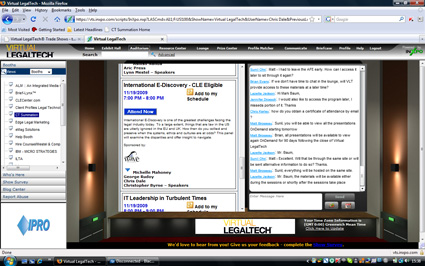
Virtual LegalTech looks good so far

Virtual LegalTech looks quite fun so far. It has an exhibit hall, an auditorium and a resource centre amongst other things, and there are people to chat to (Peggy Wechsler of ILTA was on the phone when I dropped by but I will go back later).

Virtual LegalTech sessions

It is the only conference at which I am allowed to smoke – even during my own session, which is later on – 7.00pm GMT – when Michelle Mahoney, George Rudoy, Christopher Byrne and I can be heard on the subject of International E-Discovery.  One or two of us will there to answer questions afterwards.

Being virtual, it can be attended from my desk, which is a distinct plus.

Virtual LegalTech opening

I have one tip for those attending – use the top bar for navigation between the areas and do not keep going back to the home page. One thing you don’t get at real LegalTech, mercifully, is Henry Dicker standing in the lobby saying “Hey! You made it!” every time you pass by. Henry is a nice chap, but there will be queue of people ready to murder him by the end of the day without that tip, since a video of him strikes up every time you reach the virtual equivalent of the lobby.  So the only thing which jars about Virtual LegalTech is the one thing which is not a facsimile of real life. There is a moral there somewhere.

Home

Posted in eDisclosure Conferences, eDiscovery, Electronic disclosure, Litigation Support | Leave a comment

Georgetown: Privilege, Ignorance and Certification

The PosseList has a report of the main points discussed at the judicial panel which closed the recent proceedings of the Georgetown Law CLE Advanced E-Discovery Institute.

Of the three points which the article picks out, I will leave on one side the mysteries  of US privilege, which you can read about for yourself in the article Asserting and Challenging Privilege Claims in Modern Litigation: The Facciola-Redgrave Framework by US Magistrate Judge John Facciola and Jonathan Redgrave.

The second point is summarised as Lawyers can no longer plead ignorance about e-discovery technology. The problem is actually more fundamental than ignorance of the technology – getting to know the rules and the case-law would be a good start, at least to the extent of having a mental flag which pops up when the case in hand has any volume of electronic documents. As the article says, there are plenty of good solutions providers out there, easily found and ready to help – if it is negligence not to know the rules, it is no less so to be unaware of the solutions. I prefer the more positive view that there is work to be won by alliances with someone who can do well the parts you cannot do cost-effectively for yourself. Continue reading

Posted in Court Rules, CPR, Discovery, E-Discovery Suppliers, eDisclosure, eDiscovery, Electronic disclosure, FRCP | Leave a comment

A packed day of cross-border webinars

Every interest group now has a day in the calendar dedicated to raising awareness about it. It used to be just Christmas, Easter and various saints. Then we got “Mothers Day”, and after that a flood. If there is not a Knit-your-own-organic-whale day, there surely soon will be.

19 November seems to be international cross-border webinar day, with at least three broadcasts today. Continue reading

Posted in Litigation Support | Leave a comment

Equivio->Relevance brings prioritisation to Epiq Systems’ DocuMatrix

Regular readers will know that I find Equivio’s value proposition to be extremely attractive, notwithstanding that the user – the lawyer or his client – does not always get to see it directly. That is because Equivio’s products are bought by service providers and software developers and incorporated seamlessly into their own products. The clients might ask for Equivio’s near-deduping and e-mailing thread processes to be used, and see only the result, not the legs working. Alternatively, the processes may be so closely integrated into the review application that they appear as just another function of that application.

Equivio have followed their applications for identifying and handling near-duplicates and e-mail threads with a product called Equivio->Relevance. I have mentioned it before and I am not going to say much about it here, because I am writing a white paper about it and do not want to steal my own thunder. Put as briefly as possible, Equivio->Relevance hands a small batch of documents to a human reviewer who marks them for relevance. The next batch takes account of the relevance decisions already made, and is further refined by the human reviewer’s input into them. This process continues until the application announces that it “knows” enough to mark the remaining documents (that is, the vast majority) in accordance with the decisions made about the samples. Continue reading

Posted in DocuMatrix, E-Discovery Suppliers, eDisclosure, eDiscovery, Electronic disclosure, Epiq Systems, Equivio, Litigation Support | Leave a comment

Welcome to Stratify as new Project sponsor

I am very pleased to welcome electronic discovery software company Stratify as a sponsor of the e-Disclosure Information Project. Their addition to the list of sponsors coincides with the opening of their London office and data centre, as well as Stephen Whetstone’s welcome appearance as a panellist at the Thomson Reuters conference last week.

Stratify is a subsidiary of Iron Mountain, Inc., the information protection and storage services giant. Iron Mountain has long-standing facilities and clients in the UK and EU (see the Iron Mountain UK site) as well as elsewhere in the world. There is no technical reason why the data must be close at hand, but EU clients want not only to have personal contact with their discovery suppliers but must be able to house their data within the EU for data protection and privacy reasons. Iron Mountain’s storage and data security infrastructure and experience will be comforting factors. The Iron Mountain press release sets out the business proposition for potential clients. Continue reading

Posted in Case Management, Discovery, Document Retention, E-Discovery Suppliers, Early Case Assessment, eDisclosure, eDisclosure Conferences, eDiscovery, Electronic disclosure, Litigation, Litigation costs, Litigation Readiness, Part 31 CPR | Leave a comment

The Continuing Challenges of Preservation, Collection and Exchange

The first session at the Thomson Reuters e-Disclosure Conference in London last week was called The Continuing Challenges of Preservation, Collection and Exchange. George Socha’s panel included a solicitor, a software provider and a judge – Matthew Davis of Lovells, Stephen Whetstone of Stratify and HHJ Simon Brown QC.

Judge Brown said that the court is interested in the material, and only the material, needed for a decision. The point at issue in Earles v Barclays Bank Plc [2009] EWHC 2500 (Mercantile) (08 October 2009), on which he recently gave judgment, was not a difficult one. The judge is the end user of the disclosure process and needs contemporaneous documents. He had been given many documents which were not relevant to the issues which he had to decide, but not the ones which actually mattered. Witness statements drawn up by lawyers are often not worth the paper they are written on relative to the contemporaneous documents, in this case the records of telephone conversations. Continue reading

Posted in Case Management, Court Rules, CPR, Disclosure Statement, Discovery, eDisclosure, eDisclosure Conferences, eDiscovery, Electronic disclosure, Judges, Litigation, Litigation Readiness, Part 31 CPR | Leave a comment

Business mixed with pleasure at the Thomson Reuters London e-Disclosure conference

The Thomson Reuters Fifth eDisclosure Forum was sponsored by Autonomy, Stratify and Legastat and, as before, the co-chairs were Browning Marean, George Socha and me. I enjoyed it and, unless they were just being polite, the audience seemed to think it a valuable day. The session reports will follow; this summary gives you the flavour of the day and suggests how to follow it up.

Asked why we had left the key subject of search until the last session, I said that we were sufficiently confident of keeping most of the audience until the end that we wanted to go out on a high. So it proved, even on a wet and windy Friday the 13th several miles east of the back end of beyond at Canary Wharf. This is the one conference which the co-chairs get to design from the beginning, and I do not recall that we paid much attention to the sequence. All the topics were significant. Continue reading

Posted in Case Management, Court Rules, Courts, CPR, Discovery, E-Discovery Suppliers, eDisclosure, eDisclosure Conferences, eDiscovery, Electronic disclosure, Judges, Legastat, Litigation Support | Leave a comment

Master Whitaker addresses London Solicitors Litigation Association on e-Disclosure

I went to listen to Senior Master Whitaker speak last night to the London Solicitors Litigation Association about electronic disclosure. I was not expecting to hear much that was new to me – I have heard him speak five times in four countries in three continents in the last six weeks, so the anticipation of novelty was not why I flogged up to London. I go to anything I hear about where lawyers assemble with an interest in electronic disclosure.

It has to be said that, for a group which self-selected on this basis, the level of basic knowledge was not high. Although most claimed to know the difference between the pre-1999 Peruvian Guano test of “relevance” and the CPR definition of a disclosable document (one which is supportive of or adverse to the case of the giver or any other party), few knew of the co-operation and discussion requirements in section 2A of the Practice Direction to Part 31 CPR. Fewer had heard of Digicel (St. Lucia) Ltd & Ors v Cable & Wireless Plc & Ors [2008] EWHC 2522 (Ch) (23 October 2008)
or last month’s judgment in Earles v Barclays Bank Plc [2009] EWHC 2500 (Mercantile) (08 October 2009) or knew of Lord Justice Jacobs’ thoughtful encapsulation of the problems in Nichia Corp v Argos Ltd [2007] EWCA Civ 741 (19 July 2007). Continue reading

Posted in Case Management, Court Rules, Courts, CPR, Disclosure Statement, Discovery, E-Discovery Suppliers, eDisclosure, eDisclosure Conferences, eDiscovery, Electronic disclosure, Judges, KPMG, Litigation, Litigation costs, Part 31 CPR, Stroz Friedberg | Leave a comment

Cost, quality, risk and predictability in outsourcing debate

An article in Legal Week reports that law firms are aware that existing methods of charging for work must change but says that they are wary of legal process outsourcing as the answer. The only mistake is not to weigh up the options – before the clients do it for you.

In case you have time only to read the first paragraph or two of this, let me pass on a quotation which appears at the end of Legal Week’s article Partners seek new models but wary of LPOs. It comes from Berwin Leighton Paisner partner Vanessa Barnett who is reported as saying:

Long gone are the days of paying for all types of work by the hour and all the hours being under the same roof regardless of the nature of the task. There will only be one ‘profession’ left doing that. Continue reading

Posted in Discovery, eDisclosure, eDiscovery, Electronic disclosure, Litigation, Litigation costs, Litigation Support, Outsourcing | Leave a comment

The new edition of American Legal Technology Insider

The latest edition of Charles Christian’s American Legal Technology Insider has been released, bringing its usual colour to the bare recitals one gets in press releases.

Although Charles Christian and I may appear to have a fair amount in common – both English, both lawyers who write about legal technology, both willing to be acerbic where that seems justified (“edgy” is the word somebody used of me this week, whereas Charles seems to favour “grumpy and opinionated” as his own label) – we are in fact different people with different subject areas. I say this because a press release this week credited me with being the editor of the American Legal Technology Insider and the Orange Rag blog.

We each got our respective rebuttals in within seconds. Charles was concerned either that he had inadvertently agreed to sell his stable (in which case he wanted a cheque by return) or that he had unwittingly committed himself to making a speech about the minutiae of the Practice Direction to Part 31 CPR; I was equally concerned that I might find myself expected to discuss practice management systems, accounts systems or digital dictation.

Home

Posted in Litigation Support | Leave a comment

Masters Conference appoints new Cabinet members

The Masters Conference yesterday published the list of those in its Cabinet. New members include Shawnna Childress of LECG and me – if one is going to join a committee, then one which includes the co-founder of Women in eDiscovery and joint author of eDiscovery Plain and Simple is the one to be on.

Conference organisers are increasingly involving their participants and others in shaping the strategy and agenda for forthcoming events – I am spending a lot of of my time doing this, formally or informally and, whilst it can be hard work, I prefer this to simply poling up and speaking. At a simple level, this does at least ensure that I don’t find my subject overlapping with the one which the audience has just heard, as happened to me once. Continue reading

Posted in eDisclosure Conferences, Litigation Support, Masters Conference | Leave a comment

FTI webinar: financial, transactional and operational databases in e-disclosure

FTI Consulting are presenting a webinar on structured data on Thursday 19 November at 1300 GMT. The subject is perceived by some as too difficult to talk about, but it cannot be ignored.

Elephants have provided a recurring theme throughout this blog. They are large, hard to get your arms around and difficult to describe to someone who is not familiar with them – which makes them the perfect model for the structured databases in which a very high proportion of company information resides.

E-mail, and user files like Word documents and Excel spreadsheets, spring readily to the mind of a lawyer required to disclose “documents”. Sources such as HR and financial databases tend to be overlooked, largely because they usually bear little relationship to the conventional idea of a “document”. Continue reading

Posted in Case Management, Court Rules, CPR, Disclosure Statement, Discovery, Document Retention, E-Discovery Suppliers, eDisclosure, eDiscovery, Electronic disclosure, FTI Technology, Litigation, Litigation costs, Litigation Support | Leave a comment

Legal Inc publishes e-disclosure podcast series

Litigation services provider Legal Inc has published the first two in a series of ten podcasts about electronic disclosure. They take the form of a dialogue between Legal Inc director Lisa Burton and me, and will between them provide a comprehensive overview of the rules, the practice direction to Part 31 CPR, and cases such as Digicel and Abela. We also discuss practical things such as preparation for case management conferences, the use of external suppliers, best practices, problem areas, global trends and pending developments. Continue reading

Posted in Court Rules, CPR, E-Discovery Suppliers, eDisclosure, Electronic disclosure, Litigation, Litigation Support | Leave a comment

FTI webinar – Controlling E-Discovery Costs

FTI Technology are presenting a web seminar on November 5 (that’s today) at 2pm Eastern | 11.00am Pacific | 19.00 GMT. Called Advice from Counsel: In-House Pros on E-Discovery Costs Containment, it is presented by Ari Kaplan, who will present the results of a survey of in-house counsel and senior IT people.

Although the survey was of US companies only, the results are universal – this is not about FRCP or sanctions but about the expectation that in-house legal teams will achieve the same or more with lower budgets and fewer resources, including the spend on outside lawyers. This is happening everywhere and the conclusions are as valid in countries beyond the US. We have gone way beyond shaving down charging rates and other minor economies, and into fundamental reassessments of what is really necessary to achieve the objective.

The answers inevitably lie in a mixture of process, people and technology. The perfect model, viewed in the abstract, is that companies reserve their external lawyers for the things which they do supremely well, and keep control of as much as possible of the rest by a mixture of in-house teams and technology and by direct relationships with providers of software and services.

The primary target is to cut the cost of review by minimising the amount of data sent to the lawyers – there is much more money to be saved by reducing the lawyer hours than by trimming the charging rates. The newer generations of clustering and visualisation tools are not merely more easily understood and accurate, but deliver results which can be audited and, if necessary, re-run with different parameters. The word “repeatable” means more than being able to validate the results – if the first-pass processes are routinely done in-house, then conclusions reached last time can be re-used when similar ground has to be covered for a different case.

I have written a fair amount about this shift – lawyers must either embrace it and learn to fit into the clients’ processes, or do without the work. It will be good to have some statistical backing for what is known to be happening, and Ari Kaplan’s overview and analysis will, like the results themselves, be relevant beyond the US.

Registration is here.

Home

Posted in Discovery, eDisclosure, eDiscovery, Electronic disclosure, FTI Technology, Litigation, Litigation costs, Litigation Support, Outsourcing | Leave a comment

LexisNexis eDiscovery conference in Singapore

As you might infer from its name, the e-Disclosure Information Project set out with purely national ambitions. England and Wales is the only jurisdiction in the world to give the name e-Disclosure to the process of identifying, preserving, collecting and exchanging documents for litigation. If I had known that two years later I would be speaking in Brussels, Washington and Singapore within three weeks of each other, I would not have picked a name with so narrow a jurisdictional scope.

The wider I cast my net, the more it becomes clear that the jurisdictions which require discovery of documents (principally England and Wales, the US, Canada, Australia, Hong Kong and Singapore) have more similarities than differences in their approaches to the problems and the solutions raised by electronic documents. At one level this is obvious – all of these jurisdictions give pre-eminence to contemporaneous documents as the primary source of evidence, they have all seen a vast growth in volumes of evidence, and there are a limited number of ways in which court rules and procedures could develop to take account of mass documentation in adversarial proceedings in which justice is only accessible if it can be afforded. If you were to describe the problem to someone who, although suitably skilled and intelligent, had no knowledge of the developed law and procedures, you would end up with a solution whose essentials were broadly similar to those which obtain in the jurisdictions which I have named. Continue reading

Posted in Court Rules, Court Technology, Courts, CPR, Discovery, E-Discovery Suppliers, eDisclosure, eDisclosure Conferences, eDiscovery, Electronic disclosure, Forensic data collections, Guidance Software, Judges, LexisNexis, Litigation, Litigation costs, Litigation Support | Leave a comment

European Commission takes action against UK for data protection failings

An article in Document Management News reports on the legal action being taken by the European Commission against the UK for gaps in the legislation required to comply with EU data protection laws. The investigation leading to the action was initiated because of failure to control a specific activity – BT’s trial of PHORM, which tracks web user habits and sends targeted advertising based on what the user is apparently interested in.

The UK usually complies slavishly with EU regulations, with civil servants accused of “gold-plating” the Commission’s requirements, adding refinements and extra burdens mainly as cynical job-creation exercises to keep them and their cohorts (and their cohorts’ descendants) in work. Take the dull little men at DEFRA (the Department for Environment, Food and Rural Affairs, historically a kind of dustbin for those not employable in any other government department) and give them a short EU regulation on, say, horse exports or slaughterhouses and they will (after much generously-rewarded labour), produce a law ten times as long and detailed, guaranteed to increase costs, close down businesses and put people out of work. Their own salaries and pensions, of course, are safe (if you search for “gold-plated” in Google, the results are divided between articles about British civil servants amplifying EU directives and articles about the pensions of those same civil servants). Continue reading

Posted in Civil Liberties, Data privacy, Data Protection, EU, Ministry of Justice | Leave a comment

Where does a wise man hide a leaf?

What connects Father Brown’s deduction that a trusted old soldier had been a villain with Autonomy’s tracing of Jérôme Kerviel’s activities at Société Générale? Both stories involved not just hiding leaves in forests but making a forest in which to hide the leaves. Companies need to get a grip on their data.

The Times has been running a rather good series of supplements on matters relevant to business. Last week’s was on Corporate Fraud, and I and other e-Disclosure commentators were interviewed for an article called Finding a hidden leaf in a forest (page 5) .

The heading is a misquotation. What I actually said in my interview was “Where does a wise man hide a leaf?”. This expression was used by Lord Justice Jacob in Nichia v Argos in his discussion about mass disclosure as opposed to the consideration of documents “with some care to decide whether they should be disclosed”. His paragraph 47 says this:

“…it is the downstream costs caused by the disclosure which so often are so substantial and so pointless. It can even be said, in cases of massive disclosure, that there is a real risk that the really important documents will get overlooked. Where does a wise man hide a leaf?” Continue reading

Posted in Disclosure Statement, Discovery, Document Retention, E-Discovery Suppliers, eDisclosure, eDiscovery, Electronic disclosure, KPMG, Litigation, Litigation costs, Litigation Readiness, Litigation Support, Regulatory investigation | Leave a comment

London litigation support all gathers in one pub

A large pub gathering of most of the London litigation support industry prompts some thoughts on the state of the industry and on what makes a buyer new to the market choose one supplier rather than another

If the Larder in Clerkenwell had collapsed last night, almost the whole of the UK litigation support industry would have gone with it. Bill Onwusah of Lovells, whose idea it was, thought he was being optimistic in reckoning that 25 people might turn up in response to his invitation for “an evening of convivial conversation”. As the evening began, he revised the estimate to 45. We all lost count, but the final figure was much higher than that. What probably drew in the crowds was the rider “if you can’t manage anything convivial we will settle for an evening of the usual backbiting and sniping”. Continue reading

Posted in Discovery, E-Discovery Suppliers, eDisclosure, eDiscovery, Electronic disclosure, Legal Technology, Litigation | Leave a comment

PosseList wrapup of the Masters Conference

The PosseList has managed to get out a full report of the Masters Conference and the first part of its notes on ACC Boston whilst I have yet to note up either Judge Facciola’s eleoquent keynote address at the Masters Conference or anything about the LexisNexis conference in Singapore.

My excuse, if such be needed, is that there is only one of me and that the inordinate amount of time spent on aeroplanes recently cuts into the writing time. I do not, in any event, lay claim to journalistic timeliness. Besides, as I have already noted, Patrick Burke of Guidance Software has already written up Judge Facciola’s speech and the judicial panel at the Masters Conference and now we have the PosseList’s Masters Conference wrap-up. As that makes clear, they had “various reporters” at the conference which meant they could attend sessions which ran parallel to each other. Continue reading

Posted in eDisclosure, eDisclosure Conferences, eDiscovery, Electronic disclosure, Litigation Support, Masters Conference | Leave a comment

The Orange Rag adds its weight to litigation support on both sides of the Atlantic

I wonder what was the first legal technology development reported by Charles Christian. A new design of quill pen perhaps which, coupled with a revolutionary advance in parchment development, allowed legal clerks to write on both sides of a document at once. It might have been the outsourcing of Inner Temple deed production to monks recently made redundant by the nationalisation of the monasteries, or a steam-driven calculating machine for keeping trust accounts.

His acerbic observations on the legal technology market have been pouring out apparently for ever. His audience is legal IT professionals — the people who develop, sell, buy, implement, support and manage legal IT systems within law firms and in-house legal departments. It is unlikely that any medium-to-large law firm technology purchase in the UK has taken place without reference to the Legal Technology Insider and, more recently, the Orange Rag blog. Continue reading

Posted in Discovery, eDisclosure, eDisclosure Conferences, eDiscovery, Electronic disclosure, Legal Technology | Leave a comment

Earles v Barclays Bank reported in the Times

Earles v Barclays Bank was reported in The Times today with the heading Disclosing electronic data.

I have already written about this (see Costs penalty for non-compliance with e-disclosure obligations). It is significant at several levels: unlike Digicel it is a fairly ordinary case; it is firmly grounded in authorities about evidence and not merely about disclosure or electronic disclosure; it covers the use of disproportionately expensive lawyers as well as procedural defects; perhaps most importantly, it is a case where documentary evidence would have proved immediately what it took much oral evidence to show, possibly allowing the case to be dealt with on a summary basis. The disclosure defects did actually cost time,  money and court time. Continue reading

Posted in Case Management, Court Rules, Courts, CPR, Discovery, Document Retention, eDisclosure, eDiscovery, Electronic disclosure, Litigation, Litigation costs, Litigation Readiness, Litigation Support, Mercantile Courts, Regulatory investigation | Leave a comment

Spitting on the deck of the CPR

Unintended consequences are not necessarily unforeseeable. It was wholly predictable that the pre-issue obligations of the 1999 Civil Procedure Rules would shift the battleground to the front end of the litigation, and with obvious consequences in costs. As with the notoriously hard-fought US discovery process, if the rules give a weapon to the lawyers, then their duty is to use it. Lord Woolf seems a bit miffed, but has more to contribute to the debate than his reported attacks imply.

When Stanley Baldwin retired as Prime Minister and handed over to Neville Chamberlain, he promised “not to spit on the deck nor speak to the man at the wheel”. If Lord Woolf’s only contribution to the current debate were to come down from his lair every often and attack those who follow in his footsteps, then he would do better to stay at home. He has more to offer us than that.

Woolf recently attacked lawyers, judges and the government at a meeting of the London Solicitors Litigation Association, saying that they are all to blame for the fact that we have not seen the hoped-for reduction in litigation costs. Costs have in fact risen, putting litigation beyond the reach of all but the richest. Continue reading

Posted in Access to Justice, Case Management, Civil justice, Court Rules, Courts, CPR, Discovery, FRCP, Judges, Litigation, Litigation costs | Leave a comment

When is an EDD quotation like a cold beer?

These posts sometimes acquire a life of their own in the writing especially where, as with this one, they are done in stages across a rather long day. What began as an account of my last day in Singapore turns into the observation that EDD quotations are like a cold beer on a hot day – if you really need it right now then you may have to pay more for it.

Up at 4.00am this morning [Friday], for no more obvious reason than that my internal clock was unsure what time zone it was in. It had probably caught up with Washington, but was actually now in Singapore – but not for much longer. I stayed awake throughout the second day of the conference (just as well really, since I was chairing it – how embarrassing would that be?) and went out for blameless suppers with Browning Marean, followed by early nights, respectably ignoring the fact that Singapore has a larger number of very beautiful girls than any city I have been in. It is probably that which has caught up with me (early nights, I mean, not being respectable). If you go to bed four hours earlier than usual then you wake up four hours earlier. Nothing to do with time zones. Continue reading

Posted in Discovery, eDisclosure, eDiscovery, Electronic disclosure, Litigation Support | Leave a comment

The British invade Washington again, this time to talk and learn, not burn

To say that electronic discovery is international connotes more than the cross-border ramifications of multi-jurisdictional litigation. There is commonality in the problems, the rules and the solutions, to say nothing of the implications for law firms of new ways of working. The Masters Conference was an opportunity to explore many of them.

My ambition to report on the Masters Conference in Washington before reaching the LexisNexis e-discovery conference in Singapore was defeated by various things – only so many hours in the day for one thing, and no power sockets on the planes. As I begin writing this, it is 4.00am in Singapore a week later and the conference here has been and gone. Continue reading

Posted in CaseLogistix, Court Rules, CPR, Discovery, E-Discovery Suppliers, eDisclosure, eDisclosure Conferences, eDiscovery, Electronic disclosure, FRCP, Guidance Software, Judges, Litigation Support, Masters Conference, Summation, Trilantic | Leave a comment

British liberties viewed from the Land of the Free

The subject of liberty came at me in three different ways on a single Sunday morning in Washington a few days ago. The top article in the Washington Post was headed “In today’s viral world, who keeps a civil tongue” and concerns what it referred to as “the rules of civil discourse”, specifically in relation to the freedom to say what you please. I went to the Arlington National Cemetery, and gazed on the thousands who lie buried there who fought for our freedom. My way back was blocked by a march demanding gay equality, and specifically the freedom of people of the same sex to marry. Continue reading

Posted in Civil Liberties, Discovery, eDisclosure, eDiscovery, Electronic disclosure, Litigation Support | Leave a comment

Next stop Singapore for LexisNexis E-Discovery Conference

Practice Direction No 3 of 2009 in the Supreme Court of Singapore is entitled Discovery and Inspection of Electronically Stored Information and took effect on 1 October 2009. I am off to Singapore today to take part in a conference organised by LexisNexis with the title e-Discovery & Digital Forensics.

My own subject, it will not surprise you to know, is International Parallels in e-Discovery. I aim to distil what has come out of the US-UK judicial panels which we have now done in both London and Washington and which have picked out what is best and worst from both jurisdictions. The words competence, co-operation and proportionality will inevitably feature in my speech as they do, expressly or by implication, in the new Practice Direction. Continue reading

Posted in Courts, Discovery, eDisclosure, eDisclosure Conferences, eDiscovery, Electronic disclosure, Judges | Leave a comment

Big reception for Marean-Dale video

Browning Marean and I made two short videos at ILTA09 with Kina Kim of PivotalDiscovery. The “big reception” in my title refers to the venue rather than the reaction, but this means of conveying information is well worth doing.

Years ago, back in the late 1980s, I attended a video presentation course with my then law firm partners. The idea was not to prepare us to appear in moving pictures but to improve our general presentation skills by showing us where we went wrong when speaking in public. My own weakness, I discovered, lay not in how I looked when being filmed, but in what I did when I was merely in the background. I realised that I fiddled constantly, scratching imaginary itches, rubbing the side of my nose and generally moving about all the time. When I first stood in front of audiences, I had to remember to remove everything from my pockets to make sure that I did not jangle keys and coins whilst speaking.

I have kicked that last one, I think, but my most recent video appearance shows up a new bad habit – continuous hand gestures like a demented weather girl signing for the deaf whilst warning of stormy weather ahead. Continue reading

Posted in Discovery, eDisclosure, eDisclosure Conferences, eDiscovery, Electronic disclosure, ILTA, Trilantic | Leave a comment

Discovery explorers need a map

You can kill an analogy with overuse, just as every cliché was once a clever new phrase. Describing e-discovery / e-Disclosure in terms of explorers and maps, however, does not become hackneyed, because exploration itself continues to excite and because it works very well as a parallel.

Each nation has its own stirring examples, and they come from all over the place. What do I get if I take the first ones which come to mind? Mallory and Tenzing climbing Everest in the year I was born. Howard Carter and Lord Carnarvon in Tutankhamen’s tomb. Sir Walter Raleigh in Virginia and South America. Scott, Shackleton and the others in the snowy wastes of Antarctica (I have a soft spot for Sir Vivian Fuchs, leader of the first overland crossing of Antarctica in 1958, if only for the newspaper headline “Vivian Fuchs off to Antarctica”). Doctor Livingstone greeted by HM Stanley in an African clearing. The use of maps necessarily implies that someone else has been there first, but is no less interesting – I have just bought a large-scale ordnance survey map of England in digital form so that I can scroll across it as we drive (as my wife drives, I should say), so interested am I in the landscape through which we pass.

If you are American, you do not need to go abroad to find stirring examples of exploration, and many of them are more or less in your own backyard. The names which come to mind are those of Lewis and Clark, whose expedition of 1804 to 1806 was the first overland exploration to the Pacific coast and back. That had a political and commercial purpose going beyond mere exploration for its own sake, since the US was in the process of undertaking the Louisiana Purchase, and neither it nor the French who were selling it, knew how big the acquisition was. We now know that it comprises about 23% of the modern US.

I am brought to this apparently random line of thought by a reference in Tom O’Connor’s recently published Top 10 EDD Tips for General Counsel, which can be found on the Law Technology News website (the second article on that page) and were the subject of Tom’s Masters Conference webcast. One which caught my eye was Point 5 which reads:

Talk to your IT department. They know how to make the map. You are Lewis and Clark, they are Sacajawea. You absolutely cannot navigate without them. Continue reading

Posted in Court Rules, CPR, Discovery, eDisclosure, Electronic disclosure, Forensic data collections, Litigation Support, Part 31 CPR, Stroz Friedberg | Leave a comment

A pit-stop before the last lap

There is a little BlackBerry buzz in my pocket as I put my key in the door after flying sleepless overnight from Washington. Are you happy with the eleven podcasts, the message asks, and can we do a synopsis for each? She must have a trip-wire or something to tip her off that I am home. Oh, and by the way, she adds, don’t forget the article you promised. It is just as well they are asleep in Singapore, or there would be a message asking for my slides for my presentation there next week.

Capitol WashingtonI have brought back four or five draft articles about Washington and the excellent Masters Conference there, ranging from one which needs only its hyperlinks added through to others which consist merely of scrappy notes on paper or in my head. They range from idle chatter about the US-UK e-discovery scene to serious stuff about sanctions and the UK practice direction. I also have a white paper to start, the blurb for a video presentation to write, a pocket full of business cards to go through, 254 e-mails to file, a bill or two to render, a couple of potential sponsors to follow up, part of a book chapter to edit, a telephone interview to give, and a bag full of clothes to get ready for the next trip to Heathrow on Monday. Continue reading

Posted in Discovery, eDisclosure, eDisclosure Conferences, Electronic disclosure, Masters Conference | Leave a comment

Off to the Masters Conference in Washington DC

I have gone to the Masters Conference in Washington DC.

Masters Conference

See Packed programme for Masters Conference.

I am there until Wednesday evening, staying at the Willard Hotel.

See you there.

Home

Posted in Discovery, eDisclosure, eDisclosure Conferences, eDiscovery, Electronic disclosure, Litigation Support, Masters Conference | Leave a comment

Costs penalty for non-compliance with e-disclosure obligations

A judgment given yesterday by His Honour Judge Simon Brown QC sitting as an Additional High Court Judge in the Birmingham Mercantile Court, will focus minds on the need to comply with the requirements of Part 31 CPR and the Practice Direction to Part 31 CPR when giving disclosure.

The case is Earles v Barclays Bank Plc in which the successful Defendant was penalised in its costs recovery after failing to observe the requirements of the disclosure rules. The judge was at pains to stress that there was no intent to conceal documents and that the omissions were the result of incorrect decisions as to the proportionality of the scope of search. The focus is not on the rules for their own sake but on the fact that if the Defendant’s disclosure had been conducted properly, then not only would much time have been saved at trial but a summary judgment application might have been successful. Continue reading

Posted in Case Management, Court Rules, CPR, Discovery, eDisclosure, eDiscovery, Electronic disclosure, Litigation, Litigation costs, Mercantile Courts, Part 31 CPR | Leave a comment

Packed programme for Masters Conference

The 2009 Masters Conference takes place in Washington on 12 and 13 October. Its title, Global Corporate Change – Navigating Discovery, Risk and Security covers only a fraction of the subjects covered in two days.

The best part for me last year, and the main reason I went, was a keynote speech by US Magistrate Judge John Facciola which I reported at length (see Leadership in Litigation). This took the debate beyond court rules and litigation technology and up into the importance of the court as a component of society. There is a direct line between competence and the efficient use of technology (on the one hand) and access to justice (on the other). Lawyers, judges, and governments which do not to make the courts accessible to everybody are not just failing their clients, the parties appearing before them or those whom they govern. Judge Facciola has the knack of making these things sound not just worthy sentiments but objectives directly related to our daily work.

What makes this job interesting is the breadth, from the minutiae of data handling to matters of state policy. There is almost no corner of the field which is not touched on in the course of the two day conference. If I pick out just the sessions from the program on the entirely random basis that I know the speakers, that is enough to give you the flavour of it. Continue reading

Posted in CaseLogistix, Clearwell, Court Rules, CPR, Data privacy, Data Protection, Discovery, E-Discovery Suppliers, eDisclosure, eDisclosure Conferences, eDiscovery, Electronic disclosure, FRCP, Guidance Software, Judges, Litigation Support, Masters Conference, Nuix, Part 31 CPR, Recommind | Leave a comment

Posse List post profiles Project

I find myself in the unusual position of being the subject of a blog post rather than the writer. I was interviewed in Brussels last week by Gregory Bufithis of the Posse List which describes itself accurately as “your source for news, commentary and trends in the contract legal market”.

The venue was IQPC’s Brussels eDisclosure Conference, and the resulting post IQPCs Brussels focus: ChrisDale and the e-Disclosure Information Project serves as a better history of the e-Disclosure Information Project than I have written for myself. That matters only because it illustrates how far the electronic discovery world has moved in two years and, in particular, how views and information are being shared around the world. The problems are the same, and no longer merely in jurisdictions with a history of common law discovery. The solutions, and in particular the technology solutions, developed for civil litigation purposes, are readily applied to regulatory investigations and to internal purposes such as fraud investigation. Continue reading

Posted in Brussels, Discovery, eDisclosure, eDisclosure Conferences, Electronic disclosure, IQPC, Litigation Support, Masters Conference | Leave a comment

Scottish Civil Courts Review

One of my aims this evening was to knock out a few words on those parts of the newly-published Report of the Scottish Civil Courts Review as relate to case management and disclosure of documents, before moving on to one of the many other topics which warrant discussion.

Two hours later, I have done no more than draft an appreciation of its broad approach to mediation, case management and the use of technology and have run out of time and space for the section on documents as evidence.  It is good, thoughtful stuff, but even though I skipped the sections which do not concern me, the evening has gone. Continue reading

Posted in Access to Justice, Civil justice, Court Rules, Courts, Judges, Scottish Courts | Leave a comment

Information retention at e-Disclosure conference in Brussels

I demonstrated my own commitment to information retention by mislaying my notes of the sessions at IQPC’s Information Retention and E-Disclosure Management Europe Conference in Brussels last week. As with all the best document retention policies, this means that I do not have to wade through masses of information and can focus instead only on that which is important – “important” in this context meaning what I can remember. It is reasonable to assume, perhaps, that the bits I remember are those which mattered most.

Patrick Burke and Judge Peck

Patrick Burke and Judge Peck

We kicked off with a judicial panel moderated by Patrick Burke, Senior Director and Assistant General Counsel at Guidance Software. Patrick is one of the relatively few in the US who “gets” the idea that, however sophisticated the US legal system may be in many respects, those who do business in a multinational context must take notice of jurisdictional differences. Rather too many assume that things are much the same over here if you shout and wave your arms about. Continue reading

Posted in Brussels, Court Rules, CPR, Data privacy, Data Protection, Discovery, E-Discovery Suppliers, eDisclosure, eDisclosure Conferences, eDiscovery, Electronic disclosure, Epiq Systems, Equivio, FRCP, IQPC, Judges, KPMG, Litigation Support | Leave a comment

Service of UK proceedings via Twitter

The UK High Court’s recent permission to serve an injunction via Twitter may be a first, but it has respectable antecedents and the authority of the rules.

The relevant part of Rule 6.15 CPR says this:

(1) Where it appears to the court that there is a good reason to authorise service by a method or at a place not otherwise permitted by this Part, the court may make an order permitting service by an alternative method or at an alternative place.

(2) On an application under this rule, the court may order that steps already taken to bring the claim form to the attention of the defendant by an alternative method or at an alternative place is good service.

(3) An application for an order under this rule –

(a) must be supported by evidence; and

(b) may be made without notice. Continue reading

Posted in Litigation Support | Leave a comment

Technology and constitutional protection at the Supreme Court

Readers will know that the defence of our democratic rights vies for my attention with efficient case management and the use of technology in litigation. The new Supreme Court combines both of these interests.

There is a story of a former Lord Chancellor, Lord Hailsham, who wished to speak to an MP called Neil whom he had espied in the public corridors of the House of Lords, and ran after him calling his name. Hailsham was, so the story goes, in full fig of robes and garters then worn by the Lord Chancellor. What would you do, as a tourist in that august and severe building, if an authoritative-looking man so dressed ran by shouting “Neil” in a commanding voice? They did as they were told.

Hailsham left office in 1974, so the story is not that old. Much has changed since then in the House of Lords – the hereditary peers have nearly all been expelled; the Lord Chancellor (a member of the government) surrendered the right to sit as a judge;  he is now not a Lord at all but a dull little man in a suit from the House of Commons, following a botched attempt to abolish the post in 2003; and now the separation of executive and judicial powers is complete with the removal of the national court of last resort to a Supreme Court on the other side of Parliament Square. Continue reading

Posted in Access to Justice, Civil justice, Civil Liberties, Court Technology, Judges, Supreme Court | Leave a comment

Learning in good company at IQPC e-Disclosure Conference in Brussels

I got back late on Thursday from IQPC’s Information Retention and E-Disclosure Management Europe conference in Brussels. I was on three panels on the first day, attended several others, met or re-met countless people, and yet seemed in retrospect to have spent most of the time eating and drinking. You will forgive me if this post deals with impressions rather than detail.

It is hard to convey how enjoyable these conferences can be. The concentration of raw information and informed comment into two days is not incompatible with having a good time. No one goes just for the pleasurable side, but you do not need to be an information management junkie to enjoy it, whether in the session rooms, in the networking breaks between formal sessions, and in the restaurants and bars afterwards.

Chris Dale at IQPC Brussels

Chris Dale at IQPC Brussels

I will write about some of the sessions separately, and this post is just an overview to give a broad impression for those who have not yet attended one of these conferences. IQPC do them better than most, and months of serious planning goes into them. Of course, if your company has no electronic documents or if your litigation department clients foresee no need to sue, and no risk of being sued or being visited by a regulator, then an e-disclosure conference is not for you. For anyone else, it is a cost-effective way of catching up with what is going on, in pleasant surroundings and congenial company. If part of the appeal is hearing from those who do know about the subject – the legal, practical and technological aspects – another, and under-rated, aspect is the opportunity to mix with those whose knowledge, or lack of it, is no higher than your own. Continue reading

Posted in Discovery, DocuMatrix, E-Discovery Suppliers, eDisclosure, eDisclosure Conferences, eDiscovery, Electronic disclosure, Epiq Systems, FTI Technology, Guidance Software, IQPC, KPMG, Litigation Support, Recommind | Leave a comment

Federal Court of Australia re-issues PN 17

Your heart sinks when you see a headline like that. PN 17 re-issued already? It only came into force in February. What can have turned up which warranted re-issuing it?

It transpires that this is the result of a re-numbering exercise consequent on a decision that only two forms of practice documents will be issued by the Federal Court of Australia, Practice Notes issued by the Chief Justice and local Administrative Notices issued by each District Registrar.

PN 17 is now PN CM 6 and is now entitled Electronic Technology in Litigation. My thanks to Seamus Byrne for providing the links and to Michelle Mahoney of Mallesons who, as always, was quickest to the draw when it comes to ferreting out useful pointers. Continue reading

Posted in Australian courts, Court Rules, Courts, Discovery, eDisclosure | Leave a comment

Clearing the decks before going to Brussels

I do not pretend that this job is hard work in the way that trying to reach a sales target or managing a large project is hard work. It is far too enjoyable for that. It would, however, be good if all these interesting things could be spread out more evenly across the year.

Did I really agree to deliver 10,000 words for a book chapter on digital evidence by 1 October? Did that have to coincide with finishing off two white papers? Why do all the conferences end up bunched together (three conferences in three continents in three weeks starting this week in Brussels)? Are the Twitter eDiscovery lists always so full of interesting stories to follow up, or have I joined in at a particularly interesting point?  I could write ten stories a day entirely from the leads on there alone – but for the book, white papers and the conferences, that is. Continue reading

Posted in Brussels, Data privacy, Data Protection, Discovery, DocuMatrix, Document Retention, E-Discovery Suppliers, eDisclosure, eDisclosure Conferences, eDiscovery, Electronic disclosure, Epiq Systems, EU, Guidance Software, IQPC, KPMG, Litigation Readiness, Litigation Support, Recommind, Regulatory investigation | Leave a comment

e-Disclosure is like opera – you do not start with Wagner

I am fond of analogies, as you know, and everything from motorway signs to Roman bridges gets pulled into service to illustrate e-disclosure points. It seems to be catching: Craig Earnshaw of FTI Technology in London came up with another when I was speaking to him a few days ago.

I often make the point that suppliers’ inevitable focus on their bigger cases tends to obscure their willingness and ability to work cost-effectively on smaller matters. They have only one home page on their website and it is not surprising that they use it to promote the higher end of their range.

It is like introducing people to opera, Craig said. You do not encourage newcomers to sit through the Ring Cycle, but introduce them more gently with Puccini.

It is a good parallel, embracing the sophistication, if that is the right word, of Wagner, the endurance needed to absorb it, the scale and the technical appreciation required. Most electronic disclosure cases are not that big or that sophisticated, and do not require of the user that he or she is deeply knowledgeable about the technology. The challenge of getting someone to attend their first opera is akin to the challenge of getting lawyers to undertake their first e-disclosure exercise. Continue reading

Posted in E-Discovery Suppliers, eDisclosure, eDiscovery, Electronic disclosure, FTI Technology, Litigation Support | Leave a comment

Flying the wrong messages across cultural boundaries

Most broad ideas of the characteristics which identify people from other races and cultures contain a grain of truth as well as a dollop of unfairness. The excitable French, stoic Britons and [supply your own words here] Irish turn up in a story in the Sunday Times travel supplement.

An Aer Lingus plane is approaching Paris on a flight from London. An announcement is made in French and in English. The French get into a tremendous flap with (I embellish here somewhat) much “Zut alors!”, “Sacred blue!”, “Where is the pen of my aunt?”and all the other expressions of excitement which we associate with the Gallic nature. The Britons, meanwhile, sit calmly, with what appears to the French as a degree of sang-froid quite inappropriate to the circumstances, whatever they had heard about British stoicism.

It transpires that the cabin crew have got the tapes muddled up. English-speaking passengers were merely advised to return to their seats and fasten their safety belts. The French, however, were told to prepare for an emergency landing, to note where the emergency exits were, and to await instructions from the captain.

Stories of such mutual incomprehension and cultural stereotypes turn up from time to time in the context of foreign data collections (where the standard advice, of course, includes the suggestion that you refrain from calling your hosts’ language “foreign”). Data collection experts instructed by a US law firm went to a subsidiary company abroad to collect evidence for litigation, with the understanding that the culture of the country was that staff were immensely loyal. The collectors were puzzled to find that they were obstructed at every turn, and it took a long time to discover that whatever they had said on their arrival had been interpreted as meaning that the subsidiary’s senior management was under investigation. The employees were just being immensely loyal – exactly as the lawyers had been told they would be.

Home

Posted in Discovery, eDisclosure, eDiscovery, Electronic disclosure, Forensic data collections, Litigation Support | Leave a comment

New French Data Protection Opinion on US discovery procedures

I bet that headline made your heart skip a beat with excitement, as mine did when I saw that the Proskauer Rose LLP Privacy Law blog has a new entry headed French Data Protection Authority releases new opinion on compliance with US discovery procedures. To find “new”, “data protection”, and “French” in the same country would be quite something, never mind in the same heading.

Disappointingly, there is little new in the Opinion nor (despite my initial excitement) did I really expect there to be. Proskauer Rose supplies a helpful summary and, even more usefully, a link to a translation of the Opinion

If we cannot have something new, at least it is good to have a reasonably clear statement of what the existing position is. Since neither France nor any other EU country is likely to relax its requirements (on the contrary, the general drift is in the other direction) it is as well that US courts and lawyers have the clearest possible statement of what the restrictions are and what can be done within them to meet, as far as possible, the requirements of a US court or authority. Leaving aside the detailed definitions and regulations, which you can read for yourself, the main message is that quite a lot can be achieved by, for example, anonymising data and some serious filtering. Continue reading

Posted in Brussels, Data privacy, Data Protection, Discovery, eDisclosure, eDiscovery, Electronic disclosure, EU, EU Safe Harbor | Leave a comment

Top 10 tips for working with E-Discovery from Tom O’Connor

The programme for the Masters Conference in Washington on 13 and 14 October is now published. It looks set to be even better than last year’s, even if you ignore my own small part in it. I will come back to that in a separate post.

More imminently, on 24 September, the Masters Conference is running a webinar given by the well-known e-discovery consultant, Tom O’Connor. Tom’s subject is Top 10 tips for Working with E-Discovery. The ten tips are the ones which Tom gives to his clients at their first meeting and should be well worth listening to.

The webinar takes place between 12.00 and 1:00 PM EDT (5:00 PM BST) and you can register for it here. The advertised context is US state and federal rules, but my experience of listening to Tom (which I do about once a fortnight) is that he has a large measure of sensible advice which travels well across borders.

Home

Posted in Discovery, eDisclosure, eDisclosure Conferences, eDiscovery, Electronic disclosure, Masters Conference | Leave a comment

The best technology is useless without the right people

In electronic disclosure as in everything else, the technology itself is unlikely to cause the problems. For the moment at least, it needs direction from human intelligence. Money spent on equipment is wasted if not supported by a brain cell or two and some project management skills.

The information boards which are spreading along Britain’s motorways are a good example of  technology applied to a useful, everyday purpose. They give the ability to forewarn drivers of danger or delay ahead so that they can slow down, plan a diversion or whatever. You can now even see what the notices say from the website at TrafficEngland – I guess it is technically quite simple  to repeat the information there but that makes it no less useful and it seems very clever even if, as my picture shows, half of them merely consist of nannying advice – there are few things quite so annoying as getting unsolicited advice from people you despise. Continue reading

Posted in Discovery, E-Discovery Suppliers, eDisclosure, eDiscovery, Electronic disclosure, Litigation Support | Leave a comment

Evidence Eliminator does the trick for Phoenix Four

A director who destroyed documents in anticipation of a government investigation may not be subject to any penalty for the bare act of destruction divorced from any actual proceedings against him or his company. If that is indeed the position, there will be calls to change it. Bad cases make bad law.

I will not try and make sense for you of the story of how the Phoenix consortium acquired carmaker MG Rover for £10 in 2000, departing five years later as millionaires when the company crashed into administration. You will get the picture from the Sunday Times headline How the Phoenix gang plundered MG Rover and from the paragraph in the article which reads:

While it stops short of accusing the Phoenix directors of fraud, it paints a picture of a group of men happy to pay themselves tens of millions of pounds, much of it stashed in an offshore trust, while the carmaker ran up big losses and ultimately ran out of cash, throwing 6,000 people out of work. They ignored corporate governance guidelines, switched valuable assets out of the car company into their own names, lied to MPs about the nature of their dealings, and bawled out the few advisers who dared to question the legality — or morality — of their actions. Continue reading

Posted in Discovery, eDisclosure, eDiscovery, Electronic disclosure, Litigation Support | Leave a comment

Reaching informed agreement that e-disclosure is not needed

Having just published an article about whether electronic disclosure is needed in all cases, I turned to Ralph Losey’s blog to discover that he had just published an article about whether electronic discovery is needed in all cases. We do have fun on our Sundays, don’t we?

My article is called How would Bray & Gillespie play in the UK?. The references in it to the propriety of making informed decisions against e-disclosure are a mantra which I often include to make it clear that electronic discovery / disclosure is not the inevitable outcome; the target is the right decision and the proportionate decision, and such a decision cannot be made without weighing and costing all the options. Ralph Losey’s article is called Paper or Plastic? The Wisdom of Supermarket Bag Boys and the Need for Local Rules which explores, amongst other things, the extent to which the obligation to discuss e-discovery at a Rule 26(f) conference can properly be discharged by a cursory agreement to opt for paper; the alternative, plastic, is seen as being:

where you waste a ton of money paying vendors to chase down unimportant ESI and pay young lawyers to read emails about what people had for lunch, which are then produced to each other on plastic CDs.

Ralph asks “Is there a conspiracy among attorneys, officers of the court, to disobey the very rules that they have sworn to uphold?” and concludes that he is not willing to go quite that far – yet. There are others in the US who would say that, and I used almost exactly the same words, mutatis mutandis, on my first outing before British judges two years ago, with the tactful rider that judges often made themselves silent co-conspirators by not making sure that the right questions had been asked. Ralph puts the same point this way:

[Judges] approve by their silent acquiescence. Not all do, of course, a few e-discovery oriented judges speak out, and speak loudly, but they are a small minority. Most judges just look the other way. Continue reading

Posted in Case Management, Court Rules, CPR, Discovery, eDisclosure, eDiscovery, Electronic disclosure, Litigation Support, Part 31 CPR | Leave a comment

How would Bray & Gillespie play in the UK?

Bray & Gillespie is a US eDiscovery case which has attracted attention partly because its outcome was so predictable and partly for the strong views expressed by the judge as to the conduct of those involved. What would have been the outcome if the same facts came up in a UK court?

The US courts are seeing an increasing number of cases in which the basic competence of the lawyers is called into question and, if found wanting, is punished by sanctions. These rarely involve a bare failure to understand the technology even where it is the technology which is at the heart of the case. The defect is not that the lawyers did not understand computers but that they had not read the rules and the opinions which make it clear that the electronic documents must be handled properly. This compartmentalising of the technology itself (on the one hand) and the rules relating to its use (on the other) may seem to be a distinction without a difference but it matters very much; the lawyers are hired for their legal knowledge and skills and cannot excuse themselves for failing to know the law.

If you were to say to a lawyer “Do you know how an MS SQL database works?” he might reasonably say that he does not. If, instead, your question is “Do you understand the extent of your obligations to disclose documents?”, he cannot answer “no” without admitting to professional incompetence. One of the problems in this area is that lawyers conflate the two questions and believe themselves exempt from understanding anything at all about the subject. Continue reading

Posted in Case Management, Court Rules, Discovery, eDisclosure, eDiscovery, Electronic disclosure | Leave a comment

I got it from Twitter – Normandy in pictures 1944 and now

Most of what I write about, however unlikely the starting point, brings you back to electronic discovery / e-disclosure sooner or later. Even I, however, can find no such connection for what I am about to point you to. I don’t mind, and I do not think that you will either.

The first mental draft of this post extended to a survey of the range of topics which I squeeze into here ancillary to or as illustrations of e-disclosure points. I will skip them all bar one, and perhaps come back to the rest another day.

The surviving link is the use of Twitter as a source of both information and contacts. As you will have gathered, I see it as a marketing tool of immense potential as well as a significant challenge to traditional lines of communication between lawyers (or any provider of goods and services) and their clients.  Leaving all that on one side today, have a look at this amazing set of photographs which juxtapose scenes from post-invasion of Normandy in 1944 and the same views today. Continue reading

Posted in Discovery, eDisclosure, eDiscovery, Electronic disclosure | Leave a comment

Using Twitter to talk to your clients

My article Twitter as a source of e-discovery information drew a comment from Nick Wade, Group Product Manager for Symantec’s Enterprise Vault – Discovery. I had focused on Twitter as merely a source of information. Nick draws attention to its value for keeping in touch with customers, and points to other resources. His comment is as follows:

Great article on the expanding role of social media in our world of Discovery news, Twitter being one of those prime avenues of faster information dissemination. I was also interested as I worked at Mallesons quite some time ago, and I still enjoy seeing my old colleagues’ names in the stream. 🙂

I also think an excellent example of Twitter’s use is to find like-minded people and have a new ability to engage in short conversations with them. Shel Israel (http://twitter.com/shelisrael) has written a fine book about this and I’m reading it now; Twitterville. I heartily recommend it, as it’s a strong follow-up to his first book co-written with Robert Scoble (Naked Conversations). And here’s one final use; a lot of companies use it to find new avenues with which to talk to their customers. We do it at Symantec and it has been very useful not only to point people at articles, releases, technotes, webcasts and so forth, but to help with problems and resolve questions – all more quickly than we could before. Companies should be in Twitterville (as Shel says).

One quick thing – I’d certainly find it useful if you provided a link to Michelle’s twitter (in this instance) [quite right – have done so]. Continue reading

Posted in Discovery, E-Discovery Suppliers, eDisclosure, eDiscovery, Electronic disclosure, Litigation Support | Leave a comment

Twitter as a source of e-discovery information

The best way to get informed about e-disclosure / ediscovery news first thing in the morning is to follow Michelle Mahoney’s overnight tweets (they are at http://twitter.com/michmahon). That is “overnight” in UK terms, since Michelle’s day starts rather earlier than ours – she is Director of Applied Legal Technology at Mallesons Stephen Jacques in Melbourne, which gives  her a head start on the rest of us (or perhaps she does them at night – I’ve rather lost track after a day when I went to bed at 4am).

The last few minutes have brought one of those confusing conjunctions of events which turn up from time to time. As I started dictating this post, I received an e-mail announcing Virtual LegalTech on the 19 November at which Michelle, George Rudoy (Director of Global Practice Technology at Shearman & Sterling), Christopher Byrne (General Counsel at Wave Software) and I are due to talk about international e-discovery. I had barely finished the first sentence, when another e-mail turned up reporting that George Rudoy was following me on Twitter. Since it was George who first suggested that I used Twitter, the timing was apt. I am humbled to see that the few people whom George is following include not only Michelle Mahoney and me but the New York Rangers. Continue reading

Posted in Discovery, eDisclosure, Electronic disclosure, Litigation Support | Leave a comment

More than one reason for new FTI Paris presence

It is interesting to find FTI Consulting, Inc. opening a new forensic and litigation consulting practice in Paris. There is more to this, I suspect, than the economic truism that, for those who can afford it, recession is the best time to expand and to invest against the anticipated upturn.

The press release gives three reasons for opening a new office – to deliver forensic accounting and litigation consulting to FTI’s existing French and French speaking clients, to develop its international arbitration practice in Paris, and to build on its electronic discovery and forensic technology work in France. I imagine that the business case included other and more specific factors such as the increasing incursions by US courts, regulators and government bodies into non-US subsidiaries and sister companies, investigating fraudulent activity either prompted by or exposed by the recession, and increasing activity on the part of EU regulators.

FTI are among the sponsors of IQPC’s Information Retention and E-Disclosure Management Conference in Brussels on 30 September and 1 October. My own specific reason for being there is that Guidance Software, another sponsor of the conference  (and, like FTI, a sponsor of the e-Disclosure Information Project), has asked me to take part in a couple of panels. I would be there anyway this year for the same reasons as are behind FTI’s European expansion. There are still seats available if you want to join us there.

Home

Posted in Discovery, Document Retention, E-Discovery Suppliers, eDisclosure, eDisclosure Conferences, eDiscovery, Electronic disclosure, EU, FTI Technology, IQPC, Regulatory investigation | Leave a comment

7Safe blogs to keep us informed about e-disclosure forensics

E-disclosure Information Project sponsor 7Safe has joined the growing number of businesses using a blog to pass on information about what it does and what is happening in the company. It is a powerful and cheap marketing medium whatever you are promoting.

It will not surprise you to know that I believe strongly in the role of blogging as a means of conveying business information. My blog began as a backup resource to my website, a place, as I pictured it, where I could drop snippets of information without the relative formality and structure which a website requires. It speedily became my main output platform, a place where I sometimes put thousands of words each week. Although I intended it primarily as a feeder for my website, most of the traffic in fact goes the other way, with my website acting as an index to recent blog articles. I do the same for a law firm client and am about to start another. It works. Continue reading

Posted in Discovery, E-Discovery Suppliers, eDisclosure, eDiscovery, Electronic disclosure, Forensic data collections, Litigation Support | Leave a comment

Who needs a bridge when the river goes away?

The mechanics of electronic disclosure are not an inherently legal function like Will writing or conveyancing. Instead of assuming that the work will always be theirs, lawyers must ask themselves why the clients should not divert it somewhere else.

There is something comforting about the certainty that you will always be needed. Doctors can always be reasonably sure of a steady flow of patients. Farmers and others engaged in food production know that people will always need to eat. It is not yet foreseeable that we will do without some form of energy piped into our homes. Fashions in clothes may change but we will always need something to wear.

Many apparent certainties, however, do not in fact last for ever. An article in last week’s paper predicts the end of fixed line telephony. A petrol station or roadside inn finds that its busy road is bypassed. I live between a canal, the latest thing in transportation when it opened in 1790, and the railway line opened in 1846 which killed canal trade overnight. Sometimes the need for a skill set drops away – a Western doctor specialising in, say, cholera, rickets and consumption came to need new areas of specialisation.

The need to handle torrents of documents has historically generated floods of work for lawyers,  subsidising other areas of the firm’s practice such as the delivery of high value advice from their expensive offices as big cases brought big disclosure exercises and the opportunity to turn their assistants’ hours into large bills. What, however, if document handling flows away to others? Continue reading

Posted in Discovery, eDisclosure, eDiscovery, Electronic disclosure, Litigation Support | Leave a comment

Guidance Software launches EnCase Certified eDiscovery Practitioner Program

As you will have gathered from recent posts I am not a supporter of the idea that anyone working in the ediscovery / e-disclosure field must have a certificate to prove their competence. My opposition is based largely on the near-certainty that such a requirement will operate as a bar to new entrants and on the probability that any organisation purporting to offer generalised certification will speedily become a self-perpetuating oligarchy bound up in its own bureaucracy.

I exempted from this opinion the specialised training required for the proper use of highly technical applications – those hiring people who purport to know how to use such products clearly need some evidence that the employee or consultant has reached the developer’s standard of competence, and I cited Guidance Software’s EnCase as an example.

Guidance Software has now supplemented its wide range of training courses with the new EnCase® Certified eDiscovery Practitioner (EnCEP™) program which adds to the bare skills needed to use EnCase by extending out to include planning, project management and best practices in its use. It seems to me to be a logical extension of their application training that EnCase users should understand the legal and the technology context in which EnCase is to be used. This is a step in the right direction.

Home

Posted in Discovery, E-Discovery Suppliers, eDisclosure, Electronic disclosure, Guidance Software, Litigation Support | Leave a comment

New edition of American Legal Technology Insider

The current edition of the American Technology Insider is out, with Charles Christian’s report on ILTA 2009 and some spending statistics which are realistic rather than cheery in the short-term at least. There is also, as always, a succinct summary of the latest industry news.

The American Technology Insider introductory page explains what is covered in ALTi, and how you can get one delivered to your mailbox for free. There is also a section headed “For PR and marketing departments” which makes it clear that ALTi is news-driven rather than led by advertising.

The British version seems to have been  around for ever. The means of publication may have changed but the format and the style remains as it began, probably with a report of the implications for lawyers of Charles Babbage’s planned Differential Engine in 1822. There is no obvious reason to change a formula which works and, more than a year after the launch of the American edition, that formula seems to go down well there as well.

Consistent with its own emphasis on short, snappy reports, the new edition of ALTi carries a quotation from Donna Payne of the Payne Group: “If you can’t demo a product in 15 minutes, you don’t have a product”. The point, I think, is not so much whether you have a product as whether you can get an audience for it. I went round the ILTA booths asking for 15 minute demos. They all seemed a bit taken aback by this, but I have to say that they all rose well to the challenge.

Home

Posted in eDisclosure Conferences, ILTA, Legal Technology, Litigation Support | Leave a comment

Fifth Annual eDisclosure Forum in London for only £99

London’s Fifth Annual eDisclosure Forum takes place on 13 November. Run by Thomson Reuters with Sweet & Maxwell, it is generally agreed to be one of the best in the London calendar. The delegate fee is only £99 + VAT, and any firm or company which anticipates litigation involving electronic documents (and who will not?) in the coming year should be there.

It is not just the very low delegate fee which makes this conference attractive. It is the only one whose program is designed from the beginning by its co-chairs rather than by the conference organiser. I know that, because I am again one of them. An e-disclosure conference must be simultaneously sensitive to local needs and reflective of international developments and there is a relatively small pool of people able to speak with authority at both levels. Continue reading

Posted in Case Management, Court Rules, CPR, Discovery, eDisclosure, eDisclosure Conferences, Litigation Support | Leave a comment

The UK is well-placed between the EU and the rest of the eDiscovery world

The first big eDiscovery conference of the autumn is IQPC’s Information Retention and E-Disclosure Management Europe conference in Brussels on 30 September and 1 October. I am going there mainly to take part in a panel organised by Guidance Software involving, amongst others, US Magistrate Judge Andrew Peck of the Southern District of New York, and Senior Master Whitaker of the Queen’s Bench Division, Royal Courts of Justice in London. We are to be joined by three European judges, Judge Abeline Dorothea Reiling, Vice-President of the Amsterdam District Court, Judge Frank Richter of the Supreme Court of Hesse, and Judge Carla Garlatti of the Court of Appeal of Venice.

Although the UK is, perforce, part of mainland Europe for many purposes, one of the (many) differences lies in our respective systems of domestic law. The UK has a common law system very much closer to the US, Australia and Canada than to France, 22 miles away from Dover. The discovery of documents is a common law concept, and one which most of Europe has largely managed to avoid until recently. Continue reading

Posted in Discovery, DocuMatrix, E-Discovery Suppliers, eDisclosure, eDisclosure Conferences, eDiscovery, Electronic disclosure, Epiq Systems, EU, FTI Technology, Guidance Software, IQPC, KPMG, Litigation Support, Masters Conference, Nuix, Recommind | Leave a comment