ILTA 2010 in Las Vegas: Strategic Unity, Defensibility and the Cloud

ILTA 2010 Strategic UnityILTA is the International Legal Technology Association. I am now back from ILTA 2010 Strategic Unity in Las Vegas, which was as busy and as good as ever. The red hot bloggers and tweeters were reporting on events as they happened. As usual, I prefer to wait and see what I can still remember a few days later, and to write about what interests me rather than what is seen objectively as important. My background post What happens in Las Vegas matters in the UK was a play on the old saying that what happens in Vegas stays in Vegas. These days, what happens in Vegas stands a good chance of being on FaceBook or Twitter in minutes, and the nearest I came to vice involved a new taste for cocktails, and cheesecake for breakfast (not, as my first draft had it, “cocktails and cheesecake for breakfast”, which just goes to show the importance of proper punctuation).

This avoidance of vice owed nothing to innate virtue. Between the educational sessions, the formal meetings, the social events and the random rencontres, there was no time for the more traditional Vegas pursuits of gambling, shopping, spur-of-the-moment marriage and energetic physical interaction with broad-minded fellow-delegates. I must improve my time-management next time. Continue reading

Posted in Discovery, eDisclosure, eDiscovery, Electronic disclosure, Ernst & Young, ILTA, Legal IT, Legal Technology, Litigation Support | Leave a comment

E-Disclosure Practice Direction and Electronic Documents Questionnaire – it is official

I have made many references over the last few months to the pending UK e-Disclosure practice direction and to the electronic documents questionnaire which is part of it. The more observant of you will have noticed that I have never actually said that it will come into force on 1 October 2010. Indeed, someone wrote to me only yesterday asking if I knew what had happened to it; my carefully-worded reply (quiet optimism qualified by the need to see an official announcement) led him to observe “your cautious response reminds me that once a lawyer, always a lawyer!”

Well, we do at last have the official announcement, on the Civil Procedure Rules section of the Ministry of Justice website.  I found out about it from Twitter, although the vision this brings of messages flying round cyberspace is rather undermined by the fact that the tweet was put up by Jonathan Maas of Ernst & Young, who was a only few yards away from me here at ILTA in Las Vegas. Continue reading

Posted in Court Rules, CPR, Discovery, eDisclosure, eDiscovery, Electronic disclosure, Litigation, Litigation Support | Leave a comment

What happens in Vegas matters in the UK: ILTA 2010

It is 2.30am here in Las Vegas and my laptop has just woken me up with a mating noise – yes, three days into this technology conference at this most modern of hi-tech hotels, the internet connection has sprung to life. I had better grab the opportunity while I can.

It is just as well that I do not purport to deliver red hot news. This post was written on the Sunday before ILTA 2010 opened in Las Vegas, and intended as a scene-setter, with some thoughts on the relevance of ILTA to non-US lawyers and clients. You would think that a day which began with a time-shifted 4.30am start and ended in a bar at 1.30am the following day would include space to finish and publish an article.  It did not work out that way and the next day has now passed. If I wanted a further excuse, I could not have published anything anyway with no web connection.

Sunday 22 August 2010

Four years ago, as ILTA was about to open in Orlando, I realised too late that I should be there. I had not been before: my focus then was narrowly on e-Discovery in the UK, and it was only as I read the ILTA programme and got reports on who was there and what was being discussed that I realised how universal the subjects were. It was a moment of epiphany, the point at which I saw that one could not write and talk  authoritatively about electronic discovery in any one jurisdiction without knowing what was happening in the US and in the other common law jurisdictions which require disclosure of electronic documents. Continue reading

Posted in Discovery, E-Discovery Suppliers, eDisclosure, eDiscovery, Electronic disclosure, Litigation Support | Leave a comment

Getting the timing right

The run-up to ILTA is not a good time to give the impression that I am too busy to take note of what is going on.  It is a time of product launches, when all the players in the e-discovery / e-disclosure market have something to say, so my InBox floods with press releases and every PR consultant in the market wants to make an appointment for ILTA; it is also the point when conference organisers need to get their Autumn programmes sorted out, with bullet points, flights and hotel bookings to organise.

I have been largely out of it all for a couple of weeks.  I made a deliberately oblique reference in my last post to “an unexpected domestic matter …. which has much of my attention for a few days”, but it is perhaps helpful to explain what I meant, in case I have been coming across as evasive or over-stretched, neither of which is true. Besides, my wife thought that the reference to an “unexpected domestic matter” sounded as if she had run off, and although she is out as I write, I  think she will be back later.

What was unexpected was that my father died a few days ago – no claim to uniqueness in that, of course, but it takes it out of you and you don’t get too much time to prepare. His transition from sounding fine to drawing stumps was very brief. Considerately, he chose the first week for months when we were all around, and gave us just enough notice to race down the motorway a couple of times to see him before he slipped off. He went down fighting – demanding his stick and his cigarettes, doing the crossword, and criticising what he found in the business pages of the paper – and I hope I make as good an end. Continue reading

Posted in Discovery, eDisclosure, eDiscovery, Electronic disclosure, ILTA, Litigation Support | Leave a comment

Discovering new methods of persuasion

As you know, part of my role is to persuade, and I am always looking out for new ways of getting people to consider how best to handle electronic documents. It is the mere consideration which matters – no-one is saying (well, I am not, anyway) that every case, or even most cases, require you to jump about preserving and collecting everything in sight, but anyone who engages in litigation ought to have some idea of the costs and other factors which apply when litigation threatens. Knowing the rules and being familiar with the occasional judgment is not a bad start, and is the least one might expect from a lawyer who purports to practice civil litigation.

I write a bit, and speak at conferences, do webinars and the occasional podcast or video – any method, really to promote awareness of the subject. What is the proper response, however, when you come across an audience which has self-selected as being interested in electronic disclosure but which has not heard of the Practice Direction to Part 31 CPR (it has been in the CPR for five years), or cases like Digicel v Cable & Wireless, Earles v Barclays Bank or Goodale v Ministry of Justice? Desperate remedies are needed, and I think I found one at the weekend:

New method of persuasion Continue reading

Posted in Case Management, Court Rules, CPR, Discovery, eDisclosure, eDiscovery, Electronic disclosure | Leave a comment

Welcome to Clearwell as new sponsor of the e-Disclosure Information Project

It is a great pleasure to welcome Clearwell Systems as the latest sponsor of the e-Disclosure Information Project. Given Clearwell’s present standing in the eDiscovery market, it is hard to realise that it was founded as recently as 2004 and had therefore been going only three years when I set up the Project.

How does one measure a player’s “standing in the eDiscovery market”? I do not purport to be an analyst, so my use of the word “standing” implies no comparative statistics or detailed research. One can look at Clearwell’s “Strong positive” rating from Gartner in 2009, and its “Top 5” supplier ranking from Socha-Gelbmann in 2008, an the logos of its users on its home page – BP, Microsoft, Toyota, Walmart, FedEx and others – act as kind of reference, but my sense of their standing does not derive entirely from these things either. Nor do I get it just from the references which Clearwell attracts – a quotation from KPMG’s Paul Tombleson referring to the “simplicity and speed at which Clearwell processes data” appears on its home page, and Legal Inc’s web site carries an article called Legal Inc and Clearwell – cutting complex projects down to size .

What I am talking of is a less tangible sense than one gets from such hard factual sources. Clearwell gets mentioned a lot, amongst those who are potential users and amongst rivals, and in a way which conveys ubiquity; for the benefit of non-Latinists, that means they turn up everywhere. This goes beyond their appearances on product selection short-lists. Clearwell is, in addition, a regular and informed commentator on the market, with an active blog, a range of useful white papers, and tweets which do more than merely promote its own products. They also support TREC, the Sedona Conference and lead several EDRM projects. Continue reading

Posted in Clearwell, Discovery, eDisclosure, eDiscovery, EDRM, Electronic disclosure, ILTA, KPMG, Litigation, Litigation Support, Sedona Conference | Leave a comment

Helping yourself to confidential information in litigation

Two parties, male and female, are engaged in litigation. The lady fears that the man will conceal information about his assets which ought to be disclosed in the litigation, and gets her agents to copy all his personal and business correspondence and documents from servers which, by happy chance, they control. The agents, having collected between 250,00 and 2.5 million pages, pass them to their own solicitors who instruct a barrister to weed out those for which privilege might be claimed, and the remainder, seven files of documents, are passed to the lady’s solicitors for use in the proceedings.

When challenged as to the legality, to say nothing as to the propriety, of this, the lady’s team say that they had legitimate grounds for concern based in part on something the other party had said about his assets and in part on the fact that concealment of assets is a common problem in proceedings of this kind; they also point to a rule derived from case law which, they say, is authority for conduct of this kind. The other party says that he had no intention of concealing assets, that the information was confidential, that his obligation to disclose documents had not yet arisen, that the alleged “rule” is no such thing, and that the law offers more conventional remedies to those who have genuine cause to fear that documents will be put beyond their reach. The Court of Appeal makes the lady return the documents, saying that it will be for the judge hearing the main proceedings to decide whether full disclosure has been made, to decide what use, if any, the lady may make of her recollection of what was in the documents, and to decide on the proper balance between the importance of that information and the manner in which it was acquired.

You have probably deduced that matrimonial proceedings are behind this judgment. The case is Tchenguiz & Ors v Imerman [2010] EWCA Civ 908 (29 July 2010) and the underlying divorce is Imerman v Imerman. The agents are Mrs Imerman’s brothers, whose offices and computer systems were used by Mr Imerman. That gave them access to his documents and data and they, keen to support their sister, helped themselves. Amongst the many other curiosities of the case is the fact that this relationship probably also made the brothers the data controllers under the Data Protection Act 1998; breach of confidence may not be the only issue involved here, and criminal, as well as civil, implications may arise. There is a useful summary in this article. Continue reading

Posted in Discovery, eDisclosure, eDiscovery, Electronic disclosure, Litigation, Litigation Support | Leave a comment

Catching the flood of E-Disclosure and E-Discovery articles

Applied Discovery, Jonathan Maas, The Posse List, EU Data Protection and data privacy, Iron Mountain Stratify, Aérospatiale, WP158, Safe Harbor, Irish eDiscovery, Scotland, Autonomy, FTI Technology, Senior Master Whitaker, Ernst & Young, Goodale v Ministry of Justice, Craig Ball, Multiven v Cisco, Helmert v Butterball, Singapore, Recommind, ILTA, Equivio, Ringtail – oh, and L P Hartley, West Arkansas and Schleswig-Holstein. How much more can one get into one article?

I do not usually do compendium articles pulling together several different subjects under one heading. Rob Robinson of Applied Discovery is the King of the Compendia, and anyone interested in electronic discovery should be on his mailing list, following him on Twitter or catching The Posse List’s reproduction of his weekly list of articles. The UK now has its own list thanks to Jonathan Maas of Ernst & Young whose Bong List has quickly become essential reading – send a message to Jonathan to be included. I generally have the luxury of taking one subject at a time and writing about it at whatever length it deserves, driven usually by what interests me most, and I mine these lists, as well as Twitter, for subject-matter.

This is the first week spent entirely in my office since the beginning of January, and I had looked forward to a leisurely few days following up some of the links and articles which I have been stockpiling on iCyte. The trouble is that they have been pouring in, and when it came to trying to decide which was the most important or interesting, the answer was “all of them”. Providing some brief summaries and links in a single post seems a good idea. Continue reading

Posted in Litigation Support | Leave a comment

Getting in amongst the lawyers

I referred in my last post (see The Last Lap) to the  law firms which lie below the very biggest and which have the potential to be the standard-bearers for a new approach to managing litigation. Many of their lawyers have come from the big firms, with all that that brings in terms of skills. They have a lower cost-base which goes through into their charging rates. They have the quality of work, the incentive in practice development terms and the flexibility to adapt to new ways of working. One of the factors which distinguishes them from the city giants is that they do not have large teams of people to allocate to  heavy e-disclosure jobs which means that they must either find other ways to handle large volumes or avoid document-heavy cases (they could just do them badly or unprofitably, of course).

The majority of their lawyers’ case-loads are not big budget ones with hundreds of thousands of documents, so they have not seen the need or opportunity to develop either a process or the skills to manage a large electronic disclosure exercise. They do have such cases, however, and another could turn up tomorrow, particularly as clients shop around to make their litigation budgets go further.

I am hearing from an increasing number of such firms – all names which you would know in a litigation context and which, despite variations in size and specialisation, have much in common in terms of the civil litigation work which they do. Most of them lie in the top 100, with one or two of them in the range 100 to 200 as defined by The Lawyer. Their Lawyer ranking does not necessarily define the size of the litigation which they handle. Their motivation for showing interest in e-disclosure varies: sometimes it comes with a particular matter in which they are instructed; they may have missed the cases which are reported as significant (Digicel v Cable & Wireless or Earles v Barclays Bank for example), but they may have seen the ones which attracted publicity in the press (Shoesmith v Haringey, Ofsted and the Secretary of State for Education, the OFT’s withdrawal of its price-fixing prosecution against BA and Virgin) which point up the risk of getting it wrong; they may have heard of the pending practice direction and electronic documents questionnaire and of Master Whitaker’s judgment in Goodale v the Ministry of Justice; they may sense a practice development opportunity. Continue reading

Posted in Court Rules, CPR, Discovery, eDisclosure, eDiscovery, Electronic disclosure, Equivio, Litigation, Litigation Support, Trilantic | Leave a comment

The last lap

I have not run out of things to say, in case you are wondering at this week’s silence.  This is the last week of a near-continuous run of events – preparing for them, attending them and reporting on them – which began before Easter. There is almost nothing in the diary now until ILTA 2010 Strategic Unity in Las Vegas at the end of August. I don’t want a holiday exactly, but I do need a break from always having a deadline round the corner.

I took part in a webinar today with Jason Robman of Recommind, the third in a series which we have done together. This one was called The UK e-Disclosure Questionnaire – Its Implications for Law Firms and covered the pending Practice Direction as well as the Electronic Documents Questionnaire – very much the hot topics of the moment. It appears that the sound output did not work for all those who attended. Fortunately, it was recorded and is available here.

The webinar format is unbeatable as a means of delivering information on current topics at no cost to participants particularly when, as here, you can choose your time to listen.  The burden of this one inevitably fell mainly on me, since neither Jason nor anyone else has actually seen the Practice Direction. I find webinars very much harder to do than standing on a platform – I will happily busk for 45 minutes without notice to a roomful of people, but feel the need of a script if my audience is a microphone. One loses spontaneity in the process, especially when, as here, the subject is a wordy one. Nevertheless, if you want to know about the Practice Direction – why we need it, what it says and what its implications are – the link above will lead you to a 45 minute talk about it. My thanks to Recommind for the opportunity to talk about it. Continue reading

Posted in Discovery, eDisclosure, eDiscovery, Electronic disclosure | Leave a comment

Recommind webinar: Implications for UK law firms of the Electronic Documents Questionnaire

Recommind are hosting a webinar on Wednesday July 21, 2010 4:00 PM – 5:00 PM BST with the title The UK e-Disclosure Questionnaire – Its Implications for Law Firms. It is the third in a series of webinars which I have done with Jason Robman, Assistant General Counsel at Recommind. Registration is here.

Parties to civil litigation are already required to discuss their sources of electronic documents before the first case management conference. The source for this obligation, and of similar duties to discuss formats for exchange and the use of keywords etc, is the practice direction to Part 31 CPR which is almost universally ignored.

The point of the new questionnaire, which is required only in limited circumstances, is to serve as an agenda for those discussions. Lawyers are expected to identify the potential sources of disclosable documents as well as some obviously useful information like date ranges and key custodians. It is better to flush out any disagreements about such things before disclosure is given rather than afterwards.

I am a member of Senior Master Whitaker’s working party which drafted the questionnaire and the proposed practice direction through which it is invoked. The purpose of the webinar is to show what is covered by the Questionnaire and what the implications are for law firms using it.

Home

Posted in Court Rules, CPR, Discovery, eDisclosure, eDiscovery, Electronic disclosure, Litigation | Leave a comment

Epiq launches European document review service

Epiq Systems, owners of document review application DocuMatrix, have launched a new document review service based in its new offices in London following the success of the US service. The press release is here.

It is in a sense otiose for me to give my views since they are already set out in the press release, where I am quoted as saying:

Epiq’s document review service will appeal to a wide range of law firms and corporations. Those with existing expertise in electronic disclosure can take on additional work even if their in-house teams are already stretched; those who have no in-house resources and who might otherwise have to pass up work (or take it on with inadequate skills and staff) can delegate the expensive review stage to experienced teams. The two things which are particularly attractive about the service is the emphasis on quality control and reporting, and the fact that it is product-neutral despite the fact that Epiq is itself a well-known software provider. Continue reading

Posted in Discovery, DocuMatrix, eDisclosure, eDiscovery, EDRM, Electronic disclosure, Epiq Systems, Litigation Support | Leave a comment

H5 webinar – The State of Search in 2010

I cannot realistically give notice of every webinar  given on the subject of ediscovery / edisclosure, but there are two coming up which are well worth mentioning. One is by Recommind, next Wednesday, on the UK Electronic Documents Questionnaire, and my particular interest there is that I am co-presenting it. I will write separately about that.

The other is hosted by H5 and takes place on Monday 19 July at 12:00 PM Eastern Daylight Time (UTC – 4 hours). It is called The State of Search in 2010 – A Roundtable Discussion with the Bench, Bar, and Experts.

The speakers are US Magistrate Judge Paul Grimm, Ken Withers of the Sedona Conference, Maura Grossman of Wachtell, Lipton, Rosen & Kat, and Bruce Hedin of H5.

The title and the names of the participants should be enough to attract you in for a 60 minute distillation of what is important in search as we pass the half-way point in  2010.

Home

Posted in Discovery, eDisclosure, eDiscovery, Electronic disclosure, H5, Recommind | Leave a comment

Searching for documents does not create them

There is a good article on Practical Law’s construction blog by James Clarke, a solicitor at Pinsent Masons. Called Is the ESI questionnaire the future of case management?, it is generally supportive of what is now called the Electronic Documents Questionnaire, and gives a good explanation of the reasons why those of us who drafted it felt that it was necessary.

There are a couple of points towards the end, however, which have not, I suspect, come out quite as the author intended. I cannot let them pass without comment because they might otherwise serve to feed some misconceptions which bedevil any explanation of the subject. My purpose is clarification not contradiction.

The first such sentence reads as follows:

Before committing to the questionnaire at an early stage, your client needs to realise that it could commit them to search terms and sources of electronic documents resulting in a disproportionately large number of documents to review – at significant cost.

We know from the rest of the article that its author well appreciates the value of early identification of electronic sources. This sentence, however, appears to imply (indeed, says in terms) that completing the questionnaire could lead to many documents being found. Well, if the documents exist, then we need to know about them, don’t we? The alternative is relief that the documents lay undisturbed, which seems to me to fly somewhat in the face of the primary disclosure obligations. Furthermore, the fact that you have found them does not mean that you have to disclose them, still less review them – see Master Whitaker’s judgment in Goodale v Ministry of Justice, referred to approvingly by the article’s author. If you end up reviewing everything you find, then you have almost certainly been in breach of the disclosure rules, to say nothing of the overriding objective. Continue reading

Posted in Court Rules, CPR, Discovery, eDisclosure, eDiscovery, Electronic disclosure | Leave a comment

A call to arms for ediscovery in Hong Kong

The purpose of my visit to Hong Kong last week was to speak at the InnoXcell Ediscovery and Digital Forensics Conference on 7 and 8 July. Several of the international brigade of ediscovery speakers joined local lawyers, suppliers and others for two days of intensive but enjoyable talks and panel discussions at the Renaissance Harbour View Hotel.

The best call to arms came not at the conference but at a panel session at Allen & Overy on the day after the conference. A&O associate Jonathan Crompton, winding up the event, invited the audience to look out of the window at the self-evidently thriving commercial centre below. Hong Kong needs to manage electronic discovery, he said, in order to maintain its position as a place to do business. The exhortation somehow meant more when you could see what he was talking about through the glass. I will come back to that event in due course, but I introduce Jonathan Crompton at the top of this article for more than his rhetoric. He is the author, with Aaron Bleasdale of Epiq Systems, of an article called E-discovery: time for Hong Kong to catch up which was published as the cover story in the Hong Kong Lawyer as the conference opened. It set the scene nicely.

The other comment which sticks in the mind came from Singapore’s Senior Assistant Registrar Yeong Zee Kin, who observed that if business people have adapted to the use of electronic documents, then the lawyers and courts could not neglect them. It would be tactless of me to observe that Hong Kong’s loss could be Singapore’s gain if the businesses of the region conclude that the one jurisdiction is more effective in dispute resolution than another. Not all dispute business is portable, but some of it is. Continue reading

Posted in Court Rules, Discovery, eDisclosure, eDiscovery, Electronic disclosure, Litigation Support | Leave a comment

Noel, Stanley and Ludwig in Hong Kong

I am just back from a week in Hong Kong whose primary purpose was to speak at an ediscovery conference, with a couple of other meetings thrown in. I did three panels in one afternoon and a fourth the following day, and I have three speaking sessions coming up this week, so this post is a kind of palate-cleanser in between, more about the discovery of Hong Kong than about ediscovery in Hong Kong. If you like your ediscovery reading to be undiluted forensics, case law and search strategy, then skip this post and wait for my more formal account. There will be some overlap, no doubt, but this is travelogue not subject-matter learning – I put that in right at the top to head off the Tweeter who mischievously sub-titled my last post as being from his new blog “My Summer Vacation”. Lucky me, I say, to be able to take my holidays in the up-and-coming ediscovery hot-spots just when a big conference is taking place. I am already on record as suggesting that the Australia – Singapore – Hong Kong axis is the next place for ediscovery growth, so some of you may value the introduction anyway for that reason – and I have just fielded a message asking about the place for precisely that reason.

Tea at the Peninsular HotelOne of the features of this trip was that my wife, Mary Ann, was able to come with me. This conference, for a change, was not in her university term and I had gaps on each side of it. For once I had both time and incentive to see something of the place as well as perform my duties and mix with the likeable caravanserai of ediscovery people who gather at these events. That is all pure pleasure for me anyway, but I have a bad habit when on my own of treating hotel rooms as an annex to my office, and of snacking in Starbucks. We ate in everything from a Chinese greasy spoon to the tea room at the Peninsula Hotel, where a band plays in the gallery and you expect to see Noel Coward or Harry Flashman at the next table (although Flashman’s visit to Hong Kong in 1860 en route to the Second Opium War preceded the opening of the Peninsula by 68 years). Continue reading

Posted in Discovery, eDisclosure, eDiscovery, Electronic disclosure, Litigation Support | Leave a comment

Back from Hong Kong Ediscovery Conference

I had no ambitions to write up the Hong Kong trip whilst I was there. Quite apart from the fact that I was due to be on the platform for 25% of its running time, there were a lot of people to see, a city which was new to me, and the company of my wife, Mary Ann. I loved every minute of it, have reinforced my conviction that Hong Kong and the AsiaPac region is a coming place in eDiscovery terms, and did a lot of touring and eating.

At least two long posts will result from all this, but there is some catching up to do and no let up in the UK diary, with three events this week. Bear with me. Some photographs help give you the feel for the week.

KowloonKowloon from the Peak, Hong Kong

Hong Kong Central looking west at eveningHong Kong Central looking West at evening

The US Panel in Hong KongAn Englishman moderates a US panel

Chris Dale, Browning Marean, Judge Peck, Senior Master Whitaker

An eDiscovery dinner in Hong Kong

An eDiscovery night out in Hong Kong

Gravestone at Stanley Military Cemetary Hong KongA headstone at Stanley Military Cemetery, Hong Kong

Hong Kong surrendered to the Japanese on 25 December 1941

Home

Posted in Discovery, eDisclosure, eDiscovery, Litigation Support | Leave a comment

Goodale v MoJ now has a proper neutral citation number

Senior Master Whitaker’s important judgment in Goodale v Ministry of Justice now has a proper neutral citation number. It is 2009 EWHC 3834 (QB) Handed Down: 5 November 2009. The Claim No is HQ06X03876. Thanks to Master Whitaker for passing this information on.

Home

Posted in Court Rules, CPR, Discovery, eDisclosure, eDiscovery, Electronic disclosure, Litigation, Litigation Support | Leave a comment

How much does a lawyer need to know about electronic documents?

We all make judgements, conscious or otherwise, about the degree of skill or knowledge we need to acquire to conduct our business or, indeed, for everyday living. A number of factors dictate how much we feel that we need to know, ranging from professional qualifications to what excites our interest or curiosity.

We like to think that the chap who hovers over us with a scalpel has acquired a minimum amount of both book-learning and practical experience, and there are interesting NHS statistics which suggest, unsurprisingly, that particular types of operation have more successful outcomes in hospitals which do more of them. If you run a business, then the fact that VAT is inherently dull is no excuse for not knowing at least enough to keep your VAT returns in order. If you drive a car, you need to know the rules of the road and have some idea of the mechanical actions needed to make the car go and, more importantly, to stop.

Some things which are of great importance to others can safely be ignored. I gather, for example, that some Italian has just taken eleven English ball-kicking experts to Africa to highlight the inadequacy of Uruguayan opticians – a worthy endeavour, no doubt, and one which appears to obsess many people, but I do not feel that my life is much diminished by my ignorance of the subject. Not everyone would agree, on the other hand, with my view that everyone ought to know something of the politics of their own country – it is not necessary to be a political activist, or even to have an opinion, but one ought to know broadly what differentiates one party from another and what the issues are. The playwright Tom Stoppard, applying for a job on a newspaper, felt that he ought to express an interest in politics. Asked who the Home Secretary was, his reaction was “I said I was interested in politics, not that I was obsessed by it”. This line from ignorance through interest to obsession turns up in every area of life. Continue reading

Posted in Court Rules, CPR, Discovery, eDisclosure, eDiscovery, Electronic disclosure, Litigation, Litigation Support | Leave a comment

Legal Inc offers secondment of litigation support personnel

Although most providers of litigation support services make their consultants available to law firms to help with projects, Legal Inc has gone one further and effectively set up its own recruitment arm, offering litigation support personnel at all levels.

The service, called Incterim, is described here. Although expressed primarily in terms of enabling firms with existing litigation support staff to cope with peaks and troughs, there is a big opportunity here for firms with no existing resources or experience to take on jobs for which they might otherwise feel disqualified because of the technical and procedural implications of handling even modest amounts of electronic documents.

Firms are rightly wary of stepping into the unknown, yet cannot justify the employment of full-time staff specialising in electronic disclosure. Many of the recent cases can be classified as “incompetence cases” in which significant costs and reputational consequences flowed from relatively simple mistakes or from a failure to apply the right resources at the right time.

Legal Inc’s initiative seems a good way of drawing attention to the fact that skilled people can be engaged at short notice for whatever period is needed to keep the right side of the rules and to understand what technology is available. The hard part is not in fact either of these, but lies in the lack of informed project management skills.

Home

Posted in Discovery, eDisclosure, eDiscovery, Electronic disclosure, Litigation, Litigation Support | Leave a comment

Publication of 2nd Edition of Butterworths on Electronic Evidence

The only book in my office, apart from battered copies of the Concise Oxford Dictionary and Roget’s Thesaurus, is the first edition of Butterworths’ Electronic Evidence.  When I got it, I had no particular interest in discovery anywhere but in the UK (which is why my business is called the e-Disclosure Information Project, not “e-Discovery”) and I rather ignored the non-UK sections which comprise the bulk of the book. It saved me from embarrassment on the day it arrived – I was doing a live webinar and did not know the answer to a question thrown at me by a delegate; a quick scrabble through the index gave me something to say.

I made contact with its General Editor, barrister Stephen Mason who, in due course, invited me to contribute to a chapter in the second edition. That has just been published, which is why the subject comes up now.

My bit is the England & Wales part of Chapter 7 The Practical Management of Electronic Evidence, in which my co-contributors include people I know like Sandra Potter from Australia, Dominic Jaar from Canada and M James Daley (of Sedona fame) from the US. Other contributors whom I know or have met include Iain Mitchell QC (Scotland), Seamus Byrne (Australia) and Bryan Tan (Singapore). The introduction is by Chan Sek Keong, Chief Justice of Singapore. Continue reading

Posted in CPR, Discovery, eDisclosure, eDiscovery, Electronic disclosure | Leave a comment

Dales around the World

If you come across a good-looking young Englishman in your American city who says his name is Dale and that he comes from Oxford, it is not me – not this week, anyway. My second son Tom is in the US with his girlfriend Nom. They reached San Francisco yesterday and then go on to Washington and New York.

Such a rencontre is, of course, unlikely, but stranger things have happened. We once met a girl at a legal party in London who told us about the strange people who had left an egg in the fridge of a house she was cleaning at a holiday cottage in the Dordogne. She had no way of knowing that we had ever been to the Dordogne still less, as a few questions about places and dates quickly established, that we were the culprits. The double chance – that we should meet this girl and that she should tell us this obscure story – has left me willing to accept the possibility of almost any coincidental meeting. So keep an eye out for Tom.

As he reaches the East Coast, I will be arriving in Hong Kong for the InnoXcell ediscovery conference. No coincidence will be needed there to meet up with several people I know: US Magistrate Judge Andrew Peck, Senior Master Whitaker, Vince Neicho of Allen & Overy, Senior Assistant Registrar Yeong Zee Kin of Singapore, Greg Wildisen of Epiq Systems and Browning Marean of DLA Piper will all be there, along with others whom I have met at past conferences. The programme or, at least our parts of it, is intended to encourage the idea that we are all in this together, with common themes, problems and solutions running between the different jurisdictions. That will be emphasised by the fact that it falls to Master Whitaker and me to cover Australian developments in the absence of any Australian speaker.

This commonality is again not a coincidence. All the countries represented by this group of people, along with other jurisdictions, have a shared common law (or, strictly, equitable) tradition of discovery, and it is not pure chance either that brings the same individuals together, in different permutations, on platforms around the world.

Home

Posted in Discovery, eDisclosure, eDiscovery | Leave a comment

What happens when a cool vendor meets a hot prospect?

Some of the accolades handed out at legal IT ceremonies defy parody as organisers dream up ever-narrower niches in the hope of attracting sponsorship or just attention. I do not know if anyone has in fact received an award for being the “most innovative law firm information services manager in the West Midlands”, but his or her time will surely come.

We need some shorter, snappier terms to express approval and ones which, furthermore, broaden the lexicon.  Some words have been dulled by overuse, and I have drawn attention before to the numbing effect of the polysyllabic triplets so beloved of marketing people. These give us phrases like “systematised, revolutionary and groundbreaking” or “exciting, defensible and intuitive”, where the words look as if they have been pulled at random from a cheat’s guide to Scrabble, and been arranged more for their rhythmic quality than for any real meaning.

It would be really cool if people used words like, well, “cool” which, paradoxically, would indicate warm feelings towards a company or product. And now Gartner, of all people, has done just that (I say “of all people” because I have always pictured Gartner as rather in need of lightening up; either I was wrong about that, or someone else thought so too and did something about it).

Gartner has just named four cool vendors, one of whom is outsourcing specialist Integreon (I do not know who the others are, which suggests that they are from other industries, or are coy about their prize, or were less quick off the mark with the press release about it than Integreon was). Continue reading

Posted in Integreon, Legal IT | Leave a comment

Keeping up with Equivio

Equivio illustrates the maxim “less is more” in ways which go beyond the purpose of its software, which is “the management of data redundancy in content-centric business processes” . There is something appropriate in the way that a company whose business  is identifying the fewest possible documents manages to describe itself in the fewest possible words.

Equivio’s technology, in its own words, zooms in on unique data…With products for grouping near-duplicates, capturing email threads and determining document relevance, Equivio powers a broad range of business applications, including e-discovery, data retention, records management, email archiving and intelligence.

Equivio is generally found built into something else, and this unshowy role is matched by marketing which is low-key and much the better for it. Its web site and other promotional materials state in simple terms what the products do without screaming at you. Because other providers build Equivio’s products into their own applications and processes, they have an interest in spreading the word, and even Equivio’s rivals are publicly respectful of it. I use its illustrations in some of my slides, and it has turned up in my articles in side-references (my recent Australian round-up, for example) but other things have been going on there whilst I have been engaged in my recent tour of the world’s airport lounges. Continue reading

Posted in Discovery, eDisclosure, eDiscovery, Electronic disclosure, Equivio, Litigation, Litigation Support, Millnet, Trilantic | Leave a comment

Iron Mountain completes the assimilation of the Stratify brand

What do you do as an acquiring company when you buy a strong brand?  At one extreme, you swallow it whole and relabel everything on Day One, risking the loss of goodwill and brand-awareness which is part of what you paid for, but boosting your own presence in the market. At the other, you carry on as if nothing has changed except the ownership, preserving the name with which your market is familiar. Car manufacturers, banks and law firms provide examples from other areas of business where judgements have been made one way or the other. Quite often, iconic names are preserved in a division or a product line. Sometimes it is not evident that there is a strategy.

It was always clear what Iron Mountain’s strategy was with its acquisition of ediscovery company Stratify and its subsequent addition of email archive specialist Mimosa Systems. Iron Mountain already dominated the paper archive market, and the two acquisitions fitted neatly into a presumed plan to bring corporations’ entire archiving and document-handling under one roof and one strong brand. More than two years on from the Stratify acquisition, we are seeing that logic working through into the branding. The Stratify and Mimosa web sites still occupy their former domains, but the sites are clearly branded as Iron Mountain sites. My messages from people at Stratify now bear Iron Mountain email addresses; the Stratify tagline “Know what you have” is disappearing, and we wait to see what use is made in the future of the familiar name on the company’s products. Continue reading

Posted in Litigation Support | Leave a comment

SharePoint 2010 is the next dumping ground for lawyers to understand

Larry Briggi of FTI Technology describes Microsoft’s SharePoint 2010 as “the next dumping ground”. SharePoint is already here and now and having stuff dumped in it daily. FTI’s SharePoint Harvester is one of the new products aimed at meeting the problems which SharePoint raises. Technical comparisons fall outside my remit, but Larry’s blunt description of the problem caught my eye, so I asked him to explain what the problems are in terms which a lawyer would understand.

Parallel  announcements from different vendors induce a kind of writerly paralysis in me. The press releases roll in, many accompanied by invitations to speak to someone authoritative about them. The fact that several companies have addressed the same problem indicates that the subject is an important one, but the vocabulary for describing it is finite, and five articles in succession covering the individual ways in which the problem has been tackled is not an audience-winner. I am not much interested in just passing on press releases, nor am I technically qualified to compare the merits of each (which would, in any event, require exhaustive hands-on testing in a live environment), so rival claims about relative capabilities leave me cold. Any list is bound to omit someone with a claim to a mention, so there is a temptation to avoid the subject altogether for fear of offending someone. Last but not least, May and June are always crazy times when product releases and industry announcements flood out over a period when I am either at a conference, packing to go to a conference, or sitting in an airport lounge in a cold, grey dawn when my body thinks it is tea time.

Really, though, I am interested in market trends rather than products – the problems which are being faced by companies and lawyers and what sort of solutions the providers are coming up with to help them deal with them, with a particular focus on the UK. My role is not so much reportage (that is Charles Christian’s job) or analysis (I leave that to the The 451 Group), but helping lawyers to understand what implications arise when they have to collect their clients’ documents and data for disclosure. Given that most UK lawyers are still struggling with the idea that Word and Excel files are “documents” at all, and since I write for the long-term not for tomorrow’s deadline, I am let off the production of “news” and do not feel too embarrassed if time elapses between an announcement and my coverage of it.  My piece of a few days ago about a $25 million ediscovery sale is a rare example of a story which (thanks to Twitter) I had  before almost everyone else and which warranted some instant journalism. Continue reading

Posted in Discovery, eDisclosure, eDiscovery, Electronic disclosure, FTI Technology, Litigation Support | Leave a comment

Applied Discovery + EMC + Kazeon offer combined services for collection, ECA and Review

It used to be quite easy to explain to lawyers what was the role of each player in the discovery process. It was easiest, of course, in the days when the only application was a photocopier. Many lawyers, I think, got stuck at the next stage when litigation support meant scanning paper and setting teams of people to enter information about each document by hand. The only technical expression around then was “coding” which acquired a mystique disproportionate to what was actually involved.

Then came electronic documents. You will still hear the uninformed saying that handling electronic documents is just like dealing with paper. Fortunately, electronic documents bring much of their own coding with them – I say “fortunately” because their volumes increased at a rate which made manual coding of basic identification information an impossibility. Different specialisations grew up – companies became known for their skill at collecting data, for their capacity to store it, or for their ever more sophisticated applications for analysis and review. The Electronic Discovery Reference Model (EDRM) became the standard definition of the stages through which documents passed, giving rise to the idea that the process flow moved from information management on the left to presentation in court on the right, with other stages between. The goal of most providers was to embrace the stages which lay to left or right (or both) of their starting point.

It confuses the punter – the putative buyer – no end. Those who have lived with the market as it has developed can have no idea what it looks like to someone who comes at it from scratch. The apparent simplicity of the EDRM goes for nothing once they find that market players who appear to specialise in one area have plausible aspirations to others, and that grey areas develop where it is far from clear whether the ancillary expertise – the review capabilities, say, of a data collection specialist – are fully developed products or merely gestures. Continue reading

Posted in Discovery, E-Discovery Suppliers, eDisclosure, eDiscovery, Electronic disclosure, Litigation Support | Leave a comment

Australian ediscovery round-up

My conclusion after my recent visit to Sydney was that every jurisdiction which engages in ediscovery thinks that it is behind the others. This is certainly not true of Australia, and  Master Whitaker and I were not merely being polite when we said that we had come to find out what is happening there for our own benefit, as well as bringing news of developments in the UK.

There is enough going on down there at the moment to warrant a quick summary. My own accounts of our visit to Sydney are here and here,  and I wrote before I went of the Attorney General’s Terms of Reference for a Discovery review.

Since then, Geoffrey Lambert of e.law has tipped me off about a further development, the Civil Dispute Resolution Bill 2010 (Bill) which, if enacted, will require a “Genuine Steps” process by which parties must show formally that they have tried to settle a dispute, with costs implications if they do not do so. I am slightly chary of developments like this – the experience in England & Wales of court-driven settlement is that the mechanics of managing the dispute take second place to attempts to impose a rapprochement which is itself expensive and not necessarily what the parties want.  There is a distinction (for which we must thank Professor Dame Hazel Genn QC) between “a just settlement” and “just a settlement”, and there is a difference too between mediation to resolve a dispute and co-operation to conduct it efficiently.  If judges spent less time on the former and more time imposing the latter, we might see the costs of litigation come down whilst allowing the parties to have their day in court. It will be interesting to see if Australia can take the benefits of alternative dispute resolution without losing the drive towards more efficient procedures for managing contention. Continue reading

Posted in Australian courts, Case Management, Clearwell, Court Rules, Discovery, e.law, eDisclosure, eDiscovery, eDiscovery Tools, Electronic disclosure, Equivio, Ernst & Young, FTI Technology, KCura, KPMG, Litigation, Litigation Support, Nuix, RingTail | Leave a comment

Some object-lessons from history, art and a non-discovery conference

You nearly got a grumpy old man story from me yesterday morning. You were spared only because I did not have time to write it before setting off for London. If I had known how the day would evolve, I would certainly have written it – although I suppose if I had known how the day would evolve, I would not have gone to London in the morning and there would not have been anything to be grumpy about.

I was asked at short notice to cover for someone else doing an e-disclosure session at an industry-specific conference. I am pretty conferenced-out by this stage in the year, so I was not exactly suffused with pleasure at the prospect. I am generally fairly picky about the ones I do, sticking either to the very big ones which are bound to be good, or taking an active role in shaping smaller ones in advance. This one was set in stone by the time I heard about it, but I broke all my rules about reconnaissance to help out. I roped in Vince Neicho of Allen & Overy who kindly agreed to do it with me, and we worked together to produce a slide set and a running order. All conferences have a tedious lead-in period where emails fly to and fro; my crossness was with myself for conceding a battle over the time of our session – I wanted it as late as possible in the day, but the organisers simply wouldn’t have it and I had given up fighting over it. The slot they insisted on, just after lunch, screwed up my whole day, not just part of it, and I don’t have half days to spare at the moment, any more than Vince does.  I had also failed to spot that the venue was not in fact in London but somewhere out in the Essex marshes. Continue reading

Posted in Discovery, eDisclosure, eDisclosure Conferences, eDiscovery, Electronic disclosure, FTI Technology, Litigation Support | Leave a comment

Autonomy: a very short press release for a very big eDiscovery deal

There is, alas, no rule which says that press releases must be proportionate in length to the size of the story. Those of us who are sent them usually have to plough through yards of verbiage and work out for ourselves whether the host of superlatives actually means anything of significance.

That a really big story needs very few words is illustrated by one found today on the web site of the London Stock Exchange with the heading Autonomy enters into $25 million agreement for e-Discovery software.

The admirably terse central message reads

Autonomy…  today announced that it has received an order for its e-discovery and compliance solutions with an initial value of approximately $15 million and a total committed value of approximately $25 million over the next few years.

Commenting on the contract win, Andrew Kanter, Autonomy’s Chief Operating Officer said today: “I am pleased to announce this latest significant contract win at the more sophisticated end of e-discovery and compliance solutions, in this case coming outside the historically strong verticals of the financial services and pharmaceutical industries.”

Beyond the fact that the Stock Exchange page is headed “Regulatory Story”, there are no other clues as to the buyer or its purpose. Twitter buzzes with anticipation, but the story broke only 75 minutes ago, so we will have to wait and see. Stock Exchange market news has a narrower purpose than a full-blown press release, so we may get some details as the day goes on.

More when I know more.

Home

Posted in Discovery, eDisclosure, eDiscovery, Electronic disclosure | Leave a comment

Cats at Bacchanalia

Cats Legal kindly asked me to speak at their client event last night. More compelling than me as an attraction, I suspect, was the fact that the venue was Bacchanalia , the specialists in fine Spanish wines, whose premises are on the floor above Cats Legal at Broken Wharf, close by the Millennium Bridge. To have spoken last week overlooking Sydney Harbour (as recounted here), and then to do so with the Thames at my back shows how lucky I am in the platforms offered to me.

Broken Wharf

Broken Wharf is above and to the right of the right-hand pier of the Millennium Bridge Continue reading
Posted in Discovery, eDisclosure, eDiscovery, Electronic disclosure, Litigation, Litigation Support | Leave a comment

Collecting evidence for Ofsted and its parallels with e-Disclosure

Here is a nicely ambiguous Google search. My blog stats include a list of the terms which people used to find the site, and one from earlier in the week was “collecting evidence for ofsted”. The search was presumably made by some poor blighter trying to run a school. Instead of concentrating on educating children, he or she must instead collect evidence about something which Ofsted requires. One of the more amusing aspects of a recent e-disclosure case was the contrast between Ofsted’s officious punctiliousness  in demanding information from schools and its own incompetence when required to produce documents in the Sharon Shoesmith litigation.

Ofsted is the Office for Standards in Education, Children’s Services and Skills. The mismatch between its name and its acronym derives from the empire-building of the last Secretary of State for Education, the unpleasant Ed Balls who, baulked of his ambition to become Chancellor of the Exchequer, renamed himself Secretary of State for Children, Schools and Families. There is a certain type of politician who thinks that he gains lustre by having more words in his department’s name, and one of the many grounds on which Balls was loathed by almost everyone was the way he used the breadth implied by his department’s new name to stick his oar into anything which involved young people, however peripherally. His successor restored the name Department of Education so quickly that one suspected that the signage had been commissioned before the election, emphasising the commitment to what really matters. It is that which provides my link to client objectives in litigation.

The Google searcher would have found my site because I use Ofsted’s conduct of its disclosure in the Shoesmith litigation to illustrate how disclosure failures are more often the product of stupidity, ignorance and indolence than of any misunderstanding of the law. Some paper-shuffler missed the fact that his My Documents folder included a sub-folder clearly marked “Haringey Inquiry” and a mail folder similarly entitled, and had to confess to this just before judgment was delivered. The judge has demanded to know how this happened. Continue reading

Posted in Court Rules, Courts, CPR, Discovery, eDisclosure, eDiscovery, Electronic disclosure, Litigation | Leave a comment

A meaningless comment about technology in court

An outraged e-mail came in from Dominic Regan early on Saturday morning. Headed “The most stupid comment of the year”, Dominic’s message drew attention to the report in the Times about the Saville Inquiry into the Northern Ireland shootings. The report included a quotation about the Inquiry’s use of technology: “without it, the tribunal would have had to be more focused”. I will not take up space with the exclamation marks with which Dominic followed this.

What do you think the author of this comment meant? Did the tribunal lose sight of its remit because technology was used? If the whole thing had been done from paper, would the tribunal have concentrated more closely? Does technology blur the vision – if so, then a visit to the optician is called for, not a woolly implication that technology encourages loss of focus.

I have binned the paper, and the Times web site is no longer accessible, so I don’t know who made the comment or what weight to attach to it. Its supposed author may have been misquoted. Its context is a negative one, so I assume that a negative meaning was intended. I just don’t know what it does mean.

It is curiously reminiscent of the sort of thing you hear from technology-deniers in other civil procedure contexts – you can just imagine a judge resisting the use of technology in litigation on the grounds that lawyers were much more focused in the days when everything was printed and filed in ring binders and read by eye. Actually, you do not have to imagine it.

Home

Posted in Court Technology, Discovery, eDisclosure, eDiscovery, Electronic disclosure, Legal Technology | Leave a comment

Ark Group eDisclosure conference in London

On my way to London yesterday to chair the Ark Group ediscovery 2010 conference, I read about the deletion of e-mails by an aide to the Qatari royal family (see Guardian article here). The allegation is that 19 e-mails referring to Prince Charles or his private secretary were deleted to  make them unavailable  in contract proceedings brought against the family’s development arm. People seem to forget that it is inherent in the nature of an e-mail that at least one other person has a copy of it. This is a bit like being an AIDS awareness campaigner in the late ’80s – however wide the publicity, and however many celebrities died, people carried on behaving as before. The excuse “I was just tidying up my InBox” is as valueless as “I only slept with her once”, and the odds of getting caught out are rather higher – being selective in your choice of partners is a good thing, whereas selective deletion of emails is not, not in this context anyway.

Where do you pitch the message for the audience at a conference like yesterday’s, where the range of knowledge and understanding is both unknown and variable? One of my standard slides, always near the top of the deck, used to be one one with a definition of edisclosure. I have recently removed it, reckoning that the chapters dedicated to the subject in each of Lord Justice Jackson’s reports, when added to the eye-catching cases, made that slide redundant. Apparently not, judging by one of the questions from the floor. How much does one say about the available technology? I used a composite slide covering all of it in one go, but many of those present would have appreciated the full set. Do people know about the existing practice direction, let alone the pending one? It seems that the PD remains as obscure as ever, and it is as if Digicel v Cable & Wireless and Earles v Barclays Bank had never happened. Continue reading

Posted in Court Rules, Discovery, eDisclosure, eDiscovery, Electronic disclosure, First Advantage, Litigation, Litigation Support, Recommind | Leave a comment

Recommind Webinar 16 June – Earles v Barclays Bank

I am doing a webinar with Jason Robman of Recommind on Wednesday 16 June at 16.00 BST. It is called The Impact of Earles v Barclays Bank on UK Corporations. Registration is here.

Some of the UK e-Disclosure cases recently have been lightly amusing tales of incompetence and stupidity. Earles v Barclays Bank is, I think, the only one which actually has the word “incompetence” in it, but it is far more important than some of the music hall turns we have seen in the courts in the last few months. If the headline point was that a successful party had its costs severely reduced for disclosure failures, it swept up along the way questions like the extent of the duty of preservation, litigation readiness and legal hold, neither of which has seen much developed law in the UK.

Its messages are for companies and not just for their lawyers, and go back into the way in which they keep documents, not just into the conduct of the litigation.

I am doing a session tomorrow at the Ark Group eDisclosure 2010 conference with the judge who delivered the judgment, HHJ Simon Brown QC and with Vince Neicho of Allen & Overy. It is called Earles v Barclays Bank: a client’s guide to avoiding adverse inferences, wasted time and costs and damage to reputation. I think it safe to say that I will have had enough of Earles for a bit by the end of this week. Those with large document collections and any potential for litigation will not have that luxury.

Do join us at 4.00 on Wednesday afternoon.

Home

Posted in Discovery, eDisclosure, eDiscovery, Litigation, Litigation costs, Litigation Readiness, Recommind | Leave a comment

Lunch-time talk in Sydney with Nuix and KPMG

Knowing that Master Whitaker and I were going to be in Sydney for the Chilli IQ eDiscovery conference, Eddie Sheehy of Nuix invited us to speak at a lunch organised by Nuix and KPMG. The venue was a room on the 15th floor of KPMG’s office overlooking the quay at Barangaroo and the mouth of Darling Harbour, and the audience comprised senior people from large financial and other corporations.

I like this kind of event, because it gets to audiences who are capable of long-term decision-making. Once litigation has commenced or a regulatory investigation is under way, the range of options becomes limited – you are where you are in terms of preparation, and there is often no time to choose the lawyers, decide on the technology or take a long view on the strategy. It is like being a general in the field the night before the battle; your options for deployment and tactics are constrained by what has been done or left undone in the past. The level of decision-maker round that lunch table is in a position to see, for example, the aggregated costs of last year’s litigation, which gives some incentive to plan for next year’s – and to do something about it. Continue reading

Posted in Access to Justice, Australian courts, Case Management, Discovery, eDisclosure, eDiscovery, Electronic disclosure, KPMG, Litigation, Litigation Support, Nuix | Leave a comment

Far and wide eDiscovery at the Chilli IQ conference in Sydney

Sometimes an unconscious theme develops during conferences. Appropriately, perhaps, given the “IQ” element in the organiser’s name, the point which recurred in Sydney was the use of human intelligence in parallel with the processing power and clever technology to get as early as possible to the things which matter. That phrase “as early as possible” came up a lot, not least because (as I noted when I commented on it – see Terms of Reference for Australian Discovery review),  the Australian Attorney General’s Terms of Reference for the pending Discovery Review uses those words three times in their few lines.

Beth Patterson of Allens Arthur Robinson observed, for example, that one might be able to count whole directories in or out by having someone with the appropriate skills and a bit of brain just look in them; if they are patently irrelevant, why include them in the future stages? Michelle Mahoney of Mallesons said that dependence on raw processing power alone meant taking the thinking out of discovery; computers are very good at many things, but they cannot think. Eddie Sheehy of Nuix, unsurprisingly as strong an advocate of intelligent computing power as you will find, recommended giving a couple of the team’s best brains a day or two towards the end of the exercise to try and pick holes in the result by going in any direction they thought fit, trying to find documents or categories which had been wrongly included or excluded. For the third conference running, Equivio (who were not involved at any of them) was praised for the way its products used the best of technology and intelligent human input.  And I used my stock phrase “the best technology lies between your ears”.

Chris Dale and Master WihitakerI quite like opening the batting at these conferences. The audience is awake, no-one can have stolen your thunder by covering your chosen ground, and a keynote speaker has licence to roam more widely than one with a defined topic.  I merged my session with that of Senior Master Whitaker – I gave a short introductory speech, and used the rest of the double session for an interview-style  discussion with Steven Whitaker about UK developments.  My topics in opening included the international community of interest in ediscovery; the relative importance of rules and processes on the one hand, and discretion, proportionality and the clients’ actual objectives on the other; and the changing relationship between clients, their lawyers and the technology suppliers, with the possibility that the lawyers will get marginalised in that relationship.  Steven Whitaker took us through the key points of the Jackson Report, the range of disclosure options in the draft Rule 31.5A, and the proposed Practice Direction and Questionnaire. We took the cases between us, Steven Whitaker covering the ones which turned on the law, and I taking those in which stupidity, ignorance and incompetence were the main factors (there is something about being in Australia which encourages plain speaking). Continue reading

Posted in Australian courts, Discovery, e.law, Early Case Assessment, eDisclosure, eDiscovery, eDiscovery Tools, Electronic disclosure, Equivio, FTI Technology, Judges, KPMG, Litigation Support, Nuix, RingTail | Leave a comment

Chris-crossing the globe for e-discovery

Sorry for the silence. It has been a bit busy here – not just “here” which is Sydney, but in the short gap in England between leaving Las Vegas and setting off for here. It is a brisk sunny morning (Thursday, I think) here. It is the middle of the night in Liverpool, where I spoke last Thursday. It is late afternoon in Las Vegas where I was a few days ago for CEIC. My inner clock has lost track. It is quite a liberation in a way – as long as you make sure you get to the airports before the planes leave, haul yourself onto a podium at about the same time as the audience sits down, and make it to the meetings and dinners, the division of time thereafter can be wholly arbitrary. Working when you are awake and sleeping when you are tired is not on if you land with a schedule of back-to-back meetings, but it works for me. Continue reading

Posted in Australian courts, Discovery, e.law, eDisclosure, eDiscovery, Electronic disclosure, Epiq Systems, Litigation Support | Leave a comment

E-Disclosure in Liverpool with Cats Legal, Epiq Systems and Dominic Regan

I have to take back what I said yesterday about my rail trip to Liverpool. I had expected the usual shambles, those delays with risible explanations and insincere apologies which are the norm on our overcrowded, badly-run rail network. In the event, the trains ran on time and the connections went smoothly. The new government’s warning to Network Rail directors about their obscene bonuses will obviously not keep their noses out of the trough, but may force them to pay some attention to the poor sods who have to travel with them.

A point did arise about my journey, however, which relates directly to something which came up at the e-disclosure seminar which was its purpose. It concerns transparency of pricing and the potential user’s uninformed expectation as to the costs of engaging any litigation software or services provider. My expectation from the railway bookings web site was that my return ticket would cost £247 (a three-hour journey, followed by three hours performing on my feet, followed by a three-hour journey back, warrants a first class seat, away from the unwashed masses dribbling dogburger slime down their chins whilst they boast loudly of their sex lives on their mobile phones). Face-to-face across the counter, however, the ticket seller told me that, by adjusting my departure time a little, I could get the ticket for £134, and now that I go back and look more closely, I see that this information was buried on the web site.

The point is that I only found out the true cost by speaking to somebody, and it was very much lower than I expected. This came up during the seminar when Cats Legal and Epiq Systems made it clear that many of the jobs which they do are for relatively small matters and for fees which are low relative to what can be achieved and what can be saved. The only way lawyers will find that out is by ringing up a supplier (or preferably more than one), outlining the task, and asking for an estimate. Armed with that estimate, they can make proper decisions as to the most proportionate route, decisions which inform internal strategy as well as discussions with opponents and the court. You need this information also when the boot is on the other foot and your opponents argue that proper electronic disclosure would be too expensive. That may be true, but if they have not sought quotations, how can they make that assertion? Continue reading

Posted in Case Management, CPR, Discovery, DocuMatrix, eDisclosure, eDiscovery, Electronic disclosure, Epiq Systems, Litigation, Litigation costs, Litigation Support, Lord Justice Jackson, Part 31 CPR | Leave a comment

A brief lull between conferences

“You seem to pop up everywhere” said Morgan Sheehy of Nuix when I bumped into him at CEIC 2010 in Las Vegas, a few days after I had seen him in London. Indeed so, for that is the job, or so it seems just now. The interval between that trip and the next is just long enough to write it all up and to field a near-continuous flow of requests for slides, confirmations of one kind or another, and all the bureaucracy which lies behind the relatively simple task of getting on a plane and attending a conference. I am in danger of losing count, but I think I have ten conferences between now and the end of November, half of them abroad, plus webinars. Each organiser inevitably thinks that their conference must be top of my list as it is of theirs.

If CEIC 2010 generated more of my column inches than most conferences, I was not the only one to have got value out of it. Craig Ball’s article CEIC a smash was bold enough to list most of the ediscovery people present (I consciously avoid doing this for fear of omitting someone). I met for the first time Josh Gilliland of D4 who, like me, lugs around a large camera to illustrate conference blog postingsKatey Wood of The 451 group wrote two articles here and here mainly focusing (as I did not) on the forensic backbone to CEIC and on those who supply software and services for forensics. The 451 Group is another commentator which seems increasingly to turn up everywhere – I came across Nick Patience at the InfoRiskAwareness launch in London a few days earlier.  Their role is industry analysis where mine is education and commentary; neither can be accomplished by sitting in one’s office.

Some journeys inspire more trepidation than others. Last week was just Las Vegas and back, and next week involves a return trip to Sydney; neither are particularly daunting. Tomorrow, however, I must entrust myself to the incompetent shambles known as Network Rail and whichever greedy, useless train operator holds the franchise between here and Liverpool. Wish me luck.

Home

Posted in Litigation Support | Leave a comment

Terms of Reference for Australian Discovery review

I have already reported that the Australian Attorney General has commissioned a review of  discovery laws. We now have sight of the formal Terms of Reference which embed the purpose of the review firmly in the title – “to improve access to justice”.

Their brevity may mislead one into thinking that the Terms of Reference are narrow in ambit. As with Lord Justice Jackson’s terms of reference, the opposite is true – this review is as broad in scope as it could be. Note the recurrence, even in this short document of the phrase “as early as possible”:

…requiring parties to identify and disclose critical documents as early as possible

…ensure key documents relevant to the real issues in dispute are identified as early as possible

…obligations on practitioners and parties to identify relevant material as early as possible

You cannot miss the point there, can you? Continue reading

Posted in Australian courts, Discovery, Early Case Assessment, eDisclosure, eDiscovery, Electronic disclosure, Litigation costs, Lord Justice Jackson, Nuix | Leave a comment

Early case assessment still alive and well

One of the odder suggestions which I heard at CEIC 2010 in Las Vegas was that “early case assessment” was yesterday’s idea and that it was time to move on to the next one. On reflection, I decided that the speaker was talking marketing rather than common sense. He did not mean that we should stop making early assessments of cases, nor that we should consign to history the many excellent applications which have been given that label. He was just looking for a new catchy phrase.

Part of the problem, I think, is that its appropriation as a marketing label has buried the fact that early case assessment is a process not a tool. Those big shiny capital letters do not help, and I prefer to talk of “early assessment of a case” – less snappy, perhaps, but a better description of what we are trying to do here. The software applications (and there are, as I say, some very good ones) are an adjunct, and a necessary one, to an approach to the case which depends first on the sophisticated technology which lies between your ears.

The subject comes up because, within days of my being told that ECA was dead, George Socha and Tom Gelbmann have written an article for Law Technology News called Don’t Box ECA which sets out the components of a prudent assessment of a case to be made before e-disclosure / ediscovery begins. It is, if you like, an industry-specific variant on the old expression “time spent in reconnaissance is seldom wasted”.

Time spent summarising the article, on the other hand, would be time wasted, and I simply point you to it. My thanks to Rob Robinson of Applied Discovery who, as usual, had tweeted a pointer to it before the metaphorical ink was dry.

Home

Posted in CEIC, Discovery, Early Case Assessment, eDisclosure, eDiscovery | Leave a comment

Comment on Singapore Deutsche AG judgment

Vince Neicho of Allen & Overy saw my post about the Singapore judgment of Senior Assistant Registrar Yeong Zee Kin in Deutsche Bank AG v Chang Tse Wen and others (see Singapore e-Discovery judgment shows international commonality and active management) and has input which is worth passing on. Vince says:

How refreshing that, shortly following the Senior Master’s judgment on Goodale, another judge, Yeong Zee Kin SAR in the High Court of Singapore, has grasped control in an e-disclosure dispute to instil some common sense into the process.

As per usual, Chris has reported the judgment admirably, pulling out the pertinent information for us.  I write this commentary for two reasons:- the first is to rejoice that a judge has corroborated two points that I have been banging on about for years and, second, to seek, with respect, to suggest from a practical angle, that there was an alternative course open to the Yeong Zee Kin, that would have rendered the disclosure more useful in the long run and have resulted in significant cost savings. Continue reading

Posted in Courts, Discovery, eDisclosure, eDiscovery, Electronic disclosure, Forensic data collections, Judges, Litigation Support, Singapore | Leave a comment

Liverpool EDisclosure event on 3 June

The Liverpool Law Society is host to a three-hour course on electronic disclosure on Thursday, 3 June starting at 13.30 pm. The speakers include Professor Dominic Regan and me, together with litigation software supplier Epiq Systems and litigation services supplier Cats Legal.

The venue is the Second Floor, the Cotton Exchange, Edmund Street, Liverpool L3 9LQ.

The format and content are similar to that of the event at Ely Place Chambers last month – see E-Disclosure law, practice and technology in one educational package. Dominic Regan and I will talk about the e-disclosure implications of the Jackson report, the proposed new e-disclosure practice direction and questionnaire, including Master Whitaker’s judgment in Goodale v Ministry of Justice, and about the recent cases which bring this subject to the forefront for lawyers and their clients. The prediction which I made for the Society of Computers & Law at the turn of the year was that e-disclosure failures would become public and personal in 2010, with clients, law firms and individuals named in judgments in circumstances which they would rather avoid. That prediction is being fulfilled, and the penalties generally involve costs, including adverse costs orders. The two providers will explain what technology can bring to the exercise, and what types of software and services are available. The effect of this joint approach is that the interplay between rules, practice and technology will be explained. Continue reading

Posted in Case Management, Discovery, eDisclosure, eDiscovery, Electronic disclosure, Epiq Systems, Judges | Leave a comment

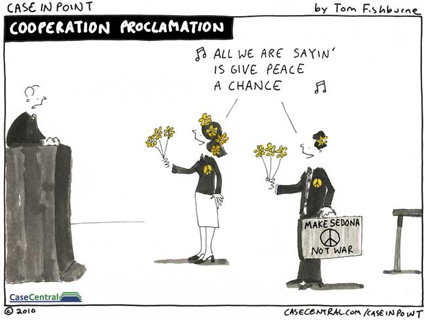
Ediscovery cooperation: Give peace a chance

Having heard two US Magistrate Judges in two weeks emphasise that ediscovery co-operation does not require “sitting round a campfire singing kumbaya”, I was interested to see that CaseCentral has picked up the same theme in their latest Case in Point cartoon.

Give peace a chance - Case in Point

Many lawyers will say that such cooperation is “sleeping with the enemy”, that they feel that it conflicts with their duty to do the best for their clients, and that they cannot explain it to them. Sometimes, they may be right about this to some extent, however unmeritorious that may be, although, in the UK at least, such an approach almost always conflicts with their duty to the court and their obligations under the rules, not least in respect of the overriding objective.

There are only two possible remedies where there has been  non-co-operation: one is pre-emptive active management by the court, imposing co-operation by order; the other is punishment in costs. In the UK, this will usually take the form of recompense to opponents for money thrown away. A lot of this wasted money is down to ignorance rather than intent – ignorance of the rules or ignorance of alternative ways of addressing the volumes. The penalties are likely to be much the same, whatever the cause.

Ignorance inevitably involves no assessment of risk. Where non-cooperation is deliberate, however, the deliberations ought to include a calculation which balances  the perceived benefits (often the grinding down of a weaker opponent) against the risk of being caught and punished in costs. The cases suggest that the balance is shifting, as judges become more aware of their powers, of their duty to hold the ring between parties of differing resources, and of the alternatives which the oppressor might have adopted.

The Sedona  Cooperation Proclamation referenced in the cartoon can be found here. Give it a read before you next decide how best to serve your client’s interests in giving or receiving discovery.

Home

Posted in Discovery, eDisclosure, eDiscovery, Electronic disclosure, Sedona Conference | Leave a comment

Cause and effect or why e-Disclosure is like cholera

“In Prussia the poor refused even to believe in the existence of cholera; noting that the eruption of the disease coincided with the arrival of doctors in their slums they drew the inexorably logical conclusion that the doctors had poisoned them.”

I am reading A N Wilson’s The Victorians from which this gem comes. How we laugh now that there should have been people so primitive that they should attribute their problem to those who come to cure it. It is a bit like people who blame the costs of electronic disclosure on those – judges and suppliers – who offer procedural or technical solutions to the problems.

Cholera was a new problem, first seen in India as a pandemic in 1817. Its progress round the globe can be charted from India to Eastern Asia to Persia and Russia until it reached Britain in 1837. The British epidemic of 1848-9 killed 53,000 people. The authorities were not keen to acknowledge that there was a problem at all and it  was left to private enterprise to show that the disease was not caused by smell itself but by the same things which caused the smells – a further muddling of cause and effect. Continue reading

Posted in Discovery, eDisclosure, eDiscovery, Electronic disclosure | Leave a comment

Clive Freedman e-Disclosure webinar

Barrister Clive Freedman of 3 Verulam Buildings gave a webinar on e-disclosure last week. Clive is a member, as I am, of Senior Master Whitaker’s working party which produced the draft e-disclosure practice direction and ESI questionnaire which were commended in his Final Report by Lord Justice Jackson. Those of us in the working party gratefully acknowledge that the brunt of the actual drafting fell on Clive. He has form in this area, having been heavily involved in the work of LiST, the Litigation Support Technology Group, in its draft PD and e-disclosure protocols.

I was in Las Vegas when the webinar was delivered – that itself is not a bar to attending (or delivering) a webinar, one of the joys of the format, though I could not in fact do so on this occasion. Mike Taylor of I-Lit did listen to it, however, and sent me this report: Continue reading

Posted in Litigation Support | Leave a comment

International eDiscovery Panel at CEIC

There is one major difference between the general run of discovery problems and those relating to international and cross-border discovery. The former are soluble – competence and co-operation coupled with judicial management would fix most ediscovery problems tomorrow; the trans-jurisdictional issues involve serious conflicts, not just of laws but of culture. As things stand, these seem irreconcilable, and it sometimes feels that the best we can do is to make people aware of and sensitive to the issues.

The panel assembled to discuss these matters at CEIC was well-qualified. M James Daley of Daley & Fey, LLP is Co-Chair of The Sedona Conference Working Group on International Electronic Information Management, Discovery and Disclosure (WG6) and a member of a delegation which recently met with the Article 29 Working Party in Brussels (see my article Sedona Conference WG6 presentation to Article 29 Working Party in Brussels. Dominic Jaar of Ledjit Consulting Inc., is Chief Executive Officer at Canadian Centre for Court Technology and is a member of The Sedona Conference’s working groups 1 (USA) and 6 (International). George Rudoy of Shearman & Sterling, LLP has more practical experience than almost anyone of managing and doing foreign data collections. Patrick Burke of Guidance Software was the moderator. Continue reading

Posted in Canadian Courts, CEIC, Data privacy, Data Protection, Discovery, eDisclosure, eDiscovery, Electronic disclosure, EU, Guidance Software, Litigation Support, Sedona Conference | Leave a comment

Judicial ediscovery comparisons at CEIC

I did a short summary piece about two of the sessions which I attended at CEIC in Las Vegas (see CEIC comes to an end), promising to expand on them when I got home. I am not quite home, sitting instead in a bus in a traffic jam caused by the dysfunctional UK Highways Agency. Lawyers who create work for themselves by deliberately stringing out the job have nothing to teach the job-creationists who constantly fiddle with road layouts to keep their pay and pension contributions rolling in. “Delays possible until July 2010” says the notice, rather too ambiguously for my taste.

Judge Peck and Patrick Burke at CEICBarely a week after moderating a US-UK judicial panel at IQPC in London (see IQPC the best London e-disclosure conference again), Patrick Burke of Guidance Software was in charge of one at CEIC in Las Vegas. Is it proper to call a judge a “common element”? Probably not, so I will say instead that Master Whitaker took part in both. The home team comprised US Magistrate Andrew Peck and Hon Judge Donald Shelton.

I have already quoted Judge Peck’s uncompromising assertion that incompetence, lying to the court or failing to co-operate are behind most sanctions decisions, and that 80% of sanctions decisions involve failure to preserve. By Rule 26f, parties are supposed to talk about the structure of discovery. The current rules say nothing about preservation except talk about it. That is too late. The recent Duke Conference had reached a consensus about the need to amending rules. Continue reading

Posted in Litigation Support | Leave a comment

CEIC 2010 comes to an end

CEIC 2010 is winding down here in Las Vegas. Whatever measure you take – the quality of the sessions, the opportunity to catch up with people and meet new ones, the sheer numbers of people attending (1,300 or so), the venue, or the glimpses through the bus windows of this not-quite-real city on the way back from dinner last night – it has been a great success.

For those unfamiliar with it, CEIC stands for Computer and Enterprise Investigations Conference and is run by Guidance Software, whose data collection and processing applications are used all over the world for everything from one-off defensible collections to enterprise-wide network collection applications and the consultancy which goes with it. My particular interest, electronic discovery, is only a part of what the applications are used for – internal investigations, HR incidents, government and military needs, and rapid reaction to external or internal demands for information, are all covered. It is deeply technical stuff, and its users need technical training to match. CEIC allows all those involved – from hands-on lab types to decision-makers – to gather once a year, to top up their skills, to meet others with the same or adjoining skills, and to find out what drives the other players. The technical people increasingly need to know about the context in which they collect data, and those who devise strategy must have some idea of technical difficulties and solutions. Continue reading

Posted in Canadian Courts, Case Management, CEIC, Data privacy, Data Protection, Discovery, eDisclosure, eDiscovery, Electronic disclosure, EU, Forensic data collections, Guidance Software, Litigation Support | Leave a comment

Missing my Dragon

Jonathan Maas of Ernst & Young says that I missed  a trick in my account of the laptop which died en route to Las Vegas and which I had to replace and set up in order to do a webinar (see Keeping at work in the Cloud from Las Vegas. I had explained that the reorganisation of my data on the plane had made it possible to save a copy of it on to a USB stick in the short period between booting up my laptop and it closing down through over-heating. Jonathan said:

I’m surprised you didn’t use the ease of transfer of your recently ordered files from your old to your new laptop as hands-on proof of the benefits of ordered disclosure from a corporation’s prepared IT infrastructure! Continue reading

Posted in CEIC, Discovery, Document Retention, eDiscovery, Electronic disclosure, Ernst & Young, Forensic data collections, Guidance Software, Litigation Support | Leave a comment

Party with a purpose at the poolside

I am told that there is record attendance at CEIC 2010 here in Las Vegas. Putting it like that implies no doubt on my part that the claim is correct, but this place is so vast that you could lose half the UK civil service (there’s a nice thought) in it, so assessing headcount by eye is quite difficult.

The numbers became clear at the welcome reception last night, the biggest poolside party I have ever attended (not that poolside parties on any scale are that common in Oxfordshire).  You get some idea of it from the photographs.

Red Rock pool from aboveCEIC 2010 float

Last night it was packed, with endless supplies of good food and drink. The quality of the company matters most, of course. There seemed nothing incongruous about discussing with a US Magistrate Judge (Judge Andrew Peck) the implications for US interests of Gucci v Curveal in such surroundings, or catching up with software company CEOs, like Victor Limongelli of Guidance Software, Eddie Sheehy of Nuix (whom I saw in London last week and will see again in Sydney in a few days time) or Andrew Sieja of Relativity, perhaps the only boss of a world-class software company who sits personally at a keyboard puzzling out how to make the search experience better for users. Continue reading

Posted in CEIC, Discovery, eDisclosure, eDiscovery, Electronic disclosure, Guidance Software, KCura, Litigation, Litigation costs, Litigation Support, Nuix | Leave a comment

Manual discovery is like herding steers down the Strip

I hope I never tire of the wonders of all this technology or cease to be amazed by what one can do with it. It is more than 100 years since the Wright Brothers flew at Kittyhawk, and I travel more than most, but I still marvel at the idea that a large box with wings can bring me to Las Vegas, itself only founded as a city in 1905, two years after Orville Wright left the ground.

View from Red RockIf the foreground in the view from my 19th floor hotel room suggests that progress is not uniformly for the better, the upside is the further view of the hills beyond. To mourn the fact that Las Vegas is no longer “The Meadows” which gave it its name is like regretting that disclosure / discovery no longer involves tactile intimacy with paper.  The city has doubtless lost something now that no-one brings cattle down to the river, just as some lawyers regret that “documents” are now electronic and come in volumes matching the population growth here since 1905, but life moves on. There is a new instant motto for you – “manual discovery is like herding steers down the Strip”. Continue reading

Posted in Litigation Support | Leave a comment

Keeping at work in the Cloud from Las Vegas

I have been here in Las Vegas a little over 24 hours. So far I have been asked by a cop if I have been arrested before, and been blatantly short-changed in Starbucks; I have been to one tourist attraction where the weather was so fine that we could not reach it for the crowds and then immediately to another where the weather was so vile we could see nothing. Oh, and my laptop, my mobile office equipped for every eventuality, has died on me and I have a webinar to do on Tuesday. Things can only get better. Continue reading

Posted in CEIC, Discovery, eDisclosure, eDiscovery, Electronic disclosure, Forensic data collections, Guidance Software, Litigation Support, Recommind | Leave a comment

IQPC the best London e-disclosure conference again

The three-day IQPC Information Retention and eDisclosure Management Summit is over for another year. It is the biggest and best conference in the London calendar and one which genuinely aspires to do better each year. Everyone I spoke to seemed to think that it had achieved that aspiration.

I have to be careful here. I am on its advisory board and was involved in some of the planning going back to a late-night session in a Brussels hotel bar last October. I also clocked up 8 hours on its platforms this year, so I am perhaps not wholly impartial. It has the greatest concentration of people interested in e-disclosure, from judges to suppliers to lawyers to clients, and is the place to be for someone whose job involves carrying information between these players. My main interest lies in talking to people, which inevitably means that I attend few sessions beyond those in which I am involved. The loss is mine – there was a packed programme of important and interesting subjects and anyone with a stake in electronic disclosure would have benefitted from being there.

Monday was a workshop day. I took part in a three-hour session run by Legal Inc called Ready for the Regulator: the importance of equality of arms. It was led by Vince Neicho of Allen and Overy who, characteristically, had left nothing to chance in our preparation. Bill Sillett, an enforcement officer at the Financial Services Authority, had provided a scenario which was no less plausible for involving almost every aspect of an FSA investigation – what started as an apparently routine matter grew into a multi-jurisdictional one with criminal implications, SEC involvement, and a potential conflict between the company and some of its employees. Antony Montague, Associate General Counsel at McGraw Hill Companies, Matthew Davis, Litigation Support Lawyer at Hogan Lovells, Peter Cladouhos, Practice Support Electronic Discovery Consultant at Paul, Hastings, Janofsky & Walker LLP, and I brought our respective professional inputs to this scenario, with Vince as an able narrator and an audience which caught the spirit of the thing and joined in. If we ran out of time before we run out of script, that was because the audience was sufficiently involved to take us down useful byways. The main take-away for me was the confirmation that the FSA looks well on those who are both willing and able to co-operate at a data level as well as at a higher factual level. Continue reading

Posted in Case Management, Court Rules, CPR, Discovery, eDisclosure, eDisclosure Conferences, eDiscovery, Electronic disclosure, Epiq Systems, Ernst & Young, FRCP, Guidance Software, IQPC, Judges, Litigation Support, Lord Justice Jackson, Masters Conference, Nuix, Part 31 CPR, Recommind, Trilantic, Women in eDiscovery | Leave a comment

IQPC: I heard your judges’ panel blew the doors off the joint

The quotation in my heading just came in from Gregory Bufithis of The Posse List. The reference is to the judicial panel yesterday at IQPC in London comprising (alphabetically) His Honour Judge Simon Brown QC, US Magistrate Judge John Facciola, Chief Magistrate Judge Paul Grimm, Lord Justice Jackson, Magistrate Judge Elizabeth LaPorte and Senior Master Whitaker. Patrick Burke of Guidance Software moderated and I opened the batting with a short introduction on the importance of international debate and discussion about electronic disclosure / discovery.

We got good feedback at the time, but if the word out there is that the panel “blew the doors off” then that is as good as an endorsement as we could want.

My own account of the event, including that panel, is proceeding slowly, not much aided by all the other things to be crammed into the two days which elapse between that conference and leaving for CEIC in Las Vegas on Saturday, nor by the eight hours I clocked up sitting (or standing) on panels, 4.5 of them yesterday. I stupidly forgot to pass my camera to anyone, so I have no photographs of that panel. Here in the interim is one from the Mock Disclosure Applications which we did at the end (thanks to Nick Pollard of Legal Inc for taking these for me).

Judges Play 1 at IQPC

The picture shows Judges LaPorte, Facciola and Grimm playing a composite judge called Fluffy, me as narrator, Steven Whitaker and Simon Brown as solicitors involved in e-disclosure applications, and Patrick Burke, in this scene as a salesman from The EDD Coalition explaining how two suppliers who hate each other have joined forces, looking and sounding the same in order to get more than 50% of the market – it works for politics, he is saying. Fluffy, the solicitors realise too late, is not a soft touch but a three-headed monster, as they would have realised if they had read Harry Potter and the Philosopher’s Stone.

That was the fun bit at the end of an intensive and extremely interesting three-day conference. My account will appear shortly, and others, I hope, will be covering the sessions (most of which, as usual, I either failed to record because I was in them or missed because I was engaged in useful conversation outside).

Home

Posted in Discovery, eDisclosure, eDisclosure Conferences, eDiscovery, Electronic disclosure, Guidance Software, IQPC, Judges, Litigation Support, Lord Justice Jackson | Leave a comment

Nigel Murray cycles to Trilantic’s new Dubai office

There is a photograph on Nigel Murray’s blog which appears to show that he has been cycling to work. Given the present state of air travel, this may be the most sensible method, even if you live in England and your office is in Dubai.

If you read it more closely, it becomes clear that Nigel was merely cycling in Dubai rather than to it. He was there in connection with Trilantic’s new Dubai office, and took advantage of the flat terrain to put in some miles towards his training regimen. The latter is needed because Nigel is again cycling across France in aid of Help for Heroes.

The journey starts on 24 May and the itinerary takes in Caen, Dieppe, Amiens, Arras, Ypres and Dunkirk, 350 miles in all. These are all places which I would like to see or see again, and I would be there but for a prior engagement in Las Vegas where CEIC takes place in the same week.

Nigel’s target was £2,200 and he has already raised £3,066. If you wish to contribute to this impressive total, you can do so here .

Good luck Nigel.

Home

Posted in CEIC, eDisclosure, eDiscovery, Electronic disclosure, Litigation Support, Trilantic | Leave a comment

A week of change in e-Disclosure as well as in politics

It is not often that you look back over a week or so and know that you will always remember it. Eight days ago, we had the same government as we had had for 13 years; now, not only the government but the face of politics has changed for ever. After years with almost no e-disclosure cases at all, two were  reported last week which we will refer to for some time. I have done two sessions with lawyers from which I have emerged confident that the messages are striking home.  At a more mundane level, all next week’s conference sessions now have plans or scripts and the travel arrangements for the next round of conferences are falling into place, or were before ash and strikes threatened. Last Thursday seems a world away. Continue reading

Posted in Australian courts, Discovery, eDisclosure, eDisclosure Conferences, eDiscovery, Electronic disclosure, IQPC, Litigation Support | Leave a comment

Court of Appeal declines to overturn specific disclosure judgment in Fiddes v Channel 4

Those interested in judicial management of disclosure might like to look at the judgment of the Court of Appeal in Fiddes v Channel 4, delivered on 24 March but published on BAILII only on Friday.

The case is interesting for several reasons: it is an e-disclosure case; it is a libel case, thus showing that e-disclosure pops up everywhere; it involves the other Jackson, the late Michael; it considers questions of proportionality where the cost (in this case of examining backup tapes) is balanced against the likely value of what might be recovered. More important than all this, it shows a Court of Appeal upholding a judge’s decision although far from convinced that they would have arrived at the same conclusion as he did. Continue reading

Posted in Discovery, eDisclosure, eDiscovery, Electronic disclosure, Judges, Litigation, Litigation costs, Litigation Support | Leave a comment

FTI Consulting partnership makes Late Shift possible for National Portrait Gallery

It is not just e-Disclosure which needs to find wider audiences. Institutions like the National Portrait Gallery also have to make their displays more accessible. The word “accessible” acquired politically correct connotations in the New Labour years, with public funds being handed out or withheld by reference to minority quotas rather than to actual need or interest. In more useful terms, accessibility often comes down to places being open outside normal working hours.

That is part of the rationale for the National Portrait Gallery’s Late Shift initiative which allows it to stay open on Thursdays and Fridays until 9:00 pm. The NPG has set up a partnership arrangement with FTI Consulting to facilitate this, and there was a party at the gallery last night at which FTI were the hosts. Continue reading

Posted in eDisclosure, eDiscovery, Electronic disclosure, FTI Technology, Litigation Support | Leave a comment

Video illustration of forensic collections tool

I am always looking out for new ways of getting to wider audiences. Although you cannot beat actually talking to people, the Internet offers other ways conveying information.

Forensics collection experts 7Safe have produced a video about their data collection application 7Phrase. If you are unclear what forensics collection means, this is a quick and easy way to find out.

It is interesting to note that it is the data collection people who have got their act together on alternative ways of reaching new markets. I wrote recently in an article about data collections about a video produced by Guidance Software demonstrating possible uses for EnCase Portable. Where are the rest of you, with new ways of telling us about your products?

Home

Posted in Discovery, eDisclosure, eDiscovery, Electronic disclosure, Forensic data collections, Guidance Software, Litigation Support | Leave a comment

Imminent reform in prospect for Australian discovery process

Reform of the discovery process in Australia is said to be “imminent”, according to an article in the New Lawyer. The article says that the Attorney General has asked the Australian Law Reform Commission to explore options to promote the early and proportionate exchange of information and evidence in court proceedings with an emphasis on the role of the courts in managing discovery by using their case management powers. My thanks to Simon Price of Recommind for drawing my attention to the article.

The article refers to the experience of international jurisdictions. Those of us concerned with improving the court process are enthusiastic about the exchange of ideas between jurisdictions, particularly where the system of law is similar to ours. Lord Justice Jackson visited Australia as part of his fact-finding tour before writing his Preliminary Report, and we studied the Australian Electronic Technology Practice Note CM 6 when drafting our own new practice direction and Questionnaire. Continue reading

Posted in Australian courts, Case Management, Discovery, eDisclosure, eDiscovery, Electronic disclosure, IQPC, Judges, Litigation, Litigation costs, Litigation Support, Lord Justice Jackson, Recommind, Singapore | Leave a comment

Recommind webinar: Technology is Changing the Economics of e-Disclosure, Are You Prepared?

My title is the name of a webinar which I am doing with Jason Robman of Recommind on 25 May. Its description reads as follows:

The enormous costs and time associated with the e-Disclosure process are staggering, with the document review phase alone frequently racking up fees that in some cases actually eclipse the amount at issue.

The reason for this is straightforward: the approach to identification, collection, processing, review and analysis of information – including technology, people and processes – haven’t kept up with the explosive growth of electronically stored information.  Law firms and corporations that continue to use outdated approaches are simply too slow, inaccurate and inefficient to keep up with today’s digital information volumes and diversity and are finding themselves at a competitive disadvantage to their better-prepared peers.

In this webinar learn how law firms, corporations and the courts are embracing the use of new technology for more accurate investigations and to reduce e-Disclosure costs.

DATE: Wednesday, May 25, 2010
TIME:  4:00 pm to 5:00 pm BST

To Register for this Webinar: https://www2.gotomeeting.com/register/268150227

Those who visit this site regularly will know that this theme recurs here. The technology itself is gaining on the problem, but the approach which lawyers and courts adopt often amounts to using the methods of paper days. The handling of electronic documents is not just “like paper but different” but requires a completely different approach. The risks are apparent from several recent cases. The advantages for those prepared to recognise them, are considerable, not just in terms of terms of winning cases but for winning clients.

Do join us on 25 May at 4.00 pm.

Home

Posted in Case Management, Court Rules, CPR, Discovery, eDisclosure, eDiscovery, Electronic disclosure, Litigation Support, Recommind | Leave a comment

E-Disclosure law, practice and technology in one educational package

The first of the E-disclosure seminars organised jointly by Professor Dominic Regan and me took place yesterday at Ely Place Chambers. Dominic and I were joined by Senior Master Whitaker and by speakers from three technology providers, 7Safe, Legal Inc and FTI Technology to bring together the law, the practice and the technology in one afternoon session.

The expressed rationale for the e-Disclosure Information Project is to bring together all those with an interest in making electronic disclosure efficient and cost-effective. That crossover is important –  knowledge of Part 31 CPR and its practice direction is a good start, and the increasing number of cases involving e-disclosure failures send a strong warning to lawyers. Lord Justice Jackson drew attention to the need for more active case management by judges, and the proposed new practice direction and ESI Questionnaire raise the temperature on that front. Meanwhile, the technology reduces in cost as it increases in capability and, if properly used, maps well to the steps which parties and the court must take together, first to decide on the scope of disclosure and then to achieve it. The case management itself must be proportionate to what is involved. Continue reading

Posted in Attenex, Case Management, Court Rules, CPR, Discovery, E-Discovery Suppliers, eDisclosure, eDiscovery, Electronic disclosure, Forensic data collections, FTI Technology, Litigation, Litigation costs, Litigation Support, Lord Justice Jackson, Nuix, Part 31 CPR, RingTail | Leave a comment

Reminder: Dominic Regan and Chris Dale on e-Disclosure at Ely Place Chambers on 12 May

Professor Dominic Regan and I will be leading a seminar from 2.00 until 5.15 on Wednesday 12th  May at Ely Place Chambers on the subject of electronic disclosure of documents.

Lord Justice Jackson’s only recommendation in relation to e-disclosure was that there be substantial training for both lawyers and judges. This is an opportunity to find out why he said:

The first point which needs to be made about e-disclosure is that it is inevitable in cases where the parties hold the relevant material electronically. For the parties to print all the material out and then exchange it in hard copy would often be impracticable. With all but the smallest volumes of material, that course would not be cost effective. Thus in cases where edisclosure is a consideration, it is often a practical necessity rather than an optional course.

Lord Justice Jackson also drew attention to the need for judges and lawyers to know about and understand the technology which is available to address the problems raised by large volumes of electronic documents. Dominic and I will be supported by three providers of litigation support services. 7Safe will talk about the collection of data. Legal Inc will describe the range of consultancy services which are on offer from a general provider of litigation services. FTI Technology will cover processing and document review.

This is a lot packed into one afternoon – there is nowhere else where you can cover the law, the practice and technology in one session. Ticket prices are £94 including VAT and can be obtained on application from Chris Drury, the Clerk at Ely Place Chambers.

Home

Posted in CPR, Discovery, eDisclosure, eDiscovery, Electronic disclosure, Forensic data collections, FTI Technology, Litigation Support, Lord Justice Jackson | Leave a comment

Women in eDiscovery at IQPC on 18 May

It is not too late to sign up for the women in e-Discovery session at IQPC’s Information Retention and e-Disclosure Summit on Wednesday 18 May. The conference itself runs from Monday 17 May and the Women in eDiscovery session takes place after lunch on the last day.

The session, which is open only to Women in eDiscovery members and is free of charge, will include talks by English and US judges as well as by solution providers. If you are not a member of Women in eDiscovery, it is not too late to join. Contact Laura Kelly.

It is not too late either to attend the whole conference which, as you can see from the programme, has comprehensive coverage of information management (that is, broadly, the things which clients ought to be doing in anticipation of litigation, regulatory investigations or internal enquiries) and electronic disclosure. My article on the Al-Sweady case gives links to a number of other cases which, taken together, make it clear that no one who purports to give advice on litigation can sensibly remain ignorant both of the obligations as they stand and of  pending developments, including the ESI Questionnaire. Continue reading

Posted in CPR, Discovery, Document Retention, E-Discovery Suppliers, eDisclosure, eDisclosure Conferences, eDiscovery, Electronic disclosure, IQPC, Litigation, Litigation Readiness, Litigation Support, Regulatory investigation, Women in eDiscovery | Leave a comment

Late disclosure of e-mails ends BA price-fixing trial

The government and its agencies have come unstuck yet again over failure to disclose electronic documents. A Reuters article British Airways price fixing trial collapses, published today, reports that the Office of Fair Trading (OFT) had failed to disclose relevant e-mails to the defence over several years.

70,000 e-mails were “found” last week, 12,000 of which were sent or received by the witness from Virgin whose evidence was central to the case. One at least of the disclosed e-mails appeared to undermine the prosecution’s own case. Production of the rest within the timescale ordered by the judge proved logistically impossible. Continue reading

Posted in Discovery, eDisclosure, eDiscovery, Electronic disclosure, Litigation Support | Leave a comment

ILTA 2010 Nashville venue under water

ILTA 2010, due to take place at the Gaylord Opryland Hotel in Nashville Tennessee on August 22-26, is confident that it will find another venue after the waters from the Tennessee floods severely damaged the hotel. This video gives you some idea of the damage.

ILTA has posted advice on its website for those who have already booked rooms at the hotel. I cannot imagine what is involved in finding a new venue at short notice for a conference of this size, but knowing Peggy Wechsler and her team, they will find something. I wish them well in their search, and will bring further information as I get it.

Home

Posted in Litigation Support | Leave a comment

Singapore e-Discovery judgment shows international commonality and active management

A judgment by Senior Assistant Registrar Yeong Zee Kin in the Singapore High Court last week shows the commonality in court-led management of e-Discovery between common law jurisdictions. The case is Deutsche Bank AG v Chang Tse Wen and others [2010] SGHC 125  and it concerns the Electronic Discovery Practice Direction 3/2009 which came into effect in Singapore on 1 October 2009. Master Whitaker and I were there a few days later, and Yeong Zee Kin was a speaker at that conference. What he says in his judgment was foreshadowed by what he said at the conference.

Before turning to the judgment itself, I take this opportunity to emphasise how small this world is quite apart from the commonality between the laws and practices in each place. The judgment was delivered on 26 April. I found out about it on 28th of April because Serena Lim of BiziBody in Singapore tweeted about it. I re-tweeted it, passed the link to a few people with a specific interest in the practice directions of other jurisdictions, and put it into my “things to write about” queue. This morning, Aaron Bleasdale of Epiq Systems in Hong Kong dropped me a line to make sure that I had seen it. Yeong Zee Kin and I are both speakers at the InnoXcell eDiscovery conference in Hong Kong on the 7 and 8 July. This combination of formal judgments cross-referring between jurisdictions, instant and worldwide communication, international conference platforms, and active interest from all over the place speaks for itself.

The judgment involves a not uncommon story of one party keen to give disclosure electronically whilst the other is not, apparently on the basis that he was already poised to give disclosure on paper and considered that e-Discovery would multiply his costs. Continue reading

Posted in CPR, Discovery, eDisclosure, eDiscovery, Electronic disclosure, Singapore | Leave a comment

Listening to myself talking about e-Disclosure for the IQPC Information Retention and E-Disclosure Summit

I have been listening to a podcast which I made recently for IQPC as part of the run-up to their Information Retention & E-Disclosure Management Summit in London on 17-19 May 2010. It can be accessed from the Summit’s home page. It is not that I reckoned to learn anything new, you understand, nor is there any narcissistic pleasure in hearing the sound of my own voice, but it is no bad thing occasionally to know what the audience is hearing, as Gordon Brown discovered last week.

The recording covers recent cases, the proposed e-Disclosure practice direction and ESI Questionnaire, and the e-Disclosure elements in Lord Justice Jackson’s Report. It also considers the importance of learning about what happens in other jurisdictions, and the collision between the US and the EU on matters of privacy and data collection. It ends with the observation that this subject is one with opportunities as well as risks – there is work to be won by those who take the trouble to learn a little about e-Disclosure problems and the solutions. It ends with the exhortation that “‘Get on with it’ has to be the message of 2010”.

The recording is intended to provide a context for the Summit, in particular for the US-UK judicial panel. Continue reading

Posted in Data privacy, Data Protection, Discovery, Document Retention, eDisclosure, eDisclosure Conferences, eDiscovery, Electronic disclosure, IQPC, Judges, Lord Justice Jackson | Leave a comment

The 2010 Duke Conference on US Civil Litigation

No one with any interest in the US Federal Rules of Civil Procedure could be unaware of the debates which have been going on about the costs of civil litigation and, in particular, of discovery. A conference is being held on May 10 and 11 at Duke Law School, Durham, NC to consider new empirical research by the Federal Judicial Centre and other data and papers prepared by lawyers, judges and academics.

Chief US Magistrate Judge Paul Grimm kindly tipped me off today that the materials for the conference are available on a public website which contains a mass of material relevant to the discussions. Continue reading

Posted in Case Management, Court Rules, CPR, Discovery, eDisclosure, eDisclosure Conferences, eDiscovery, Electronic disclosure, FRCP, Guidance Software, IQPC, Litigation, Litigation costs, Lord Justice Jackson | Leave a comment

Government cannot keep documents secret in Guantanamo civil claim for damages

The Court of Appeal has held in Al Rawi and Others v The Security Service and Others that it is not open to a court in England and Wales, in the absence of statutory authority, to order a closed material procedure for the trial of a civil claim for damages in tort and breach of statutory duty. The decision overturns a judgment to the contrary made by Silber J last year. Part of the court’s decision follows from an incompatibility between the closed material procedure and the general provisions of the civil procedure rules and would not be reconcilable with the overriding objective in CPR 1.1. Continue reading

Posted in Discovery, eDisclosure | Leave a comment

Recommind research shows UK companies not ready for e-Disclosure

I spent much of today digging out quotations from judgments whose theme was inexcusable e-Disclosure failures, which I need for a paper which I am writing. We have had a run of cases in the UK where significant costs have been incurred which fall, often on an indemnity basis, on the party which is in default of its obligations. My focus is not so much on the rules, important though they are, as on the waste of time and costs which follow inevitably from the failure to get a grip pre-emptively or at an early stage. My drafting exercise is taking a long time, not because examples are hard to come by, but because there are almost too many to choose from.

In some of the cases, it is hard to decide whether the failures were the result of incompetence, ignorance, or the hope of concealment – and that is really the point: if documents have to be dragged out of you, then it is unsurprising if you find yourself accused of bad faith. When the remedy, in the form of fast and efficient processing tools, lies to hand but has been ignored, then the imputation of concealment will hang over you when you are forced to admit that you do, after all, have documents whose existence you have hitherto denied. If a fraction of the money thus wasted had been spent in getting to grips with managing document collections, then the stories would have been very different. In one case, the indemnity costs payable by the defaulting party amounted to £1 million, that is, their opponents had demonstrated the waste of at least that sum for their work in pressing for proper disclosure. I am concerned at several levels, not least because I am paying for much of this as the taxpayer funding an evidently incompetent government department, but I am concerned also for litigation generally. Continue reading

Posted in Discovery, Document Retention, eDisclosure, eDiscovery, Electronic disclosure, Litigation, Litigation costs, Litigation Readiness, Litigation Support, Recommind | Leave a comment

Search technology: an intelligent adjunct to the lawyer’s skills, not a black box

An article by H5 on the professionalization of search ties in with my recent suggestion that lawyers and search experts have parallel roles in e-Discovery and that clients, rather than the lawyers, will manage the process. The UK courts have not yet seen a challenge to a search algorithm, but it will come, and it won’t be the lawyers who will defend it

I do not generally have a project plan for what appears here. There is always a list of pending subjects, from part-drafts to ToDo list entries to vague ideas floating around in my head, but no overall schema which brings topics or people round in regular rotation. I resist both deadlines and urgent announcements – I have enough deadlines as it is for more formal papers or for conference slides, and breathless messages inviting me to get an embargoed scoop on next week’s announcement (“revolutionary, unique”) leave me cold, with their implication that I must drop everything and scurry around at a time of someone else’s choosing in order to get out an article on the same day as the rest of the world. Apart from announcements of pending conferences and near-contemporaneous reports of conferences or important cases, I take subjects as they reach the top of my mental in-box, where they simmer for a bit before I write.

This measured approach to it all sometimes means that sub-conscious connections appear between two or more subjects, so that a snippet about one thing finds a home in an article about another, or this week’s subject-matter stirs recollections of last year’s thinking. A subject which has raised its head a few times lately has been the question whether English courts consider that electronic means of culling, filtering and refining data collections are good enough relative to the lawyers’ duty of candour. That took me back to the resources on search on H5’s web site. H5 is not, of course, the only provider of search skills and technology which takes the subject seriously, nor are they the only ones who evidence their interest by active participation in TREC (the Text Retrieval Conference ) and the Sedona Conference. Their web site was, however, the first place on which I lighted when I started to investigate the points which arise when the academic and deeply complex principles of search meet the day-to-day business requirements of those who “just” want to find the right documents. Continue reading

Posted in Court Rules, CPR, Discovery, eDisclosure, eDiscovery, Electronic disclosure, H5, Litigation, Litigation Support | Leave a comment

The Franco-British Lawyers Society on cross-border e-Disclosure 17th of May 2010

The Franco British Lawyers Society have organised an evening session called Searching for evidence: a panel discussion on cross-border e-Disclosure from an English and French perspective. The event takes place on Monday, 17 May at 6 pm at Pinsent Masons, 30 Aylesbury Street, London EC1R 0ER.

The speakers are:

  • Mark Surguy: Legal Director at Pinsent Masons LLP.
  • Caroline Jan: Solicitor at Pinsent Masons LLP.
  • Claire Picard: Avocat at Salans.
  • Vicky Harris: Business Development Director at Merrill Corporation.

Registration is solely via the FBLS and places are limited. The event is free and includes a drinks reception. Contact Marie-Blanche Camps by email at yfb31@dial.pipex.com

You might also be interested in the FBLS events programme. I see from it that I missed an event in Edinburgh called The use of modern technologies in the Scottish and French court systems. The speakers included the Unit Manager of the Electronic Service Delivery Unit ‐ Scottish Courts and the Senior Legal Adviser of the E‐Justice working group of the Council of Bars & Law Societies of Europe. Both E-Justice and the use of technology in Scottish legal practice catch my interest, and I would have promoted this talk, or even attended it, if I had known about it.

I cannot, unfortunately, attend the 17 May Anglo-French event because I will be out at an Anglo-US dinner that evening with a group of judges – e-Discovery experts all – from both sides of the Atlantic. If we merged the two events, we could probably resolve any number of multi-jurisdictional discovery problems.

Home

Posted in Data privacy, Data Protection, Discovery, eDisclosure, eDiscovery, EU | Leave a comment

EDiscoveryMap helps navigate cross-border issues

Monique Altheim, a New York qualified lawyer, has quickly established her blog, EDiscoveryMap, as a mine of information on matters of personal data, privacy, data transfer and cross-border transfers. I follow her on Twitter as EUDiscovery and EDiscoveryMap which keep me up to date both with her own writing and with other sources.

Monique attended the IAPP International Association of Privacy Professionals Global Privacy Summit 2010 in Washington recently. Many from Europe failed to make it thanks to the volcano. They, and anyone else interested in this topic (judging by Monique’s blog hits, a great many people) ought to look at her blog which, as I write, includes near the top several video interviews with people who are knowledgeable in this area. Continue reading

Posted in Data privacy, Data Protection, Discovery, eDisclosure, eDiscovery, Electronic disclosure, EU, EU Safe Harbor | Leave a comment

You have an urgent e-Disclosure requirement NOW. How do you get started NOW?

Although I have long had an interest in disclosure and specifically in electronic disclosure, the sense that there was a mission and a message to promote dates from the IQPC conference in London in May 2007. It was the first big conference I had attended, and was the first time I met Senior Master Whitaker and heard him speak. The other speaker who caught my attention at that conference was Mark Surguy of Pinsent Masons. His message was not addressed to those accustomed to e-Disclosure but to lawyers who might find themselves suddenly involved in a case which required skills and knowledge about handling electronic documents for which their experience had not equipped them. His message was that everyone should know what they would do if an urgent e-Disclosure problem arose tomorrow. Lawyers ought, he said, to know who they would call whom they could trust, and what the terms of engagement would be. His suggestion was that every firm should identify at least two providers of software and services and should have reached a framework agreement with them on matters including price and the  divisions of responsibility and liability. Continue reading

Posted in Discovery, eDisclosure, Electronic disclosure, Litigation, Litigation Support, Posse List, Trilantic | Leave a comment

ILTA Insight 2010: lawyers risk becoming just part of the clients’ process

The most powerful single message from ILTA INSIGHT 2010, held in London yesterday, was that lawyers risk becoming merely part of the clients’ processes in a slot marked “insert lawyer here”. Technology must become part of the lawyers’ business processes, and not merely an adjunct to them.

St Pauls CathedralILTA INSIGHT 2010 took place yesterday at the Grange Hotel St Paul’s Hotel. Peggy Wechsler and her team put on an interesting programme, as ever, at an event which always manages simultaneously to be friendly but challenging. ILTA’s scope is much wider than my own specialist subject, e-Disclosure, embracing every aspect of bringing technology to the business of being a lawyer and, in consequence, has a delegate contingent which is wider than I usually see. There is a greater emphasis on law-firms-as-businesses, which tends to be side-lined at pure e-Disclosure conferences. It deserves a place there – the internal decision-making about this aspect of the litigation process should be driven as much by the firm’s own costs as by those incurred by the clients.

The British election has so far not thrown up a single defining slogan, that killer combination of words which simultaneously captures the mood and skewers an opponent. Abby Ewen of Simmons & Simmons came up with one at an ILTA INSIGHT session led by Charles Christian of Legal Technology Insider and the Orange Rag blog. The context was the identification of things which lawyers are good at, as opposed to all those other things which they do as part of their traditional work for clients and to the (relatively novel) idea that they are running a business. Abby said that  “not much of what lawyers do is all that clever stuff they went to university to learn”. It was important, she said, to “try and extract the things which lawyers are not very good at”. The corollary to that is that the clients are only interested in those things which the lawyers are good at, so that they, and the charging rates which go with them, are applied only when necessary. Continue reading

Posted in Discovery, eDisclosure, eDiscovery, Electronic disclosure, ILTA, Judges, Legal Technology, Litigation, Litigation costs, Litigation Support, Lord Justice Jackson | Leave a comment

Structured data is neither as easy nor as difficult as it sounds

Lawyers tend to overlook structured data. If they think of it at all when giving disclosure, it goes into the box marked “too difficult to deal with”. A decision that it is disproportionate to handle it may be right, but “decision” implies that its value has been weighed against cost, which is not the same as just ignoring it. I asked Jim Vint at FTI Technology to give me some examples where structured data was crucial to a case.

In general, lawyers like structure, with its implication of order and of things being in the right place. I do not necessarily mean that they (or “we”, strictly, since I am a lawyer too) prefer that every day is the same from alarm clock to Ovaltine (that is what the civil service is for as a career), but lack of organisation wastes time, and time is money. If you need a library book, your favourite coffee, or a particular iTunes track, then it is helpful to have some degree of pattern and consistency to help you find those of a like kind in a regular place. You expect a library to group its stock by subject and type, and not have law reports, textbooks and periodicals stuffed any old how into random shelves or all over the floor; imagine going into Starbucks and being told that every possible permutation of coffee, chocolate and the rest is in a cup somewhere, but that you must lift each lid to see which is which; you would not appreciate having to scroll down endless lists of iTunes tracks until you find the one you want. We go for the structured stuff every time. Continue reading

Posted in Attenex, Discovery, eDisclosure, eDiscovery, Electronic disclosure, FTI Technology, Litigation Support, Part 31 CPR, Regulatory investigation, RingTail, Structured data | Leave a comment

Chris Dale and Dominic Regan on e-Disclosure at Ely Place Chambers on 12 May

Professor Dominic Regan and I will lead a session on electronic disclosure at Ely Place Chambers, 30 Ely Place, London EC1N 6TD on Wednesday 12th May 2010. The event starts at 2.00pm and will run until 5:15pm

The Chambers notice about this event is here . The cost is £80 + VAT, a total of £94. Application should be made to the Chief Clerk, Chris Drury cdrury@elyplace.com.

This is the first of an intended series of talks around the country. Dominic Regan is Visiting Professor of Litigation at City University, and is well-known as a speaker on all aspects of litigation, and particularly on costs. He will talk about the law and I will cover the practical aspects of handling electronic disclosure in a climate which, thanks to the recent cases, brings enhanced risks to reputation as well as in relation to the actual conduct of the case on behalf of the client.

Of particular interest at the moment is the ESI Questionnaire annexed to Master Whitaker’s judgment in Goodale & Ors v The Ministry of Justice & Ors [2009] EWHC B41 (QB) (05 November 2009), one of the topics which we will focus on.

Lord Justice Jackson has highlighted the value to practitioners and judges of education in this area, including the benefit of actually seeing some of the types of applications and hearing about the services which are available to help tackle the problems.

We will be accompanied by suppliers of some of these tools and services who will between them cover the different stages of collection, processing and review.

There are practice development opportunities here as well as mitigation of risk. This is a good opportunity to get up to date in an area which is growing in importance.

Home

Posted in Court Rules, CPR, Discovery, E-Discovery Suppliers, eDisclosure, eDiscovery, Electronic disclosure, Litigation, Litigation costs, Litigation Support, Lord Justice Jackson, Part 31 CPR | Leave a comment

451 Group e-Discovery and e-Disclosure report points up the pain of purchasing decisions

The 451 Group, Rob Robinson of Applied Discovery, and I each have different roles in the business of spreading information about e-Discovery and e-Disclosure. The 451 Group is a technology analyst company whose business involves in-depth knowledge of enterprise IT underpinned by research into the industry and its players. Rob Robinson remains, as he has been seemingly for ever, the fastest gun in the West (Austin, Texas in fact) at picking up information, news and views across the industry and serving it up in easily digestible form, not least in a weekly list of articles distributed by e-mail and by widely-read resources such as the Posse List’s Electronic Discovery Reading Room. Mine is the easiest role – I have the luxury of writing, in my own time and without regard to journalistic deadlines, about only those things which interest me and which I hope will interest others.

The ideal model therefore, from my point of view, is that The 451 Group does some research and analysis, Rob Robinson and Applied Discovery tip me off about it, and I write about it, adding such comment as seems appropriate, particularly if there is a UK angle to bring in. Continue reading

Posted in Discovery, E-Discovery Suppliers, eDisclosure, eDiscovery, Electronic disclosure, Guidance Software, Litigation Support, Marketing | Leave a comment

Shoesmith loses judicial review but disclosure candour questions remain open

Sharon Shoesmith has failed in her application for judicial review against Haringey, Ofsted and The Secretary of State, Ed Balls. This, as the judge made clear, was to do with the narrow ambit of the judicial review process and says nothing about (or, at least, is not determinative of) the unfair dismissal proceedings which have been stayed pending the disposal of the judicial review. The judgment, a summary of it, and the judge’s remarks are on the Judiciary website. The judge said (in paragraph 546)

The point simply is this: the court’s power to intervene in respect of an administrative decision exists to ensure that it is not made unjustly in the sense that, when a fair process is required, the adoption of an unfair process will operate to undo the decision. For the reasons I have given I have not been persuaded that the grounds for intervention have been made out as against Ofsted and the Secretary of State. Whether Haringey was unfair in the way it dealt with the Claimant’s dismissal (not merely procedurally, but substantively) will, if she pursues the case, be decided ultimately by the Employment Tribunal.

The judge confessed to a “lurking sense of unease” in reaching his decision, partly because of an apparent gap between the statutory powers of a minister in such circumstances and the contractual relationship between employer and employee, and partly because of the particular circumstances of the case. He said as to the latter (in paragraph 543):

If there had been a sustainable case that the Ofsted report had been ‘made to order’ at the instance of, or on behalf of, the Secretary of State and that the results of the inspection were thus either a foregone conclusion or had been manipulated to give grounds for his decision, the outcome of this case would have been different. Suggestions of such dark processes have been made during the proceedings. Ofsted’s inept handling of its obligation of candour during the case may at the time it was revealed have appeared to provide a key to an otherwise locked door. When the further disclosure took place, the suggestions were renewed with greater vigour. However, on the evidence as deployed before me, those suggestions could not be translated into anything of greater substance whatever suspicions, on one interpretation of the material, might have been engendered.

Two appendices relate to the duty of candour point. I do not intend to summarise them in a hurry, but the short point is that the judge intends to pursue certain aspects of the conduct of disclosure with the Treasury Solicitor. Mention is made twice (once in the judgment itself and once in the second appendix) to the Al-Sweady case which I have written about (see Al-Sweady v Secretary of State for Defence: blame for e-Disclosure failures gets personal – and public). It appears that a note has been circulated internally by the Treasury Solicitor as a result of Al-Sweady to remind people about the duty of candour – I guess there may have been another one following Master Whitaker’s judgment in Goodale v The Ministry of Justice (see Goodale v MoJ – a template judgment for active management of eDisclosure). Every law firm responsible for litigation disclosure ought to be producing something similar, and for its clients as well as its own staff.

I suspect that there will be more than article to come about this. I will pull together the points of general application when I have had the chance to read, rather than merely skim, the judgment. Meanwhile, as I have suggested before, keep a copy of the standard form of disclosure statement pinned above the desk and give it a read before you embark on a disclosure exercise, not just as your pen (or your client’s pen) is poised to sign it. It is too late to reflect at that point on what is meant by the duty of candour.

Home

Posted in Disclosure Statement, Discovery, eDisclosure, eDiscovery, Electronic disclosure | Leave a comment

Shoesmith judgment due today

Mr Justice Foskett’s judgment in Sharon Shoesmith’s judicial review application against Haringey, Ofsted and Ed Balls is due to be published at 12.00 today. It will be accompanied by some judicial observations. My own interest, of course, lies not so much in the outcome of the case itself as in the disclosure aspects.

Amongst my predictions for the year was that 2010 will see disclosure failures getting personal, with lawyers and their clients being named and shamed. It is not, I have to say, my weapon of choice in this battle – there are so many positive business reasons for getting the mechanics of disclosure right that it seems a pity to have to emphasise the costs and reputational risks of getting it wrong. The rules run to about five easily-understood pages; the technology is there to be used where it would help; the clients want their litigation run cost-effectively. All we see is people screwing it up in ways which results in someone – often the taxpayer – picking up huge bills for remedying easily-avoided defects. There are marketing opportunities here which make a much more positive message than mere fear of failure.

Wearing my marketing hat, the Conservative Party campaign leaves one open-mouthed with amazement, whatever one’s political affiliations.  We will be mining it for decades as an example of a product beginning with a strong market position and throwing it away day by day. It is not the off-the-cuff stuff which is letting them down – anyone can trip in the unremitting light of media exposure – but the lack of the clear, coherent messages which the times and the “market” require. Sure, any unequivocal message will alienate someone – one man’s reduction in the burden of the state is another man’s job loss – but there are votes to be won simply for offering clear unequivocal policies without compromising the message by trying to please everyone.

There was a nice comment last night on the way Gordon Brown retreats behind a spout of numbers when under pressure . Someone referred to them as “tractor stats”, invoking in two words the the whole Stalinist era of  Five Year Plans and state-led methods of production. Those of you with products to sell may care to look at your printed material and consider how much of it consists of tractor stats as opposed to clear identification of things which actually mean something to the lawyer with a job to do.

Home

Posted in Discovery, eDisclosure, eDiscovery, Electronic disclosure, Marketing | Leave a comment

Plenty to do in an ever busier eDiscovery market

It is very flattering when people write in to ask if I am all right because they have noted that the number of blog posts is down in a particular week, suggesting as it does that people do not merely read what I write, but look out for it.  It would, no doubt, be a very pleasant life if I could just sit in my office writing carefully-honed articles but, if that was all I did, I would soon run out of things to say. Furthermore, blog posts are not the only written output, and writing is not the only way of meeting my objective of spreading the word about e-Disclosure.

To allay the suspicions of those who may think that I have taken a week off, it is worth quickly summarising what has been going on. It is useful, periodically, to give some idea of the range of activities which promote the subject, because it shows how much activity there is in the market. Continue reading

Posted in Brussels, Discovery, eDisclosure, eDiscovery, Electronic disclosure, iCyte, ILTA, IQPC, Litigation, Litigation Support | Leave a comment

Peer-to-peer networking at the IQPC Corporate Counsel Exchange in Brussels

The night before I left for IQPC’s Corporate Counsel Exchange in Brussels, I gave a short talk at an event organised by 7Safe in London. I will write about that separately, but its theme was that we are seeing a greater rate of change in the UK e-Disclosure world than at any time hitherto, thanks to a combination of procedural initiatives and salutary cases. Change is very much in the air in other areas as well – when I went away, the Liberal Democrats were a joke with no hope of a role in government; by the time I came back, they were a joke with a serious prospect of a role in government. The expression “change is in the air” acquired additional resonance when another minority entity thought to be capable of zero impact managed to bring the entire world to a halt. As the current joke has it, it is cash we want from Iceland, not ash. My wife and I came within a hair’s breadth of falling victim to the latter. Mary Ann, sensibly, took it for granted that we would travel by Eurostar and, in her role as my travel department, and in that no-nonsense way which women have, was poised to make the booking. Wait, said I, in my male, have-we-considered-every-option? way, we should check out the flights. Fortunately, anything that BA had to offer was both more expensive and more inconvenient than the train, even before Iceland intervened.

I was busy down to the moment of leaving home, and had not begun to focus on the implications of the volcano. I assumed that the long queues at the St Pancras Eurostar terminal comprised people keen to get away before the Lib Dems took power (if you think that New Labour loves interfering in our lives, wait till you see what inherent contradictions lie in the two words which make up the name “Liberal Democrat”). Uniquely amongst British public transport ventures, Eurostar just works. Uniquely also, the St Pancras terminal combines aesthetic pleasure with practicality – c.f. the Brussels terminal which has been apparently been designed deliberately to be as ugly and inconvenient as possible, inside and out. Our choice of hotel was another example of the triumph of female instinct over the curious male need to weigh every option. It took Mary Ann about ten minutes to light on the Stanhope Hotel, and a further two hours, at my insistence, for us to examine every alternative and read all the reviews before booking – at the Stanhope.

Incidentally, I just loved the notice on the hotel website offering a “10% kickback on conferences”. I am sure that “discount” was the word they were after, but the subconscious message sent out by using “kickback” just yards from the heart of the EU’s Parliament and bureaucratic centre, was perfect. Continue reading

Posted in Brussels, Discovery, DocuMatrix, eDisclosure, eDisclosure Conferences, eDiscovery, Epiq Systems, IQPC, IQPC Exchange, Kroll, Regulatory investigation | Leave a comment

Cable & Wireless beats off Digicel claims

Cable & Wireless has beaten off Digicel’s claim that its entry into the Caribbean telecoms market was deliberately and wrongfully blocked by Cable & Wireless.

According to an article in the Guardian, Cable & Wireless Communications wins legal war with Digicel (thanks to Dominic Regan for pointing me to this) Digicel succeeded on only one head of claim, with damages assessed at just £2. The newspaper also reports that the costs bill to be picked up by Digicel will be £25 million. I am never clear where newspapers get these figures from, but it is reasonable to suppose that the number will be a large one.

For those of us interested in electronic disclosure, the final outcome of the case is of less significance than Mr Justice Morgan’s judgment of October 2008 in relation to Digicel’s applications for specific disclosure. The judgment records that £2 million had been spent by Cable & Wireless before this before the judge ordered that existing searches be redone using his choice of keywords and that Cable & Wireless should immediately have discussions with Digicel about giving disclosure of 800 backup tapes. Whether or not that figure is right, there must have been considerable wasted costs to say nothing of time. Continue reading

Posted in Discovery, eDisclosure, eDiscovery, Electronic disclosure, Litigation, Litigation costs, Litigation Support | Leave a comment

Cowen Group survey shows US e-Discovery workload and jobs increasing

It is always hard to know what weight to attach to anecdotal evidence about the litigation and e-Discovery market place. I personally take notice of sniff-the-breeze impressions derived from the people I talk to and what I read. It is fair to say, however, that most of us rate our own ability to detect trends, right down to the moment when someone invites us to give investment advice based on that gut feel. One’s reluctance to go that far does not invalidate an intuitive feel, but that intuition is no substitute for hard facts.

Even hard facts fall into different categories: actual instructions given to lawyers or signed contracts for the supply of litigation software or services are not necessarily publicised and, even if they are, the task of assembling sufficient data to point to a trend is non-trivial. One step back from that, in terms of statistical value, are the results of surveys of representative elements in the marketplace. Even then, however, one needs to be cautious. Who is asking the questions? Were the questions framed in a way designed to elicit one answer rather than another? Do the respondents have a motive for weighting their answers in one direction or another? At least if you ask the questions yourself, you can evaluate all that by applying those subconscious filters which take body-language, tone of voice and similar subliminal factors into account in considering an answer. Continue reading

Posted in Discovery, eDisclosure, eDisclosure Conferences, eDiscovery, Electronic disclosure | Leave a comment

Al-Sweady v Secretary of State for Defence: blame for e-Disclosure failures gets personal – and public

The Court of Appeal has castigated a Minister, the Treasury Solicitor, and a serving army officer by name, for disclosure failures in a judicial review application derived from the Iraq war. You do not need such an elevated cast of players nor so important a subject for such a public humiliation to be visited on you.

I suggested in one of my turn-of-the-year predictions that 2010 would see individuals, both from clients and from their lawyers, being named personally in judgments about failures to give disclosure properly. I had in mind the judgment in Earles v Barclays Bank Plc, and suggested that those charged with disclosure might care to consider the possibility not only that their firm’s name might appear in the same paragraph as the word “incompetent” but that they might have a walk-on part of their own. We have yet to see the judgment in Shoesmith v Ofsted & Ors, but it is reasonable to expect that some stronger word than “incompetence” will appear in relation to named individuals responsible for a disclosure exercise which not only failed to uncover seventeen very relevant drafts of a key report, but which included an instruction to delete all documents containing highly material keywords. It is unlikely, you would think, that a personal reputation could sink lower.

If you think that, take a look at the judgment in Al-Sweady & Ors, R (on the application of) v Secretary of State for the Defence [2009] EWHC 2387 (Admin) (02 October 2009) and at what is said about the principal witness on disclosure matters for the Ministry of Defence:

Accordingly, if [insert your own name here] continues to be put forward as a principal or even a significant witness in judicial review proceedings or if he is in any way responsible for disclosure, it is our view that any court seized of those proceedings should approach his evidence with the greatest caution.

I would work quite hard to ensure that the name in that sentence was not mine. Continue reading

Posted in Discovery, eDisclosure, eDiscovery, Electronic disclosure, Litigation, Litigation costs, Litigation Support | Leave a comment

Marketing political parties is like marketing anything else

No one interested in marketing could fail to appreciate a British general election. I do not disguise my own political affiliation (broadly described as “anything but Labour”) but I will both try to be even-handed in my observations on the campaigns and to stick to subjects which have some bearing on my main theme. That sweeps up not merely the art of marketing but things to do with privacy, data protection and information security. My sweeper commitment is to try and help my non-UK readers understand something of British culture to the extent that it affects those who do business here. That gives me a pretty wide range.

Let’s start with Labour, and a nice crossover between marketing and the misuse of confidential information. Last week, Labour sent 250,000 leaflets to women whose names appear to have come from an NHS database of cancer patients. They followed that up by writing to hundreds of doctors, using their work e-mail addresses only available from an NHS database, and urging them to sign a letter of protest about alleged Conservative plans for NHS cuts. The fact that the said plans bear no relation to anything announced or even hinted at by the Conservatives is neither here nor there – misrepresenting your opponent’s position is something all the parties do – but using contact information which is only available to the government, and which is confidential, is not on. Any marketing benefit was immediately wiped out by the adverse comment from all sides. Continue reading

Posted in Discovery, E-Discovery Suppliers, eDisclosure, eDiscovery, Electronic disclosure, Litigation Support, Marketing | Leave a comment

Hear Master Whitaker at ILTA INSIGHT 2010 on 27 April

ILTA INSIGHT 2010 takes place on 27 April at the Grange St Paul’s Hotel.  INSIGHT 2010 is ILTA’s 5th annual event in the UK and brings a pocket-sized and UK-focussed version of the excellent main ILTA conference, which I go to every year in the US.

It is an opportunity to hear from leading technologists and business strategists, from the UK and the US, who will share their expertise on matters of great interest to the legal profession. The main event so far as I am concerned (I am allowed to say this in an e-Disclosure blog) is a session called Technology as a Component in Lord Justice Jackson’s e-Disclosure Recommendations in which Senior Master Whitaker and I will discuss the technology aspects of e-Disclosure developments in England & Wales. In this area of case management, you cannot separate the operation of the rules and the use of technology – you have only to look at Master Whitaker’s own judgment in Goodale v Ministry of Justice (I wrote about it in Goodale v MoJ – a template judgment for active management of eDisclosure) to see that some understanding of the available technology solutions is required by judges and practitioners alike. This point was made by Lord Justice Jackson in his recent Report on Litigation Costs, whose only express recommendation on the subject was for education. The Jackson Report, the proposed new Practice Direction and ESI Questionnaire (the latter was annexed to the Goodale judgment) and some other recent cases will all be covered in our session.

There is plenty else going on, as the ILTA INSIGHT brochure shows. Other sessions include: The Evolution of Office, Traversing the Generation Divide, Business Processes (BPM, BPA and BI), The Future of the Traditional Desktop, 21st Century Collaboration, the Electronic Working in the RCJ, Electronic Evidence – Preservation to Production, and a presentation by LITIG on their Review of Case and Matter Management Systems.

There is no fee for law firm and law department professionals to attend this event, but space is limited.  Registering online at www.iltanet.org/INSIGHT2010, or by e-mail to Peggy Wechsler at peggy@ILTAnet.org.

Home

Posted in Court Technology, CPR, Discovery, eDisclosure, eDisclosure Conferences, eDiscovery, Electronic disclosure, HM Courts Service, ILTA, Legal Technology, Litigation, Litigation costs, Litigation Support, Lord Justice Jackson | Leave a comment

Reminder: 7Safe eDiscovery networking event tomorrow

A reminder that 7Safe are hosting an eDiscovery networking event tomorrow evening at the The Hoxton Hotel, 81 Great Eastern Street, London EC2A 3HU at 6.30pm.

I will be giving a brief overview of the many developments which are going on at the moment – see my original post about this here. The rest of the evening involves just eating, drinking and talking in congenial company.

I look forward to seeing you there.

Home

Posted in Discovery, eDisclosure, eDiscovery, Electronic disclosure | Leave a comment

IQPC Corporate Counsel Exchange in Brussels 18 – 20 April

I am off to Brussels at the weekend for IQPC’s Corporate Counsel Exchange. The format for this conference is rather different from the conventional series of panel discussions and platform speeches – there are plenty of these, but the primary purpose of the event, as its name implies, is for the exchange of ideas rather than merely their promulgation. The speeches and panels serve as the catalyst for business meetings and round-table discussions.

This format seems to be appreciated both by corporate counsel on the look-out for ideas and answers and for those who have software and service solutions to offer. Amongst the latter are Epiq Systems, Trilantic, Kroll OnTrack, Applied Discovery, Clearwell, LexisNexis and Wolters Kluwer, who should between them cover pretty well all the bases.

I am going to it for various reasons, none of which, for a change, is a speaking commitment. This session which interests me most is a case study led by Greg Wildisen and Mike Brown of Epiq Systems and by Vince Neicho of Allen & Overy. The title is Your company has just been raided and an investigation is under way. Have you an effective strategy to focus your resources on only the most relevant documents? Continue reading

Posted in Brussels, Clearwell, Discovery, DocuMatrix, eDisclosure, eDiscovery, Electronic disclosure, Epiq Systems, EU, IQPC, Kroll, LexisNexis, Litigation Support, Regulatory investigation, Trilantic | Leave a comment

LSB OK for BSB’s ABSs and LDPs under the LSA – what does it all mean?

I don’t really do cutting edge when it comes to reporting legal developments. Sometimes there is a story worth running on the day – one software supplier buys another, or an important judgment comes out. Occasionally I get a tip-off and have the story ready to publish as it happens, like the Ofsted one a few days ago. For the most part, however, I am content to let things happen, assimilate the comments of others, dig out some original sources, and try and fit it all into a context relevant to case management or e-discovery.

One development which has been on my To Do list for a while is the growing possibility that barristers might overhaul solicitors in getting on top of electronic disclosure. It has long been foreseeable that clients would begin to challenge the historic model for handling litigation documents; that model involves the solicitors requiring that the clients hand over their documents, which the solicitors then search through both for evidence relevant to the issues and for disclosure purposes.  The conventional solicitor approach to this is to throw waves of assistants at the problem, like Douglas Haig at the Somme, whilst lobbing bills at the client. That approach is dying, mown down by the twin enfilade of client resistance and the growing realisation (elegantly expressed by Lord Justice Jackson) that “proportionate” and “necessary” do not mean the same thing when you come to consider questions of costs. Continue reading

Posted in Discovery, E-Discovery Suppliers, eDisclosure, eDiscovery, Electronic disclosure, Litigation costs | Leave a comment

Substantial e-Disclosure figures exercise for charity

Andrew Haslam of Allvision and Nigel Murray of Trilantic have one or two things in common: they are both long-time and well-known figures in the UK e-Disclosure scene, and are both figures of substance in more ways than one, usually to be found in some hostelry with evidence of their taste for good food and drink both in their hands and about their persons. In case New Labour has passed some law prohibiting such comments (it is hard to keep up), I should say at once that both of them are on record as saying the same about themselves. Both are in training for charitable causes involving uncharacteristic exercise.

On 15th May, Andrew and his wife Ann (Ann Hemming for those who know her only in her professional capacity) will be walking 40 kilometres (that is 25 miles) in memory of Jackie, partner of Kelvin McGregor-Alcorn, who died in January from a very painful spinal cancer.  In her final days Jackie was cared for by the Heart of Kent Hospice in Kent – run by MacMillan nurses – and Andrew and Ann are hoping to raise money for them.

The web site that tells you all about this is at: www.40katgoodwood.org.uk/home and you can donate on-line at www.justgiving.com/40katgoodwood

It is a little unfair to say of Nigel Murray that his exercise is uncharacteristic since this is the second year in which he has cycled hundreds of miles across France in a good cause. That cause is again Help for Heroes and the distance this year is 375 miles over six days, from Le Havre to the Second World War port of Dieppe then inland through the First World War battlefield regions of Amiens, Arras and Ypres before finishing at Dunkirk to coincide with the 70th Anniversary of the evacuation of our troops in 1940. Details of the route can be found at http://nigelmurray.blogspot.com/. You can sponsor him at at www.justgiving.com/nigel-murray.

Nigel’s training regime will presumably be as tough as last year when, to everyone’s surprise (including, I half suspect, his own) he stuck to it. I recorded that I had only ever once seen him break into a trot, and that was across a pavement and into a taxi in the rain. I heard it suggested last year, rather unfairly I thought, that more money might be raised by betting against him succeeding, but the bookies would have been the winners since Nigel did indeed finish the course.

Andrew Haslam reports that his and Ann’s training began with a gentle six mile walk into Cardiff down a “nice solid path, slightly downhill all the way” followed by rugby, alcohol, meat pies and burgers. I was suitably impressed until I realised that they had merely watched the rugby and not actually taken to the field themselves. The rest, meat pies and all, was billed as part of the training.

It is what happens on the day which counts, not the training. These are both good causes and I commend them to you.

Home

Posted in Andrew Haslam, eDisclosure, eDiscovery, Electronic disclosure, Trilantic | Leave a comment

Ofsted has shown us WHY we should collect data properly and now lawyers must find out HOW

We do not yet know if Ofsted’s failure to give proper disclosure in the Shoesmith litigation was the result of cock-up or conspiracy – I am hedging my bets and assuming both that Ofsted fouled it up and that the government interfered to spin the story they needed. What matters is that the world now has a very public example of why a proper collection of documents is necessary. The next step is to explain how to get it done. A new video about EnCase Portable helps to get the message across.

As you may have gathered, I am resistant to the use of words like “revolutionary” when applied to products in the litigation support market. Most of the best products are, in fact, simply the latest iteration of a tried and tested product whose new features represent quiet and steady evolution rather than anything as exciting as a “revolution”. From my own years of selling software, I know that anything which suggests revolutionary change tends to alarm rather than excite, particularly if the audience includes lawyers. Revolution makes them think of tumbrils or Bolsheviks and the loss of an exclusive authority as power passes overnight to the masses – not the sort of thing lawyers go for at all.

What about the situation, however, where they are the masses and there is an opportunity for them to take power from a yet more exclusive group? I was talking along these lines to a couple of lawyers from a go-ahead regional firm a few days ago. I have come across them at various e-Disclosure-related functions, and they are a model for the kind of firm which is in a position to win work either by taking it away from other firms or by creating new areas of expertise in-house. The immediate context was the urgent collection of data, and I suggested that every firm ought to have a copy of Guidance Software’s EnCase Portable and the in-house skill to use it. I made it clear that I was not advocating that firms of any size should routinely handle all their own data collections, but that there are often circumstances when the ability to collect modest amounts of data – perhaps from a client’s laptop there and then – could save much time and expense and, indeed, could save a case in some circumstances. Continue reading

Posted in Data privacy, Discovery, eDisclosure, eDiscovery, Electronic disclosure, Forensic data collections, Guidance Software, Litigation Support | Leave a comment

Jonathan Maas joins Ernst & Young

Jonathan Maas has joined Ernst & Young as an Assistant Director in its Forensic Technology & Discovery Services team in London. This is good news for both of them. It is also good news for the development of electronic Disclosure in the UK – Jonathan is one of the best advocates for the subject, and the conjunction of his ability and experience with the team which Paul Walker and Sanjay Bhandari have built up at Ernst & Young is a force for good in the market which it is my job to promote.

I first met Jonathan in 1993 when he managed the litigation support team at Lovells when I went there to demonstrate some litigation support software which I had written. I did not manage to persuade Lovells to buy it, but Simmons & Simmons took it, and it was in use there when Jonathan moved to Simmons in 1994 as their first litigation support manager. He was a demanding task-master on the projects which we did together before he moved to DLA Piper as their Head of Litigation Technology in 2006, but those were the years when I developed my skills as a hands-on litigation support consultant, and S&S was a good client to have.

Jonathan is best known, though, for his role in the LiST Group, a high-level think tank of London-based litigation support managers. He was in the LiST working groups which, between 2004 and 2008, drafted a Practice Direction for the use of IT in Civil Proceedings, a Data Exchange Protocol, a Technology Questionnaire and a revised form of Disclosure Statement. It is LiST’s work which got me interested in the rules as the best mechanism for encouraging the take-up of electronic methods for handling electronic data. As a supplier, which I then was, I was disqualified from membership of LiST and its working groups, but was actively involved in the consultation phases. That experience led in due course to my membership of Senior Master Whitaker’s working party whose draft Practice Direction and ESI Questionnaire owe much to the earlier work of LiST (not least because three other LiST veterans were also members and Master Whitaker is that group’s honorary president).

Jonathan’s role at DLA Piper curtailed his ability to spend time on LiST and on the development of court-driven ways of managing e-Disclosure. He disappeared from the conference scene in which he had been an active player on both sides of the Atlantic, which was DLA Piper’s loss as well as ours. What is remarkable, however, is that his name persisted in the market as one of the key people to make contact with over the four years for which he was effectively off the field.

It seems unlikely that his talents as one of the most recognisable faces of international e-Discovery will be wasted at Ernst & Young. The team there has been built up steadily over the three years since Paul and Sanjay joined E&Y, and my outsider’s perception has been that the team was ready for an outward facing, client-getting big name to help promote E&Y’s strengths in investigations and dispute services. There are not many faces in the market which stand out in the crowd.

Home

Posted in Court Rules, CPR, Discovery, eDisclosure, eDiscovery, Electronic disclosure, Ernst & Young, LiST, Litigation Support | Leave a comment

Marketing: put yourself in the position of the putative punter before publishing

Marketing legal IT solutions has more in common with marketing a political party than one might think – the product in both cases is something which the target audience would like to be able to do without, and all the products look the same from the perspective of the uncommitted would-be buyer. In both cases, the “suppliers” all suffer from the adverse impression left by the others, and in both cases, overall impression matters more than the detail. The advertisers need to give more thought to the arrival of the message as well as the delivery – what does it sound like to the would-be buyer?

My recent article Using marketing to make people hate you brought me concerned messages from two companies who thought that I was aiming at them. Both of them, as it happens, are people who produce marketing material which is the more useful for being restrained and to the point and, as I assured one of them, if I had strong views about the marketing material of anybody known to me, I would tell them, not the world.

Meanwhile, my primary target in that post, the US translations company which is crowding out the limited attention span of the e-Discovery market, continues to pour its dross into our inboxes. The record is four Google alerts about them in a single message, each as badly written as the last. I hope they get a contract soon, as in someone taking out a contract on them. Continue reading

Posted in Discovery, eDisclosure, eDiscovery, Electronic disclosure, Legal Technology, Marketing | Leave a comment

eDiscovery April Fools

I have already written about Applied Discovery’s Reviewitter.  CaseCentral came up with the first eco-embedded, carbon-neutral, green platform for environmentally efficient eDiscovery. Good stuff, albeit slightly undermined by the fact that so much verbal effluent is tossed out into the ether by the green lobby that it defies parody.

Clearwell, who have form in this area, have managed to take advantage of the near-coincidence of the iPad’s launch and All Fool’s Day to produce a video called Clearwell for the iPad. Funny for itself, it also sends up all those words which I hate in press releases – the words “a magical, fantastic, awesome, earth-shattering, revolutionary device” could have been lifted almost verbatim from some PRs which I have seen which did not have the excuse of inclusion in a parody.

Home

Posted in Clearwell, Discovery, eDisclosure, eDiscovery, Electronic disclosure | Leave a comment

Ofsted altered report against Shoesmith and ordered deletion of documents

The title of the BBC report about the Sharon Shoesmith / Ofsted / Ed Balls disclosure row now reads Ofsted changed Shoesmith report. The documents in the BBC’s possession also apparently show an instruction to delete documents relating to “Baby P” or “Haringey”.

As to the editing, the fact that an important report went through multiple drafts is not itself surprising. What matters, in the context of disclosure obligations, is what drafts existed at the moment that litigation appeared likely, what happened to the preceding drafts, and what evidence exists within any of the surviving versions as to changes made to them? Even in an ordinary case, all this leads up to the main question as to what documents existed or ought to have existed, and in what form, when the cause of action arose. Here, there is an added element, because the changes included a clear and consistent trend – they worsened the conclusion against Shoesmith. The BBC article has examples. Continue reading

Posted in Discovery, eDisclosure, eDiscovery, Electronic disclosure | Leave a comment