Lawyers replaced by computers for ediscovery search – a retrospective

The dust is settling on the debate aroused by the John Markoff article in the New York Times of 4 March headed Armies of Expensive Lawyers, Replaced by Cheaper Software. We can’t have that, so I thought I would keep the ball in play for a bit with a round-up of some of the comment stirred by the article. The consensus, for those in too much of a hurry to get to the end, is that the skills matter more than technology, as long as those skills include the ability to choose the right technology for the case.

As with all good journalism, the basic premise of the NYT article appears from the heading – technology is advancing at such a rate that the expensive (and profitable) contribution made to electronic discovery / disclosure by lawyers will become unnecessary. Computers, so the argument runs, will perform searches more efficiently, more reliably and at significantly lower cost than lawyers can achieve, so the demand for lawyer hours will decrease significantly with a consequent reduction in employment prospects for lawyers.

To recap, Ralph Losey was the first out of the traps with a contrary view. His article was headed NY Times Discovers eDiscovery, but Gets the Job Report Wrong. New, highly-skilled jobs will appear, he said, and the vast increase in electronic material will counter-balance new ways of increasing productivity; a wider range of cases will need this wider range of new skills. I took much the same line in my article King Ludd and the Lawyers – e-Discovery and the Luddite Fallacy which gave a quick tour of C19th economic history and listed a range of largely non-technical and non-legal skills such as project management. Steven Levy’s article Watson Takes on E-Discovery covered the change–adoption curve and suggested that the mere appearance of such an article in the NYT marked a transition from the innovators to the early adopters. Continue reading

Posted in Clearwell, Discovery, eDisclosure, eDiscovery, Electronic disclosure, Predictive Coding | Leave a comment

ILTA Insight in London on 5 April

St Pauls CathedralILTA, the International Legal Technology Association, holds a one-day conference in London each spring called ILTA Insight. This year it is on 5 April at the Grange St Paul’s Hotel which, as its name implies, is centrally and conveniently located.

Charles Christian has helpfully summarised the program on the Orange Rag, giving me the choice between repeating his work, copying it, or linking to it. The latter seems to combine ease and propriety, so I point you to Charles’s article which gives the website details, the e-mail address of Peggy Wechsler, the Program Director, and a PDF of the program.

This is always a good event for anyone interested in the wider aspects of legal IT, not just for the sessions (a good selection, as always), but for the chance to speak to others who may be going down the same path as you. I am doing a New Law Journal panel elsewhere in the morning with Drew Macaulay of First Advantage Litigation Consulting amongst others, but will be along later.

Home

Posted in ILTA | Leave a comment

E-disclosure Great Debate at The Lawyer

The Lawyer today carries a report by editor Catrin Griffiths of an edisclosure  panel last week hosted by The Lawyer as part of a series of such debates. The panel included Senior Master Whitaker, Phil Beckett of Navigant, and senior representatives of the three main interest groups – a solicitor, a barrister and an in-house lawyer. Unsurprisingly, a panel of this calibre on this subject drew an audience of 70 lawyers.

I will take two points out of what is already a succinct summary of an hour-long discussion. Master Whitaker said this:

“It’s important for a human to review the volumes of data being produced. Predictive coding software doesn’t review documents, it ranks them [by] how it’s been taught to search for them. Nobody can be certain that there won’t be documents left over, but you have to take that risk.

The point bears repeating, and Master Whitaker takes every opportunity to do just that. No one is suggesting that lawyers give disclosure of documents they have not reviewed. The point of predictive coding and other technology aids is to weed out those documents which one might safely assume will not be disclosable in circumstances where, as Phil Beckett put it, the paper equivalent of some electronic sources can be measured in ESBs (heights equivalent to the Empire State Building).

That inevitably raises the question: what does “safely” mean? Geoff Nicholas of Freshfields is quoted as saying:

“It’s a journey. We’ll use predictive coding when we’re sure it works. We looked at that option with a number of providers and we and our clients were not confident it was currently adequate.”

Jonathan Bellamy of 39 Essex Street added this:

“Most decision-making tribunals are wedded to the idea of human judgement and they’ll need persuading that predictive coding works.”

Is this right? I do not believe that many courts or tribunals get involved in the evaluation of software applications – indeed, I would love to have some information, however anecdotal, which suggests that they do. What they ought to do is press the lawyers for information as to the costs, benefits and risks of reasonable alternative ways of tackling the problem and then take a view, if the parties cannot agree, on the most proportionate way forward. Continue reading

Posted in Discovery, eDisclosure, eDiscovery, Electronic disclosure, Litigation, Part 31 CPR, Predictive Coding | Leave a comment

Virgin nearly screws up my webinar

My apologies if my title has brought you here under a misapprehension as to its subject-matter. It has been that kind of day. “Virgin” is Virgin Media, supplier of telecommunications services which generally work, albeit not at the speeds advertised. “Screws up” is what my head usually says when things do not go to plan, but which my typing fingers translate as “ruins” or “fouls up”; nothing short of the original expression will do for today. A “webinar” is a live or recorded conversation between two or more people, intended for broadcast to a potentially wide audience on some improving subject. “Nearly” implies that I made it by the skin of my teeth.

I was due to moderate a webinar this afternoon with a couple of people from US law firms. Although the theory was that I just had to open and close it, do the introductions and say the formal bits, in practice one prepares for these things, so that an hour of broadcast is backed by masses of emails, notes and arrangements to allow a useful contribution to the discussion. I am quite conscientious about setting all this up, using anything up to four screens to give me all my references to hand plus paper as a backup, testing the lines, turning off anything noisy and so on – everything necessary to provide a calm and efficient environment.

About 30 minutes short of start-time, the broadband line-speed starts to drop. That’s not ideal, but OK, just use the internet for the pictures and do the talking over the phone. Then the whole lot falls silent – no internet, no land-lines, not even 3G iPad data over Vodafone, which leads me to conclude that Vodafone data is carried by Virgin for part of its route. I’m left with BlackBerry email and phone.

My wife phones Virgin; she knows that, however calm I am about most things, I generally end up screaming with incoherent rage at call centres, especially Virgin’s – at the time-wasting recording of some badly-spoken fool telling you all sorts of crap you don’t need to know, and the endless button-pushing and loops through multiple options before you end up with someone whose skill-set does not include either the comprehension or the speaking of anything resembling English. Continue reading

Posted in Litigation Support | Leave a comment

Aggressive Transparency and Strategic Cooperation in Electronic Disclosure

Lieutenant Schrank: You hoodlums don’t own these streets. And I’ve had all the rough-house I can put up with around here. You want to kill each other? Kill each other, but you ain’t gonna do it on my beat. … So that means you’re gonna start makin’ nice with the PRs [Puerto Ricans] from now on. I said nice – GET IT! ‘Cause if you don’t, and I catch any of ya doing any more brawlin’ in my territory, I’m gonna personally beat the living crud out of each and every one of yas and see that you go to the can and rot there.

Riff: Now, protocality calls for a war council between us and the Sharks, to set the whole thing up. So I would personally give the bad news to Bernardo.
…..
Gee-Tar: Where you gonna find Bernardo?

Baby John: It ain’t safe to go into PR territory.

Riff: He’ll be at the dance tonight at the gym.

A-rab: Yeah, but the gym’s neutral territory.

Riff: A-rab. I’m gonna make nice with him! I’m only gonna challenge him.

You will recognise the lines from West Side Story. They are clearly a parable – Schrank is the judge and Riff is preparing for a case management conference with Bernardo, as protocality (otherwise known as the Practice Direction) requires. Can you “make nice” with your opponent and yet challenge him?

In my account of LegalTech, I mentioned a panel led by Laura Kibbe of Epiq Systems whose participants included the UK’s Senior Master Whitaker, US Magistrate Judge Andrew Peck and ediscovery specialist partner David Kessler from Fulbright and Jaworski. I said this of it:

An animated discussion arose during this session about the conflict between co-operation to minimise over-disclosure (on the one hand) and the risk of showing more of your hand than you intend (on the other) with the judges in one corner and the terrier litigator David Kessler of Fulbright & Jaworski in the other. The discussion deserves more space than I can give it here, and I will come back to this.

The principles at issue here apply equally in a US and a UK context. The UK 1999 Civil Procedure Rules were founded expressly on a “cards on the table” approach, and the co-operation duty is both implicit and expressed in the e-disclosure Practice Direction 31B. Rule 26 (f) of The US Federal Rules of Civil Procedure is its parallel. Many lawyers on both sides of the Atlantic find it counter-intuitive (read “treacherous”) to have any co-operative discussions at all. My favourite judicial quotation in this context is the one which says that “co-operation is not all sitting round the camp-fire singing Kumbaya”. Browning Marean of DLA Piper US captures the same spirit with two neat phrases “strategic cooperation” and “aggressive transparency”.

Although I look at this subject with a bias towards the UK rules in this post, much of what arises transcends jurisdictional differences. My premise is that we can only manage electronic disclosure proportionately (meaning, in this context, at a price the clients are willing and able to pay) if we require or persuade the lawyers to try and reach agreement on the scope of disclosure/discovery. Litigation is inherently a contentious process but we need, where possible, to separate the fighting over the facts and issues from the mechanics of disclosure. I include the words “where possible” because it has to be recognised that there are cases where the parties are never going to agree about anything and where the costs seem to them to be irrelevant. It is for the court to manage that, and to punish those who use the disclosure obligations as a weapon. Continue reading

Posted in Discovery, DocuMatrix, eDisclosure, eDiscovery, Electronic disclosure, Epiq Systems, Equivio, LegalTech, Litigation, Part 31 CPR | Leave a comment

Risk, Processes, Proportionality and Objectives in Bribery and eDisclosure

This post is actually about a talk given jointly by me and Barry Vitou of Pinsent Masons and of thebriberyact.com to an audience invited by Iron Mountain in Westminster this week about the Bribery Act and developments in e-Disclosure. I came across a couple of diversions on the way which help illustrate some relevant words and terms which are in danger of losing their meaning – we all nod wisely when they come up but have lost any sense of what they mean in practice.

Barry’s subject and mine had various things in common, but both come down to having business processes in place to anticipate likely eventualities, to assess and manage risk, and to reach business objectives. You consider some external pressure, evaluate your exposure to it, understand its implications and the possible downsides, add up the costs of anticipating it, make an informed decision about it and set up a system to handle it. Or perhaps not.

Take hotels and their booking systems, for example. Risks range from accepting a booking and then denying all knowledge of the guest when he turns up to having him freeze to death in your room. Or, perhaps worse, not quite freezing to death and surviving to write about it afterwards.

One clearly-identifiable risk for me when I am due to speak early in the morning is that the trains will not run: the wrong kind of leaves on the line, the wrong kind of snow or, more probably, the wrong kind of management, all make it possible that this will be the day when you hear some variant on “We really can’t be arsed to run your service today” over the tannoy at Oxford station. I manage the risk by going up the night before and staying in an hotel. Continue reading

Posted in Bribery Act 2010, Discovery, eDisclosure, eDiscovery, Electronic disclosure, Litigation Support | Leave a comment

Digital Reef, kCura and Foley & Lardner Webinar on 9 March

I do not catch all the webinar notices which fly by, and get to mention only a fraction of those. That implies no lack of support for the format or for those who put them on, but it is only Tuesday night and I have already this week been side-tracked by two major stories – the ‘Watson’ / Jeopardy! one and the spin-off from the NYT Expensive Lawyers / Cheaper software story – and given a talk in London which I will write up separately. The other major achievement was to miss the talk this evening by Mike Lynch of Autonomy which has been firmly in my diary for months – just not on the right day. I doubt very much that I entered it incorrectly, and I suspect it fell victim to my experiment, painful to set up but ultimately successful, to ensure that calendar and contact data entered in any of Outlook, Google, Blackberry, iCal or iPad all end up in each of those places. I wonder what else I have missed. I will find out in March 2012 perhaps.

There is no chance of your doing the same with the webinar to be given by Digital Reef, kCura and Foley & Lardner, because it happens tomorrow – probably today by the time you see this. Its title is A Playbook for the Fastest Way to Legal Review: Speeding Litigation Processing to Review and Production and it goes out on Wednesday, March 9, 2011 at 1:00 pm Eastern Standard Time which is 18.00 GMT. There is more information and registration here.

Home

Posted in eDisclosure, eDiscovery, Electronic disclosure, KCura | Leave a comment

King Ludd and the Lawyers – e-Discovery and the Luddite Fallacy

Since I am about to refer you to three weighty articles by others, I will keep my own comment to a minimum. The context is the ability of modern litigation software to analyse documents more quickly and more cheaply than lawyers can. This was the subject of my own recent article The relevance of a computer called ‘Watson’ and a television game show to electronic discovery, which sought to explain in non-technical terms what you can expect from modern litigation software applications. The articles to which I now refer you take the discussion one stage further – if software can perform some of the functions of lawyers, and do so quickly and cheaply, then what are the prospects for lawyers? If the first stage of user acceptance is that the lawyers should understand what the software does, then the next is to emphasise that this is a promise of better things, not a threat. The argument takes us back to the machine-breakers of the early 19th Century and the economic theory named for their putative leader, Ned Ludd.

The discussion was kicked off by an article in the New York Times on 4 March. Headed Armies of expensive lawyers, replaced by cheaper software, it covered much of the same ground as my article, including references to ‘Watson’ and Jeopardy! and the marshalling of large teams of lawyers. Where I referred to lawyers having “hangovers, lovers, debts and day-dreams to distract them”, the NYT article said “People get bored, people get headaches. Computers don’t”. The NYT author, John Markoff, and I are clearly barking up the same tree at least in the identification of the technology trends. We differ as to the outcome or, rather, I see survivors and beneficiaries where Markoff emphasises losers Continue reading

Posted in Clearwell, Discovery, eDisclosure, eDiscovery, Electronic disclosure, Predictive Coding | Leave a comment

The relevance of a computer called ‘Watson’ and a television game show to electronic disclosure

A computer with a homely name like ‘Watson’ and a US quiz show may sound like trivialisation of the serious subject of electronic discovery / eDisclosure. Equally, a reference to ‘Probabilistic Latent Semantic Indexing” sounds way over the top for a non-technical audience. What if we ally the speed of a computer with the sophistication of software algorithms to mimic human thought-processes? New skills are needed.

Let me make it clear right from the start that I do not understand the deeper technology behind Probabilistic LSI and that I nearly overlooked the many articles about IBM’s computer ‘Watson’. I got the message that ‘Watson’ had beaten the star contenders in a US television quiz game called ‘Jeopardy!’, and gathered also that many commentators at the geek and nerd end of the electronic discovery world were excited about it. What I missed was the experiment’s potential for explaining in lay terms what one might expect from the higher end of eDiscovery / eDisclosure applications. It was only when I caught sight of the name Recommind in one of the articles that I thought I had better read further.

Recommind is one of the sponsors of the eDisclosure Information Project, and I am familiar with the user interface which puts a friendly face on what are evidently extremely sophisticated functions. Recommind is not the only provider of intuitive front-ends to complex algorithms, and I pick on it mainly because it was the most familiar name in the first article I read about ‘Watson’. My purpose, however, is to use the Jeopardy! example to illustrate the searching power of some of the tools available to lawyers faced with a very large volumes of data. Most lawyers are familiar with keywords, because they use them every day in Google, and treat Google as a simple keyword matching tool – Google is in fact very much more sophisticated than that, but most of its users neither know nor care as long as they get an answer to their question in the first few hits.

eDiscovery obligations, however, require more than gathering the first few hits or even the first few thousand hits. They also require more than simple word matching, yet many lawyers reject (that is, do not even look at) such tools because of perceived reliance on a “black box”. The ‘Watson’ and Jeopardy! example gives us a good explanation in lay terms which may help break down these fears. (There are other fears, to do with the consequential potential loss of lawyer roles and jobs, which I will come on to in my next article). Continue reading

Posted in Discovery, eDisclosure, eDiscovery, Electronic disclosure, Predictive Coding, Recommind | Leave a comment

Phlogging IQPC with Dominic Regan and ipadio

Let us deconstruct my title in stages, taking the easy bits first. IQPC is a well-known conference organiser whose Information Retention and E-Disclosure Summit is generally recognised as the best of the London conferences on information management and the use of electronic evidence. It takes place this year between 9 and 12 May. I have just recorded a podcast to promote its benefits, which is what the less familiar words in my heading are about.

IQPC’s Day 1 deals broadly with the information management side, kicking off with a session on US and European regulatory investigations and prosecutions with speakers including Vivian Robinson QC, General Counsel to the Serious Fraud Office, whose talk on the Bribery Act at IQPC in Munich alerted me to the crossover between the Bribery Act defence of “adequate procedures”, and broader information management principles. Another star turn is Damon Greer, Director, US-EU and Swiss Safe Harbor Frameworks at the US Department of Commerce. Day 2 brings us, amongst other things, the US-UK Judicial Panel which serves as an annual stimulus to conjoined Anglo-American thought on the court’s role in managing electronic documents.

I am not going to give you a list of the many thought-leaders from companies, law firms and suppliers because it would simply repeat what you can read in the programme. Take it from me that you will not find a better assembly at any other conference, and book your place while you can. I turn up in the programme from time to time, generally in my preferred role as introducer or moderator. Continue reading

Posted in eDisclosure, eDiscovery, Electronic disclosure, IQPC | Leave a comment

UK Government abandons Henry VIII powers to by-pass Parliament

The UK government is abandoning its attempt to give itself new powers to act without parliamentary scrutiny. That is interesting in itself, but also encourages observations on the rise of informed blogging on legal matters in opinion-forming.

My January article Judges defend our long-term liberties from short term politicians included a section on the so-called Henry VIII powers by which the government can bypass Parliament, pointing back to the Statute of Proclamations of 1539 which is the source of the pejorative nickname given to the proposed powers. Given New Labour’s contempt for Parliament, it was unsurprising that they should have had a go at introducing such powers. It was disappointing to find that the coalition government was holding out for them in the Public Bodies Bill.

An article by barrister Adam Wagner called Henry VIII powers to be dropped on the UK Human Rights Blog reports that the government has given way on this. Two points arise, in addition to the obviously welcome news that we are not going back to 16th century despotism even as we condemn other nations for their lack of democracy. Continue reading

Posted in Civil Liberties, Human Rights | Leave a comment

The Bribery Act and e-Disclosure – Iron Mountain breakfast seminar on 8 March

Registration is now open for the Iron Mountain Breakfast Seminar on Electronic Disclosure and the new UK Bribery Act which takes place on Tuesday 8 March at 8.30am at Altitude 360, Millbank Tower, London. The registration form is here.

The Bribery Act part is given by Barry Vitou of Pinsent Masons and thebriberyact.com and is called What every business needs to know about the new UK Bribery Law. The precise details continue to be the subject of speculation as the government reconsiders both the act itself and the guidance notes which are to accompany it. It seems unlikely that there will be changes of any substance to the act, but the guidance notes are rumoured to have had a major overhaul.

thebriberyact.com is a constantly updated source of information about this. You might also like to read an article in the Telegraph headed Government relaxes Bribery Act which, however authoritative its alleged source, much be treated as speculative until the government finally goes to press. Much of the concern about the act has focused on corporate hospitality with fears – exaggerated fears, I think – that the SFO will be touching the collars of anyone who gives or accepts routine entertainment in relevant circumstances. The most extreme example of irrational fears to have come to attention is a bowls club which has forbidden gratuities to a groundsman with the implication, presumably, that the grass will be rolled and cut in a particularly favourable way for those who hand out the biggest tips. Common sense is needed here, and Barry Vitou is the man to give it – see, for example, the Q&A here, which covers hospitality, and the report of an interview with SFO Director Richard Alderman headed Prosecuting overseas corporates will be a top priority for the SFO. My own article of a few days ago includes links to some other articles which you may care to read. I also recommend an article by Neil Cameron called Ruminations: The Bribery Act 2011 and Legal IT: Let’s Lunch! which pours the cold water of reality on the flames of irrational fear. Continue reading

Posted in Bribery Act 2010, eDisclosure, eDiscovery, Electronic disclosure | Leave a comment

AccessData conference carries electronic discovery message to Germany

I am very much looking forward to moderating an electronic discovery conference in Frankfurt on 22 March. The hosts are AccessData and the speakers are drawn from a broad range of legal, technical and compliance backgrounds, and from well-known firms and companies such as the Luther Law Firm, Siemens AG, DRSDigital, Allen & Overy and Alvarez & Marsal. The programme is here.

Between them, these speakers will cover the growing importance of ediscovery in Germany, forensic services from the viewpoint both of those who collect and manage data and of those who advise on it, and matters of compliance and due diligence. Brian Karney, President and COO of AccessData, rounds the conference off with a session called Getting the Job Done: the Technology. My role is to open the show with a welcome and introduction, to keep us to time (no small challenge with this number of speakers crammed into one afternoon) and to lead the closing panel.

The number of corporate counsel at IQPCs ediscovery conference in Munich last year showed what an appetite there is for discussion about ediscovery in Germany. This is hardly surprising: Germany has the fifth largest economy in the world and the largest in Europe, with a 3.3% rise in GDP in 2010 following an earlier fall. Its exports in 2010 are estimated at $1.337 trillion; 6.7% of this went to the US, which also provided 5.9% of its imports.

That volume of trade with the US, quite apart from US investment interests, inevitably brings US-related litigation, regulatory and compliance implications. Germany’s position in the EU brings growing activity of the same kind, both from Brussels and of domestic origin. The last two years have seen Germany as one of the leading (perhaps the leading) player in the development of data protection and privacy activity. Like other civil countries of mainland Europe, Germany has no discovery tradition such as is found in the US, the UK and other common law countries.

There is, therefore, much to learn in a short time. Anecdotally at least, there seems to be recognition of this, at least amongst the bigger German companies and I anticipate a good turnout for an event as broadly structured as this one and with a cast of this calibre.

The venue is the Schlosshotel Kronberg outside Frankfurt. Who could not warm to an establishment which describes itself as Very Britisch and talks of Tradition, Hightea-Kultur und Schlossatmosphäre (Tradition, high-tea culture and castle atmosphere) which, it says “are inevitably associated with Great Britain”. Quite so. The conference finishes with a dinner at which I suspect the day’s discussions will continue.
There are places left for this event. The AccessData contact details are on the programme.

Posted in AccessData, Data privacy, Data Protection, Discovery, eDisclosure, eDiscovery, Electronic disclosure, EU, Regulatory investigation | Leave a comment

Nigel Murray rides again for Help for Heroes

It is time again for that annual ritual known as “Shrink the Nigel”. It is a kind of cultural fusion, merging two French traditions – the making of Pate de Foie Gras and the Tour de France – with a variant on the traditional British stiff upper lip which in this case involves stiff lower limbs. Standing in for the goose used for foie gras, you take Nigel Murray, MD of Trilantic (now part of Huron Consulting) and fill him with fine food and drink from mid-June to mid-February – I myself have been privileged to observe this part of the tradition in restaurants around the world, from London to Hong Kong to several US cities. Phase 2, the stiff lower limb stage, takes place away from the public eye, when Nigel, by now suitably rotund, takes to his bicycle and starts burning off the weight with a punishing regime of exercise, building up the miles and the muscles as he prepares for Phase 3. This, the Tour de France stage, involves cycling for 350 miles – up to 80 miles a day – from the battlefields of Northern France en route for Paris along with 299 others.

The cause is a good one. Help for Heroes exists to provide support and rehabilitation for military personnel injured in war. There is information here about this year’s Big Battlefield Bike Ride, which begins on the Normandy beaches, and Nigel has his own web page here from which you can make a donation. Last year, he raised over £3,500 cycling from the Somme battlefields. His target this year is £6,000 of which, as I write, he has already achieved nearly £1700 including Gift Aid. Continue reading

Posted in Trilantic | Leave a comment

Metadata and Data Exchange Formats in Electronic Disclosure – a US model for a common-sense approach in the UK

UK lawyers are rightly sceptical about the relevance of US e-discovery rulings to their own cases. Occasionally, however, one comes along which is grounded in universally-applicable common sense or which throws light on some basic technological point which has not been tested in the UK. Judge Shira Scheindlin’s ruling in the Day Laborer case is one such.

Every so often, a US ediscovery case appears which is illuminating to UK lawyers dealing with e-disclosure. I put it like that, because many US cases have the opposite effect when recited to a UK audience. The general principles are broadly the same, but most US cases rely on terminology and principles – of “sanctions”, “defensibility”, “preservation” and “legal hold” – which all have their equivalents here but which we decline, so far at least, to get quite so worked up about. If the US thinks us backward as a result, then we are content to be thought so. Some of our key principles – that you do not have to look under every stone when searching for disclosable documents, for example – are near-heresies in the US.

They will come to our way of thinking eventually and, meanwhile, we have quite enough to do at a more fundamental level. When Lord Justice Jacob challenged the view that “No stone, however small, should remain unturned” (Nichia v Argos, at paragraph 50), he was enunciating a principal vital to the meaning of proportionality which needs to be clearly understood; he did not mean that we could ignore electronic documents completely if it all looked a bit complicated. Master Whitaker’s judgment in Goodale v the Ministry of Justice simply applies existing principles of proportionality, active management, discretion and co-operation which, if understood correctly, could reduce the cost of electronic disclosure in almost any case. The new Electronic Disclosure Practice Direction 31B is neither complicated nor technical, and is easily understood by anyone who bothers to read it – as some commentators may care to before they next criticise it as unduly burdensome. Let’s bite that lot off before we start inventing new problems to conquer.

Whilst most US ediscovery cases are of limited appeal in the UK, we have the luxury of picking and choosing the bits we like – as in fact do US courts, since most of the Opinions are merely persuasive rather than binding outside the court in which they were made. Some Opinions give us painstaking explanations of basic facts which are relevant and helpful in any jurisdiction, and one of those is Judge Shira Scheindlin’s Decision in the Day Laborer case (National Day Laborer Organizing Network v. U.S. Immigration and Customs Enforcement Agency, 2 011 WL 381625 (S.D.N.Y. Feb. 07, 2011) which was about a Freedom of Information Act (FOIA) request. It concerns the exchange of metadata and other matters relating to the form in which documents are handed over to the other side and, in looking at it from a UK perspective, I am going to skip most of the differences between our respective systems, the controversies over Judge Scheindlin’s ground-breaking opinions on other matters, and broader questions about lawyers’ discovery /disclosure duties, and just focus on metadata. Continue reading

Posted in AccessData, Court Rules, CPR, Discovery, eDisclosure, eDiscovery, Electronic disclosure, FRCP, Part 31 CPR | Leave a comment

Davis v Grant Park – EDiscovery Sanctions just like the Advantage Rule in Rugby

I am keen on parallels and analogies which help illustrate serious subjects by drawing on historical, fictional,  cultural or any other references which may throw light on (or at least help us to remember) things we ought to know. The brief summary of US Magistrate Judge Facciola’s opinion in Davis v Grant Park on the Gibbons E-Discovery Law Alert made me think immediately of the rules of Rugby Union. There are parallels between the penalties in court and on the rugby pitch, and a side-wind brings me an Australian connection which fits my theme.

I have talked about rugby before, on the occasion of an enjoyable day out as a guest of FTI at the Varsity Match in December. That article prompted Kate Holmes of FTI to ask me on Twitter to explain the rules of rugby, an invitation I declined on the grounds that 140 characters would barely get me started. I am not really qualified anyway to expound upon the rules, but one that I do know is the Advantage Rule. I will come back to that, and its relevance to Davis v Grant Park in a moment.

The full title to the Gibbons summary is Davis v Grant Park holds that sanctions motions for breach of duty to preserve electronic communications are premature until the close of discovery. Judge Facciola refused a motion for sanctions for the alleged destruction of electronic communications finding it “premature to consider the question of sanctions until discovery ends and the court can assess accurately what prejudice, if any, the loss of the electronically stored information has caused”. Judge Facciola cited his own decision in D’Onofrio v SFX Sports Group, Inc., where he said:

“[i]t is only after establishing the prejudice the plaintiff suffered that any resulting sanction will fairly address that prejudice, consistent with this Circuit’s insistence that any sanctions imposed be a function of the prejudice done to a party by its offending opponent.”

I have written before about the non-US perception of ediscovery sanctions, most recently in an article called The ups and downs of US ediscovery sanctions. I said there that “To my eye, if one wanted to design a system which was absolutely certain to encourage satellite litigation, tactical play and (as a defensive reaction) excessive discovery as a back-covering exercise, you would come up with something like the present sanctions regime”, whilst cross-referring to an earlier article which made it clear (I hope) that I was alert both to the rationale behind sanctions in appropriate cases and to the fact that (as Judge Facciola himself put it in a conference speech) judges do not wake up every morning asking “Who shall I sanction today”. For all that balance and fairness, however, the outsider’s perception is that the fear of sanctions, and particularly sanctions which are disproportionate to both the offence and the prejudice, drive up the scope, and therefore the cost, of electronic discovery. D’Onofrio and Davis v Grant Park are welcome correctives to this. Continue reading

Posted in Court Rules, Discovery, eDisclosure, eDiscovery, Electronic disclosure, FTI Technology, Litigation, Litigation Support | Leave a comment

Levelling out after LegalTech

LegalTech, UK educational sessions and calls from law firms, an LPO conference, Irish eDiscovery, litigation as an invisible export, legal blogging in New York and eDiscovery in Germany all help to pass the time.

By and large, I find that the amount of work which has to be done in a year broadly matches the time available to do it. That is in part thanks to variables which I can control – the things I choose to write about as opposed to those which I must cover, and whether I go to bed at 2.00am or 3.00am – and is explained in part by a variant on Parkinson’s Law. That, you will recall, says that “work expands so as to fill the time available for its completion”. One way of defeating that is to leave important things until the last minute, ticking off the non-urgent things (which would otherwise never get done) so that the time available for completion of the urgent things is reduced. It infuriates conference organisers (for whom everything is apparently needed TODAY) but if I dropped everything to comply with their deadlines, I would never get anything done.

Sometimes, however, tasks stack up like aeroplanes at dawn over Heathrow (an example I pick with particular feeling after my last aimless circling of the Home Counties). February is invariably one of those times, thanks to the cuckoo which is LegalTech. Its three days always take at least two weeks of my life in preparing for sessions, getting there, being there and writing about it afterwards. The result is an uneven spread in my articles – I wrote six in one day just before I left but only two in the ten days after my return. I get bullied, you know. It took a while to do my report on LegalTech and, just before I published it, I received an e-mail saying “I sense some collective thumb-twiddling amongst your readers – the biggest show in town has come and gone and the site is still welcoming Digital Reef etc” (a reference to the last post which I did before I left, about new e-Disclosure Information Project sponsor Digital Reef). It is some consolation to find that Andrew Haslam has only just published his account.

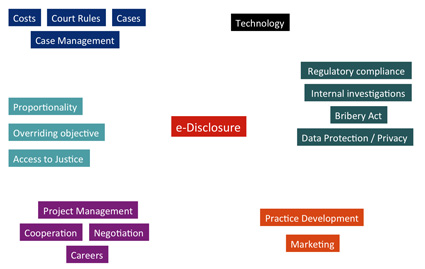
It is worth, occasionally, just running through what is happening, to show how many subjects get swept together under the umbrella of electronic disclosure. It touches on a lot of topics, as the extract below from my slide set shows. I do not disdain PowerPoint, as has become fashionable, and use my slides at educational sessions to allow me to canter over the ground more or less without taking breath – the audience can always ask me back for expansion on discrete subjects.

edisclosure-related subjects Continue reading

Posted in AccessData, Andrew Haslam, Bribery Act 2010, CPR, Discovery, eDisclosure, eDiscovery, Electronic disclosure, IQPC, LegalTech, LexisNexis, Litigation, Outsourcing, Symantec, ZyLAB | Leave a comment

Clearwell white paper: the Next Generation of Concept Searching

A recent article by US ediscovery expert Tom O’Connor discusses the ever-green subject of ediscovery certification. One of the points he made was to do with understanding basic concepts before we get too ambitious in describing (still less certifying) proficiency in wider aspects of ediscovery skills. He gave as examples questions like “what is a tiff” and “what is a native file?”

The next tier up from simple descriptive terms like this are the technical terms which the experts bandy about between themselves as if they were common currency. A good example of this can be found in the various types of search technology which have been developed to handle large volumes of documents.  I have a list of them on one of my slides and do my best, along with many other subjects which I cover in a rapid-fire one-hour talk, to give the audience the briefest summary possible of what “predictive coding”, “e-mail threading” and “clustering” mean.

All these technologies, and others, serve different purposes to the same end. They vary in sophistication (although, of course, an apparently simple function in user terms may have an extremely clever algorithm below it). On the face of it, “concept search” is easier to describe and to understand than some other technologies. After all, we have had Roget’s Thesaurus since 1805, so the idea of semantically-linked words is not new.

Clearwell has produced a white paper called The Next Generation of Concept Searching to back their Transparent Concept Search functionality. It describes in straightforward terms why simple keyword searching is an inadequate way of finding relevant documents, using the multiple meanings of the word “strike” as its prime example. Very large sums of money, and not a little risk, turn on doing the best job one can of finding documents required in litigation and analogous proceedings, and I commend this paper as a straightforward guide to what concept searching is and why it helps in 21st century document search.

Home

Posted in Clearwell, Litigation Support | Leave a comment

Welcome to CY4OR as a sponsor of the e-Disclosure Information Project

I am very pleased to welcome CY4OR as a sponsor of the e-Disclosure Information Project. I wrote about them a few days ago, but that was about their marketing, which I rated highly. What about their work?

CY4OR was founded in 2002 with specialist expertise in computer forensics and data collection for crime, fraud and civil disputes. There is more to this than just examining a computer to prove guilt – computers are only one of many devices which may be may require examination, and a forensic expert may equally be engaged to prove innocence, something which is easily overlooked. Mobile phones and other portable devices are an ever-growing source of information as these devices become more and more sophisticated and more widely used. Call history attracts attention as an obvious piece of evidence (all those suspicious spouses get the subject into the papers), but that is just the start – names in the address book, and the record of transfers via iTunes or WiFi connection history, are just some of the details which can be pulled from a mobile device. Each new platform and development brings new potential for evidence tracking.

The ability to copy data from a range of devices shades naturally into electronic disclosure for the purposes of civil litigation, for internal investigations and for regulatory purposes as well as for matters involving crime. That in turn leads into the next stages in electronic disclosure, such as processing data to remove duplicates and unwanted files (at the simplest level) before the data can be analysed for relevance. Continue reading

Posted in Litigation Support | Leave a comment

Welcome to First Advantage as a sponsor of the E-disclosure Information Project

I am very pleased to welcome First Advantage Litigation Consulting as a new sponsor of the e-Disclosure Information Project.  First Advantage was already a well-established forensics, litigation consulting and eDiscovery company when I met them at my first LegalTech in 2007; they set up in London shortly afterwards. I often come across Robert Brown, now VP of Eurasia Operations, at conferences, where he speaks lucidly about forensic data collection amongst other things; and I knew Drew Macaulay, Director of Business Development, before he joined First Advantage.

Back in 2007, the forensic and litigation function appeared on the First Advantage website as just one component amongst a broad range of business and information services. The wider group still does all that, but over the years the litigation arm acquired a strong identity of its own (as First Advantage Litigation Consulting) in the US, the UK, Europe, India and the Far East. First Advantage was acquired by Symphony Technology Group at the end of 2010. The result is a niche specialist company within a strong umbrella group.

After that first meeting at LegalTech, I met up with the then Executive Vice President for Litigation Consulting to talk about the company’s plans – it was exactly 4 years ago this week as it happens, and he was in London to recruit staff for the new office. The move to London, he said, was made largely because of the litigation and regulatory involvement in Europe of First Advantage US clients. Proximity was the initial driver for the move to London, as well as the need to manage EU privacy and data protection laws. The ambition was to make the London (and Brussels) offices into players with local business in their own markets within two years. I would guess (I don’t know) that the target was reached well within the two years and First Advantage Litigation Consulting has become an established player in the London e-disclosure market. Continue reading

Posted in Data privacy, Data Protection, Discovery, eDisclosure, eDiscovery, Electronic disclosure, First Advantage, Litigation Support | Leave a comment

Don’t bank on long deferral of UK Bribery Act nor hold strange and unjustified expectations of precision in its definitions

Relatively keen supporter though I am of our relatively new government, even with its Lib Dem make-weights hanging round its ankles, I do wish for rather more coherence in its decision-making, some evidence, perhaps, that today’s policy-making has a heritage older than yesterday’s breakfast. I was going to say that it feels like watching a yacht tacking into a stiff breeze, but actually it is worse than that – it is like being on board a yacht tacking into a stiff breeze. Earlier this week, for example, the banks woke up to find they were subject to a new levy. Last week, we were going to sell all our woodlands to spiv developers who would chain them up before hacking them down; this week, we see the distant flutter of a white flag on this subject and, by next week, the government will probably be planting new woods. At this rate, we might even start building new public libraries instead of closing them down as is presently planned.

Standing in the street in a cold New York dawn last week, I found a tweet from the always quick-off-the-mark thebriberyact.com“Bribery Act reportedly delayed again confirmed on the Today programme”. I tweeted back “So the most dishonest UK gov’t ever and most corrupt Parliament ever passed a UK Bribery Act and now this gov’t defers it”

A word or two or explanation might be helpful both as to the deferral and to the suggestion that the last government and parliament fell somewhat short of the accepted standards of probity. The latter actually needs little explanation. I have just started reading Peter Oborne’s book The Rise of Political Lying which begins by distinguishing between the personal dishonesty endemic in the last Conservative government and the dishonesty-by-party consciously adopted by Labour even as Tony Blair entered Downing Street, fresh-faced and expressly intent on cleaning up politics. The defining cartoon of his era showed him flogging ermine robes and coronets from a barrow; the emblematic quotation was his claim to be “a pretty straight kind of guy” which caused guffaws up and down the land, not least because he actually seemed to think we might believe him. If he is not thought of as the most dishonest man ever to have occupied Downing Street, that is only because he was succeeded by Gordon Brown. Together they presided over an era in which MPs and peers of all parties fiddled their expenses, lied as policy, sold influence and generally debased the currency of public life. There are only two in prison so far (one more than when I started writing this), but there will be more. Continue reading

Posted in Bribery Act 2010 | Leave a comment

An Englishman Abroad – a personal account of LegalTech 2011

There are plenty of helpful articles about LegalTech 2011, just closed in New York, and about what was on view there. This is a more personal account, aimed at encouraging more UK lawyers to go next year for a concentrated immersion in the subject of electronic disclosure / discovery – the problems, the solutions, the practice and the technology. You can also have a good time.

Chris DaleI was a bit taken aback when the young lady said “You Englishmen always look as if you have stepped out of bed looking like that”. She had just been admiring my suit notwithstanding (or perhaps because of) its style, which belongs 25 years ago when it was made for me. My very conventional black-and-white spotted tie had aroused similarly positive comments. Now she was saying that I looked as if I had slept in my clothes. What she meant, it transpired, was that Englishmen look as if a suit was natural attire, not just something formal put on for show. I am not sure either that that is generally true of the English or any less true of anyone else, but I know how to take a compliment gracefully.

You could not miss the UK contingent at LegalTech whatever they were wearing. It sounds odd now, but the reason I first went to LegalTech five years ago was the calculation that I could see more UK providers and litigation support people in less time and for less expense than by any number of trips to London. I mention this as part of my annual suggestion to UK lawyers that three or four days in New York in February would give them a better knowledge of electronic disclosure / discovery than they will get in a year at home. You still hear in London the rather silly objection that “electronic discovery is something Americans do and look what a mess they make of it”. I am no enthusiast for the American way of litigation, but neither are many Americans. We can borrow the best of their thinking, and their technology, but only if we understand it. There is more to FRCP e-discovery than sanctions and excess, just as an Englishman is more than a double-breasted suit and a spotted tie (there is the accent as well, as we will see below).

This does not purport to be a comprehensive survey of LegalTech and of the technology displays and sessions which comprise the formal part of the show. These summaries by Sean Doherty, Nick Patience and Katey Wood will suffice for that and The Posse List’s Electronic Discovery Reading Room has Applied Discovery’s index of post-LegalTech articles. Although most providers with a UK presence turn up somewhere below, I have no intention of reciting everything I saw nor name-checking everyone I met, and nothing is to be inferred from inclusion in or exclusion from my quick summary. I aim merely to indicate what you can get through in three days if, as a corporate counsel or external lawyer, you come to LegalTech. Continue reading

Posted in Litigation Support | Leave a comment

Welcome to Digital Reef as a sponsor of the e-Disclosure Information Project

I am very pleased to welcome Digital Reef as the newest sponsor of the e-Disclosure Information Project. This news comes in as I am packing to leave for LegalTech and you, and they, will forgive me for giving the briefest of notices to draw attention to their arrival on these pages.

Their own description of themselves will serve as a good summary introduction. It reads:

Corporate, legal, and IT organizations use Digital Reef for the fastest way to reduce the time, cost and risk associated with locating, organizing and governing information for eDiscovery, compliance, records management or proactive file management/ migration.

I will be meeting up with them (again) – this relationship has not sprung up from nowhere – at LegalTech in a day or two, and will be able to write a more thoughtful piece then.

Home

Posted in Discovery, eDisclosure, eDiscovery, Electronic disclosure | Leave a comment

Guidance Software adds forensics and ediscovery for iPad and iPhone

Guidance Software, best known in the e-disclosure / e-discovery world for enterprise network collections with EnCase eDiscovery, has announced a new forensic tool for the Apple iPad, iPhone 4 and iPod Touch. Encase Neutrino also handles Android 2.1 and 2.2.

An iPad may seem small fry compared with the enterprise servers which hold the bulk of a company’s data. The iPad is, however, increasingly the first tool of choice for many executives – it is said that one in five Americans plans to buy one over the next six months, on top of the many who have one already. The volumes on any one iPad are relatively small, but it tends to be immediate in the sense that this is where the employee was working yesterday. It is also right to point out, as Guidance Software’s Frank Coggrave does in this article, that each iPad potentially contains 64 GB of very mobile storage.

It is also interesting to see that IT security departments, who are not unreasonably resistant to the ad hoc addition of external devices to their precious networks, are having to bow to the inevitable in the face of such widespread usage, another point made by Frank Coggrave. When IT departments have spent years trying to encourage user adoption of new technology, they have found it hard to stand in the way of such spontaneous user demands.

Apple products have a way of raising challenges. Giving a talk to lawyers recently, I explained that my iMac desktop had a virtual Windows PC inside it. The word “virtual” obviously passed some of them by, and one could see a mental picture forming of a traditional Windows PC case somehow shoehorned into the slim iMac. What I meant, as I went on to explain, was that you can run Windows within a suitably specified Mac, with its own applications and, potentially, a great deal of data, all invisible to those who were not familiar with the concept of a virtual PC. Forensic data collection is not a game for the amateur.

I am not quite ready to abandon my conventional laptop in favour of the iPad, and I will take both to LegalTech next week. I strongly suspect that, by the end of the year, I will be leaving the laptop behind on such trips, and if anyone needs to collect my data, they will have to do it off my iPad, as well as finding the virtual PC lurking in my iMac.

Home

Posted in Discovery, eDisclosure, eDiscovery, Electronic disclosure, Forensic data collections, Guidance Software | Leave a comment

What the Trilantic-Huron combination means for clients

Well-known UK litigation support provider Trilantic was acquired by Huron Consulting Group last November. I went to see Trilantic’s Nigel Murray to find out how the clients will benefit from the combined fire-power of the two companies.

Although Trilantic seems to have been part of the UK electronic disclosure scene for ever, it was in fact set up only in 2005. The founder and managing director Nigel Murray, however, has been in the industry since it began – he and I started at about the same time. Electronic discovery has changed somewhat. Then it involved scanning paper and coding documents by hand; it generally required a capital purchasing decision and the employment of staff to run in-house systems; it had yet to be renamed “disclosure” in the hope that relabelling would somehow make it better. Of all the changes, the only one which most lawyers readily grasped was the change of name – lawyers are always good at terminology.

They can be forgiven for being confused about the provider market, which first diversified, then consolidated: some providers specialised in the collection of data; others had specialist applications for processing the data or for reviewing it, whilst others offered consultancy and project management. Companies broadened out from their original starting points by expansion or acquisition: collection companies now offer processing and review applications and host the data on a transactional basis; specialist software companies enhance their products with consultancy services; some companies offer “end to end” products and services whilst others remain best known for particular niches. Downward pressure on costs makes price a less useful discriminating factor than it used to be, whilst any one software application looks much like any other to the novice. It is hard enough to keep up for those of us who have watched this market evolve and develop. It is extremely difficult for those who approach it from scratch.

Trilantic has always been a front door to a range of software and services, with its own staff, infrastructure and services, but calling on a wide range of others’ specialist skills or applications appropriate to the clients’ needs. Its web site inevitably draws attention to its ability to handle major work for big clients, but that ability scales down to allow it to do smaller jobs, whether as a continuing provider of choice for repeat business or for one-off jobs. Nigel Murray may spend a lot of time at international airports, but much of Trilantic’s business remains domestic and the company has always felt accessible to those facing their first e-disclosure case. Continue reading

Posted in Discovery, eDisclosure, eDiscovery, Electronic disclosure, Litigation Support, Trilantic | Leave a comment

New web sites and a case study make good marketing

Although the nuts and bolts of what I do involves e-discovery / e-disclosure rules and the crossover between rules and practice on the one hand and technology on the other, my real interest lies in marketing, with a self imposed brief to market the concepts and benefits of ediscovery / e-disclosure as well as those who provide services. My biggest article in the last few days (see Twitter, bribery and 37 corporate counsel in a virtual bar ) has been about that rather than about either rules or technology.

I have always had a soft spot for the blog maintained by forensics experts CY4OR because they provide automatic links to my own blog posts. They never sought my permission to do this, nor did I ask them to, but I certainly don’t complain at this unsolicited outlet for what I write.

I have had no cause to look there recently, but a couple of recent tweets have taken me to CY4OR sites – it would be interesting, would it not, to get them to track how many of the visits to their sites came from those tweets?

The first tweet took me to CY4OR’s new e-disclosure site which shows how far CY4OR has moved from its roots as a pure forensic expert. It has partnerships with Clearwell and Nuix to add a processing capability to the stage which follows the collection. I am obviously interested in the mere fact of those partnerships, since both Nuix and Clearwell are sponsors of the e-Disclosure Information Project.

My other interest, however, lies in how well a web site guides a potential client through the range of services on offer – the alliances of skills and partnerships make perfect sense to those familiar with what these products do and how they fit into the process, but it is not so easy for those coming new to e-disclosure. I judge a web site by the ease with which an e-disclosure virgin could find out what services are on offer and how a provider can help. Continue reading

Posted in CY4OR, eDisclosure, eDiscovery, Electronic disclosure, Forensic data collections, LegalTech, Litigation Support, SEO | Leave a comment

Cross-Border and Multi-National eDiscovery at LegalTech from FTI and Epiq

I have written already about those sessions at LegalTech 2011 in New York which have a UK element in them (see Strong UK presence at LegalTech 2011). As I said in that article, it is impossible to list, let alone expand on, every session which is likely to be interesting or which involves someone I know.

As always, I marked down the sessions I wanted to attend but have gradually had to concede them as the time needed for meetings, and for the two sessions which I am moderating (Monday at 14.00 and Wednesday at 12.15 since you ask), began to exceed the total time available. I have managed to cling on to the Tuesday morning sessions.

Last year at LegalTech I was involved in two panels on multinational and cross-border disputes, a subject of inexhaustible importance to US lawyers. With a bit of rushing about, I should be able to attend at least parts of the three overlapping sessions which cover cross-border matters this year on LegalTech Day 2.

I have already mentioned the two sessions run by Epiq Systems, Navigating the Challenges of Cross-Border Regulatory Investigations at 9.00am on Tuesday, and Managing a Global Review while Minimising Risk at 10:45am. Between them, they include three UK people with whom I speak regularly at conferences, Vince Neicho of Allen & Overy, Professor Dominic Regan and Senior Master Steven Whitaker as well as other people worth hearing.

Overlapping them, however, is a session run by FTI called Multinational Discovery: Privacy and Process. Joe Looby, Senior Managing Director at FTI, is the US lead on FTI Investigate , which pulls together the human and technology elements needed for rapid investigations across national boundaries. The thorny problem there, apart from the logistical one, is often the conflict between the need to extract as much information as quickly as possible and the restrictions of local data privacy laws. I interviewed Craig Earnshaw, FTI Managing Director – Technology in London, about this recently and am looking forward to this session to round out a paper which want to write on the broad issues as well as on FTI’s specific service.

The FTI Investigate web page has some case studies which I commend to anyone who is interested in this area. I have mentioned before the  RAND Europe Two-Part Report: E-Discovery and Legal Frameworks Governing Privacy and Data Protection in European Countries which came out in October and which gives a good overview of the issues arising in the EU. That can be found here on FTI’s website.

The other main draw for this session is Amor Esteban of Shook Hardy Bacon LLP. I did a panel with him at the Georgetown Advanced Ediscovery Institute (see  International discovery, sanctions, ethics and US-UK comparisons at Georgetown and will be glad to hear him again.

Home

Posted in Data privacy, Data Protection, Discovery, eDisclosure, eDiscovery, Electronic disclosure, Epiq Systems, FTI Technology | Leave a comment

Epiq Systems and Huron Consulting as Angels for US-UK e-disclosure play at LegalTech 2011

An “angel” in theatrical terms is someone who puts money into a play or film. Many productions would not happen without such support. I have already mentioned the judicial play which we are putting on at LegalTech and which consists of light-hearted scenes based largely on recent UK e-disclosure cases. Epiq Systems and Huron Consulting Group have kindly given the support which makes this possible.

The play – really a series of loosely-linked scenes – is an adapted version of something we did at IQPC in London last May and which, despite the levity, has the serious purpose of creating a better understanding on each side of the Atlantic of what happens in the other jurisdiction.

We have an all star cast. US Magistrate Judge Elizabeth LaPorte and US Magistrate Judge Andrew Peck play a composite judge called Fluffy. Fluffy may sound a soft touch, but those who know the first Harry Potter story will know that Fluffy is extremely fierce and guards a mystery which no one else understands.

There is, in fact, a subliminal point about Anglo-US terminology here: that book was called the Philosopher’s Stone when published in England but was re-named the Sorcerer’s Stone in the US version, apparently because the US publisher thought that children would be put off by the word “Philosopher”. US distributors have a habit of under-estimating their public (is it really true that the film of Alan Bennett’s play The Madness of George III had to be called The Madness of King George because of the fear that American audiences would think that they had missed the first two films in the franchise?). Much the same patronising logic underlay the 1999 UK rule change which abandoned the word “discovery” in favour of “disclosure”. The point is not that this jettisoned several hundred years of tradition, but that the word “discovery” embraced both the “uncovering” of your documents to opponents, and the prior, and very much bigger, exercise of finding out what you have. The proper term therefore became more, not less, appropriate as search became the dominant requirement. Those of us with feet on both sides of the Atlantic must refer continually to both terms. Continue reading

Posted in Clearwell, Court Rules, CPR, Discovery, eDisclosure, eDiscovery, Electronic disclosure, Litigation Support, Nuix | Leave a comment

Government says Bribery Act on course for April commencement

There has been talk of a late review of the Bribery Act, due to come into force in April. Much of this has been floated by those who consider that Britain’s competitiveness in international markets will be hampered if British companies are not allowed to bribe and be bribed with the best of them (I paraphrase, a little). The arguments are summarised, and demolished, by an article on thebriberyact with the uncompromising heading The Bribery Act and the review by No. 10: Will pigs fly? We don’t think so.

That prediction appears to be reinforced by an answer given in the House of Lords yesterday – I say “appears” because the Government’s answer does not in fact match the question (asked if commencement will be in April, the minister talks of “commencement of the Act in spring this year” and spring perhaps extends into May. I suspect that years of working for the Blair-Brown government has made the civil servants unaccustomed to giving straight answers to questions.

I was not aware of an outfit called Transparency International, but its head is today reported in TrustLaw as “hopeful that implementation of the Bribery Act 2010 is still on track” whilst warning that Transparency International “will take seriously any attempts to water down the legislation”. I doubt that this on its own will make the government quake in its boots, but it is hard to reconcile the unqualified certainty of the government spokesman quoted by thebribaryact with the faint odour of dragged feet which appears in the TrustLaw article. We shall see.

Meanwhile, some commentators appear to need reminding that bribery is a crime anyway.

Home

Posted in Bribery Act 2010 | Leave a comment

Exposing your thinking parts to the outsourcing discussion

That old image of the ostrich burying its head in the sand is apparently unfair. The purpose is apparently to use the ground as a sounding board, vibrations giving advance warning of problems to come. This prosaic reality undermines that quotation from the great libel silk George Carman,who said of one claimant that he “behaved like an ostrich and put his head in the sand, thereby exposing his thinking parts”.

I used to have reservations myself about mentioning outsourcing, but that was because every reference to it brought down on my head a stream of offers from people wanting to tell me at nauseating length about the services which they could offer without, apparently, making any attempt to establish whether I was likely to be a buyer. I stemmed the flow eventually by abandoning my usual courtesy and telling them exactly what I thought of their marketing.

It does not matter whether you prefer the traditional picture of the ostrich’s motives or take the revisionist view that it is just getting early warning of what is coming. Lawyers, whether in private practice or in companies, need to expose their thinking parts to different ways of covering the ground. Most information management involves a mixture of technology, grunt work and high intellectual input, and the trick is to work out how much of which you need to apply to what. You cannot begin this without some idea of what is on offer from both technology suppliers and from those who offer to do the parts which you cannot do cost-effectively yourself – or, to put it more accurately, which someone else can do at least as well at a lower cost.

I was recently invited to take part in the Global LPO (Legal Process Outsourcing) Conference, organised by KPO Consultants and taking place in London on 2 and 3 March.  It had a good spread of speakers already engaged, including general counsel from big employers and people from law firms, the Law Society and the Legal Services Board, together with David Kemp from technology provider Autonomy . Continue reading

Posted in eDisclosure, eDiscovery, Electronic disclosure, Outsourcing | Leave a comment

Recommind expands in UK and EU with hires and hosting

A couple of years ago, Charles Christian of the Orange Rag observed that whilst other providers made a lot of noise about what they were going to do in the UK market, Recommind quietly got on with making sales. The company has been less quiet about it lately, particularly in law firm enterprise search, as can be seen if you just run your eye down the list of press releases, with Mills & Reeve, Mischcon de Reya, Macfarlanes and Clifford Chance all named in the first page.

These in-house information systems, all rebranded during 2010 with the Decisiv label (Search, E-mail Management and Categorisation) have been joined over the same period by ediscovery / e-disclosure products with the name Axcelerate (one covering ECA and Collection and one for Review and Analysis). The same softly-softly approach to marketing has been evident with these products. My evidence as to Recommind’s penetration with these products is anecdotal, consisting largely of hearing the name mentioned by lawyers and others to whom I speak. It turns up enough for me to know that the products are getting serious attention.

I now know Recommind rather better than I did when Charles Christian made that comment, but it remains a mystery to me how so small a European team achieves this, particularly as there is business being done in Germany as well (see a video made by Project Counsel at IQPC in Munich, in which European Director Simon Price and European Sales Director Hartwig Laute are interviewed).

Two new developments signal the end of this low-key approach. One is the appointment of additional staff in London, including a Regional Sales Manager, a Regional Manager for E-discovery and sales engineering staff. The press release is headed Recommind doubles London presence and expands European operations by 30%, which says it all. Continue reading

Posted in Discovery, eDisclosure, eDiscovery, Electronic disclosure, Recommind | Leave a comment

LDM Global webinar on 27 January – Sampling for Dummies: Applying measuring techniques in ediscovery

We all have a notion of what “sampling” means. My dictionary defines it as a “small separated part of something illustrating the qualities of the mass”. In electronic disclosure / e-discovery terms it can be useful at an early stage in determining what your document collection includes, to help make decisions as to what to include or where to start. At a later stage, it is used for checking what has been done, by pulling out examples of documents left in or out of a subset to check that the decisions stand scrutiny.

The new UK Practice Direction 31B includes “the use of Data Sampling” as one of the things which might be discussed with opponents before disclosure begins. The ability to take samples afterwards is part of the QA which lawyers like to do to reassure themselves, never mind anyone else, that they have done their job properly.

There is more to it than just sticking your hand into a bag and pulling out a few documents. Equally, it does not necessarily have to be a deeply mathematical exercise requiring the help of a statistician. Much modern software has tools designed to help manage a sampling exercise which will stand scrutiny.

LDM Global are producing a webinar on Thursday 27 January with the title Sampling for Dummies: Applying measuring techniques in ediscovery with Maura Grossman of Wachtell, Lipton, Rosen & Katz and Professor Gordon Cormack of the University of Waterloo’s David R. Cheriton School of Computer Science. I did a webinar with Maura just before Christmas – she gives good value, which translates across jurisdictions.

The details are as follows:

Date: Thursday 27th January
Time: 11am EST, 4pm GMT
Duration: Approximately one hour

You can find all the details and the registration link for the webinar on LDM Global’s website.

Home

Posted in Discovery, eDisclosure, eDiscovery, Electronic disclosure, LDM Global, Litigation Support, Part 31 CPR | Leave a comment

The ups and downs of US ediscovery sanctions

The sanctions handed down by US courts for ediscovery failures bewilder the rest of us somewhat. To my eye, if one wanted to design a system which was absolutely certain to encourage satellite litigation, tactical play and (as a defensive reaction) excessive discovery as a back-covering exercise, you would come up with something like the present sanctions regime. I wrote about this in my article International discovery, sanctions, ethics and US-UK comparisons at Georgetown in the context of Judge Shira Scheindlin’s Pension Committee Opinion, saying:

Providers of software and services use the threat of sanctions to encourage that pen across the bottom of the order form; if none of them has yet produced an advertising picture with an axe breaking through the door to the cry of “Here’s Shira”, it can only be a matter of time. The English just gape at them; you mean you get fined massive sums of money because you didn’t send everyone in the company a legal hold letter? Because you overlooked a box of old tapes?
……
Americans have rather more respect for senior office holders – judges, public servants and politicians — than we do, or respect at least for their offices, and it has been mildly amusing to an outsider to watch the legal establishment in its various forms implying, without actually saying so, that Judge Scheindlin might, you know, perhaps, have gone a little over the top in Pension Committee. An outsider can be less restrained and say that, whatever view you take of the decision, Pension Committee has elevated the fear of sanctions to the point where they have driven out proportionality.

They seem to like it. The problem which it gives us in the UK is that the inevitable obligations to disclose electronic documents become confused with the apparent message from the US that it is both dangerous and expensive to do so, which is why I spend a lot of my time drawing distinctions between the two systems. The UK is no more tolerant than the US of truly culpable omissions and failures but we have, so far at least, managed to avoid giving litigants the impression that every false move risks enormous financial penalties. Continue reading

Posted in Catalyst, Court Rules, Discovery, eDisclosure, eDiscovery, Electronic disclosure, FRCP, Litigation Support | Leave a comment

Twitter, bribery and 37 corporate counsel in a big virtual bar

All your highly-polished marketing materials are useless if you do not get them in front of your intended audience and engage with them about it. An article intended merely to point you to a source of messages about the Bribery Act became side tracked – in a good way – into a discussion about the media used to promote it. Dust off that Twitter account which your marketing people opened one Friday afternoon and have been too nervous to use.

You have a specialist subject which is of interest and importance to a wide range of people and which ought to be known to and understood by many more. It is a multi-faceted subject which can be approached from many different directions and is of interest internationally. People, both those already knowledgeable about the subject and those coming new to it, seem to appreciate what you write. You are competent in modern means of disseminating information and views, have plenty of energy and do not mind working seven days a week.

No, this is not about me but about Barry Vitou of Pinsent Masons London who, with Richard Kovalesky QC, uses thebriberyact.com, to bring news and views on the UK Bribery Act which comes into force shortly. Actually, is it not really about Barry, who in this context merely serves as a hook for some thoughts on using modern media forms to promote ideas and demonstrate expertise. His approach is the same as mine, but I have been looking for an example which will not be confused with my promotion of me – I don’t mind doing that, of course, but it muddies the example if it has that parallel motive.

I have referred to thebriberyact.com already (see Some resources on the UK Bribery Act 2010). The crossover between e-disclosure / e-discovery and the Bribery Act is obvious (the clue, if you need one, lies in the Bribery Act defence of “adequate procedures”), and Barry and I are jointly presenting a breakfast session with Iron Mountain on 8 March.

I come back to the subject now, partly because you might otherwise miss the stream of useful articles appearing on thebriberyact.com or linked from its Twitter account, and partly because I met Barry last week at the suggestion of Malcolm Durant of Iron Mountain. We met at Barry’s club, the flavour of which can be gathered from the minimalist rules which seem to come down to “be polite”; the dress code reads “nudity is discouraged” and it positively welcomes both laptops and dogs, all of which make it my kind of place (I once belonged – briefly – to a London club which was so impolite as to send my wife back upstairs – the backstairs, not the one reserved for gentlemen which she had descended – to put on her ball dress for breakfast because women in trousers were banned, as was any evidence of business; I am sure that dogs were no more welcome than women, though you would probably have been allowed in on a horse). Continue reading

Posted in Bribery Act 2010, eDisclosure, eDiscovery, IQPC, Litigation Support, Marketing, Recommind, Twitter | Leave a comment

Lord Justice Jackson fights for his costs reforms

An article published yesterday in the Solicitors Journal is headed Jackson LJ demands his reforms are implemented in full. It draws attention to a letter from Lord Justice Jackson, the author of last year’s Litigation Costs Review, to Justice Secretary Ken Clarke calling on him to ensure that the costs reforms are put through in full.

The letter itself is published on the judicial website. You get the flavour of Sir Rupert Jackson’s approach from this paragraph:

….. the complexity of civil procedure is now a real problem and generates substantial costs. The new rules must be simple and clear. Any attempt to legislate for every situation is a chimaera, resulting in complexity and escalating costs.

Those who read my article of last week headed Judges defend our long-term liberties from short-term politicians will spot more than one connection here. One concerns the willingness of judges to take on politicians publicly where the interests of justice require it – there are in fact two points in one here, since the publication of Sir Rupert’s letter is a step distinct from the confrontation implicit in the letter itself; the other is the reference to “any attempt to legislate for every situation” which parallels one of Lord Judge’s complaints, reported on in my article and illustrated by his media-friendly reference to the possible variants of a particularly esoteric crime.

It is not clear, in fact, that Jackson and Clarke take different views – Clarke has been supportive, publicly at least. There are certainly powerful interests with good reason to fear the implementation of the proposed costs reforms, and civil servants are skilled in that delicate balancing act which always finds reasons for blocking change whilst creating enough work to keep them in employment.

It is good to see Lord Justice Jackson fighting his corner where a lesser man might have subsided gratefully back into his place in the Court of Appeal.

Home

Posted in Civil justice, Court Rules, CPR, HM Courts Service, Judges, Litigation, Litigation costs, Lord Justice Jackson, Ministry of Justice | Leave a comment

Welcome to LDM Global as a sponsor of the e-Disclosure Information Project

I am really pleased to welcome LDM Global, a company which I have known almost since its foundation 15 years ago, as the latest sponsor of the e-Disclosure Information Project. In the days when my work involved handling rows and columns of data, some of the long days and nights involved exchanging data files with ever-helpful LDM people when we were working on the same projects.

I then thought of LDM as a London company, because that is where I worked with them. When I started travelling to the US, I kept bumping into Chris O’Reilly by elevator doorways (for some reason) in hotels and at conferences; when I was last in Sydney, I come across Greg O’Reilly in a coffee bar. None of this is really surprising of a company with the word “Global” in its name – Chris O’Reilly has always run the US operations, and Greg O’Reilly has returned to his native city to establish the Australian end to the business there. That followed a period of high-level recruitment, including the appointment of Scott Merrick as International Marketing Director and Steve Couling as Head of Global Sales.

That, it now appears, was merely consolidation for further expansion. It was interesting enough to see any company in this industry making big global appointments during a recession in which others retrenched or fell away, but the company also expanded in the US, with new offices in Washington DC and a production facility in Virginia. That much was, as it were, public, with announcements and press releases and all the usual fanfare which accompanies overt physical expansion. What really matters, of course, is what goes on behind the scenes, and LDM Global has recently hired new technology and professional staff to support increased business from the UK, Europe and Asia Pacific operations.

In the e-Discovery / e-Disclosure world, the ability to undertake work in different regions is more than mere efficiency – the nature of international discovery work, and in particular that which involves data covered by EU privacy and data protection laws, means that the ability to handle production on both sides of the Atlantic opens the door to work which one could not otherwise do. LDM’s work includes data recovery, computer forensics, large-scale electronic and paper-based discovery services and international projects for law firms, corporations and government institutions. The company operates from seven major locations – London, Brussels, Paris, Manchester, Sydney, Virginia and Washington DC, partnering with the world’s leading electronic discovery software vendors.

LDM Global executives from all the company locations will be at LegalTech in New York at the end of January, with a wine tasting event for clients on Tuesday evening as well as meetings with clients and prospects. Those from London who are unable to be at LegalTech may be interested in LDM’s post-show event in London which will report on the main points arising from the show.

A press announcement was made when I first set up business entirely on my own in October 2006. Early in the morning of the following day, the first message which came in was from Greg O’Reilly and read “Well done on venturing out on your own. If there is anything I can do to help just give me a call”. I was extremely touched by that, and by the occasional message which followed, apparently at random, to similar effect. Both our respective businesses have come a long way since then, and it is a particular pleasure to be working now with LDM Global.

Home

Posted in Discovery, eDisclosure, eDiscovery, Electronic disclosure, LDM Global, Litigation Support | Leave a comment

The Trilantic Commonwealth Brunch on Sunday at LegalTech

The invitations to parties, receptions and meetings at LegalTech New York continue to roll in – my personal best so far is four assignations on one evening. The biggest issue, so far as I am concerned, is not fitting them all in, but getting them recorded accurately in a calendar which does not recognise the concept of time zones. My recent move to Apple’s products reveals an unexpected limitation – Microsoft Outlook 2011 for Mac lacks the useful function in Outlook for Windows which allows you to set up parallel time zones.

Four options emerged during a recent discussion on Twitter: a) look up the local time on www.timeanddate.com and use that, hoping that you transfer it accurately and that everything falls into place when you adjust your devices’ time zones; b) enter events twice and include the local time as part of the description to give you a clue if neither makes sense when you get there; c) buy a watch and leave all your devices (I have four) at UK time, entering appointments as if the time difference did not exist; d) buy a stout diary and a pencil (the suggestion made by Charles Christian, editor of the Orange Rag and American Legal Technology Insider, and a long-time Mac user). There is a fifth option, I suppose – I could revert to the PC, but I invested far too much of Christmas in the changeover to contemplate that. The final option involves a trip to California and an act of violence upon the insular geek who failed to deal with time zones in his pretty but defective software.

One event which I will not forget, not least because it happens at the same time every year, is Trilantic’s Commonwealth Brunch at 10.30am on Sunday. This used to be a sedate affair called the British Brunch. Last year, for the first time, it became the Commonwealth Brunch, reflecting the widening scope of Trilantic’s work and the increasing connections between the non-US common law jurisdictions. Last year’s Brunch was attended by people from Australia, India and Canada amongst other places, as well as by one or two US people with tenuous claims to Commonwealth ancestry. I have the impression that we will see many more Australian and Canadian people this year – both places are seeing interesting developments in ediscovery.

Trilantic is, of course, now part of Huron Consulting Group, and we can expect a yet wider catchment area as a result. Nigel Murray is always a genial host, and this is a good way to launch the week.

Laura Kelly is co-ordinating the event. Contact her if you think you are qualified to attend.

Home

Posted in Discovery, eDisclosure, eDiscovery, Electronic disclosure, LegalTech, Litigation Support, Trilantic | Leave a comment

Welcome to ZyLAB as a sponsor of the e-Disclosure Information Project

You will have noticed the addition of another new logo to the collection of those who sponsor the e-Disclosure Information Project. ZyLAB joined up before Christmas, and I deferred writing my usual welcome piece because of a plan to go down and see them at their Bagshot offices. The snow put paid to that idea, and I did not get down there until last week.

My original connection with ZyLAB goes back to the dawn of modern search technology. The company brought out a text searching application for the then new PC in 1983, and I acquired a copy not long afterwards. Search in those days involved learning how to construct Boolean queries by hand – my first inkling that search technology and document discovery were made for each other. Not many of the players in today’s market go back that far.

ZyLAB was early in another respect as well – it has long had headquarters in Europe (in Amsterdam) as well as in the US. When US document demands for civil litigation, for regulation and for state-led investigations began to impinge on European corporations, ZyLAB was already there. They have always had UK clients, and they are now building on this to meet the growth expected to follow from the heightened UK focus on electronic disclosure in civil litigation, from the increase in financial regulation, and from the UK Bribery Act.

The product set includes systems for e-discovery and production, for compliance and litigation readiness, and for law enforcement and investigation. They cover the full EDRM (Electronic Documents Reference Model) from information management within a company all the way through to production of documents to opponents, with advanced search, text mining and analytics, data visualisation and machine translation built into their systems. The applications are available both for in-house use or as SaaS (Software as a Service). It is sold to both corporations and law firms, as well as to government and law enforcement agencies.

I spent most of a day with Ronald van Vuure, ZyLAB’s UK sales and marketing director, and his team. The aim of these visits is to exchange information – I give much the same talk as I give to lawyers about changing developments in the UK market, and I start to find out about the company’s products and services. It is a useful exercise on both sides.

There will be more about ZyLAB in these pages in due course. Meanwhile, it is good to be joined by such a long-standing player in the litigation search market.

Home

Posted in Bribery Act 2010, Discovery, eDisclosure, eDiscovery, Electronic disclosure, ZyLAB | Leave a comment

A reminder about some ediscovery sources plus a mini-conference on video

My plan to update the reference section on my website over Christmas was thwarted by the time it took to move from Windows to Office 2011 on the Mac – one of those jobs for which you allocate an hour or two and are still struggling with a week later. That, perhaps, is a story for another day, perhaps under the “awful warnings” section.

While that remains on the “Pending” list, the turn of the year is an opportunity to point to one or two resources which I use to keep me up to date. These are just the ones which come to mind today so please (please!) don’t write in to say I have missed yours.

Twitter has become the top source, mainly because it happens as it happens. There is a big network of thoughtful people out there, and it does not take long to build a list of those worth following – UK readers might perhaps start with the list of people followed by me @chrisdaleoxford, Jonathan Maas @MaasJonathan and Charles Christian @ChristianUncut and pick the ones who tweet abut things which interest you. That deliberately UK-based starting-point will take you a pre-filtered selection of US, Australian and other sources whose tweets have some bearing on UK thinking. You can always UnFollow if we or they do not live up to expectations.

Like some other forms of activity (so I am told), participation is not obligatory – you can get value from just watching. Having caught the flavour of the conversations, however, you might like to join in – we could do some more users (real-life users, I mean, not just experts who happen also to be lawyers in practice). Continue reading

Posted in Bribery Act 2010, Discovery, eDisclosure, eDiscovery, Electronic disclosure, Ernst & Young, Guidance Software, IQPC, Litigation Support, Recommind | Leave a comment

Webinar on 13 January – interview with the General Counsel of the SFO about the Bribery Act

A reminder that Vivian Robinson QC, General Counsel of the Serious Fraud Office, is taking part in a webinar on the implications of the UK Bribery Act 2010 on 13 January.

The other participants are Barry Vitou, partner in Winston & Strawn’s London office, Richard Kovalevsky QC of 2 Bedford Row and David Childers, CEO of EthicsPoint.

I have already put up a page of resources about the Bribery Act. If you want a single update source in the run-up to the Act’s implementation in April, thebriberyact.com is the place to go, with a good flow of useful tweets at  @thebriberyact.

Iron Mountain have invited me to take part in a breakfast session about the Bribery Act with Barry Vitou in February – details to follow. The main focus for corporations is the defence that the company had “adequate procedures” in place to prevent bribery. There is an obvious crossover here with the requirement in civil litigation that companies should at least know what sources of documents and data they have and should have a plan or process for digging it out urgently (and cost-effectively) when it is needed.

So far as I can see, the act has attracted much more legal interest abroad (in the US, in Asia and in the EU in particular) than amongst UK lawyers.  I raised it last week with the organisers of InnoXcell’s forthcoming Hong Kong ediscovery conference (21 to 23 June) as something they really must have in their programme. It is already included, they said, at the request of other proposed participants.

The big London firms, generally speaking, have been organising their in-house training for some time but I do not have much sense that anyone else has done so. This is not just a matter of being able to disguise your ignorance when the client rings you up about it. There is missionary-like work to be done making sure the clients know about the implications of the act  – it can take a while to plan and implement the requisite level of “adequate procedures”, starting with an assessment of what “adequate” means client by client. What is adequate for one will be pitifully lax for another and well over the top for a third.

Vivian Robinson is eloquent and better informed than anyone as to what the implications are for companies and their lawyers. Listening to this free webinar will give you a good start in understanding what it is about.

Home

Posted in Bribery Act 2010, eDisclosure, eDiscovery, Electronic disclosure, Litigation Support | Leave a comment

Planting eDiscovery ideas inch by inch and 
step by step

Every article could cover one more topic, bring in another side-reference, or round out the discussion with another example, parallel or exception.  Sometimes it is best to stick to one core subject.

The continent of Europe is so wide,
 Mein Herr.
Not only up and down, but side to side,
 Mein Herr.
I couldn’t ever cross it if I tried, 
Mein Herr.
So I do..
.
What I can…
Inch by inch..
.
Step by step…
Mile by mile…
Man by man.

I am not sure that Cabaret’s Sally Bowles would make a great role model, but her meticulous approach to getting her arms round something, as described in the song Mein Herr, is spot-on. Take one subject, get everything you can out of it, and move on to the next. it is much easier if you stick to one at a time. With experience, you can perhaps take on more than…. well perhaps I have exhausted the analogy already. I only really wanted the “inch by inch, step by step” bit for my immediate purpose.

My December 23 post Judges and automated coding tools for electronic discovery drew an immediate comment from Joe Howie of Howie Consulting and the e-Discovery Institute. Joe is co-author, with Anne Kershaw of A. Kershaw, P.C. Attorneys & Consultants, of the recent Judges’ Guide to Cost-Effective E-Discovery which, in 25 brisk pages, gives judges an introduction to a subject which many of them find difficult – see its contents page for an idea of what is covered. Deciding what the strict obligations are in relation to electronic discovery generally is hard enough; it is those words “cost-effective” which make it particularly difficult. Any fool of a lawyer can give discovery of everything which might possibly be relevant, and any fool of a judge might let them have it. Similarly, it is easy enough to challenge the other side’s discovery, leaving the judge to decide whether the demands represent an unwarranted tactical pressure or a legitimate demand for evidence – or, indeed, ignorance on the part of both parties. Assessment as to what is easy, what is difficult and what is reasonably practicable at a reasonable cost is required of the judge, and this book aims to help judges in this respect. I was at its launch party in Georgetown in November and the critical reception (in that most critical of audiences) was uniformly positive. Continue reading

Posted in Discovery, eDisclosure, eDiscovery, Electronic disclosure, Judges, Litigation Support | Leave a comment

Strong UK presence at LegalTech 2011

LegalTech 2011 is only a few days away and the programme is packed. Almost everyone whose name has appeared in these pages is taking part in something, and I will not attempt to list them all. Following on, however, from my recent piece about the Georgetown Advanced e-Discovery Institute (see International discovery, sanctions, ethics and US-UK comparisons at Georgetown) and the growing mutual interest in US e-Discovery and UK e-Disclosure, I thought it worth drawing your attention to the sessions involving UK participants. If I have missed any, please let me know.

Epiq Systems have two panels involving well-known UK participants. Greg Wildisen of Epiq moderates a panel called Navigating the Challenges of Cross-Border Regulatory Investigations with panelists including Professor Dominic Regan and David Cracknell of Slaughter and May’s London office. That is followed by a panel called Managing a Global Review while Minimising Risk moderated by Laura Kibbe of Epiq. The panelists include Senior Master Whitaker and Neil Mirchandani of Hogan Lovells in London. Non-UK participants known to readers of this blog include US Magistrate Judge Andrew Peck (who has teamed up with Master Whitaker in various jurisdictions, including Brussels and Hong Kong), and David Kessler who has recently moved to become Co-Head of E-Discovery at Fulbright & Jaworski – an entertaining and informative fellow, David, as I discovered to my relief when he was on a LegalTech panel which I moderated for Epiq last year (I say “relief” because it can be an interesting business, moderating panels of people you have never met before). Anyone interested in global and cross-border matters should attend these sessions.

Andrew Szczech of Kroll OnTrack UK takes part in a panel called Trends in Social Media and Cloud Computing. Jan Durant, IT Director of Lewis Silkin is on a panel called Business Processes Utilising SharePoint. Alex Dunstan-Lee of KPMG in London is doing a session called The Clearwell E-Discovery Platform: did you know? UK solicitor Mark Ross, VP legal solutions at Integreon, is covering Legal Process Outsourcing: Ethical, Practical and Legislative Considerations.

Apart from the UK, the non-US world is represented by Michelle Mahoney, Director of Applied Legal Technology at Mallesons Stephen Jaques in Australia, talking about the Intersection of Project Management and Practice Support. She was anointed Practice Management Champion at ILTA last year, so knows what she is talking about. Continue reading

Posted in Data privacy, Data Protection, eDisclosure, eDiscovery, Electronic disclosure, Epiq Systems, Integreon, KPMG, Kroll, LegalTech, Litigation, Litigation Support, Thomson Reuters, Trilantic | Leave a comment

Judges defend our long-term liberties from short-term politicians

Can you get Henry VIII, necrophilia, the Human Rights Act, Phil Woolas, quangos, rubbish bins, the nuances of the English language, New Labour statism and health & safety into one serious article about the role of the judiciary vis-à-vis the executive? I’ll give it a try.

The relationship between parliament and the judiciary reached its nadir under the recently departed Labour government. The battlegrounds were the Human Rights Act, the so-called “Henry VIII” powers with which Labour sought to by-pass parliament, and the inverse relationship between the quantity and the quality of the mass of legislation which poured out of Westminster. Matters do not seem much improved under the coalition. The Lord Chief Justice, Lord Judge, has been making his views known.

The Human Rights Act

To some, the Human Rights Act is one of the signs that Britain is going to the dogs, whilst others see it as a fundamental assertion of the rights of ordinary people against the state. Most of us, politicians included, would like to pick and choose, depending on our own views of the individual outcomes of cases brought under it. The same applies to other circumstances where our liberties are at stake, where the authorities increasingly see our rights as a barrier to their powers rather than something which they were elected or appointed to protect, and we expect simultaneously to be guarded and left alone. To a judge, it is a more sober matter of applying the law to the facts.

The incoming Labour government in 1997 was quick to introduce the Human Rights Act, which passed into law in 1998. Almost immediately, however, it found that the Act stood in the way of things it wanted to do. Tony Blair, not a man to let little things like democracy and the rule of law stand in his way, was openly irritated by judicial intervention, as was his first Home Secretary, Jack Straw, (who introduced the Act). Straw’s successors, especially David Blunkett (a man whose undoubted political cunning seemed unqualified by common sense or self-awareness) seemed to see the judges as the enemy, whilst Jacqui Smith (for whom “home” and “secretary” somehow seemed just the right words) behaved as if the entire population was the enemy, and certainly made us feel it. Considerable political capital was expended in the government’s fight for 42 days’ detention of possible terrorists, which trampled on much more ancient rights. The government thought it almost treasonable that judges “used” the Human Rights Act to thwart the executive’s stance on possible terrorists – I put “used” in quotation marks to emphasise the gulf between judges applying the law as they found it and the government’s perception that it was judicial spite which turned their own creation against them.

The conflict continues to bubble along in matters both specific and general. A specific example is the recent decision by an Immigration Tribunal to allow an asylum seeker to remain in Britain despite an unlicensed driving career which included mowing down and killing a child. Prime Minister David Cameron was outraged at the tribunal’s conclusion that the driver’s subsequent marriage and fatherhood meant that his human right to family life trumped the ordinary man’s view as to what was right. Outrage, however, is no substitute for a cool appraisal of the law – see this post on the Human Rights Blog for an analysis and for comments both ways which show why Joe Public (that’s you and me – and, in this context, the government of the day) do not get to convert our instinctive judgments into action. Continue reading

Posted in Litigation Support | Leave a comment

LPO predictions for 2011 from Fronterion and Integreon

When I look at the pile of articles which I dictated before Christmas, and at the mess which my voice recognition software has made of them, I wonder if the time has come to outsource the typing around here. Instead of talking into a machine and trying, days later, to work out what I meant from the random selection of words on the screen, I could have someone like that nice Peggy Olsen (Elizabeth Moss) from Mad Men sit beside me and take down my drafts, leaving me free to concentrate on what really matters. Perhaps Mad Men’s Joan Holloway (Christina Hendricks) would come and run the office, whilst Andy Sachs (Anne Hathaway) from The Devil Wears Prada would do all those other litle jobs which distract from my primary business functions.

That is not really outsourcing, of course – that would involve sending the dictation to South Africa or India, which would be less enjoyable but probably more efficient (or at least less distracting). The real answer, in fact, is to invest in better technology, and get voice recognition equipment whose output more closely resembles what I dictate.

The point of this rather glib introduction is to draw attention to the fact that every business needs to reappraise how it gets its work done. The nature of the work may change; new inventions can provide faster, cheaper or better ways of getting through the work and thus make time for things which add more value to the working day; new services are offered by people who specialise in a sub-set of your activities, and who can do it better for a lower cost. The only mistake is not to consider from time to time where the bottlenecks are in your production process – and most businesses are, at bottom, production lines, even for those of us who publish words for a living. I am unwilling to delegate as much as the placement of a comma to anyone else, so my focus is on better technology to accelerate the production process and on minimising the time spent on activities which, however essential, are peripheral to getting words published. It gives me more time to decide where that comma goes.

Although I usually try to add some value of my own when passing on links to articles by other people, there are two reasons why I simply point you to Fronterion’s LPO (Legal Process Outsourcing) predictions for 2011 and to Integreon’s comments on them. The first is that Integreon and Fronterion are not just big players in the LPO market but shrewd and informed – and objective – commentators on it; they need no additional comment from me. The other is that the last few weeks of 2010 were packed with useful and interesting things, and I do you a better service by pointing to as many of them as possible than I would by adding detailed commentary on a few. There is no point in publishing things just before a holiday, which is why I am only now picking up what I squirrelled away at the end of the year. Continue reading

Posted in eDisclosure, eDiscovery, Electronic disclosure, Fronterion, Integreon, Outsourcing | Leave a comment

Big cases coming for big firms – but what about more ordinary litigation?

An article in the Lawyer of 3 January is headed Top firms gear up for action as litigation tsunami hits UK . Perhaps the most interesting point made in it concerns the cost of arbitration with the corollary that the court seems still to be the most attractive option, at least for bigger cases.

As its headline makes clear, the article largely concerns a list of very big cases due for hearing in 2011. What about more “ordinary” commercial litigation, the kind with hundreds of thousands or tens of thousands of pounds at stake rather than millions? The article’s premises – that companies have “exhausted more amenable avenues” for resolving disputes, that they must fight because they cannot afford to settle, and that they are “turning their backs on the arbitration process” almost certainly apply further down the scale. The government has promised a fresh drive to encourage mediation, but the target is primarily the smaller matters. Good legal advice appropriate to the dispute is expensive whatever the forum. No-one is knocking the idea that mediation is the right approach for many cases, but the focus should be on improving the court processes, not on driving litigants elsewhere.

Many companies seem to prefer to litigate – or would do if the costs were reduced or at least made more predictable. Lord Justice Jackson drew attention to the importance of certainty, not just as to the outcome but also as to the costs implications. The lawyers who will win business – by beating their rivals but also by encouraging companies to use the courts – are those who are best able to predict costs and keep within their estimates. Continue reading

Posted in Court Rules, Courts, CPR, Discovery, eDisclosure, eDiscovery, Electronic disclosure, Litigation, Litigation costs, Lord Justice Jackson, Outsourcing | Leave a comment

Richard Susskind’s law firm technology predictions for 2011

A short interview with Professor Richard Susskind on the Legal IT web site gives a packed 12 minutes or so which is well worth listening to at the beginning of the year. E-Disclosure is covered along with iPads, social media, the cloud and outsourcing as areas in which the gap between those who look forward and those who drag their heels will differentiate one firm from another in business practices, in the eyes of the clients, and in profitablility.

Before you dismiss what Richard says as fanciful, you may care to think back to his record as a predictor of legal business practice – how, for example, everyone laughed when he said that firms would communicate with each other and with clients by e-mail, or would publish legal information for free on their websites.

His four main predictions are:

1. There will be wider take-up of the iPad and other tablets, particularly when Word and PowerPoint become available on them. Lawyers are already using them for many daily activities both at home and at work, as are their clients, and mainstream acceptance cannot be stopped.

2. Many firms will move their data and processing to the cloud. Confidentiality concerns are being addressed and, in any event, it is probable that a first-rate outsource provider will offer better security than many firms can provide for themselves. This applies to litigation as much as to other things – much litigation data is either price-sensitive or very personal; how many firms can say in a post-WikiLeaks world that they are truly confident of their own security?

3. There will be an increase in outsourcing, with whole systems, not merely data, passed to third-party providers. This is not necessarily bad news for IT staff who may find more interesting challenges (and less aggravation) if they transfer their employment out of law firms.

4. There will be an uptake in the use of social media as firms make use of LinkedIn, FaceBook and Twitter for legal purposes, as many companies – the clients – are already doing, to tell the world what they are doing, planning or thinking. This is so predictable a development that firms must get policies in place in anticipation of it. Without them they will either get left behind by more adventurous firms or will embark on the use of social media without thinking through either the risks or social media’s place in their wider public-facing plans. Continue reading

Posted in Court Rules, Discovery, eDisclosure, eDiscovery, Electronic disclosure, Litigation, Litigation Support, Predictive Coding | Leave a comment

Judges and automated coding tools for electronic discovery

I took part this week in a podcast called Will Judges Think It Is Okay To Use Clustering and Suggestive Coding Tools? which was led by Karl Schieneman of ESI Bytes. I was the token Englishman alongside US top-drawer participants Judge Grimm, Judge Facciola, and Maura Grossman of Wachtell, Lipton, Rosen & Katz, who is also Topic Authority in the Legal Track of the Text REtrieval Conference (TREC).

As its title implies, the podcast concerned the acceptability of technology like clustering and what is variously called “suggestive coding” or “predictive coding”. Karl used the term “suggestive coding” so I will stick with that. These technologies aim to reduce the volumes which must be subjected to this most expensive (and most inaccurate) method of making document decisions. The starting point, for a lawyer or a judge, is the need for competent, ethical, co-operative and proportionate discovery, and a recognition of the role which technology must play in this. It is technical stuff, as Judge Grimm observed at the outset of our podcast, referring approvingly to Judge Facciola’s observations in US v O’Keefe about what judges and lawyers may dare opine in the face of technological complexity and about angels fearing to tread. The volumes, the technology and the expected standards have all increased substantially since then.

You can listen to the podcast yourself, so I will not do more than list some key points which came out: Continue reading

Posted in Discovery, eDisclosure, eDiscovery, Electronic disclosure, Judges, Predictive Coding, Project Counsel | Leave a comment

E-Discovery / E-Disclosure Predictions for 2011

Metadata, as we all know, is data about data. Perhaps next year we could have predictions about predictions – an article put up at about the beginning of November guessing what the various pundits will include in their list of predictions for 2012, based on their known interests.

My own, for example, are likely to include one about medium-sized firms taking work away from large ones, one about the e-Disclosure Practice Direction, one about the e-Disclosure implications of some pending legislation, one about US-EU privacy conflicts, a side-swipe at judges who fail in their duty to manage the discovery aspects of the cases, and a poke at the government, some civil servants or a government agency.

That is what I gave this year, anyway, as my contribution to Computers & Law’s seasonal collection of predictions. There are links to all the other contributions down the right-hand side. I am not volunteering, but it would be interesting to consolidate them into a Top 10 and review them at the end of next year to see how many of them came good.

I will not attempt an index of all the other sets of predictions made around the world which relate to e-discovery. You should not miss those put up by the Posse List, which thankfully declines to take the whole subject too seriously. I like in particular the prediction that “Browning Marean’s great-great grandchild writes e-book on the implications for legal holds.”

I think I am safe in suggesting that most of us in this field will be even busier next year. I do not aspire to beating the 150,000 miles which I flew in 2010, but who knows? I do expect to do more UK road and rail miles (I mean even more than I did in 2010, not more than 150,000 miles), largely as a result of my first C&L prediction, the one about medium-sized firms.

Home

Posted in Case Management, Discovery, eDisclosure, eDiscovery, Electronic disclosure, Litigation Support, Posse List | Leave a comment

Glad I am not going anywhere today

It is very beautiful here in Oxford this morning, but I am glad I am not going anywhere today.

Port Meadow Oxford under snow

Larger version

There is no bread in the shop. The car has been buried for two days and I am not sure I want to take it on the roads anyway.

Home

Posted in Litigation Support | Leave a comment

Not guilty of aiding and abetting over Christmas carol

In my shy, retiring and very English way, I have been busy disclaiming credit for things this month. Those of you who were at the Judicial Roundtable at Georgetown, or who read my account of it, will know that I felt compelled to take the microphone when the US judges were praising various aspects of the UK e-disclosure model. I said that we were happy to hear praise for the rules and the spirit of proportionality which they promote, but that I wanted to make it clear that the practice does not yet live up to the promise which the rules imply.

In the same spirit, I must stress that I do not deserve the credit given to me for Jonathan Maas’ spirited e-disclosure version of the Twelve Days of Christmas which appears on Charles Christian’s Orange Rag today  The idea, and all bar two of the words, were Jonathan’s. My only input was a minor point of scansion, and the suggestion that Jonathan was “aided and abetted” by me dilutes the credit which properly belongs with him.

There’s more to it than not wanting to share the limelight. I thought I had better look up the expression “aided and abetted”. One web definition says this:

Notice, however, that before any person can be held criminally responsible for the conduct of others it is necessary that the person wilfully associate himself in some way with the crime, and wilfully participate in it. Mere presence at the scene of a crime and even knowledge that a crime is being committed are not sufficient to establish that a person either directed or aided and abetted the crime.

It’s a risk management matter, really. On the one hand I might share in the royalties and be able to retire. On the other hand, if Paul Chambers can get a criminal conviction and £3,000 in fines and costs for a 140 character tweet, God knows what the CPS will make of a 12 verse poem. Pro rata to word-length, my share of the royalties would be 1/1717th of the gross receipts and the financial penalty would be £52,157.15. My risk assessment suggests that I forgo the chance of royalties and deny that I aided and abetted.

Thank you, Jonathan, anyway, for brightening up a dull Friday.

Home

Posted in Litigation Support | Leave a comment

Avoid bringing the company to a halt when collecting data

If, as I do, you go round law firms encouraging them to consider the proper handling of electronic data, you realise that it is very hard for them to visualise what actually happens when it becomes necessary to collect documents and other data for litigation, regulatory purposes or other investigations. It s no different within organisations who have not yet had to undertake such an exercise.

I am not here talking of deep technicalities – the lawyers do not really want to know how the technology works, whether at the collection stage or in subsequent culling and review. What is omitted from most of the supplier websites, though, is some idea of what the implications are for the company once the lawyer, whether in-house or external, has put the phone down having set the collection operation into motion.

An article by Victor Limongelli, President and CEO of Guidance Software, is called When it comes to collection, the OS is not your friend, and is concerned primarily with issues such as collecting open files whilst relying on the operating system to manage the collection. Along the way, however, it illustrates the practical point that, however important the reasons for the collection, you cannot bring the organisation to a halt whilst the data is collected. Executives must communicate with each other and with the outside world; a salesman deprived of the use of his e-mail is a wasted resource.

Open files are not the only problem. Before you commission a collection exercise, it is necessary to specify that the interruption to the business will be minimal and that the collection will include not merely those working at their desks, but also those who are travelling or in different time zones.

It is bad enough if you do this as a one-off or rare exercise. What if it is or might become a regular occurrence? I have just published an article about the UK Bribery Act 2010. This does more than merely add yet another implication to the existing list of factors which may make data collection exercises a more frequent event, but is (in words taken from the Huffington Post article referenced in my article), “the new international gold standard in anti-corruption”. Furthermore, the Act extends to all commercial companies, not just the larger ones. Time to have a process, perhaps, a standard way of reacting to demands for documents quickly, for collecting everything, open or not – without bringing the company to its knees whilst you do it.

Home

Posted in Bribery Act 2010, Discovery, eDisclosure, eDiscovery, Electronic disclosure, Guidance Software | Leave a comment

Some resources on the UK Bribery Act 2010

I mentioned briefly in my report of IQPC in Munich the lucid explanation given by Vivian Robinson QC, General Counsel of the Serious Fraud Office, of the implications of the UK Bribery Act 2010. The aspect which interests me in particular is the defence in paragraph 7 (2) of the Act that a company “had in place adequate procedures designed to prevent persons … from undertaking such conduct”. I suggested in my Munich article that companies who had hitherto felt able to ignore the costs and risks inherent in inadequate information management procedures might like to think again.

I will write more fully about this in due course. I thought it might be helpful for now to collect together some of the resources which have come my way about the Bribery Act and its implications.

Start with the Act itself and with paragraph 7, headed Failure of commercial organisations to prevent bribery, which defines the offence and the “adequate procedures” defence.

An article by Ben Kerschberg in the Huffington Post is called Why corporate counsel must implement stringent corporate anti-corruption policies in 2011. It refers to both the US Foreign Corrupt Practices Act (“FCPA”) and the UK Bribery Act and describes the latter as “the new international gold standard in anti-corruption”. The article also summarises six principles set out by the UK Ministry of Justice in an easily digested form. I have not seen the detail behind this, but Fulbright & Jaworski apparently suggest  that 11% of US respondents believe that the UK Bribery Act will impact the way that companies operate.

The SFO’s own website section on Bribery & Corruption includes a webcast interview with Vivian Robinson.

One of the best sources of constantly updated information about the Bribery Act is a website called thebriberyact.com maintained by Barry Vitou of Winston & Strawn’s London office and Richard Kovalevsky QC. You can follow them on Twitter as @theBriberyAct and can subscribe to their newsletter from the website.

I am booked to do a breakfast seminar for Iron Mountain with Barry Vitou in mid-February – more details to follow.

Home

Posted in Bribery Act 2010, Discovery, eDisclosure, eDiscovery, Electronic disclosure, IQPC, Litigation Support | Leave a comment

Don’t believe everything you read in the papers

Mark Twain said “The report of my death is an exaggeration” when his obituary was published prematurely. Rudyard Kipling, in similar circumstances, wrote to the offending magazine saying “I’ve just read that I am dead. Don’t forget to delete me from your list of subscribers.” The suggestion that I have given up writing this blog is (as you can see) similarly untrue – a case of mistaken identity. The other one is said to have tired of the back-biting endemic in his line of business.

Some of the articles I write never get published, which may sound strange coming from one who has only to press a button marked “Publish” to push his words out into Google’s indexes. Some subjects prove less interesting than I expected, and if I cannot even interest myself, it seems unlikely that anyone else will want to read the result; some just don’t fly – I cannot catch the right tone or voice; some will offend without purpose – I don’t mind offending people (which is not necessarily the same as being offensive to people), but there ought to to be a reason for doing it.

I wrote an article a couple of months ago based on my observation that electronic discovery providers were beginning to snipe at each other again. The recession quietened the back-biting a little, and I had wondered if there was an element of solidarity in the face of shared adversity. I began, though, to get reports of an increase in bitchy comments (don’t think that being stuck in my ivory tower in an English provincial city cuts me out of the gossip), and heard more of it directly. This face-to-face bitchery is additional to the polished barbs which fly across the internet as people in rival companies, with greater and lesser degrees of subtlety, challenge each other’s claims.

I don’t like the back-biting for various reasons, not least because it undermines the idea, which I do my best to promote, that there is a mature market of healthily competitive products and services for the users to choose from. I don’t like it because it is hard enough to explain the benefits of the broad concepts to a non-technical audience without the the issues being clouded in this way. I don’t like it because there is limited bandwidth anyway to get positive messages, both individual and collective, out to possible buyers. And I don’t like it because the most usual reaction to campaigns of this kind is the “plague on both your houses” approach which is the common feeling aroused by the meaningless posturing of political parties (“a plague on all two-and-half of your houses” we would have to say in Britain, I suppose). It is why people do not vote. In Britain, it makes us think of the bitter fights between two down-market airlines – “there is no settling the point of precedency between a louse and a flea” as Dr Johnson put it, and as I feel when I ignore the squabbling rivals and cheerfully pay BA’s higher price to avoid them both. In our market it encourages people to say “Sod the lot of you, I’ll just print the documents”. Continue reading

Posted in Discovery, E-Discovery Suppliers, eDisclosure, eDiscovery, Electronic disclosure, Litigation Support, Recommind | Leave a comment

Webinars from ZyLAB and LDM Global

I do not catch the news of all the webinars which take place about e-discovery / e-disclosure. Their announcements fly by on Twitter or elsewhere and are gone before I can pick them up. Two of them came by today, and I thought I could do a quick note about them in less time than it would take to add them to my ToDo list – they both happen on Thursday, so if I don’t do it now they will have happened.

One is from ZyLAB and is called The lessons learned from e- discovery sanctions in 2010. It takes place on Thursday 16th December at 1:00 pm EST and features Seth D Rothman, Partner, Hughes Hubbard & Reed LLP and Johannes Scholtes, Chief Strategy Officer, ZyLAB. Registration

The other is UK-based and is presented by LDM Global. It is called Quantifying the Cost of eDislosure and features LDM Global’s in-house counsel Don MacFarlane. It will cover the subjects which you read about here – the new Practice Direction, the Jackson review, e-Disclosure cost drivers and estimating and managing costs. It will take place on the same day, 16th December, at 4:00 pm GMT. Registration

Home

Posted in Discovery, eDisclosure, eDiscovery, Electronic disclosure, ZyLAB | Leave a comment

Predictive coding and defensibility

An article called The Red Herring of Defensibility and Predictive Coding by Craig Carpenter of Recommind on the Inforiskawareness site draws attention again to the technology generally known as “Predictive Coding”. Craig can fight his own corner as to the merits of Recommind’s technology versus, say, Equivio>Relevance – anyone interested in speeding up document review should look at least two implementations of prioritising software.

I say that because whilst such technology is not necessarily easy to describe to those unfamiliar with it, its benefits are instantly obvious when you see it. One might add that anybody not interested in at least considering one or more of these solutions might usefully try and articulate the reasons for ignoring it – I will be happy to host a debate.

From my experience of talking about it (and I moderated a panel in Singapore recently with a star panel from Recommind, Epiq Systems, Nuix and Kroll OnTrack which covered various aspects of automated review) the chief concern is the one which Craig identifies and which is generally labelled “defensibility”. I prefer to think of this as “Am I doing my job properly by using such technology?”

The focus when you look at such things is not so much what the algorithms are doing, still less how they are doing it, but whether you can follow in their footsteps, for example by sampling, to satisfy yourself both as to what has been included and as to what has been left out by the process.

This is by now a mature technology, and one which is available for users far less exalted than those identified in Craig’s article. How big does a case have to be before there is a value in having a means of prioritising them, that is, putting the most important documents at the top of the pile, so that the best-qualified lawyers can look at them first? Not necessarily enormous, I would say.

There is much more to write about this subject (I am in fact doing just that at the moment), but Craig’s article gives you the flavour of the subject.

Home

Posted in Discovery, eDisclosure, eDiscovery, Electronic disclosure, Epiq Systems, Equivio, Kroll, Litigation Support, Nuix, Predictive Coding, Recommind | Leave a comment

The cost of data security breach notifications

At first sight, the publication on 10 December of an article headed Data security – is Europe still lagging behind the US? brings a wry smile here. We are used to US articles speaking in condescending terms about everything from our teeth to our discovery processes, so it was faintly amusing to see such a heading in the week after the US managed to mislay so much diplomatically sensitive material.

The article is written by an insurer with an interest in encouraging awareness of data security risks, but that does not invalidate the message that companies must understand the potential costs. The article focuses on the cost of complying with the data breach notification requirements, particularly those of the US, when private information has been compromised. It does indeed seem anomalous that the privacy-conscious EU should be behind the US (at least from the perspective of an insurer) in facing up to the risk of security breaches. The article refers to “the lack of any uniform regulatory status of notification requirements” in the EU as being a reason why European companies are “lagging” in this respect. One might expect that lack of uniformity leads to an increased risk, so I am not sure that that is the cause of the disparity when it comes to buying cover.

It may be that EU companies have weighed the risk and decided advisedly that their risk profile is not such as to warrant the purchase of cover. It is also possible that, with money tight, budgets are being spent on reducing the risk than in insuring against the consequences of breach. A further possibility, and one which I favour, is that few companies have undertaken the risk assessment which sets the burden of compliance with security regulations against the cost of insuring against failures to comply. Continue reading

Posted in Data privacy, Data Protection, Data Security, Litigation Support | Leave a comment

IQPC Exchange in Munich: Information Retention and eDiscovery in Europe

The civil law jurisdictions of mainland Europe have no discovery tradition as it is understood in common law countries like the US and UK. The IQPC Information Retention and eDiscovery Exchange in Munich was an opportunity for corporate counsel to find out what matters, why it matters and what to do about it, as well as to meet service providers who can help them. The “adequate procedures” defence given by the UK Bribery Act sets a target which acts as a spur to the initiation of pre-emptive measures regarding information management.

Any discussion about electronic discovery in common law jurisdictions comes freighted with history, not all of it helpful. Common law discovery rules require the exchange of documentary evidence between parties to litigation. Our definitions vary, and our rules, case law and practice can produce different results; there may be more (the US) or less (the UK) skirmishing in advance as to the proper scope of discovery, and different jurisdictions have different ways of measuring compliance and of punishing defaults. The end result, however, is that a lot of documents are handed over. I may have strong views on how we should go about this and about how we can reduce the volumes in play without any risk to justice, but I will fight to defend the principles of common law discovery.

Civil jurisdictions, such as those in Europe, have none of this. I simplify for the sake of brevity, but the general approach in these jurisdictions is that the court decides what documents it needs to reach a conclusion. Those who seek other documents must specify them with a degree of particularity which effectively requires that they can say exactly what they are looking for.

The privacy and data protection laws which limit what you may hand over are less onerous when viewed in the context of this civil framework, for the fairly obvious reason that the discoverable volumes are smaller. It becomes easier to understand the EU Commission’s attitude to the impact of privacy restrictions once you appreciate how little is exchanged. This is the world for which the data protection and privacy laws were invented – Europe not only has incentives for minimising document exchange derived from its political history, but has no tradition anyway of handing over documents in civil proceedings.

US lawyers tend to see an obstructive Europe standing in the way of legitimate demands for information. It looks rather different from the perspective of a French or German company which, with no discovery tradition, finds itself under siege. Its links with US companies, whether as a parent, a subsidiary, sister company, or as just as a business or trading partner, bring demands for US-style discovery which appears to recognise no jurisdictional limits. A range of US authorities claim both regulatory and criminal rights over their documents. The EU has its own regulatory authorities and an unquenchable zeal for interference. There is proactive assertion of the rights of the individual against the state and against corporations. On top of all these external pressures comes the recognition that we cannot just go on collecting information at the rate at which we can now create it – a business incentive added to the external factors.

Conference Chairman Patrick Burke of Guidance SoftwareAll this gives a different flavour to e-discovery conferences in mainland Europe, even where the organiser (in this case IQPC) has a well-established London conference with almost the same title, and where many of the speakers are the same as those I meet everywhere else. The Munich event was, in IQPC parlance, an “Exchange” rather than a “Summit”, which means that the corporate counsel (who are the main audience) have pre-arranged meetings with suppliers whose offerings have been pre-matched to their expressed needs. The impression I got from speaking to both providers and delegates was that there was a high compatibility rate. The Exchange format also provides conventional speaker and panel sessions plus the opportunity to mingle and talk in the gaps and over meals. If my primary reason for going to these events is to speak at them, I am equally interested in meeting informally with delegates and suppliers, with as much emphasis on listening as talking. Continue reading

Posted in Data privacy, Data Protection, Discovery, eDisclosure, eDiscovery, Electronic disclosure, Ernst & Young, Guidance Software, IQPC, IQPC Exchange, Litigation Readiness, Litigation Support, Symantec | Leave a comment

To the Varsity Match with FTI to watch Oxford win (and other things)

I went yesterday via Terminal 1 at Heathrow to the Varsity Match as a guest of FTI, where Oxford beat Cambridge 21-10. The last time I watched rugby at Twickenham was 4 November 1967, when the Queen nearly ran me over.

That is a paragraph which raises more questions than it answers for many readers. What is a “Varsity”? What is “rugby”? Who on earth remembers precisely where he was 43 years ago? Oh, it’s that bloke who is always at Heathrow – but what is he doing there on a journey from Oxford to south-west London? How does a homicidal head of state come into it? At least the name FTI means something, so let’s start there.

FTI Consulting is a large international advisory company, whose business segments include FTI Technology. FTI Technology owns well-known discovery brands, such as the review tool Ringtail Legal and the processing tool Attenex Patterns, and has developed other products and consultancy services around them. It therefore competes in the same marketplace as both the software-led and the consultancy-led e-disclosure / e-discovery vendors in addition to its wider consultative role, something which is often overlooked by those who are short-listing e-discovery providers.

FTI Technology is amongst the sponsors of the e-Disclosure Information Project, which gives me the opportunity to hear and then write about a wide-range of discovery-related topics. Coming up, for example, is a piece about a paper which FTI has commissioned from RAND on eDiscovery in European Countries, which ties in with FTI Investigate, FTI’s recently-launched global investigations initiative.  I have been speaking on panels on US-EU data collections in both the US and Europe recently, and the subject is one which matters. Continue reading

Posted in Discovery, eDisclosure, eDiscovery, Electronic disclosure, FTI Technology, Litigation Support | Leave a comment

Clearwell White Paper: the new Practice Direction and e-Disclosure

Clearwell Systems has published on its website a White Paper which I co-wrote with them with the title The New Practice Direction and e-Disclosure: Best practices for Complying Proportionately (registration required). Its purpose is to set out recent developments in UK electronic disclosure and to show how Clearwell addresses the requirements which arise as a result.

I can give you the flavour of it by quoting part of its summary:

If you take together the outcome of the cases mentioned above, the requirements of the Practice Direction, and the model for case management provided by the Goodale decision, you see a requirement (and it is a requirement of competence and proportionality as well as a formal requirement of the rules) that parties to litigation assemble and exchange sufficient information before the case management conference to enable themselves, their opponents and the court to make the “proportionate and cost-effective” decisions needed to control electronic disclosure. A part of achieving this goal are the four main considerations laid out in the Practice Direction and summarised above.

Before you can make decisions about narrowing the scope of disclosure, you must know what you have got, be able to evaluate which of it is worth picking out for full review, and be equipped to debate value against cost with opponents. The next section of this paper considers how this might be done as a matter of best practice using Clearwell Systems’ software. Continue reading

Posted in Clearwell, Court Rules, CPR, Discovery, eDisclosure, eDiscovery, Electronic disclosure, Litigation Support | Leave a comment

Premonitions of what was to come

I have no idea what is happening in this photograph:

Chris Dale, Steven Whitaker, Denise Backhouse at IQPC Munich

That is not strictly true – I know that it was taken at IQPC in Munich last week just as I was about to moderate a panel on data protection with Senior Master Whitaker and Denise Backhouse of Morgan Lewis. I know too that everything was prepared – slides in order, confident of my subject, panel present and correct, audience in its seats, right country, trousers on, all the standard things to run through as a panel is about to begin. I had slept well, drunk little and felt fine. So why am I clutching my head?

Perhaps I had subliminal premonitions of things which awaited me – of the next day’s take-off in blinding snow, of the urgent demands by conference organisers for next year’s session topics which would hit me before I had written up this year’s, of the e-mail which observed in a non-specific way how interesting it is that my web site looks different in every browser when I thought I had fixed all that, or the letter from my accountant demanding last year’s figures which I would find on my return.

I was probably in fact just pushing my glasses up as we were about to begin. The session seemed to go well, and the conference as a whole was useful and interesting. A report follows shortly.

Home

Posted in Data privacy, Data Protection, Discovery, eDisclosure, eDiscovery, Electronic disclosure, IQPC, Litigation Support | Leave a comment

International discovery, sanctions, ethics and US-UK comparisons at Georgetown

I was, I think, the only UK speaker (or, indeed, delegate) at the Georgetown Advanced e-Discovery Institute. If the primary reason for going was to talk about US-EU differences, there was progress made too on the continuing US-UK dialogue about our respective disclosure rules and practice. There is two-way value in seeing how others see us.

A great deal of ground was covered, much of which illuminated the divide between US and UK practice and procedure. I make no apology for the fact that the result is a rather longer article than my usual ones.

Introduction

The Georgetown Advanced e-Discovery Institute is a polite, learned event, some of whose sessions, one feels, may actually change things, not merely report or comment on them. There is certainly a mood for change, in the sense that no-one involved in US eDiscovery believes that the present approach is sustainable. An outsider sees what appear to be obvious places to start which inevitably centre round the points of differences with one’s own jurisdiction and, indeed, the UK rules came in for much positive comment, as I report below. We in the UK, in turn, need to raise the level at which we discuss the issues, and get more people, particularly judges, to engage in that discussion in the manner so impressively displayed at Georgetown. We might then see a convergence between our rules and the way they work in practice.

Any attempt to translate these thoughts into positive recommendations founders on deep cultural differences plus the knowledge that whilst the UK rules may be fit for their purpose, the practice has a long way to go. Do US lawyers and jurists bang on so much about ethics and keep each other in line with sanctions because they are more ethical than we are or less so? Do parties collect so much data because a) they really think that proportionate justice is to be found that way b) because the fear of being sanctioned has driven all reason out of litigation or c) because the lawyers and technology providers make a lot of money that way? Or is it just that the wheel is going round so fast – technology catching up with volumes and driving expectations – that no-one can stop it now?

And is it presumptuous of us from the UK to accept praise for our rules and for the proportionate spirit behind our rules, when so few UK judges take e-disclosure seriously, when parties in big UK cases can still assert that the disclosure of electronic documents is ipso facto disproportionate, and when we have just had to fight a long hard battle to persuade our Civil Procedure Rule Committee even to accept that the subject is worth raising?

Whilst the English say “electronic discovery is something Americans do, and look what a mess they make of it”, Americans say “England is two years behind the US”. Well, I for one will not disparage the US approach any more severely than they do for themselves, and if a two-year lag saves us from the worst excesses of US discovery, then can we have longer please? The reality is that we can both learn from each other.  The dream combination, perhaps, would be the rules of England & Wales managed by the array of US judges who were present at Georgetown. My view is obviously a partial one.

I will try and pick out the subjects which have most relevance across the jurisdictions, either because there are parallels, or because their absence is itself a matter of note. Continue reading

Posted in Court Rules, Courts, CPR, Data Protection, Discovery, eDisclosure, eDiscovery, Electronic disclosure, Guidance Software, Litigation costs, Litigation Support, Part 31 CPR | Leave a comment

Catching an eyeful in Leeds and a snowfall in Munich

The paucity of posts lately may lead you to think that all is quiet on the e-disclosure / e-discovery front. It is in fact a symptom of the opposite – there has been more than enough to keep me amused, and on things which seem to point to an increase in e-disclosure activity. My side-interest in civil liberties has provided a diversion, and I took a daring Saturday off to go to Leeds for a Phoenix Fall gig.

I have recorded October’s trips to Washington, Canada and Singapore. November has brought a London conference and one in Washington which I have yet to write up. I am just back from Munich for IQPC’s Information Retention and e-Discovery Exchange which I will also write up shortly.

These trips are the icing on a cake whose main ingredient is domestic and below the surface. I have been to a couple of major regional cities to talk to firms with the potential to capture work from larger but less agile players, and done the same with some London law firms. The expressed motive behind their invitations is to hear about the Practice Direction and Electronic Documents Questionnaire, which gives me the opportunity to suggest to solicitors that we have a window in which we can shape e-disclosure as we think it should be. The window will close if we start seeing judgments which apply old principles to new problems.

You will see shortly from my pending report of an impressive judicial panel at the Georgetown Advanced e-Discovery Institute that the developments in England & Wales – the Practice Direction, the Goodale judgment, the Birmingham costs-management trial, the spate of cases – are exciting attention in the home of electronic discovery; all we have to do is make the practice conform to the framework of rules which others are beginning to envy. If there is plenty to fear (have a look at these cases, for example), there is also opportunity to capture work from others and to offer new skills to clients. Continue reading

Posted in Data privacy, Data Protection, Discovery, eDisclosure, eDiscovery, Electronic disclosure, EU, Litigation Support | Leave a comment

Thomson Reuters 6th eDisclosure Forum in London

It is Friday night as I start writing this. I am in BA’s lounge at Washington Dulles Airport after the two-day Georgetown Advanced eDiscovery Institute. There I took part in an international panel, talked and/or listened to the Who’s Who of US ediscovery including a dozen judges, and heard much that was thoughtful and interesting. Comparisons with the UK were inevitable, both those which were expressed in the sessions and those which crossed my mind as I talked and listened. No one is keeping the score, but I think we ended up about even.

First things fiBrowning Mareanrst. The week began with a conference in London, the Thomson Reuters 6th Annual eDisclosure Forum co-chaired by Browning Marean of DLA Piper US, George Socha and me. Three of us took part in panels at both conferences – Browning Marean, Laura Kibbe of Epiq Systems and me. As you will see from my report of Georgetown, there is increasing crossover between the US and the UK in relation to electronic disclosure / discovery. This may seem obvious – we are all facing the same problems, and suppliers like Epiq are active in both – but the gap is narrowing as we move from dismissal of each other’s approach to a greater willingness to listen to what is being said on the other side of the Atlantic.

The speakers included Senior Master Whitaker, HHJ Simon Brown QC, Mark Surguy of Pinsent Masons, Vince Neicho of Allen & Overy, Laura Kibbe and Deborah Blaxell of Epiq Systems, Ted O’Neil of EMC Kazeon, Bill Onwusah and Matt Davis of Hogan Lovells, Anne Marie Gibbs of Daegis, Jeremy Marshall of Irwin Mitchell and Simon Clark of Pfizer. The audience included several in-house litigation support managers, some suppliers, and lawyers from firms and government, many of them introduced from in-house sessions which I do around the country. My role is to introduce all these players to each other, and in opening the conference I began by asking the audience members to speak to someone whom they did not know. The resulting hubbub was gratifying, and I will do this again. Continue reading

Posted in Discovery, E-Discovery Suppliers, eDisclosure, eDiscovery, Electronic disclosure, EMC, Epiq Systems, Litigation, Litigation Support, Thomson Reuters | Leave a comment

Consultation paper on Discovery in Australian Federal Courts

If Lord Justice Jackson’s review of Civil Litigation Costs included the most important summary of disclosure and e-disclosure of 2010, the Australian Law Reform Commission’s Discovery Review will be the key analysis of 2011. The Attorney General’s terms of reference attracted my attention because of the reiterated phrase “as early as possible”, which seems the right priority for all jurisdictions which require discovery of documents.

The ALRC has now published a Consultation Paper. The closing date for submissions is Wednesday 19 January 2011. So far, I have skimmed it rather than read it in my short gap this week between conferences in London and in Washington. My quick skim was sufficient to see that there is much useful thinking in it and I look forward to reading it properly on the plane.

I did, however, pick up two references in it to things which I have written. One of them, read out of its context, has the potential to misrepresent my views in much the same way as a few carefully chosen words from a play review on a theatre billboard can subvert the original sense. I stand by the quotation, but its words were something I had set up in order to knock them down, not my own opinion. Continue reading

Posted in Australian courts, Court Rules, Discovery, eDisclosure, eDiscovery, Electronic disclosure, Litigation | Leave a comment

Two podcasts and a video on electronic disclosure

I have done two podcasts and a video recently which you may find a painless way of absorbing information about electronic disclosure.

I was interviewed last week by Karl Schieneman of ESIBytes earlier this week, on an introduction from Mike Taylor of I-Lit. The interview was given the title E-Discovery Versus E-Disclosure – How The English Handle E-Discovery.

We covered, amongst other things:

  • my emphasis on technology as an adjunct to the brain, rather than vice versa
  • the new UK Practice Direction and Electronic Documents Questionnaire
  • the difference between an approach which collects everything and then seeks the things which matter versus the approach in Goodale v Ministry of Justice which focuses from the outset on the things which matter and work outwards from there if necessary
  • the pressure which US-style spoliation threats gives to maximise discovery
  • the value of predictive coding and other technical aids and the impetus which Goodale (again) gives to adopt this approach
  • the alleged “gold standard” of manual review (and its advantages in terms of billable hours, if not of proportionality)
  • the importance of cooperation
  • the need for education of both lawyers and judges.

Inevitably (this being a US interview), we turned to the conflict between the US demands for documents and EU privacy and data protection laws. In this area, as in others, the more focused the original scope of disclosure / discovery, the less work than there is to do in identifying and, if necessary, redacting, private (or privileged) information. Continue reading

Posted in Court Rules, CPR, Discovery, eDisclosure, eDiscovery, Electronic disclosure, Litigation, Litigation Support | Leave a comment

A week of law, justice and public opinion

Last week saw the mobilisation of a large body of opinion via Twitter in support of the airport “joker” Paul Chambers. If we cannot exactly claim success, we have at least seen how quickly a mass protest can pick up. By contrast, the same week saw a violent student protest which was entirely counter-productive. If the law was an ass in one court, it was guardian of our rights in two others where the courts acted as counter-balance to politicians.

Legal commentator CharonQC (http://charonqc.wordpress.com and http://twitter.com/Charonqc hides a deep concern for freedom and the law behind a façade of banter and quizzical amusement. He was quick to spot the irony of the conjunction between the trial and conviction of airport “terror” tweeter Paul Chambers and the launch last week of Magna Carta’s 800th anniversary celebrations. Those who do not know about Chambers’ twitter “joke” (it was not that funny, really, but equally was patently not serious) can catch the details of the original conviction here and of the appeal here; those who do not know about Magna Carta include the humourless little man in a regional CPS (Crown Prosecution Service) office who authorised Chambers’ prosecution. Quite what to make of the judge, I do not know, and had better not say.

Neither the airport staff nor the police took Chambers’ tweet very seriously. I do not know what it takes to become a prosecutor in a regional office of the CPS – I have always assumed that it is what you do if you aren’t good enough to get a place in a barristers’ chambers or a firm of solicitors. Meanwhile, Twitter is full of people repeating the original tweet with the hashtag #iamspartacus; lawyers are announcing their shame at their profession; greatest living Englishman Stephen Fry has effected a remarkable comeback from his recent vilification; and the little drone at the CPS continues to assert that the prosecution was justified. Continue reading

Posted in Civil justice, Civil Liberties, Twitter | Leave a comment

The InnoXcell eDiscovery Exchange Platform in Singapore

The InnoXcell eDiscovery Exchange Platform in Singapore seems months ago, though I have in fact been back for only a fortnight. I wrote briefly about it then (A quick ediscovery trip to Singapore)  and promised a round-up of the sessions. I will keep it brief – the primary purpose is to show the commonality between jurisdictions, on which I have said a fair amount recently anyway.

Chris Dale, Craig Carpenter, Steven WhitakerWhy do I go to these far-flung places? It is certainly not for the tourism – I was in transit to and from Singapore for as long as I was there, and did not get more than one block from the hotel. It was not just to meet up with old friends – most of the people I saw there are people I have seen elsewhere recently and will see again at LegalTech in February. I have heard quite enough of my own voice recently and do not need to cross the world to hear more. I do not really need any more air miles. Have you ever tried to spend BA’s air miles? The system is cunningly weighted to ensure that only those with infinite leisure and complete indifference as to their destination can ever make use of them. Whilst I appreciate the access to lounges, the ability to jump queues and the occasional upgrade, these things are only of value if you travel a lot anyway, and that gets us no closer to providing a motivation for going.

Eddie Sheehy | Steven Whitaker | Vince Neicho | Yeoung Zee Kin Continue reading

Posted in Litigation Support | Leave a comment

6th Annual eDisclosure Forum on 15 November

I am co-chairman, with Browning Marean and George Socha, of the Thomson Reuters / Sweet & Maxwell Sixth Annual eDisclosure Forum on 15 November at Canary Wharf in London.

Speakers include Senior Master Whitaker, HHJ Simon Brown QC, Mark Surguy of Pinsent Masons, Vince Neicho of Allen & Overy, Laura Kibbe and Deborah Blaxell of Epiq Systems, Ted O’Neil of EMC Kazeon, Bill Onwusah and Matt Davis of Hogan Lovells, Anne Marie Gibbs of Daegis, Jeremy Marshall of Irwin Mitchell and Simon Clark of Pfizer.

This is a UK-focused conference despite having two US co-chairmen. The new UK Practice Direction and Electronic Documents Questionnaire, recent cases, new technology and costs management are all to be covered. The conference sponsors will be on hand to answer questions about the technology solutions which they bring to the problems of electronic disclosure.

Home

Posted in AccessData, Court Rules, Discovery, DocuMatrix, eDisclosure, eDiscovery, Electronic disclosure, Epiq Systems, Judges, Litigation Support | Leave a comment

If judges can rate barristers then barristers should be able to rate judges

The Master of the Rolls is considering the idea that judges should rate the quality of the barristers who appear before them, with marks out of ten for various elements in their performance – a kind of Strictly Come Advocating, I suppose. One pictures judges holding up scorecards at the end of each hearing.

Two letters in today’s Times come from judges reacting to this. One, from His Honour Judge David McCarthy, points out that barristers must be fearless in defence of their clients, against the judge if necessary, and suggests that this duty may be compromised if the judge is to report on the advocate’s performance. The other, from His Honour Judge Simon Brown QC, focuses on electronic disclosure and draws attention to Lord Justice Jackson’s recommendations for training for judges as well as for barristers and solicitors, and to existing powers which put lawyers at risk of personal costs orders.

As you might expect from me, I am against this box-ticking approach to quality; quite apart from the fact that judges have quite enough to do already, it reminds me of all those dull little people from Ofsted grading schools and teachers by almost every black and white standard apart from the actual quality of the education received by the pupils – “meeting the target whilst missing the point” as New Labour’s epitaph has it. The market is a pretty good regulator: good barristers get more work and in time rise to become judges; the rest sink to oblivion, perhaps as low as a post at the Crown Prosecution Service – see Judge questions father’s kidnap charge both as justification for my comment and for an example of existing judicial power to make public criticisms of lawyers where, as in this case, the borderline between incompetence and stupidity becomes blurred.

If we must have such an approvals system, then it is only fair that it works the other way round as well, giving barristers the opportunity to rate the judge. Picture a case management conference where the judge has merely ticked a box for standard disclosure, or told the parties to “go away and agree a protocol for disclosure” as I heard one say recently. The judge might get one out of ten for case management because he turned up. The results could be published, and parties could try and avoid courts where the judge ignores his responsibilities in this way.

Home

Posted in Case Management, eDiscovery, Electronic disclosure, Judges | Leave a comment

From Clearwell in Cornhill to Millnet on Millbank via Memory Lane

I went to Millnet’s 15th birthday party on Friday and, in consequence, wound up with very sore feet. That is not the non-sequitur which it may appear to be. The day began with an e-disclosure talk and ended with an e-disclosure party, but included a long walk and took in some recollections of the past and ruminations on newly-admitted solicitors, Apples (and other fruit and veg), the right to take photographs in public, and other things touching on my wider interests.

The e-disclosure element came with a meeting with Clearwell’s UK team, where my purpose was to bolster their roles as allies in the spread of understanding about electronic disclosure. Relatively few lawyers seem to know the rules, including many of those who rail against the new practice direction and the alleged burden of its questionnaire without apparently having read either of them. There are also many who assert that the technology for handling electronic documents is expensive, without either suggesting alternative methods (just ignoring them does not count) or making a telephone call or two to find out what the cost might actually be. More subtle, and harder to grasp in some ways, is the very close relationship between what the rules require and the range of technology solutions which exist. If the lawyers need to understand this inter-relationship, then so do the solution providers, which is why I am always happy to talk to them.

My broad theme is that there is a higher discretionary element in the rules than people realise, and that there is more to the technology than a bare recital of functions and benefits may suggest. There is a close match between the obligations of transparency and cooperation required by the rules and the ability of he technology to help the lawyers to assess the relationship between value and cost – the components of proportionality. Proper use of the right technology allows the lawyers, for example, to test the effect of adding or removing keywords from the list being discussed with opponents. If the technology can show that the inclusion of a particular keyword will add 50,000 documents to the disclosure set without any obvious benefit in terms of the evidence, then there is money to be saved – an obvious example of technology as a facilitator of informed discussion. Continue reading

Posted in Clearwell, Discovery, eDisclosure, eDiscovery, Electronic disclosure, Litigation Support, Millnet | Leave a comment

Rybak v Langbar sends warning to those who destroy evidence

Extreme cases do not necessarily add materially to our understanding or give us as much guidance for the future as one might think. Rybak & Ors v Langbar International Ltd [2010] EWHC 2015 (Ch) (09 July 2010)  is what would be called a spoliation case in the US and some other jurisdictions. It is important because we do not have many reported judgments on such matters. The bulk of it, however, is taken up with the judge’s painstaking analysis of the key facts of the alleged document destruction, leaving no one in doubt that there were deliberate acts aimed at suppressing potentially disclosable documents. Once that had been proved, there was little room for argument about the conclusion. The case certainly acts as a warning to those who might be tempted to tamper with their laptops before handing them over, but it gives us no new law.

It would be fair to say that the judgment is rather longer and more complicated than one might think necessary, parts of it reminding me of an undertaker going round with a second set of screws to make absolutely sure that there is no escape. The repetition extends to one passage which is an exact copy of another, suggesting that copy/paste was used where cut/paste was intended (Paragraphs 21-22 are more or less identical to paragraphs 31-33 for the benefit those who, reading it in the middle of the night as I did, might think that their minds must be wandering).

I am not burdened by the need to prove what happened, so my summary can be relatively short. Reducing it to its simplest: Continue reading

Posted in Discovery, eDisclosure, eDiscovery, Electronic disclosure, Forensic data collections, Litigation Support | Leave a comment

A useful guide to sources on EU Data Privacy Laws

The Guidance Software Newsroom carries a new article by Denise Backhouse of the eData Practice of Morgan, Lewis & Bockius, LLP headed Master European Data Privacy Laws. I refer you to it because it is expressly intended as a guide to useful sources of information on EU data privacy and data protection, a subject which exercises many US lawyers but not, apparently, to the extent that they feel the need to learn about it in advance of their next major EU data collection exercise. Denise’s article may help them to understand what the issues are.

One key to understanding the problem is to know that no one has all the answers, and Denise rightly draws attention to the need to take local advice in each jurisdiction in which the data may have to be collected. As she points out, a “jurisdiction” is not just the whole EU, nor merely any legal state within the EU, but can include smaller units like individual Länder in Germany. Knowing even that much is a good start for those who tend to approach EU data collections as if the writ of an American court runs everywhere.

Denise and I were on a Guidance Software panel at IQPC’s conference in Brussels last year, and were more recently on a London panel organised by Recommind. The subject comes up again on a panel I am on at Georgetown on 18th and 19th November, and Denise and I are covering the subject, together with Master Whitaker at IQPC’s Document Retention and EDiscovery conference in Munich starting on 29 November. I am moderating, and Denise is the main speaker, as befits her status as one of the few US lawyers who is authoritative on the subject. Master Whitaker will talk about the use (and misuse) of the Hague Convention, and I will talk about the cultural differences which lie at the root of the conflict between US demands for documents and EU unwillingness to part with them.

You need practical as well as legal help when stepping into the deep waters of EU data collection, and that means a technology supplier with experience in the area. Sticking to those who have come to my attention recently (so don’t all write in if I have missed you off my list), FTI have recently announced a new consultancy service FTI Investigate aimed at helping with EU collections, I have written a paper (not yet published) about Iron Mountain’s services on this subject, Epiq Systems has a fully-staffed office in Brussels, and Trilantic (now part of Huron Consulting Group) has a section of its website which links to the laws of every relevant jurisdiction.

Look, perhaps, at the list of those sponsoring the IQPC Munich event referred to above which, in addition to most of those already mentioned above, includes AccessData, Alvarez & Marsal, Clearwell, Commvault, Ernst & Young, KPMG and Symantec. They will be there because this is territory which they know, so ring one (or more) of them up before you pack your bags to set off on what may appear to be a routine data collection exercise. But perhaps read Denise’s article first, and follow some of its useful links.

Home

Posted in AccessData, Alvarez & Marsal, Clearwell, Data privacy, Data Protection, Discovery, eDisclosure, eDiscovery, Electronic disclosure, Ernst & Young, EU, FTI Technology, IQPC, KPMG, Litigation Support, Recommind, Symantec, Trilantic | Leave a comment

Changes in the UK eDisclosure market: Huron acquires Trilantic just after Grant Thornton acquires Legal Inc

The consolidation of the UK and international e-discovery market took a further step today when Huron Consulting Group announced the acquisition of Trilantic. This follows the recent announcement that Grant Thornton had added Legal Inc’s people and expertise to its range of investigative, forensic and litigation services.

For the moment, I have little to add to the press release, but I will be talking in due course to both Lisa Burton, co-founder of Legal Inc, and Nigel Murray of Trilantic, to find out more about what these acquisitions actually mean in terms of the range and depth of services offered to clients, particularly UK clients.

There is a temptation to assume that fees march in step with the size of the provider, that is, that it must necessarily cost more to involve a large organisation to help with e-Disclosure. This perception is derived from two things, neither actually relevant: firstly, this is almost invariably what happens when law firms get bigger, so lawyers expect a corresponding hike in fees when a smaller provider is acquired by a larger one; secondly, larger providers are able to handle larger jobs which necessarily involve fees proportionate to the work which is to be done. That does not mean, however, that an international software company or one of the big consulting firms such as Ernst & Young, KPMG, FTI or Grant Thornton is not willing and able to compete for smaller jobs.

You will only find out by making contact with a broad spread of providers and finding out what the cost implications are of jobs like yours. Quite apart from the point about untested assumptions, the engagement of a big ally allows mid-sized law firms to take on work which would otherwise be beyond them. You happily engage a big-name barrister (whose fees will indeed reflect his or her status) in order to play in the big game; why not find out what it would cost to team up with a top-flight technology supplier? You might be pleasantly surprised, but if you don’t ask, you will never know.

Home

Posted in Discovery, E-Discovery Suppliers, eDisclosure, eDiscovery, Electronic disclosure, Ernst & Young, FTI Technology, KPMG, Litigation Support, Trilantic | Leave a comment

Getting back to the e-Disclosure day job

Although it may seem that I spend most of my time in the departure lounges of the world, travel is a relatively small element of a typical month’s work. I am back to the meetings, the platform and media opportunities and the writing which fulfil my obligation to find out about e-disclosure problems and solutions and to try to match the one with the other. The travel informs that, but it is not an end in itself. I take the opportunity to summarise what the ends, and the means, are so far as I am concerned.

Douglas DC3Some semblance of normality descends after a month which kicked off with the launch of the UK eDisclosure Practice Direction and included visits to Washington, Toronto and Singapore. It would be easy to get the impression that travel is my main activity, but last month is, fortunately, not representative. I clocked up 27,936 air miles (the distance around the equator is 24,783 miles), and two of the conferences involved a fair amount of activity – planning in advance, taking part in sessions, and writing them up afterwards. This is, nevertheless, an activity which is ancillary to my main role.

Many years ago, I did a stint in Uzbekistan for an EU-funded project. One of the legacies of that is the deep hatred of the whole EU institution which you may have detected – the waste, the expensive, self-serving bureaucracy, and the very strong feeling that a large group of elected representatives and appointed officials have created an interfering monster whose primary function is to give them lucrative employment. The other legacy is that, for years afterwards, many people assumed that working in Tashkent was my main occupation, whereas it was in fact run in parallel, and only briefly, with litigation software development and consultancy work in the UK.

The same is true of the trips I do now – they are important, interesting, non-trivial in time terms, and allow a two-way traffic in understanding e-discovery problems and solutions, but they are not my main function. They are not compatible with writing, for which I require absolute silence, no distractions and a good supply of coffee and cigarettes, none of which are available on aeroplanes. Continue reading

Posted in AccessData, Clearwell, Discovery, eDisclosure, eDiscovery, EDRM, Electronic disclosure, Epiq Systems, H5, KPMG, Litigation Support, Thomson Reuters | Leave a comment

Master Whitaker and Trilantic encourage e-Disclosure in Dubai

There is much emphasis in these pages on the fact that discovery of documents (“disclosure”, for some reason, in England & Wales) is a common law tradition not found in civil law jurisdictions such as those of mainland Europe. We tend to discuss e-discovery / e-disclosure as if it were merely a method of complying with the rules, and may overlook the reason why discovery plays such a large part in common law civil court proceedings.

We have discovery because the documents are usually the best source for the facts. Oral evidence and deductions, however well-intentioned or carefully arrived at, are no substitute for the documents which evidence what people said and thought at the time. If discovery is now an even bigger component of cost than it used to be, that is because of the ease with which we can create and disseminate recordable information, and not, as some seem to think, because rule-makers and technology suppliers have conspired to exaggerate the problems and the cost.

The Dubai International Financial Centre (DIFC) could presumably have chosen any model when it defined the dispute resolution processes for its court. One assumes that it is the primacy of contemporaneous written evidence which led it to adopt something very similar to the common law discovery processes (the court is in any event expressly established as a common law forum).

An article in The Gulf Today of 20 October headed DIFC courts initiative provides coaching in e-Disclosure domain reports on a panel moderated by Nigel Murray of Trilantic, which has recently opened an office in Dubai. The panel comprised Steven Whitaker, Senior Master of the Senior Courts of England and Wales, Queen’s Bench Division, Sir Anthony Evans (former Chief Justice of the DIFC Courts) and Graham Lovett, Managing Partner of Clifford Chance Dubai. Continue reading

Posted in Court Rules, CPR, Discovery, eDisclosure, eDiscovery, Electronic disclosure, Part 31 CPR, Trilantic | Leave a comment

Another London doorway to Equivio technology

Legastat is the latest London-based e-disclosure services provider to offer Equivio’s technology for speeding up the identification of redundant data and enabling early case assessment. It is not the only such provider, and the same technology is available as integrated components of some software solutions.

There are not many providers of electronic document services whose logo includes the words “Established 1953”. It was obviously a good year for those whose involvement in electronic disclosure was necessarily preceded by a long period doing something else. It was the year in which I was born and it is the year in which Legastat was founded, and both of us had to occupy ourselves elsewhere until e-disclosure came along. I was a solicitor and Legastat was a provider of printing and copying services. When I was an articled clerk, I used to go to its premises in Carey Street, at the back of the Royal Courts of Justice, for urgent copies, a service which it still provides from the same premises.

More recently, it has added e-disclosure services to its more traditional offerings, now under the direction of Casian Sala. It crosses my radar now because it has augmented the services offered to its clients by taking Equivio’s technology for identifying near-duplicates and e-mail threads. It joins many of its rivals in the UK litigation services market, Trilantic, Hobs Legal Docs, and Millnet among them, on the list of those who provide Equivio’s technology (I will come on in a moment to those who provide them as part of and in addition to their own software solutions). Continue reading

Posted in AccessData, Catalyst, Discovery, DocuMatrix, Early Case Assessment, eDisclosure, eDiscovery, Electronic disclosure, Epiq Systems, Equivio, FTI Technology, KCura, Legastat, Litigation Support, Millnet, Summation, Trilantic | Leave a comment

Welcome to Symantec as a sponsor of the e-Disclosure Information Project

It is a great pleasure to welcome Symantec as the latest addition to the sponsors of the e-Disclosure Information Project.

Earlier today, in my article about Canadian e-discovery (see Lessons from Applied Discovery Proportionality panel in Toronto ) I passed on this advice from the panel there:

A large organisation will not be able to say any more “we cannot restore it because it is not proportionate”. That is like saying “we decided not to keep a filing cabinet”. One should not run proportionality arguments about something one could easily have done. One will not be able just to say “I cannot find them in this morass” because the court will say “You are expected to have a system for this”

I then pointed out the similar message from what I see as the most important section in HHJ Simon Brown QC’s judgment in Earles v Barclays Bank (a message which does not, of course, apply only to banks) :

One expects a major high street Bank in this day and age of electronic records and communication with an in house litigation department to have an efficient and effective information management system in place to provide identification, preservation, collection, processing, review analysis and production of its ESI in the disclosure process in litigation and regulation.

This is exactly where Symantec sits in the discovery process with its well-known Enterprise Vault, whose web page  says that it:

enables users to store, manage, and discover unstructured information across the organization… and … helps customers deduplicate information at the source to reduce costs, delete information confidently and discover information efficiently.

… and that its  Discovery and Search functions give

roles-based access for legal users to search, preserve, review and export electronically-stored information efficiently.

This is exactly what is meant by those who argue that the key to e-discovery lies in the way an organisation looks after its own data. If as a software company you already take responsibility for the archived content – the e-mail, electronic files, SharePoint, instant messaging and databases – of many of the world’s largest corporations, you have an obvious role in the e-discovery process, for the reasons given in my quotations above.

Symantec has recently concluded a survey of 5,000 EMEA lawyers and legal professionals, both in-house and external, across 10 countries. I have not absorbed it all yet, but the conclusion which stood out for me is that there is still a very large gap between respondents’ top-of-the-head reaction to questions about their preparedness and the reality once their detailed answers are analysed. This is consistent with the results of surveys by, amongst others, KPMG and Recommind over the last twelve months. One might have hoped that the interim would have seen either a less confident anecdotal reaction or (and preferably) evidence of movement within companies to tighten up their systems and to have in place the “efficient and effective information management system” referred to by Judge Brown in the Earles decision.

I look forward to learning more about Symantec and Enterprise Vault. Meanwhile, for the reasons given above, they are a welcome addition to the e-Disclosure Information Project.

Home

Posted in Discovery, eDisclosure, eDiscovery, Electronic disclosure, KPMG, Recommind, Symantec | Leave a comment

Berezovsky v Abramovich – refusal of enhanced disclosure order in the Commercial Court

A decision about edisclosure made in the Commercial Court by Mrs Justice Gloster DBE in August has recently been published on BAILII. The case is Berezovsky v Abramovich , the pleaded sum at stake exceeds US$3.5 billion, and the allegations made by both parties are serious ones of dishonesty and impropriety. The application was made before standard disclosure had taken place for what is variously called “train of enquiry” or “Peruvian Guano” disclosure, referred to by the judge as “enhanced disclosure”. No formal application was in fact made and no evidence was filed either in support or in answer. It seems unlikely that the judge would have reached a different conclusion if such evidence had been before her, although her rejection of the application was based in part on its lack of particularity.

The judge did, however, helpfully set out the sort of evidence which a court might expect on such applications, namely:

  • i) what documents or categories of documents might be regarded as liable to be searched for, or disclosable, in accordance with standard disclosure procedures;
  • ii) what wider or different categories of document would have to be searched for if an order for enhanced disclosure were to be made;
  • iii) any indication as to the nature of the searches that would have to be carried out, or the extent of the relevant universe of documents, if an enhanced order were made, or the difficulties, if any, that the conduct of such a search would impose on the parties; and
  • iv) any indication of what inquiries, in relation to which issues, such an order for disclosure would require.

The judgment is short and I will leave you to read the arguments for yourself. The key points, to my eye, include the following: Continue reading

Posted in Commercial Court, Court Rules, CPR, Discovery, eDisclosure, eDiscovery, Litigation, Litigation costs, Litigation Support | Leave a comment

Lessons from Applied Discovery Proportionality panel in Toronto

It sounds a bit flippant to say that I went to Toronto for breakfast. It certainly would not do as an answer to the immigration official asking the purpose of my visit. Readers with long memories may recall two earlier occasions when I nearly made it to Canada and failed. Since then, I have been back to Australia, and spoken in Singapore and Hong Kong, leaving Canada as a big gap in my close-up view of the common law jurisdictions which require discovery of documents in litigation (the other gap is New Zealand, which I hope to remedy soon). I jumped at the chance when Applied Discovery invited me to a breakfast panel session in Toronto called Understanding Proportionality.

Canadian flag and CN TowerThe moderator was Crystal O’Donnell of Applied Discovery, whose white paper entitled Proportionate Litigation was launched at the event. What you need to know from that, by way of introduction, is the new Rule 1.04 s 1.1 which took effect on 1 January and which says this:

In applying these rules, the court shall make orders and give directions that are proportionate to the importance and complexity of the issues, and to the amount involved, in the proceeding.

If you are tempted to think that this is just a statement of the obvious, you may care to read the 17 pages which Lord Justice Jackson devoted to the subject of proportionality in his Final Report on Litigation Costs starting at page 27. He says this (at paragraph 5.16) à propos his proposed changes to the UK rules:

“The rules should also provide that the fact that costs were necessarily incurred does not make them proportionate. This should be stated explicitly….”.

Once you see a distinction between costs “reasonably incurred” and those which are “proportionate” you see more to proportionality than merely being reasonable.

Crystal O’Donnell had assembled a first-rate panel. Master Calum MacLeod of the Ontario Superior Court of Justice occupies a position as judicial thought-leader equivalent to that of Master Whitaker in the UK. Kelly Friedman of Ogilvy Renault is Chair of Sedona Canada. Susan Nickle is from Wortzman Nickle a specialist ediscovery practice which describes itself as “the go-to law firm in Canada, assisting corporations and their counsel to find practical ways to meet their ediscovery obligations”.

One of the themes running through the session was the need to find the “golden nuggets”. I propose to adopt the same approach to reporting on the session, picking out, without attribution, the passages with the widest general application. Unsurprisingly, they are ones which recur in every relevant jurisdiction. Continue reading

Posted in Canadian Courts, Discovery, eDisclosure, eDiscovery, Electronic disclosure, Litigation, Litigation costs, Litigation Support | Leave a comment

A quick eDiscovery trip to Singapore

I got back at dawn this morning from the InnoXcell eDiscovery conference in Singapore. I was only there for the two days of the conference and had only just got back from a one day trip to Toronto to attend Applied Discovery’s breakfast seminar on proportionality. My notes about both will follow, together with a catch-up on what else has been happening. The eDiscovery / eDisclosure world is simultaneously expanding and getting smaller.

In discovery as in so many other things, it is often easier to get the hard things right whilst overlooking the easy ones. In the UK Shoesmith case, for example, the documents overlooked by OFSTED lay in a clearly-labelled folder in someone’s My Documents. One of the speakers at Applied Discovery’s session in Toronto last week drew a distinction between things which can be remedied, albeit at some expense, and things which cannot be put right once the critical moment has passed.

I feel much the same about the planning for some of my foreign trips. The hard things involve rounding up panels, preparing slides, organising flights and hotels, and making sure I take all the files and equipment needed to keep working whilst I am away. Inevitably one overlooks something easy – chargers are an obvious example, and I once discovered that a visa was required only when checking in at the airport. Things like this can usually be put right. This is the first time, however, that I have set off without the only thing which is actually irreplaceable – my passport.  What could be easier to remember or to pick up? My son got it to me in time.

Someone once coined a word to describe a place so attractive and accessible that everyone goes there, so making it neither attractive nor accessible. I cannot now remember what the word is, but I have discovered an equivalent concept in preparing to go away – the work needed to pack everything for working on a long flight is so knackering that you fall asleep on the plane and do none of it. I set off with laptop and iPad loaded with sources of articles and draft papers to write, and then slept from Berlin to Burma. There was not much catch-up time on in the 48 hours which separated my arrival in Singapore and my departure. Continue reading

Posted in Catalyst, Discovery, eDisclosure, eDiscovery, Electronic disclosure, Epiq Systems, Litigation, Litigation Support, Nuix, Recommind, Singapore | Leave a comment

Proportionality making you think and making you laugh

My own notes on Applied Discovery’s excellent Toronto panel on proportionality are still in draft. Virginia Henschel,  Vice President of E-Discovery Affairs for Applied Discovery, has beaten me to it, and her report is here. It includes some useful links.

A different view on proportionality (or perhaps it is the same view differently expressed) comes from this week’s Case in Point cartoon from CaseCentral.

CaseCentral Case in Point Parking Ticket

Home

Posted in Court Rules, Discovery, eDisclosure, eDiscovery, Electronic disclosure | Leave a comment

Addressing the outsourcing of document review

The word “addressing” in my title is used here as the opposite of “ignoring”. As with the use of technology, you cannot dismiss the idea of outsourcing document review without finding out who does it, how they go about it, and at what cost. Is your own document review as good as you like to think? Are your “ethical” concerns just a convenient way of closing your mind to the subject? And is not cost-reduction part of the ethical responsibility? It may in fact not be right for you and for your cases, but you don’t know that without finding out about it.

Like the use of accelerated review tools (see Having the Acuity to determine Relevance with Predictive Coding), the outsourcing of document review raises professional and ethical issues amongst lawyers, particularly those who have been brought up to consider it their duty to read every document. The question comes up in my discussions with law firms, and we now have the launch of the latest US State bar ethical code on the subject. Other factors also make it topical.

To save you reading the rest of this, I will say right at the top that the delegation of work of this kind is, as a practical matter, the only way in which many law firms are going to be able to review large volumes of documents at a price which the clients are willing and able to pay. If you have document volumes of any appreciable size, you must at least consider either using technology or outsourcing the work, and probably both. Continue reading

Posted in Discovery, eDisclosure, eDiscovery, Electronic disclosure, Epiq Systems, Litigation Support, Posse List, Project Counsel, UNIFIED | Leave a comment

Having the Acuity to determine Relevance with Predictive Coding

Many commentators have lighted on the paper Crash or Soar – Will the legal community accept “predictive coding?” by Anne Kershaw and Joe Howie, in which they explored whether lawyers will be willing to abide by the results of review accelerators, which they group together with the label “predictive coding”.  The article is based on the results of a survey of eleven legal software companies whose applications or services include review accelerators of some kind. Three of those who took part in the survey are companies which I know well, and happy chance enables me to make a plausible title for this article from FTI Technology’s Acuity, Equivio>Relevance and Recommind’s Predictive Coding.

“Acuity” is sharpness or acuteness. “Relevance” connotes bearing upon, pertinent to, the matter in hand. “Predictive” implies foresight and the ability to anticipate. These are good names, therefore, for products or services whose function is to get you to what matters quickly. The Kershaw/Howie article gets its name from the fact that many lawyers are nervous of reliance on any form of automated review, preferring, or at least claiming, to read every document.

Those who advocate human review must address three points: if predictive coding (I will stick with the Kershaw/Howie label for convenience) can save significant costs without significantly reducing accuracy then the burden falls on its opponents to point to its flaws; consistent accuracy by humans – Monday to Friday, morning till night, across multiple reviewers – is impossible to achieve, at least within reasonable time-frames; and even if you could expect such accuracy, you have no way of verifying it without repeating the exercise with a different set of reviewers, whereas (as Kershaw and Howie observe) “predictive coding is based on human-assisted computer analysis, sets of documents can be examined multiple times using different parameters or sample sets”. Continue reading

Posted in Discovery, eDisclosure, eDiscovery, Electronic disclosure, Equivio, FTI Technology, Litigation Support, Recommind | Leave a comment

Sedona Conference Commentary on Proportionality in Electronic Discovery

As a shortcut to the Sedona Conference Commentary on Proportionality in Electronic Discovery, I refer you to the excellent  K & L Gates Electronic Discovery Law site  which gives a summary of the Sedona Conference’s eagerly awaited commentary on proportionality together with a link to it (login required). I have not yet read it myself, but the K & L Gates summary sets out what may appear to be statements of the obvious, with the general theme being that the costs of any step should be weighed against the likely benefit of taking that step. If they were in fact obvious, then many of us would be out of a job.

You may care to compare the last point “Technologies to reduce cost and burden should be considered in the proportionality analysis” with paragraph 6(2)of the new UK E-disclosure Practice Direction which says “Technology should be used in order to ensure that document management activities are undertaken efficiently and effectively”.

Are we all saying the same thing, then? Of course, but that it is because it is really too obvious to need saying at all. Why would one not use electronic means to handle electronic documents? There are various stages of denial here: at the bottom we have those who think that electronic documents can simply be ignored, dismissing the whole subject with an airy cry of  “it is disproportionate” whilst in fact having not the first clue as to either side – value and cost – of the proportionality equation;  next up are those who accept that electronic documents exist and must be dealt with, but who treat them as if they were paper – by turning them into paper; beyond them are those who embrace the whole subject with gusto but who, in focusing on the wonders of their technology, overlook the clients’ objective which is not, generally, disclosure / discovery for its own sake. There are shades and variations within and between these categories, few of which are guided by any concept of proportionality.

This is a problem common to every jurisdiction which requires disclosure of electronic documents. I have been to all of them, except Canada. Canada is the source of much thought and practical attention to e-discovery, and the link with Sedona is the Sedona Canada E-Discovery Principles. These were released in early 2008 (in both English and French) and were immediately recognised by federal and provincial courts as an authoritative source of guidance for Canadian practitioners. They were explicitly referenced in the Ontario court rules and practice directives that went into effect in January 2010. Applied Discovery has assembled a distinguished panel discussing the subject under the title Understanding Proportionality . The panel include two Ontario judges and is moderated by  Crystal O’Donnell of Applied Discovery. I am very much looking forward to attending this, and will report back in due course.

Home

Posted in Court Rules, Discovery, eDisclosure, eDiscovery, Electronic disclosure | Leave a comment

Fulbright & Jaworski issue their 7th Litigation Trends Survey

There is no point in my summarising this when Monica Bay has already done so and provided a link to it.

The sentence Asked if EDD for civil actions needs to be curtailed in the U.S., 70% agreed, and 50% said the U.K. “also needs some tailoring is presumably not a reflection on the dress sense of UK lawyers but on the way the rules are used or not used to provide disclosure which fits the case and its issues. Much e-disclosure (to continue the analogy) is like hoping for a well-cut suit and getting instead a whole roll of cloth.

Home

Posted in Litigation Support | Leave a comment

Technology providers strike up long-term links with clients

Since I do not purport to be a journalist, I have the luxury of letting things float around in my head until an angle evolves. Odd strands – things I read or see or which come up in discussions – sit around like ingredients for an as yet unplanned recipe until a context appears.

The context in this case is something which I mentioned in my long omnibus article of a few days ago called Turning e-discovery news and views into a community of interest.  I said I would come back to an interview with Professor Richard Susskind in which he discussed the transition of legal technology providers from being mere suppliers to being trusted advisers to law firms or companies.

The transition has parallels in other areas.  The supply of computer hardware began as a bespoke personalised thing – my first PC was delivered by a man who unpacked it, set it up and showed me how to use it. As competition tightened the margins, suppliers could not make money like that, so they switched to volume box-shifting. Now that everyone can shift boxes cheaply, they need other ways both of attracting attention and adding value. Litigation support services have followed the same path from individual attention to ever-thinner margins on coding and hosting through to co-operative work with clients to make best use, for example, of new culling tools and review accelerators. The next phase moves beyond such transactional co-operation and towards longer-term working. Continue reading

Posted in Discovery, eDisclosure, eDiscovery, Electronic disclosure, FTI Technology, Litigation Support | Leave a comment

Roundup of The Masters Conference 2010

“We have been travelling since we saw you last. We have been in America, entertaining the Americans whose need, let’s face it, is greater even than yours. Of course when we’re over there we say that the other way round”

That is how Michael Flanders opened Flanders & Swann’s second selection of comic songs At the Drop of Another Hat in London in 1963. They seem successfully to have crossed the Atlantic divide despite a style which was rooted so firmly in English traditions of education and culture that it more or less excluded the Welsh, Irish and Scotch; the verses to their Song of Patriotic Prejudice – “The English are best” (lyrics and video) would today bring complaints from some humourless official who would investigate it as incitement to racial hatred and arrange a compulsory diversity course. Fashions change in these things – has Hollywood at last given up casting a well-spoken Englishman as the villain in every film? The devolution of powers within the UK, the subservience to Europe which culminated in the Treaty of Lisbon, and Blair’s shameful grovelling to Bush have left us without influence in areas which we used to dominate. Perhaps that is why I am so keen that we should be heard in my own field.

I am just back from Washington, where Master Whitaker and I flew the English and Welsh (but not Scottish or Irish) edisclosure/ediscovery flag at the Masters Conference.  We were joined by an Australian judge, Justice Einstein, of the Commercial List in the Supreme Court of New South Wales.  I am not sure that anyone in the US would have been interested two or three years ago. Before then, as I said in opening my International Judicial Panel, US judges would come to London to tell us, in a rather de haut en bas way, how we should be handling electronic discovery, and English lawyers and judges reacted by disdaining the whole subject. The tide turned with a judicial panel which I organised with Guidance Software in 2008, when we put Judge Grimm and Judge Facciola from the US on a panel with Master Whitaker and HHJ Simon Brown QC from the UK. Since then, we have tapped into and shared not just each other’s thinking, but the developments in other common law jurisdictions; bringing Justice Einstein from Australia to a US platform marked a further step towards pooling judicial thought on this shared problem.

The Masters Conference has grown over the same period to be a very good forum for just this level of thinking. It is big enough to attract a good range of speakers, delegates and sponsors; it is thoughtful without being overbearingly intellectual; the mix of law, technology and practicality is about right; it recognises the importance of local interests without forgetting that there is a wider world out there which is important to US interests both as a market and as a source of ideas.

I give a brief account of the sessions which I attended – I usually do separate posts about individual sessions, but there were thematic links running through them which then would be lost. Continue reading

Posted in AccessData, Clearwell, Court Rules, CPR, Discovery, Early Case Assessment, eDisclosure, eDiscovery, Electronic disclosure, EU Safe Harbor, Guidance Software, Integreon, KCura, Litigation, Litigation Support, Masters Conference, Nuix, Summation, Trilantic | Leave a comment

Back from the Masters Conference in Washington

I am just off the plane after the Masters Conference in Washington. This is a conference which gets better every year and there is a lot to write about. I was on a panel on early case assessment led by Craig Ball, and had my own panel with an English and an Australian judge. I went to a really good Women in eDiscovery panel, to one on judicial expectations, and to one of the best cross-border sessions I have heard. As always, there were people to meet, and parties and dinners to attend.

It would be good to settle down and write it all up at once, but I am doing a big seminar about the eDisclosure Practice Direction in London tomorrow with Dominic Regan and another on Monday with Master Whitaker. It may take a while to catch up.

In the meantime, you may like to see the the reading list for my international judicial panel and Ron Friedmann’s live blog on the judicial expectations panel.

Home

Posted in Discovery, eDisclosure, eDiscovery, Electronic disclosure, Litigation Support, Masters Conference | Leave a comment

London litigation support party coincides with eDisclosure Practice Direction launch

I believe that it was a coincidence that almost the entire UK litigation support industry gathered at the Larder in Clerkenwell on the evening before eDisclosure Practice Direction 31B passed into the rules. I do not mean that the presence of dozens of  EDD people in one pub simultaneously was the result of random chance – Bill Onwusah of Hogan Lovells and Jack Bond of Dewey & LeBoeuf fixed the venue and sent out the invitations at about the same time last year. What I mean is that the date was not fixed with the PD’s launch in mind.

The PD was, nevertheless, a recurring topic of conversation, as you might expect. Most of those present were busy and had been increasingly so for some time – as you know, I like to see the whites of their eyes when they are asked how business is going, and I believe that there is plenty of work around. I don’t think this is directly related to the practice direction – that (as I keep saying) is a reaction to the existence of electronic documents, not the cause of them. It is generally felt that the PD will encourage more people to handle their clients’ electronic documents electronically, but that it is because it has engendered more knowledge about cost-effective ways of doing the job, not because it is driving lawyers to do it against their better judgement just because that is what the court expects.

There are a few like that, of course, and I heard reports last night of lawyers muttering about more upfront burdens. I have come across at least two people who carry a copy of my article Over-estimating both costs and risks in the eDisclosure Practice Direction to hand over when this argument is heard. That is what I wrote it for. Continue reading

Posted in Court Rules, CPR, Discovery, E-Discovery Suppliers, Early Case Assessment, eDisclosure, eDiscovery, Electronic disclosure, Litigation, Litigation costs, Litigation Support, Masters Conference, Nuix | Leave a comment

Low-tech privacy breaches

Amidst all the proper concern about the use of technology in breaches of privacy, it is easy to overlook the ease with which we can give away information by more everyday means. Some examples illustrate what I mean.

My railway carriage this morning had more than its usual quota of people braying into their phones whilst the rest of the carriage tried to sleep or, in my case, to write an article. One such caller was involved in some capacity in litigation involving a departed employee – it seems that the company has a better case than it originally thought because of newly-found evidence about the ex-employee’s preparations to set up a competing business whilst he was still employed by the company. The speaker had not yet been able to find out more because he had not been sent the backup tapes for a particular custodian – presumably the ex-employee in question. A name was mentioned which I did not, alas, write down; if I had recorded it, I would be happy to repeat it here. Continue reading

Posted in Data privacy, Discovery, eDisclosure, eDiscovery, Electronic disclosure, Litigation Support | Leave a comment

Over-estimating both costs and risks in the eDisclosure Practice Direction

There is a general sense that the eDisclosure Practice Direction has broad acceptance amongst lawyers – those who have read it before commenting on it, anyway. It is not just another CPR burden, nor is it something to fear – whatever you may hear from scaremongers with an interest in making it seem so.

I do not need to declare my interest in the success of the eDisclosure Practice Direction and its Electronic Documents Questionnaire. I helped draft it and have advocated its principles – of informed co-operation as a pre-requisite for proportionate disclosure – for years. It is good then to report that the initial reactions from lawyers seem to be favourable, even amongst those who accept that there are challenges. Most recognise that the challenges derive from the existence of the electronic documents, not from the measures being taken to control them.

We need to know, in due course, how it works out in practice. Meanwhile, it is worth drawing attention to two wholly predictable reactions which emerged within a few days of publication. The first is properly the subject of debate, though that debate will be more valuable when the proponents on each side have some experience of working with the PD, or have at least run their eyes down its main provisions. The second may appear a matter of nuance, but it is a nuance which matters. The common element is an interest in making the implications of the PD sound more alarming than they are.

I am referring to:

  • The exaggeration by some lawyers of the new burdens allegedly imposed by compliance with the E-disclosure obligations in the rules
  • A similar exaggeration by some technology providers of the same burdens, shading the useful “we can help” into the less useful “you have to involve us to do the job properly”.

Whether the dominant motive is the overriding objective or increasing your profits (and both are perfectly respectable drivers) these exaggerated reactions turn the end user (the lawyers from the perspective of the technology provider and the clients who can choose not to litigate if the system seems inimical to cost-effective litigation) against the whole subject. Let’s debate this by all means, but let’s start by looking at what the obligations actually add up to. Our sources are the documents themselves, the eDisclosure Practice Direction and the Electronic Documents Questionnaire. Continue reading

Posted in Case Management, CPR, Disclosure Statement, Discovery, E-Discovery Suppliers, eDisclosure, eDiscovery, Electronic disclosure, Litigation, Litigation Support, Part 31 CPR | Leave a comment

Turning e-discovery news and views into a community of interest

Those of us who work in e-discovery / e-disclosure get better and better at passing information and views between ourselves.  Web sites, blogs and Twitter allow us to keep up with developments – new products, company news and cases – in a market which changes all the time. Improvements in the mechanics of information delivery do not make it easier for new readers (which is the audience which matters) to understand it all. Can we turn this stream of information into a community of interest?

The word “community” has been hi-jacked by the woolly thinkers of the soft left. Private Eye runs a regular column pillorying those who write of meaningless “communities” whenever two or more people have some characteristic in common.  The expression “community of interest” has a meaning worth keeping, however, and is correctly used (and hard to replace) when different groups have common ground. The one in which I am interested is the loose assembly of lawyers, their clients, judges and technology providers who aspire to the proportionate use of electronic documents in litigation. That aspiration is purely notional in many cases, mainly because many of the players do not fully understand what the others need or can offer.

This article began as a way of covering many apparently disparate pieces of news or information in one place. As I wrote it, themes began to emerge which mapped on to some of the conversations which I have with lawyers seeking a quick ramp into the broad options which they face when e-disclosure becomes inevitable. We who have grown up as the industry grew up throw names and terms at each other, as if the audience shared the building-blocks of knowledge. They do not. Running several stories together may make for a long article, with loops and digressions as I expand on things which seem obvious to industry regulars, but those to whom it is all new may find that helpful.

One of the links which I intended to pass on anyway happened to be an interview in which Richard Susskind argued for better use of social media and for the development of a community of interest between the participants in the wider legal IT industry. That neatly tied in with my plan to base this article round a series of tweets, and suggested by extension that Twitter provides a ready-made core for such a community. It does so already for those on the inside. We need to invite the users in. Continue reading

Posted in AccessData, Clearwell, Data privacy, Data Protection, Discovery, DocuMatrix, Early Case Assessment, eDisclosure, eDiscovery, EDRM, Electronic disclosure, Epiq Systems, EU, FTI Technology, Guidance Software, KCura, Litigation Support, Masters Conference, Nuix, Recommind, Trilantic | Leave a comment

AccessData joins the e-Disclosure Information Project

It is a great pleasure to welcome AccessData as the latest sponsor of the e-Disclosure Information Project. AccessData has been involved in digital investigations for more than 20 years and its Forensic Toolkit®, cyber security and eDiscovery software solutions allow organisations to preview, search for, forensically preserve, process and analyse electronic evidence.

More recently, AccessData has added the ubiquitous Summation solutions to its offerings,including AD Summation iBlaze, Enterprise and CaseVantage. It therefore covers the full range from document collection and preservation through to review and case management.

I will get a proper review of the product-set and of AccessData’s ambitions shortly, and will pass that on. This brief note merely flags AccessData’s arrival as a welcome member of those who support the educational and awareness purposes of the e-Disclosure Information Project.

Home

Posted in AccessData, Discovery, eDisclosure, eDiscovery, Electronic disclosure, Litigation Support, Summation | Leave a comment

E-Disclosure and E-Discovery at home and abroad

I have given my first law firm talks since the Edisclosure Practice Direction became official and have started talking to my sponsors about its implications for them – the questionnaire gives them a useful and early role, if they are ready to give help to lawyers who need it; the speakers for my international judicial panel for the Masters Conference in October are booked; other autumn conference plans are moving forward. The new season is well under way.

I will come on to these things in a moment, including a quick digest of some points from the PD which may not be immediately obvious. They are not the only reason why there has been a gap since my last article: I have been off on my summer holidays – well, it was a long weekend really, and not that long, just half a day tacked onto a weekend before I had to get back for an interview. Maybe next year.

Orford Castle and ChurchMasts at OrfordPagodas at OrfordWe have been at my mother’s house at Orford on the Suffolk coast.  The word “defensibility” means something rather more tangible in Orford than it means in ediscovery.  Orford Castle was built between 1165 and 1173 and its keep dominates the skyline still. On Orford Ness, a narrow strip of land between the River Alde and the sea, secret military tests were conducted from the 1930s onwards, first on radar and later on cold war weaponry, for which purpose the curious Pagodas were built. It was also the home of a post-war over-the-horizon radar station for an Anglo-American system called Cobra Mist, abandoned in 1973. Orford Ness lighthouse may have been the source of the lights reported in the 1980 Rendlesham Forest UFO sightings, and attributed at the time to triangular flying objects – the only known example of someone demonstrating their technology and not following it up with a sales call.

This was a brief hiatus before activity picks up on both domestic ediscloure and international ediscovery. The UK’s Edisclosure Practice Direction comes into force on 1 October, and I have given my first law firm talks on the subject to one of those good regional firms which, I have suggested, have everything to play for in document-heavy litigation. That type of work used to require large teams and other resources available only to the biggest firms. The practice direction should see an end to the “brute force and ignorance” approach to edisclosure; the cudgel should give way to the stiletto, as firms learn to use the rules and the technology to narrow the disclosed documents as early as possible down to those which matter or which matter most. The practice direction requires [paragraph 6 (2)] that technology should be used in order to ensure that document management activities are undertaken efficiently and effectively. You do not need to be a big firm to handle large volumes, just aware of the tools which exist and (just as importantly) how to use the rules and the cases to meet the clients’ objective – which is not usually disclosure for its own sake. Continue reading

Posted in CPR, Discovery, E-Discovery Suppliers, eDisclosure, eDiscovery, EDRM, Electronic disclosure, Litigation, Litigation costs, Litigation Support, Masters Conference, Sedona Conference | Leave a comment

Mrs Justice Gloster on disclosure of documents in the Commercial Court

If you wade through all the sex and celebs, fashion, make-up and gossip which comprise the bulk of The Times these days, you can occasionally still find good articles on legal matters, usually written by the excellent Frances Gibb. Their former influence has been diminished by the fact that the Times has disappeared behind a paywall – I express no view on that beyond mourning the former ability to point you to articles of interest.

An article of 2 September was headed Commercial Court goes modern with a woman head judge and new building which, as its title implies, was largely about the appointment of Mrs Justice Gloster as head of the Commercial Court and the imminent move of the Chancery, Commercial and Technology and Construction Courts to the new Rolls Building.

Mrs Justice Gloster has long been influential in case management matters. I once heard her describe  voluminous paper bundles as “counsel’s comfort blanket”. The whole Times article is an interesting one, so it is a pity that you cannot read it. I will, however, set out what it says about disclosure: Continue reading

Posted in Commercial Court, Court Rules, Discovery, eDisclosure, eDiscovery, Electronic disclosure, Litigation, Lord Justice Jackson | Leave a comment

Inquiry blog – Discovery of Documents in Australian Federal Courts

An Inquiry into the law, practice and management of the discovery of documents in litigation before Australian Federal Courts was launched by the Attorney-General in May 2010. I wrote about it at the time (see Terms of Reference for Australian Discovery review), and see it as one of the most important pending developments in discovery (and therefore necessarily in electronic discovery / e-disclosure) in hand anywhere in the world at the moment. The other, of course, is the UK’s e-disclosure practice direction and electronic documents questionnaire which will take effect on 1 October 2010.

Masters Conference for legal professionalsThese two initiatives have significance, even for the US as it struggles with the implications, in time and in costs, of handling electronic documents proportionately. I am moderating a panel at the Masters Conference in Washington on 4 to 6 October which will consider these UK and Australian developments and will suggest that even the US has something to learn from them.

The duty of consulting and reporting on discovery falls on the Australian Law Reform Commission (ALRC). The ALRC has set up a blog called Discovery of Documents in Federal Courts to report on its progress, to raise subjects for discussion and to capture comments. The Attorney-General’s Terms of Reference can be found there; as I said in my original post, the reiterated use of the words “as early as possible” points the enquiry in what is obviously the right starting place. Continue reading

Posted in Australian courts, Case Management, Court Rules, Discovery, eDisclosure, eDiscovery, Electronic disclosure, Litigation, Litigation Support | Leave a comment

ILTA 2010 wrap

This is my third (and last) article about ILTA 2010 Strategic Unity which closed in Las Vegas last week. My first article was a scene-setter, designed to give the flavour of the event and to explain why I thought it important for the UK to know what is going on in the legal technology market. The second article was largely devoted to the two sessions which I attended, on defensibility and on cloud computing. This article is about some of the people, companies and products which I came across.

I am not here solely concerned with my home market, the UK, but that well illustrates the growing need for lawyers to know something about the range of legal technology providers. The cumulative effect of the new practice direction and electronic documents questionnaire and of some recent cases (the ones I characterise as the “incompetence cases”, turning more on sloppiness and ignorance than on fine points of law), is that many UK lawyers will make their first acquaintance with electronic disclosure during the coming year. It is not, of course, that the problems have been invented by the cases or by the changes to the rules; most potentially disclosable documents are electronic, and few cases can be conducted proportionately by printing and reading them all.

If many UK lawyers will make their first call to a provider of litigation software or services for the first time over the next 12 months, their US counterparts will be making similar calls. The US case law continually raises the bar, not because it is binding on other courts, but because it redefines the standard of care expected of lawyers generally; clients expect more for less in the US as in the UK; the technology evolves continually; every player snipes at its rivals’ costs models, but competition keeps overall costs stable at worst; companies merge with and acquire each other, and individuals move from one provider to another. It is hard enough to keep up even if you already have experience of electronic discovery. Continue reading

Posted in Alvarez & Marsal, CaseLogistix, Clearwell, Discovery, eDisclosure, eDiscovery, Electronic disclosure, Equivio, Ernst & Young, FTI Technology, Guidance Software, iCyte, Integreon, KCura, Litigation Support, Nuix, Recommind, Thomson Reuters, Trilantic | Leave a comment

Copying my work is OK – up to a point

From time to time, people ask if they may republish my articles; sometimes they simply go ahead and copy them without asking. I am usually relaxed about this – although most of my work involves writing, that is not what I am paid for; the job is to spread the word about e-disclosure / ediscovery as widely as possible, and that objective is best served by wide republication of what I write. I ask only that I am credited with it, and that anything of mine which is quoted, whether the whole or any part of an article, appears exactly as I wrote it – I am not tolerant of people “improving” my prose.

I do not have a Google Alert set up for my name (although perhaps I will from now on), but I do have one for “e-disclosure”. An alert turned up this morning with a text extract which looked familiar, although the heading and website address did not. It turned out to be an article copied from my website or, rather, an article made up of passages cobbled together from various articles on my website. So far as I can tell, most of the extracts have been reasonably faithfully copied, although there is at least one passage which I do not recognise. Continue reading

Posted in Discovery, eDisclosure, eDiscovery, Electronic disclosure, Litigation Support | Leave a comment

The e-disclosure practice direction and electronic documents questionnaire in tangible form

Since I have been banging on about the “proposed” or “pending” edisclosure practice direction for months now, it is not surprising that everyone seemed to think that I would be the first to know when it had been formally published. I was nine days late in reporting its publication by the Ministry of Justice and, even then, did not point to a source for the official version.

To judge from the messages I have had since, some of you felt that this was as if King Aegeus had somehow failed to spot the sails of Theseus’s ship despite his long vigil on the Cape of Sounian.  One correspondent was “surprised” and another “amused” that the news had reached me via Twitter, as if I should  have been watching the MoJ web site night and day; perhaps they think that the Master of the Rolls would telephone me personally when the final signature landed on the parchment or whatever they print Statutory Instruments on these days.

The reality is that helping to draft these things gives you no special status when it comes to tracking their progress; indeed, like Aegeus, I did not know whether to expect black sails or white ones, which is why I said nothing concrete about the PD until I saw an announcement in official form (if you are lost by all this stuff about Greeks on cliffs and monochrome sails, by the way, Plutarch’s Theseus is a good read). Continue reading

Posted in Court Rules, CPR, Discovery, eDisclosure, eDiscovery, Electronic disclosure, Litigation, Litigation Support | Leave a comment