The illusion of progress while producing confusion, inefficiency and demoralisation

You may have come across the quotation attributed to Gaius Petronius Arbiter who, in Nero’s time, apparently wrote:

We trained hard . . . but it seemed that every time we were beginning to form up into teams we would be reorganized. I was to learn later in life that we tend to meet any new situation by reorganizing; and a wonderful method it can be for creating the illusion of progress while producing confusion, inefficiency, and demoralization.

I saw it retweeted this week. It seems so apt for our times – companies, government departments, law firms, academic institutions and local authorities all hope to create the illusion of progress by fiddling with things. In a slightly different context, software companies are forever frigging around with their applications – Evernote is the most recent example to affect me – producing confusion, inefficiency and demoralisation under the guise of progress.

As this article, Debunking Gaius Petronius Arbiter, shows, this very 20th century set of sentiments in fact originated … in the 20th century. Its alleged classical roots give it a spurious heritage which it does not really need – if it were written yesterday, it resonates with anyone who works in a large organisation or who is affected by it.

Posted in Litigation Support | Leave a comment

Nigel Murray jumps for Help for Heroes

Nigel Murray is Managing Director at Huron Legal in London. Those who have known him for years as the exemplar of practice development sociability (with all that that entails in food and drink) were rather surprised when, a few years ago, he announced his intention of cycling several hundred miles across France in support of the wounded servicemen’s charity Help for Heroes. He defied our surprise and completed the ride, doing so every year since and raising large sums of money for the charity as a result. This year he was accompanied by a Huron team.

Nigel spends a lot of his time on aeroplanes – even more than I do, which is saying something. I don’t enjoy it particularly, but I have never felt the urge to jump out of the plane. Last Saturday, however, Nigel did just that, from a small plane over Netheravon airfield in Wiltshire. His feat has so far raised over £2000 for Help for Heroes.

His fund-raising page is here. It links to a video of the event which I challenge you to watch without feeling compelled to support Nigel (you may feel slightly sick as well at the thought of it). I simply could not do it, and I salute him for his courage.

Watching the video gives you the sight – and sound – of the lady who apparently changed her mind at the last minute as she was sitting on the step ready to jump (that would have been me had I been there). They pushed her out anyway, and her wailing can be heard as she fell. If I had made it that far and was next in the queue, this would be enough to put me off but Nigel merely looks as if they had just announced his gate at Heathrow.

I am banging on about this on Twitter because I am determined that Nigel reaches at least £2,500. If you want me to stop, you know what to do.

Posted in Litigation Support | Leave a comment

Guidance Software webinar: Top Five eDiscovery Recommendations for 2013

Guidance Software is giving a webinar on 11 December at 11am PST with the title Top Five eDiscovery Recommendations for 2013. The presenters are Daniel Lim, Vice President and Assistant General Counsel at Guidance Software and Bryant Bell, Senior Product Marketing Manager at Guidance Software.

They will talk about the eDiscovery challenges facing businesses in 2013, including:

•     Legal hold automation

•     A holistic approach to e-discovery

•     Leveraging the cloud

•     Policies for preservation

•     Gaining control over complex litigation

These challenges are not unique to US companies – the rest of us may not have the peculiarly onerous obligations of preservation and legal hold which US companies face, but it is still vital to preserve evidence likely to to be required, and there is in addition is a growing need for companies and their lawyers to know what data they have got and to be able to  discuss it with opponents and with the court.

This will become of increasing interest in the UK as the new rules come into effect in April 2013 requiring such discussions in all multitrack cases except personal injury cases. How will you comply with those obligations without some effective (and cost-effective) means of identifying and securing data?

The registration page is here.

Posted in Litigation Support | Leave a comment

Christmas Tweeting Legals evening drinks on 12 December at the Knights Templar on Chancery Lane

Legal tweeters are invited (the invitation is here) to gather at the Knights Templar on Chancery Lane at 7pm on Wednesday December for “drinks and good company” and an opportunity to “practice those social skills people keep telling us we need”.

I am giving a talk in London that night and may or may not be able to attend. Are the legal tweeters as good company in person as they are on Twitter? Find out by being there.

Posted in Litigation Support | Leave a comment

Chief US Magistrate Judge Paul Grimm becomes US District Judge Grimm

It is a very great pleasure to be able to use the first post on this new blog to congratulate former Chief US Magistrate Judge Paul Grimm on his confirmation by the Senate as a District Judge.

I had heard of Judge Grimm by reputation when, some years ago, IQPC asked me to choose two judges to speak at a London conference. “Ask Grimm and Facciola” I said, conscious as I did so that this was the equivalent of asking for Domingo and Pavarotti to come round for a singsong in the pub. They both came, and I have had the privilege of appearing on platforms with them ever since.

Paul Grimm’s appointment as a district judge has been long awaited by those of us who respect and admire him, partly because of the value he will bring to the job but also because he deserves it as a consistent and fierce promoter of the “just, speedy and inexpensive” requirement in Rule 1 of the Federal Rules of Civil Procedure, and as a tireless educator.

An article by Craig Ball explains that Judge Grimm was lecturing at a university school of law even as the vote was being taken. Those of us who come from a jurisdiction where judges are appointed rather than elected may also be interested in the record of the vote (my thanks to Mary Mack of ZyLAB for drawing my attention to this).

Posted in Litigation Support | Leave a comment

Barry Murphy of eDJ Group – Defensible Deletion Gaining Steam

Everyone is talking about defensible deletion, but is anyone actually doing it? That is the question posed by Barry Murphy in his eDiscovery Journal article Defensible Deletion Gaining Steam.

The expression “defensible deletion” derives, of course, from the siege mentality adopted by US companies and their lawyers as a result of cases where the absence of required documents has led to sanctions – an attitude apparently divorced entirely from the circumstances giving rise to such sanctions in reported cases.

The concept is relevant in more rational jurisdictions – you do not need the fear of sanctions, misplaced or not, to appreciate the costs of keeping large volumes of data. Storage and other physical implications are only the start of it – everything which you have kept is potentially discoverable and must be processed and reviewed multiple times before, often, being discarded as irrelevant. The word “defensible” implies the application of rational thought to the destruction of documents, together with a process which will stand scrutiny.

Barry Murphy’s article suggests that we may at last be seeing such rational thought challenging the knee-jerk “keep it all” mentality.

Posted in Litigation Support | Leave a comment

Adobe GC: Things I Wish I Learnt in Law School

One of the continuing themes in legal practice is that the law
schools are failing in their duty to produce the next generation of
lawyers armed with the skills needed for the world in which they will
(if they are lucky) work. We come across this specifically in the
context of electronic discovery / eDisclosure, which is barely talked
about all, even in US law schools. Richard Susskind’s next book
addresses the subject. Now we have an article on the website In-house Access which gives some advice from Mike Dillon, GC at Adobe, with the heading Things I Wish I Learnt in Law School.

There is no reference to black letter law – the article is all about
“using the legal organisation to enable the business” and about budgets,
communication, simplifying complex issues and understanding business
risk.

It is perhaps not surprising that I came across the article via a tweet from Geoff Wild, Director of Governance and Law at Kent County Council, recently named General Counsel of the Year at the British Legal Awards. I wrote about Geoff earlier this year – see County Council sets modernisation example to the rest of us
– and thanks to him I now have to add “There are exceptions, of course”
to anything I write about the people who work (or who are, at least,
paid to turn up to work) at UK local authorities.

Although Mike Dillon’s target audience was those who are embarking on
a career as in-house counsel, the messages apply equally to those who
work externally for them – or who hope to work for them – in private
practice. If these are his expectations in his own office, what does he
look for in his external advisers?

Posted in Uncategorized | Leave a comment

AccessData Summation Roadshow reaches Charlotte on 6 December

Since its complete revamp of its Summation litigation applications, AccessData has been touring the world, literally, to introduce the new product – and it is entirely new – to existing and new users. On 6 December, the roadshow reaches Charlotte in North Carolina. The details are here.

Posted in Litigation Support | Leave a comment

New Blog for eDiscovery Updates

My main output is a blog at http:chrisdale.wordpress.com which has carried commentary on eDisclosure / eDiscovery around the world since 2007. Some time ago, I started using a Google Plus page for shorter articles – promoting webinars, drawing attention to articles by others, reporting on new releases or industry appointments – which were no less important than my own commentary but which were of a different kind. A proper blog post might take me a day to write and is intended to be as useful a year hence as on the day it is written. Every word is carefully chosen, every sentence is reviewed and edited if necessary, and every paragraph is rolled around in my head until it flows properly.

There is a limit to the number of these I can produce in a year. The Google+ idea was to supplement the contemplative stuff with some of the many interesting things whch fly by every day. It is easily updated, requires little formatting, picks up a hyperlink or photograph and, of course, has the beenfit of Google’s own indexing which, supplemented with some failry intensive cross-linking from elsewhere, gives me good SEO (Search Engine Optimisation).

I just don’t get along with it. The most obvious visible defect is that it truncates my business name (“eDisclosure Information Proj” lacks style, I think), and Google shows no interest in fixing the constraint. They clutter the edges with the sort of crap they think you want to see, and give very little control over appearance. Going into Google Plus feels (as someone else once said) like entering an empty meeting room at an airport hotel. Google already likes to tell you what you really meant to search for. How long before they start telling you what you really meant to write?

WordPress has superb SEO, and gives much more control over appearance. If this page looks a little bare at the moment, that is because I have a backlog of short posts to do, reflecting the fact that my November was spent largely in aeroplanes. I am more interested in getting them up so that I can move onto more substantal things.

I have given this site the imaginative url, chrisdale2.wordpress.com to make it easy to find. One of the drivers for the extra resource was that I could publish several short posts without driving away those who have signed up for an email with every new post on the main blog. You can do that here, but you know what you are signing up for. The longer posts will still be found at chrisdale.wordpress.com

Posted in Litigation Support | Leave a comment

A Hong Kong eDiscovery snapshot in the company of Epiq Systems

On the surface, my area of professional interest looks pretty narrow. When I launched the eDisclosure Information Project, its proposed scope was implied by the word “eDisclosure” – only the civil jurisdiction of England and Wales uses the term “disclosure”, and I set myself the task of carrying information between courts, lawyers, clients and providers in that narrow context. That proved limiting very quickly: civil litigation is only one of the reasons why parties need to identify, analyse and review electronic information, and England and Wales is only one of several jurisdictions which impose such requirements. The US, Australia, Singapore, Hong Kong, Canada, New Zealand and Ireland have relevant obligations in civil litigation and they – the US in particular – export those obligations by expecting foreign parties to comply with their domestic rules when they litigate in US courts or fall within the powers of a regulator or state enforcement body.

That brings in countries with no discovery tradition, including EU countries and those of the Asia-Pacific region, such as China, who have increasing amounts of trade with the US but whose data protection and privacy laws, as well as culture, are inimical to common law discovery demands.

I could purport to cover all this by sitting at home in Oxford distilling what I find on the Internet, and communicating with people around the world by email and video-conferencing calls. That would certainly be easier than what I actually do, which is to get on a plane to go and see things for myself. I don’t kid myself that I become expert in a jurisdiction by dropping in from time to time, but the “carrying messages” part of my role is better fulfilled if I go occasionally to talk with (not just talk to – the listening matters more) people who practice in other places. That took me to Hong Kong for a quick visit to Epiq Systems there earlier this month.

Epiq Systems

Epiq Systems has three business activities, of which the eDiscovery solutions component (the others are bankruptcy solutions and class-action solutions) plays an ever-bigger part in each succeeding year’s accounts. It has grown from being a software-led company (with its processing tool eDataMatrix and review tool DocuMatrix), to being a broadly-based eDiscovery consulting company offering forensics and collections, processing, document prioritisation and document review services. Its first non-US office was in London, which is where I came across it, and it subsequently opened an office in Hong Kong. Epiq uses Equivio’s Relevance product (now part of Equivio Zoom) for predictive coding and document prioritization, and recent acquisitions bring it a wide range of review tools, including kCura’s Relativity, iCONECT and Concordance FYI together with expansion of its managed review services. Epiq’s most recent development has been the opening of a document review service in Hong Kong, allowing it to offer a full range of consultative, technology and review services in the Asia-Pacific region. Continue reading

Posted in Data privacy, Data Protection, Discovery, eDisclosure, eDiscovery, Electronic disclosure, Epiq Systems, Equivio, Hong Kong, iCONECT, KCura, Singapore | Leave a comment

Around the eDiscovery world in 35 days

You may have noticed a certain sporadic element in my written output recently, with patches of silence interspersed with blocks of posts. That pattern will continue through the rest of November, thanks to a conjunction of events in the UK and abroad which has left me with a very little time at my desk.

EDiscovery / eDisclosure crosses a lot of boundaries. It embraces statute and case law, procedural rules, technology and the business of being a lawyer; it sits across subjects and sectors; it embraces marketing, practice development and careers; the same issues arise in multiple jurisdictions; it affects judges, lawyers, clients and providers of software and services; its outputs include speaking, writing, webinars and Twitter, and those outputs are fed by a volume of reading matter which never seems to die down, and by conversations with its participants at which I listen as much as I speak.

The activities are mutually exclusive – one cannot (I cannot, anyway) write a blog post whilst speaking from a platform, nor participate in a webinar from an airport lounge. For the most part, the load evens out across a year, but every so often a back-to-back series of events keeps me moving from place to place with barely a break. Written output inevitably declines as a result. Continue reading

Posted in Costs Management, Discovery, E-Discovery Ireland, eDisclosure, eDiscovery, Electronic disclosure | Leave a comment

Short eDiscovery updates to 27 October 2012

This is a summary of the posts about eDiscovery / eDisclosure on my Google Plus page between 21 and 28 October 2012. Those which relate to webinars etc which have now passed may lead to blind links. Where I know of a new address for a downloadable version I have given it.

______________________________ Continue reading

Posted in AccessData, CY4OR, Epiq Systems, First Advantage, FTI Technology, Guidance Software, Huron Legal, Litigation Support, Nuix, Recommind, Summation | Leave a comment

The main messages from eDiscovery Ireland 2012 in Dublin

I have written an introductory piece which gave a context to the excellent eDiscovery Ireland 2012 conference which took place last week in Dublin – see eDiscovery in Ireland – coming from behind gives opportunities to get it right. The overall message from that is that there are opportunities for a jurisdiction which has litigation of all sizes, from major financial, governmental and commercial disputes downwards, to devise rules and procedures specifically to focus on case management generally and the costs of electronic discovery specifically. The latter can often consume more than half the total budget for a case, and  there is growing awareness in Ireland that its management cannot be left to drift following rules devised for a different age.

In this article, I summarise the main points made in the sessions which I attended. My earlier article distilled some of the overall conclusions from the day. Most of them are applicable in any jurisdiction.

Primer Session: Introduction to eDiscovery – Dr Vivienne Mee of Rits Computer Forensics and Lisa Broderick of DAC Beachcroft

I did not attend this session, but I commend the idea of introducing a conference with such a primer, and in any jurisdiction.  It would be easy to assume, for example, that all US lawyers and judges spring fully-formed into a knowledge and understanding of eDiscovery principles and that they all start from some higher level than the rest of us. That is far from the case, and pitching things at the right level for the audience is one of the challenges of speaking on the subject.  An introductory session allows the subsequent speakers to assume at least a minimum level of knowledge.

One year on – the Changing Face of eDiscovery–The Hon Mr Justice Frank Clarke

The “year” referred to in the title of Mr Justice Frank Clarke’s session is the twelve months since the first eDiscovery Ireland conference, a year which has seen his elevation to the Supreme Court and the development of a procedural guide on discovery which is almost ready for publication.

Mr Justice Clarke opened with what may be the single most important point to get across to lawyers.  Studies in the US have shown that, properly used, technology is more accurate than manual search and review (with the emphasis, of course, on “properly used”). We need to develop more trust between lawyers and IT professionals and it may be that some research could be undertaken on Irish cases which would develop the necessary degree of trust.

Mr Justice Clarke’s second, and equally significant, point was that no system is going to be perfect. The obligation, as a matter of law, is to take all reasonable steps, and innocent mistakes are unlikely to have serious adverse consequences.

Parties may be risk of not recovering the costs if they did not use the best methods, he said, and “best” included cost considerations. It is open, he said, to a party to say “You did it in a stupid way. Why should we have to pay €600,000 when you could have done it for €250,000″. Continue reading

Posted in Discovery, eDisclosure, eDiscovery, Electronic disclosure, Ernst & Young, Huron Legal, Ireland, Predictive Coding, ZyLAB | Leave a comment

Judicial activism: Delaware judge orders both sides to use predictive coding

I am all for judicial activism, and certainly for judicial endorsement of the informed (and preferably consensual) use by litigation parties of a range of technology tools which have been developed to manage the time and costs of litigation discovery. The new UK eDisclosure rules, due to take effect in April 2013, give considerable power to judges (strictly, they spell out powers which judges already have) to direct not only the scope of disclosure but also the manner of dealing with it.

I am less taken with the idea that a judge might, of his own motion, announce to surprised parties that they must “talk about a single discovery provider… One of these wonderful discovery superpowers [or] if you cannot agree… submit names to me and I will pick one for you”

It was a case, said Vice Chancellor J. Travis Laster in Delaware Chancery Court, “in which the parties would benefit from using predictive coding”. If they don’t want to do that, he adds, he would like them “to show cause why this is not a case where predictive coding is the way to go”.

Do not misunderstand me – when I say I am “less taken” with this approach, I do not mean that it is necessarily wrong, if the case and the parties are the right ones. The judge does, after all, expressly give the parties the opportunity to show that this is not “the way to go” and it will be interesting to see in due course what they have to say. Continue reading

Posted in Discovery, eDisclosure, eDiscovery, Electronic disclosure, Predictive Coding | Leave a comment

The use of technology in regulatory investigations

Hobs Legal Docs was the sponsor of an interesting article in The Lawyer recently which emphasised the need to use technology to respond quickly to regulatory demands.

Those who find themselves overwhelmed by the timetables for eDisclosure / eDiscovery in civil litigation may like to consider the pressures faced by companies and their lawyers when a regulatory investigation turns up.  There are no nice long periods for reflection when decisions are to be made not only about the proper scope of the discovery exercise but also about the tactical and strategic implications.

Litigation searches are generally bounded by defined issues, and one can usually identify a date range and a handful of key custodians. Regulatory investigations often have no such boundaries and the question to be answered very quickly is “How deep is this pit?”. That in turn dictates the approach to be taken vis-a-vis the regulator, ranging from aggressive rebuttal to grovelling contrition, often backed (in cartel cases, for example) by a potential hurry to be the first to come clean – the “race for leniency” as one contribuotr puts it in the article.

If the use of technology like predictive coding seems optional in some cases, it is hard to see alternatives for some of these regulatory investigations. There is no time to set junior fee earners to making document trawls and it is vital to put senior lawyers to work at once to “teach the system how to look at documents in the way lawyers do” (as Mark Surguy of Eversheds put it in his Dublin speech last week). A ticking-off from a judge is a mild consequence compared with the effect on the share price and other significant things if one gets this reaction wrong. Continue reading

Posted in Clearwell, Discovery, eDisclosure, eDiscovery, Electronic disclosure, Equivio, Guidance Software, KCura, Litigation Support, Regulatory investigation, Symantec | Leave a comment

Short eDiscovery updates to 20 October

Here is a summary of the (relatively few) eDiscovery updates posted on my Google Plus page between 14 and 20 October.

______________________________

Xerox adds streamlined redaction to its upgraded Omnix 5.4 discovery platform

The headline feature in the new release of the Xerox XLS discovery platform Omnix is a redactions tool which allows redactions to be applied automatically, together with reasons for the redaction, to specific terms in documents based on search results and advanced text pattern hits. The new tool also allows reverse redactions, that is, the blanking out of anything in a document which does not meet certain criteria. [More]

Published: 16 October 2012

G+ Post | Link to Source | Xerox Litigation Services

______________________________

Going it alone: Millnet comment on Drinker Biddle’s in-house discovery function

I wrote recently about the subsidiary company set up by Chicago firm Drinker Biddle to manage the eDiscovery function for the firm’s litigation clients.  This development was said by the firm to be a reaction to the high costs of involving external providers of eDiscovery services. I described this reaction as a conventional market development, a way of fighting back as others encroach on your traditional territory. [More]

Published: 16 October 2012

G+ Post | Link to Source | Millnet

______________________________

A Very Gallant Gentleman – Captain Oates walks out into the snow

The article Going it alone, by Millnet’s Charles Holloway, mentioned below, includes a part of the painting called A Very Gallant Gentleman  painted in 1913 by John Charles Dolman.  It depicts Lawrence Oates, a member of Scott’s ill-fated 1912 Antarctic expedition, going out into the snow to die alone because his ill-health was slowing the others down. His last words, “I am just going outside and may be some time”, are taken as the epitome of self-sacrificing courage, causing Scott to write that Oates “died a very gallant gentleman”. [More]

Published: 16 October 2012

G+ Post | Millnet

______________________________

Nuix and RSD partnership aims to bring data in from the cold

eDiscovery and Information Governance software company Nuix has joined forces with Geneva-based RSD to help organisations identify and tag documents and data which lie outside the formal document repositories. Once found, documents can be brought in from the cold, left where they are or deleted according to the policies in force in the company.

The partnership involves the incorporation of the Nuix search and analysis technology into the RSD GLASS 3 platform.

Published: 17 October 2012

G+ Post | Link to Source | Nuix

______________________________

Recommind: The ROI of Predictive Coding – Thursday, 18 October

This webinar discusses the cost savings and the quality improvements associated with Predictive Coding. It is obviously good to be able to assess in advance what the return will be on the investment in any technology. Two things are needed to begin – some metrics from past cases in order to see what the typical cost is, and some idea of the percentage reduction which might be achieved using the proposed technology. Given the cost of review, you do not need a very high percentage reduction to pay for the use of the technology. [More]

Published: 17 October 2012

G+ Post | Link to Source | Recommind

______________________________

Home

Posted in Discovery, eDisclosure, eDiscovery, Electronic disclosure, Millnet, Nuix, Recommind | Leave a comment

7th eDisclosure Forum in London on 15 November. Are you ready to benefit from the new eDisclosure rules?

The reforms consequent on Lord Justice Jackson’s recommendations will take effect in April 2013. A conference taking place in London on 15 November will focus on those which relate to eDisclosure, stressing the benefits which will flow to lawyers and clients and not merely the risks and burdens of compliance with new rules.

It is conventional, when new laws or rules are pending, to see warnings in lurid headlines about the consequences of being unready for the coming changes. Lawyers do this with their clients, of course, urging them to seek advice (from them, obviously) about the steps which must be taken, the policies which must be drafted, the training which must be given and the other preparations which must be made if the clients are not to take the high road to Sodom and Gomorrah when the new rules take effect.

It is easy to take the same line with lawyers themselves when court rules or imminent legislation will affect the way they work. We saw this when the eDisclosure Practice Direction 31B came into force in October 2010 with its obligations to discuss with opponents the sources of their clients’ data, the scope of the search, the tools and techniques which they intend to use to identify disclosable documents, and other things all preparatory to having a meaningful discussion with the judge at the CMC.  Many were content to wait until the problem arose, to take on the chin the criticism from their opponents and the judge and to learn the ropes on the job, as it were.

The reforms consequent on Lord Justice Jackson’s report on litigation costs are all to take effect on the same day, 1 April 2013. They are so broad in scope, and some of them are so contentious, that it is easy to miss those parts of the rule changes which directly affect case management generally and eDisclosure specifically.  Since they include closer judicial control of cases and an end to the generally relaxed approach which the courts have shown hitherto towards non-compliance with rules and orders, it might be a good idea to start finding out what the changes include.

There is more to the case management regime than the risk of punishment or being made to look a prat in front of court and client. Rule changes, both those of 2010 and those which are coming in April 2013, offer real advantages to lawyers who understand the rules, and to their clients. The 7th eDisclosure Forum, taking place in London on 15 November, is a one-day summary both of the rule changes and of the parts which offer opportunities to those who are ready for them. Continue reading

Posted in AccessData, Discovery, eDisclosure, eDiscovery, Electronic disclosure, First Advantage, Lord Justice Jackson, Part 31 CPR, Thomson Reuters, ZyLAB | Leave a comment

eDiscovery in Ireland – coming from behind gives opportunities to get it right

There is a long-running quiz in the Sunday Times called Where Was I? Geographical, historical and literary information is given and two questions are asked, one of which is usually “Where was I?”. Let’s try the same with the conference which has just closed in Dublin (and yes, I know the answer is in my headline).

One speaker opens his session by sharing a video clip of a horse (the speaker is a co-owner) winning the Irish Grand National. The speaker who preceded him, a judge of the Supreme Court, turns out to have been a steward at the race. Where was I?

The answer, of course, is Ireland, where there has always been a close connection between the bar and the turf. The co-owner was Tom Gilsenan, who is co-owner also of document management company Informa. The horse was Lion Na Bearnai, or ‘Fill in the Gaps’ who, at 33-1, was not necessarily expected to win the race. Mr Justice Frank Clarke was one of the stewards.

If eDiscovery were a race between jurisdictions, then Ireland would not necessarily start as the bookies’ favourite. Coming from behind, however, is no indicator of final position, as you will know if you watched Frankel stroll out of the starting gate at Ascot last week.  If Ireland’s civil litigation system is to move to the front rank then, on the strength of his recent outings, Mr Justice Frank Clark will be its steward. Continue reading

Posted in Discovery, E-Discovery Ireland, eDisclosure, eDiscovery, Electronic disclosure, Ireland | 1 Comment

What is legal when collecting and processing personal data?

As with so many subjects, cross-border discovery has many aspects to cover, and it is sometimes helpful to pull out a sub-set and look at it on its own.

A helpful page on the European Commission Justice website called Collecting and Processing of Personal data: What is legal?  focuses narrowly on the circumstances in Article 7 of the 1995 Data Protection Directive in which the collection and processing of personal data of individuals is legitimate. For those who want the full version, the text of the relevant parts of that is here.

The ones which cause trouble are the third and sixth in this summary list, that is, c) and f) in the actual Directive.

c) If processing is required by a legal obligation

f) If the data controller or a third party has a legitimate interest in [the collection and processing]

The last one carries its own restrictions by making it clear that the “legitimate interest” referred to must be balanced against the interests of the individual – the precise words are “except where such interests are overridden by the interests of fundamental rights and freedoms of the data subject”.

The third one, compliance with a legal obligation, raises the appearance of the hope that the “legal obligation” to comply with a US discovery request is enough to legitimise any data processing. It does not. For one thing, the legal obligation must be one to which the data controller is subject, and not all discovery demands impose such an obligation on the data controller.

More importantly, these criteria for making data processing legitimate are not exceptions to the general protection given by Article 6 of the Data Protection Directive (though they are sometimes described as such). Even where the discovery demand appears to impose an obligation on the data controller, it does not oust his obligations given by Article 6 which, for example, refer three times to “the purposes for which the data were collected”, providing expressly that data must not be “further processed” in a way “incompatible with the original purpose”.

That refers to the original collection, whose purpose will rarely have been for compliance with the present discovery demand. The “legal obligation” clause does not entitle companies to ignore for discovery purposes the basic principles which apply to all data processing.

I will stick to my expressed intention to keep this simple. If you want a fuller explanation of the inter-relation between Article 6 and Article 7, CyberMatron’s article called Curbing unwholesome desires spells it out. The context is the information which can be obtained from ISPs rather than eDiscovery, but paragraphs 8 and 9 are worth reading for their wider implications.

Home

Posted in Data privacy, Data Protection, Discovery, eDisclosure, eDiscovery, Electronic disclosure | Leave a comment

What exactly is defensible deletion?

Philip Favro of Symantec, in an article called Defensible Deletion: The Cornerstone of Intelligent Information Governance on the eDiscovery 2.0 blog, defines defensible deletion as “a comprehensive approach that companies implement to reduce the storage costs and legal risks associated with the retention of electronically stored information (ESI)”.

He goes on to say that organisations which have done this “have been successful in avoiding court sanctions while at the same time eliminating ESI that has little or no business value”

That is the point, of course, of the word “defensible” in this context. It matters most in the US, where everyone goes in fear of the sanctions bogeyman, apparently without regard to the terms of Rule 37(e) of the Federal Rules of Civil Procedure which reads as follows:

(e) Failure to Provide Electronically Stored Information. Absent exceptional circumstances, a court may not impose sanctions under these rules on a party for failing to provide electronically stored information lost as a result of the routine, good-faith operation of an electronic information system.

Most other jurisdictions can manage without this “safe harbor” because they do not have the same (alleged) reason to fear sanctions. I say “alleged” because if US companies paid more attention to Rule 37(e), they too could set about the deletion of material which is not presently the subject of a legal hold and which is not required for statutory or business purposes. It would help, too, if they read some of the sanctions Opinions which cause such dread to see how many of them were the consequence of the “routine, good-faith operation of an electronic information system”.

If you are short of ROI information to justify the work involved in a defensible deletion programme, try and calculate how much money was spent last year processing and reprocessing useless data for eDiscovery purposes, rejecting it time after time, at considerable expense. There’s a big chunk of ROI there.

Home

Posted in Discovery, eDisclosure, eDiscovery, Electronic disclosure, Symantec | Leave a comment

Regional and personal data privacy controls in the local cloud from Bloomberg Vault

Compliance with data privacy controls is much more than an eDiscovery / eDisclosure problem. Those whose primary focus is eDiscovery tend to see data privacy compliance as an obstacle which stands in the way and complicates data collection for litigation or regulatory purposes, but the privacy laws of the EU and, increasingly, of other regions, present compliance challenges quite apart from potential discovery obligations.

The solution to a wide range of discovery problems lies increasingly in pre-emptive action – in defensible deletion, in pre-emptive tagging to give searchable labels at the moment of creation, and in instituting policies which define the status and life-cycle of data. This applies in any context, but is particularly valuable where personal data is or may be involved. Put the stuff in the right bucket, so the inescapable logic goes, and you simultaneously flag it for general compliance purposes and make it easy to identify for discovery reasons.

The latest extension to Bloomberg’s cloud-based enterprise information management service, Bloomberg Vault, gives physical form to this approach by the concept of the “Local Vault” which allows data compliance and archiving policies to be configured at the employee level by reference to the regional regulations which apply to the content, including e-mail, mobile communications, social media, instant messaging, files and documents. Continue reading

Posted in Data privacy, Data Protection, Data Security, Discovery, eDisclosure, eDiscovery, Electronic disclosure, Legal Hold | Leave a comment

Hobs Legal Docs and Relativity maximise the value of the clients’ own eDisclosure review

How much work should the clients put into their own eDisclosure / eDiscovery? We express caution at the idea that the clients should collect their own data, largely because of the risk that they will damage its integrity in the process or, at least, lay themselves open to the suggestion that they might have done. On the other hand, it is their case, their facts and their document collection, and it is right to hope for their input into the decisions as to what is important – or, to put it another way, it is rather arrogant for the lawyers to get stuck into a disclosure exercise without getting as much information as they can from the clients.

Laura Zubulake, she of the eponymous sanctions case in the US, is emphatic that her own detailed review and analysis of the documents, relying as it did on her own knowledge of her former employer, was crucial in challenging their discovery and winning her case.

Terry Harrison of Hobs Legal Docs tells an interesting story about a case in which the clients had devoted a great deal of time to their own painstaking analysis of the documents required for a case. Hobs first reduced the volume from its original 300Gb of forensically-collected data and brought it down to 40Gb. They then used Relativity Assisted Review (RAR) to help work through the rest, much aided by the work which the clients had done. Continue reading

Posted in Discovery, eDisclosure, eDiscovery, Electronic disclosure, KCura, Litigation Support, Predictive Coding, Technology Assisted Review | Leave a comment

iCONECT + EMC SourceOne – Kazeon equals seamless workflow integration

Two of the most interesting shifts in the eDiscovery market in recent years are embraced by the words “consolidation” and “integration”. “Consolidation” implies that one company has bought another to fill a gap in its portfolio, to broaden its client-base or to acquire a mixture of skills, IP and markets.  “Integration” connotes a technical relationship by which two companies whose strengths lie in different places in the EDRM (Electronic Discovery Reference Model) work together to ease the movement of data from one to the other.

This gives potential users an interesting set of choices. They can go with a provider whose portfolio covers the full range of eDiscovery functions (probably as a result of a consolidation event) or they can employ a project manager (whether internal or external) to manage the transition from one platform to another.  Users are pulled in opposing directions here – there are obvious advantages in having “only one butt to kick” (in that inelegant but useful phrase), and true end-to-end providers can guarantee seamless data transfer; the corollary is the loss of negotiating position between providers and the loss also of the ability to choose the application which is, for whatever reason, the tool of choice for that part of the EDRM for that client.  Different cases require different tools depending on the volume, complexity, budget and so on. Continue reading

Posted in Discovery, eDisclosure, eDiscovery, Electronic disclosure, EMC, iCONECT, Nuix | Leave a comment

Guidance Software webinar today: Five best practices in eDiscovery readiness

There is a webinar today at 2:00pm EDT given by Patrick Burke, Assistant General Counsel at Guidance Software, and me, with the title Five Best Practices in eDiscovery Readiness. Corporations of any size face litigation, regulatory requests, or the need to undertake internal investigations at very short notice. Regulatory requests in particular are increasing in number and can have serious implications for the organisation. The need to find and produce electronic documents quickly will not go away.

Our webinar identifies five best practices which organisations should adopt to put themselves in the best position to face such demands and to find what they need promptly and efficiently. The side-benefits lie partly in the improved negotiating position which results from being able to show that you are on top of your data and partly in the saving of expense – it is a costly business conducting your information governance at short notice at lawyer rates, which is generally the effect of waiting until you have been hit.

The webinar includes discussion about developments in UK civil procedure which are aimed at identifying data sources promptly for the purposes of the discussions which are now required before the first case management conference. Being able to meet this this obligation is a tangible example of the advantages which flow from investment in the technology and processes described in the rest of the webinar.

The registration page is here.

Home

Posted in Discovery, eDisclosure, eDiscovery, Electronic disclosure, Guidance Software | Leave a comment

Short eDiscovery updates to 13 October

Most of these updates on my Google Plus site are from the week ending 6 October. After that, I was at the Masters Conference in Washington and at an event given by Symantec-Clearwell at Tower Bridge, with no time to write. I am content, in fact, to come late to my summary of these short posts – it gives s second life to subjects which would otherwise sink in the Twitter-stream.

I keep a large stock of things to write about thanks to my favourite software product, Evernote – I dip into it whenever there is a spare moment and pull out something to link to. That is fairly easy; the subsequent linking – via LinkedIn and Twitter at the time of publishing, in these updates, and (in due course) in the master list of articles on my web site, is extremely time-consuming and a major addition to my work-load. The payback comes in the form of SEO (Search Engine Optimisation) both of my own articles and of those to which I link.

______________________________ Continue reading

Posted in AccessData, Alvarez & Marsal, Clearwell, Discovery, eDisclosure, eDiscovery, Electronic disclosure, Epiq Systems, First Advantage, Guidance Software, Huron Legal, Litigation Support, Masters Conference, Millnet, Nuix, Predictive Coding | Leave a comment

Legal IQ in Washington – covering every eDiscovery subject in one place

In a previous article, Legal IQ makes a success of their Washington eDiscovery Exchange, I gave the background to Legal IQ’s recent Information Governance and eDiscovery Strategy Exchange, together with a little local colour. The latter, incidentally, is more than mere travelogue. It is perfectly possible to jet into someone else’s country, take part in a panel and jet out again, and sometimes I have to do just that. I prefer to spend a little time there, not kidding myself that I thereby become anything more than a casual visitor, but at least absorbing a little of the culture and feel of the place.

This event packed a lot into two-and-a-bit days. I could not attend every panel, but I got to most of them. What follows is what appeared to me to be the key points from those which I attended. Continue reading

Posted in Litigation Support | Leave a comment

Xerox Litigation Services Webinar with Senior Master Whitaker on 15 October – Preparing for the Jackson reforms

Xerox XLS is organising a webinar called Preparing for the Jackson Reforms to take place on Monday 15 October at 4 PM BST. The participants are Senior Master Steven Whitaker, U.K. Royal Courts of Justice, Robert D. Brownstone, Esq., Technology & E-Discovery Counsel and Co-Chair, EIM Practice Group, Fenwick & West LLP and Gabriela P. Baron, Esq., Xerox Litigation Services. I am the moderator.

April 2013 brings a number of significant reforms to the management of litigation in England and Wales. Many of those concern case management, giving effect to Lord Justice Jackson’s comments in his reports about the need for judges to make full use of their powers of active management to ensure that cases proceed in line with the overriding objective.

One of Lord Justice Jackson’s themes was that clients require (and deserve) transparency and predictability of timescales and costs. A big step was taken in this direction with the eDisclosure Practice Direction 31B of 2010 and the Electronic Documents Questionnaire which came with it. That was in hand before Lord Justice Jackson’s report on litigation costs, but was consistent with the same theme of active management and predictability.

The 2013 reforms, amongst other things, extend the obligation to exchange information to a wider range of cases, give the court a clearer power to order disclosure appropriate to the case by replacing the present default of standard disclosure with a “menu option” of orders which might be made, and provide for costs management in the form of budgets to be agreed and / or ordered by the court.

Senior Master Whitaker led the working party which devised the practice direction and is a practical authority on its implementation – “practical” in the sense that he is an active case managing judge. Although the rules obviously apply only in England and Wales, the principles which they set out apply more widely. Robert Brownstone and Gabriela Baron will help us draw wider messages from the proposed new rules which are of importance to judges, lawyers and clients in any jurisdiction which requires discovery of documents.

The registration page is here.

Home

Posted in Litigation Support | Leave a comment

Video promotion for Prague eDiscovery conference on 12 November

I have already expressed my respect for the way in which Fred Gyebi-Ababio has brought his new LawTech Europe Congress from a standing start to an impressive-looking program.

The conference home page now sports a video which reinforces my impression that Fred knows his stuff. Contributions from Charles Christian, from local service providers and from Fred himself do a really good job of promoting the event which, as I have said before, other conference organisers might learn from.

Here is the introductory video from the events home page.

In this one, Charles Christian talks about the speakers and about the aims of LTEC

Here is Monique Altheim interviewing Fred over Skype – a format which works surprisingly well

Home

Posted in Discovery, eDisclosure, eDiscovery, Electronic disclosure | Leave a comment

UK-based Legal IQ makes a success of their Washington eDiscovery Exchange

There is much more to organising a conference than the mechanics of bookings, venues and other practical things. It requires a good understanding of the industry to which the conference is addressed, a wide range of connections in that industry, and the ability to attract sponsors, speakers and delegates in circumstances where the interests of each of these groups is dependent on the others –  delegates come for the programme, speakers like to know that they will have an audience, and sponsors expect to reach delegates who might be interested in the products and services. That is not a circle which I would care to handle.

Now add a dimension – a London-based conference team is organising an eDiscovery conference in the US, the spiritual home of eDiscovery, in competition with many other providers for whom this is home territory. A big hat tip, therefore, to Abi Manders and the team from Legal IQ in London whose Information Governance and eDiscovery Strategy Exchange, held outside Washington DC in September, was a great success. Jason Velasco, writing in eDiscovery Journal, described it as “one of the most intense structured education/networking schedules I’ve seen in our industry”. I fully endorse that description.

I always bid high when asked whom I would like to see on my panels at these conferences. Years ago, this group asked me who I would like to see on a London panel. “Grimm and Facciola” I said ambitiously. I got a call a few days later: “They have agreed to come. What would you like to do with them?”.  The result was the first proper US–UK judicial eDiscovery panel, with Judge Grimm and Judge Facciola representing the US and Senior Master Whitaker and HHJ Simon Brown QC for the UK. I and Patrick Burke from Guidance Software made the most of that, setting a high target to beat with stimulating discussion and exchange of ideas from these leading judicial thinkers.

When asked the same question this year, I asked casually for Mr Justice Frank Clarke from Ireland, for any judge involved with the New South Wales Practice Note SC EQ 11, for one of the two UK judges named above, and for any one or more of the handful of US judges (and it is still only a handful) who knows the subject and can speak informatively and entertainingly about it. And that is what I got –  six judges from four jurisdictions on one panel, each of them expert both in their own jurisdictions and in the principles which apply in every jurisdiction. There is more on this in my summary of the panels themselves. Continue reading

Posted in Discovery, eDisclosure, eDiscovery, Electronic disclosure, Guidance Software | Leave a comment

TransPerfect acquires Digital Reef for fast processing and ECA tools

In my recent article ILTA 2012 Part 3 – Some market observations I said this:

There are rumours of at least one significant acquisition – by “significant”, I mean that a major player will buy a strong but smaller niche player to give it new markets and not merely talent and client lists.

I would like to say that my antennae had picked up TransPerfect’s acquisition of Digital Reef, which was announced today, but that would not be true. What I had heard was something different and did not identify the target. It is probably not the case either that TransPerfect’s primary motive was the opening of new markets, since TransPerfect seems well able to open new markets anyway.

The acquisition is, however, consistent with the broad idea expressed in my ILTA article – that bigger players will fill the gaps in their market offerings by acquiring the best tools and skills, if necessary by buying the companies which own them. Digital Reef’s Big Data processing power for enterprise-scale eDiscovery and its early case assessment abilities make an attractive addition to TransPerfect’s service offerings.

TransPerfect is a big player with annual revenues of over $300 million. It is the world’s largest privately-held provider of language services and technology solutions with offices in 80 cities on 5 continents. It also has hosting facilities in London and Hong Kong amongst other places.

Digital Reef’s clients will be pleased, I would guess, to have access to the latter as well as to the increased footprint, the support, and the backing for future development. I recall a conversation a long time ago with Ivan O’Sullivan, Chief Operating Officer of Digital Reef and now joining TransPerfect’s senior management team, about his unwillingness to take on projects which Digital Reef would find hard to support for geographic reasons. That brake is now removed.

I await future developments with interest.

Home

Posted in Discovery, Early Case Assessment, Early Data Assessment, eDisclosure, eDiscovery, Electronic disclosure | Leave a comment

Perhaps a lull before the storm as SFO revises Bribery Act guidance

A few days ago, thebriberyact.com drew attention to changes on the Serious Fraud Office web site pages about facilitation payments and corporate hospitality. The changes consisted merely of a statement that the area was “currently under  revision”.

The thebriberyact.com’s latest article is headed Confusion must not fill the vacuum following removal of SFO guidance. The presence or absence of any guidance is less significant, perhaps, than the general view that  the SFO lacks the will or the ability to take any useful steps anyway.

Don’t bank on that. Every day which passes since the Bribery Act took effect diminishes the excuses which a company can offer about the extent and usefulness of its “adequate procedures” to prevent bribery. The SFO has a new broom at the top, David Green QC, who seems rather more focused on the real purpose of the Bribery Act than was his predecessor – or, at least, that is the impression he seems keen to convey.

I suspect that  the forthcoming amendments to the pages which are under revision is but reculer pour mieux sauter, a regrouping before the big push. The SFO is known to have some investigations – some stemming from self-reporting, others not – bubbling on its stove. Make sure your adequate procedures are indeed adequate.

Home

Posted in Bribery Act 2010 | Leave a comment

ILTA 2012 Part 5 – Future ILTA events

This is the last of my series of articles about the ILTA conference in Washington in August. What else is ILTA doing around the world?

ILTA has recently partnered with ALM, the owners of LegalTech. Apart from LegalTech itself, the next of these events is LegalTech Asia 2013 on March 4-5 at the JW Marriott in Hong Kong. I intend to be there.

ILTA also runs an event in London each year. Called ILTA Insight, this was a deliberately modest one-day event until this year when, again in partnership with ALM, ILTA put on a two-day event – the only one in the UK which attempts to bring eDiscovery / eDisclosure and the other components of legal technology together under one roof. We do not yet have a date for ILTA Insight 2013, but preliminary discussions suggest that it will be an attractive show for exhibitors and delegates alike, and across the whole legal IT field including eDisclosure / eDiscovery.

You do not need to wait until then. Regional Vice President Gareth Ash of Allen & Overy is keen to expand the membership of ILTA in the UK and Europe. As I suggested in an earlier article, if membership has benefits for Allen & Overy, Wragges and Bond Pearce then it has potential benefits for you, whatever the size of your firm. Why not drop Gareth Ash a line?

Home

Posted in Discovery, eDisclosure, eDiscovery, Electronic disclosure, ILTA, ILTA Insight, Legal IT, Legal Technology, LegalTech, Litigation Support | Leave a comment

Short eDiscovery updates to 29 September

I was at a Washington conference for much of the week ending 22 September and the updates for that week are correspondingly reduced in number. This selection covers two weeks’ of my Google+ updates. Some of them relate to webinars etc which were pending at the time of the G+ notice but whose date has passed by the time the summary is published. In many cases, the link will take you to a recording.

Some of these updates relate to future conferences. There is a list of these on my web site. Continue reading

Posted in CEIC, Clearwell, Discovery, eDisclosure, eDiscovery, Electronic disclosure, Epiq Systems, Equivio, First Advantage, FTI Technology, Guidance Software, Huron Legal, KCura, Nuix, Recommind, Symantec, Technology Assisted Review, Thomson Reuters | Leave a comment

New data sources drive innovative eDiscovery forensics at Millnet

The appointment of Stuart Clarke to head a new forensics function at Millnet gives me an opportunity to set out here something which I cover in some of my eDisclosure / eDiscovery talks. The general theme there is that, important though it is to collect, in a proper and defensible manner, the multiple gigabytes of e-mail, Microsoft Office files and the other conventional sources of electronic evidence, those who stop there and consider the job done might well be overlooking apparently trivial sources on which cases can turn.

Stuart Clarke has been at Millnet since earlier this year. We met at CEIC in Las Vegas in May, a conference which, thanks to its Guidance Software heritage, brings together the brightest and best in data collection skills. One of my own panels there, delivered in conjunction with Craig Ball, was about social media; my focus was on the potential traps which lie in the data stored by apparently trivial applications which are used every day but which might easily be overlooked when one comes to collect all relevant data.

My context was not so much the formal obligations and the sanctions which may follow from failing to comply with them, but the fact that the evidence which they produce and hold might prove or disprove something critical to the dispute. Some of my own examples were about an application called Evernote, to which I revert below. I discovered from talking to Stuart that he was similarly interested in the implications raised by this particular tool. Continue reading

Posted in Discovery, eDisclosure, eDiscovery, Electronic disclosure, Guidance Software, Millnet | Leave a comment

Changes coming in the litigation and eDisclosure landscape

Justice requires full disclosure of all potentially relevant electronic documents. Lawyers will always take the lead in managing electronic disclosure / eDiscovery. It is impossible to budget for the costs of litigation. Judges making disclosure orders just tick default boxes and leave the parties to get on with it.

Most people with any knowledge of litigation in the UK would nod agreement at all the statements given above. They are part of the fabric of disclosure / discovery, some of the comfortable assumptions which lawyers bring to the litigation process. All were challenged at the Information Governance and eDiscovery for Financial Services conference held at Canary Wharf a few days ago.

Assumptions, of course, derive from all sorts of things – from the way things have always been or because of prejudices based on past experience or even a legend. I had certain assumptions, for example, about the hotel to which I was allocated – a Holiday Inn across the river in Sarf London. I pictured a cheap modern block full of truckers and back-packers, sitting in a wasteland of industrial estates, elevated dual carriageways, roundabouts and car parks, inhabited by gangs whose social interaction is conducted with sawn-off shotguns and knives. The last part of this impression, the prejudices of one who watched The Long Good Friday at an impressionable age, proved to be wrong – that part of London is too desolate even for the gangsters. The rest of it was only too accurate. They need to level the whole area and start again.

That second week in September saw the anniversary of the last time that part of London was razed to the ground – the photograph below shows a Heinkel III at 6.48pm on 7 September 1940, the first day of the Blitz. Continue reading

Posted in Discovery, eDisclosure, eDiscovery, Electronic disclosure | Leave a comment

Short eDiscovery updates to 15 September 2012

This continues my new practice of summarising posts, mainly about eDiscovery, which have appeared on my Google Plus page recently. There are 26 of them in this summary, which points to a busy week (now two weeks ago) of announcements and stories. Google still can’t be bothered to show the full heading of these pages, or lack the competence to do so. They index well, however.

I omitted last time to break the summary after its introduction, and pushed off to the US leaving a long list at the top of the blog. My apologies to those who came in search of the next article of substance. That follows shortly. Continue reading

Posted in AccessData, Discovery, eDisclosure, eDiscovery, Electronic disclosure, Epiq Systems, First Advantage, Guidance Software, H5, iCONECT, Millnet, Nuix, Recommind, Summation, Symantec, ZyLAB | Leave a comment

Short eDiscovery Updates to 9 September 2012

This adopts my experimental new format which bundles my Google Plus posts for a period (not necessarily a fixed period) and makes their text available here, together with links to the G+ posts, to the source and to some of the names mentioned in the post.

______________________________

In Re: Actos – Does New Federal Litigation Clarify Predictive Coding In eDiscovery?

Article by Matt Nelson of Symantec concludes that the answer to the question posed above is “no” because:

While Actos represents another step in the evolution of predictive coding, the protocol explained in the Order does not provide enough transparency to ensure the overall integrity of the predictive coding process.

Published: 2 September 2012

G+ Post | Link to Source | Clearwell eDiscovery Platform

______________________________ Continue reading

Posted in AccessData, Catalyst, Discovery, eDisclosure, eDiscovery, Electronic disclosure, Equivio, FTI Technology, Guidance Software, KCura, Millnet, Recommind | Leave a comment

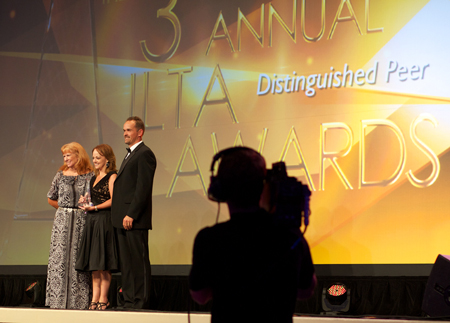
ILTA 2012 Part 4 – The end of the show: the ILTA awards dinner

This is the fourth of five articles about ILTA 2012. Whatever may happen at other awards dinners, this one celebrates the people who lead by an example in an industry which needs them.

ILTA ends with a big dinner, with a comedian and awards. Between you and me, those elements usually add up to an event which I would cross the Atlantic to avoid. For the ILTA Peer Awards dinner, however, I am always prepared to stay an extra night when I could be asleep on an aeroplane heading home.

The draw is not generally the food or the comedian, though both were good. I go to support the principle that ILTA is a peer-driven organisation which encourages those who have the expertise to share it with others, and I am prepared to sit through the sonorous intonations of the announcer on the grandiloquent linking videos to see individuals, firms and companies singled out for taking a lead. The UK was up there – Bond Pearce was shortlisted for a couple of awards and Vince Neicho of Allen & Overy was in the top three for Litigation and Practice Support Champion, an award which went to Paige Hunt Wojcik of Perkins Cole. Continue reading

Posted in Discovery, eDisclosure, eDiscovery, Electronic disclosure, ILTA, Legal IT, Legal Technology, Litigation Support | Leave a comment

ILTA 2012 Part 3 – Some market observations

This is the third of five posts about ILTA 2013. The preceding one ended with the observation that there was much to gain from just talking with people. That may include application-specific tips, ideas about department organisation or training, and pointers to things to try and avoid. This post covers the mood of the conference. Where are we going as an industry?

Part of the point of talking to so many people is a kind of crowd-sourcing of opinion. What is the mood? What developments are coming up? What are the lawyers asking, and are their clients asking anything different? It was quite interesting being in the same venue as the conference of three years ago because that somehow evoked the mood of the time. People were handing round their CVs that year, either already unemployed or hoping to jump ship because they could see water at the gunwales. The talk then was of clients deferring litigation, collecting data and stockpiling it against possible future action; there were rumours of bankers and shareholders who were putting in more money because they stood to lose so much if the company went down. It rather coloured the mood of that year’s conference.

This year felt different. After a while in this game you get to see behind what the mouth says and at the often rather different message coming from the eyes or from the tone of voice.  Using that rough-and-ready approach, I would say that there are a few players in this market who are doing very well, many who are just keeping afloat and will pull through, and a few who won’t be here next year (you don’t need to be very clever to make such an observation in a recession; the bit which counts is that some are doing very well). There are rumours of at least one significant acquisition – by “significant”, I mean that a major player will buy a strong but smaller niche player to give it new markets and not merely talent and client lists.  I suspect that quite a lot of the conversations going on around the Gaylord were between providers rather than involving clients – not the desperate circulation of CVs as in 2009, but quiet hints of greener grass or of a willingness to move if the terms were right. Continue reading

Posted in Discovery, eDisclosure, eDiscovery, Electronic disclosure | Leave a comment

ILTA 2012 Part 2 – My own ILTA Conference

This is the second of five posts about ILTA 2012. In other posts I talk generally about the benefits of going to ILTA’s big conference, about some of the themes which emerged and about the ILTA Peer awards. This one is largely about my own time there.

I arrived on Saturday, partly because the air fares are lower then and partly to play myself in gently. I like watching conferences come to life, venues gradually filling up and empty spaces turning into a stage set with a big cast. The putative UK ILTA virgin to whom this post is directed would similarly appreciate a gentle start to an event which, once under way, proceeds at an unrelenting pace.

I went to only two sessions. One involved eDiscovery/eDisclosure experts from the US, the UK (Vince Neicho from Allen & Overy), Australia and Canada, which set out succinctly the developments in each jurisdiction. I hope to write about this separately.

The other was billed as The ESI debate is on! and was a free-form discussion whose participants were described as “passionate and cantankerous”. That sounded about right, for I was one of them. The others were George Socha and Patrick Oot, moderated by Browning Marean of DLA Piper US. You catch the flavour of it from the fact that the first question was framed as a debating motion, that “US discovery is much better than UK eDisclosure”.  I felt it necessary to preface my opposition to this motion by making it clear that, notwithstanding anything I was about to say, I was in favour of most things American except its eDiscovery and its coffee. Continue reading

Posted in Discovery, eDisclosure, eDiscovery, Electronic disclosure, ILTA, Litigation Support | Leave a comment

No disclosure in New South Wales Equity Division without exceptional circumstances

I have referred before to Practice Note SC EQ 11 in the Equity Division of the Supreme Court of New South Wales. Its key paragraph reads as follows:

The Court will not make an order for disclosure of documents (disclosure) until the parties to the proceedings have served their evidence, unless there are exceptional circumstances necessitating disclosure.

I refer to it again because I have two panels coming up involving Australian judges. On Wednesday of this week I am at IQPC’s Information Governance and eDiscovery for Financial Services Conference at Canary Wharf, London. My first panel consists of the UK’s Senior Master Whitaker and the Honourable Justice Robert McDougall of the Supreme Court of New South Wales.

Next week, I am at IQPC’s Information Governance and eDiscovery Strategy Exchange in Washington, where I am moderating a large judicial panel (with judges from the US, the UK, Ireland and Australia) which includes the Honourable Justice John Sackar of the Supreme Court of New South Wales. I intend to ask both of them about the Practice Note.

We obviously want to hear how it is working in practice – my understanding is that many, if not most, of the applications made under it have failed either because they were premature or because the applicant did not make a case for “exceptional circumstances”.

I also hope to provoke a discussion with wider implications – whilst it seems unlikely that many other jurisdictions will follow the lead taken by the New South Wales Equity Court, it will be interesting to challenge the opposite idea – that parties must collect and disclose large volumes of documents which no one will ever read, at prohibitive expense.

Home

Posted in Australian courts, Discovery, eDisclosure, eDiscovery, Electronic disclosure, IQPC, IQPC Exchange | Leave a comment

ILTA 2012 Part 1 – Why you might want to go to ILTA next year

This is the first of five articles about ILTA 2012 in Washington D.C. Why do we go, what is it like, what conclusions can one draw about the market? The main aim is to encourage you to go next year, and to find out in the mean time what ILTA can offer you apart from its big conference.

If asked to explain what their father does, my children generally say “He’s a blogger”, ducking the inevitable follow-on question “No, I mean what does he do for work?”. If they were to add that he wanders around hotel lobbies having brief encounters with several people in succession, that does not make it clearer. That, however, was my major benefit at the annual conference of the International Legal Technology Association, ILTA, in Washington D.C. at the end of August. Everyone is there.

There is more to ILTA’s annual conference than that of course, just as there is more to ILTA than its annual conference. You can make of it what you like: seeing technology solutions, attending sessions led by people who have been down that roll-out path ahead of you, hearing about the pros and cons of a proposed investment from those who have been there, or just talking to others. When you have done all that (and this is a hard-working conference for all its leisure elements) there is entertainment of pretty well every kind.

I do not propose in this post to recite all the people I met or the products which I saw – apart from the obvious risk of drawing fire from those whom I fail to mention (it happens), I value my readership, and nothing drives the audience away faster than lists. ILTA is not a place for big product launches, nor do you get startling pronouncements from influential figures. It is more a place for knowledge-sharing and, as one law firm person put it to me, for spending time with the more thoughtful people from the suppliers.

My purpose here is to give some impression of what it is like to attend ILTA’s big conference, with the aim of encouraging greater attendance from the UK (and anywhere else) next year. I will mention a couple of sessions and pass on some general ideas which came my way in the course of my many discussions, but the main aim is to try and convey why it is important to be here, and not just for Americans. Continue reading

Posted in Discovery, eDisclosure, eDiscovery, Electronic disclosure, ILTA, Legal IT, Legal Technology, Litigation Support | Leave a comment

Short eDiscovery updates to 28 August 2012

I am increasingly using Google Plus to supplement the main articles in this blog. This allows me to cover a wider range of topics, mainly links to articles by others, to webinar announcements and to other things which would otherwise go unmentioned. These are quick and dirty posts, distinct from the generally longer posts on the blog itself. Apart from the speed and convenience of G+ for this purpose, every new post on the blog triggers an email alert to many regular readers, who will be driven away if I send them an email with every short post.

These compilations are in a fuller form than previous ones, which have been merely hyperlinked references. This format repeats the G+ articles and gives links to my G+ post, to the source file which is linked from G+, and to some to the names mentioned in the text. The purpose is partly to bundle them conveniently for blog readers who do not pick up these short posts from G+, or from my Twitter and LinkedIn pointers, and partly because of the SEO (Search Engine Optimisation) benefits of the cross-links.

______________________________

FTI webcast – Survey Results: What Does Counsel Really Think About Predictive Coding?

This webcast has now taken place but is available for download

Ari Kaplan, Principal, Ari Kaplan Advisors
Barry Murphy, Principal, Murphy Insights
Joe Looby, Senior Managing Director, FTI Technology

While the promise of predictive coding is alluring, many questions remain for corporations and law firms. Where does the software end and the importance of workflow begin? What can lawyers do to effectively defend its use? Are companies using it successfully? How much money can it save?

FTI Technology commissioned an interdisciplinary survey of law firm leaders and senior corporate counsel to identify key trends and perspectives on the emergence of predictive coding. The interviews covered everything from high-profile court rulings and cost savings estimates to adoption inhibitors.

Attend this webcast to learn the survey findings and hear first-hand perspectives and practical advice for implementing predictive coding software and processes, including:

Fortune 1000 and Am Law 200 predictive coding adoption trends
Best matters on which to use predictive coding
Top areas of concern, including predictive coding as a “black box”

Published: 21 August 2012

G+ Post | Link to Source | FTI Technology Continue reading

Posted in Discovery, eDisclosure, eDiscovery, Electronic disclosure, FTI Technology, ILTA, Millnet, Nuix, ZyLAB | Leave a comment

LawTech Europe Congress in Prague on 12 November

My series of articles on future eDisclosure/eDiscovery conferences keeps being interrupted by my attendance at current conferences, most recently by a week at ILTA 2012 in Washington D.C. The conference season now seems to last all year, at least for those of us (and I am not the only one) whose interests embrace the US, the UK, Asia-Pacific and continental Europe.

For eDiscovery purposes, the expression “continental Europe” has hitherto meant Germany or the Netherlands. That does not mean that no other country has eDiscovery problems to solve, merely that conference organisers can be reasonably sure of getting audiences in Germany and Holland.  As Spain, Portugal and Italy drop off the economic map, so eyes turn east to the area to the area known geographically, culturally and politically as Mitteleuropa, whose Western edge includes Germany and which embraces, amongst other countries, Austria, the Czech Republic, Hungary, Slovakia, Switzerland and Poland.

The economic standing of these countries varies as much as their languages do, and it is no more than a geographical convenience to group them together. One measure of economic importance is the number of law firms and international consultants who think it worth their while opening offices in one or more of the region’s capitals. They are there.

More or less bang in the middle of this vast area sits Prague, the capital city of the Czech Republic and, so Wikipedia tells me, the fourteenth largest city in the European Union.  It is here that Frederick Gyebi-Ababio has established a new player in the international legal technology conference league with the LawTech Europe Congress, due to take place on 12 November. Continue reading

Posted in AccessData, Discovery, eDisclosure, eDiscovery, Electronic disclosure, Guidance Software, Nuix, Recommind, ZyLAB | Leave a comment

Proportionality and a choice of technology from Hobs Legal Docs

Recent posts by Hobs Legal Docs remind us that the problems raised by e-Disclosure are resolved by adherence to principles like proportionality as well as by the selection of appropriate technology.

You don’t need scientific proof (though it exists, apparently) for the proposition that your brain does one of two things when subjected to too many choices:  after an attempt to assimilate and evaluate all the options, it either abandons analysis and plumps for something by instinct or gives up the selection process entirely and does without whatever it was which was being considered.

Something similar happens with words like “proportionality” which have multiple potential meanings and no certain definition, and subjects like “cross-border eDiscovery” which sounds like something which other people do, and only occasionally. They quickly become unnoticeable, like ambient music in a shop or the chatter of radio announcers – you have a vague idea that they are there but lose focus on content and meaning.

EDiscovery / eDisclosure has all these elements; multiple providers offer similar-looking solutions with terminology picked from a narrow vocabulary which includes polysyllabic words like “proportionality” and expressions  like “cross-border eDiscovery” whose meaning gets lost with every repetition. All these things do in fact have meaning and potentially have daily implications for lawyers.  In practice, proportionality is usually invoked only retrospectively when the lawyers are called upon to justify an alleged under-disclosure, and however important it appears at US eDiscovery conferences, UK lawyers give little thought to the implications of collecting documents and data from other jurisdictions. Continue reading

Posted in CaseLogistix, Clearwell, Discovery, eDisclosure, eDiscovery, Electronic disclosure, Equivio, Guidance Software, KCura, Symantec, Thomson Reuters | Leave a comment

The Masters Conference for Legal Professionals – Washington 8-10 October

I usually come only once to Washington in a year, with the Masters Conference as an annual fixture.  This year, I will be in Washington three times within a few weeks, but that does nothing to diminish my appreciation of this always informative event.

There are changes this year. Most significantly, the Masters Conference has moved from the echoing concrete labyrinth which is the Ronald Reagan Center to the much more conference-friendly Grand Hyatt. Second, It has appointed Lisa Lehman as its director. Third, but by no means least, it has undertaken a series of smaller events during the year, establishing itself as a leading player in eDiscovery education.

This year’s conference title is Information Convergence: Creating Synergy Between Compliance, Discovery and Security – the conference summary is here. I am involved in two international panels, put together in conjunction with Amor Esteban of Shook, Hardy & Bacon. He and I spoke together on international eDiscovery in Brussels last January, and were also on the comprehensive panel organised by Nigel Murray of Huron Legal at LegalTech. Amor’s supervisory role in the production of the Sedona Conference International Principles on Discovery, Disclosure & Data Protection makes him the ideal person for this kind of panel.

I will write more about this conference in due course.  The main point in writing about it now is to draw your attention to what are described as all-inclusive packages available until September 4, 2012 which include three days of CLE education and three hotel nights at the Grand Hyatt for $1,599. To register online for the Masters Conference, visit www.themastersconference.com.

Home

Posted in Discovery, eDisclosure, eDiscovery, Electronic disclosure | Leave a comment

London conference: Information Governance and eDiscovery for Financial Services on 10-12 September

IQPC is running an event called Information Governance and eDiscovery for Financial Services at Canary Wharf between 10 and 12 September 2012.  Recent events in the banking industry suggest that those who work in financial services, and those who advise them, might appreciate an update on the importance of managing and finding electronic information.

The conference begins with a workshop day comprising two sessions which are well worth your time. One, led by Drew Macaulay of First Advantage Litigation Consulting, is called Evidence handling in financial services investigations: tools, tips and traps. The second, led by Sanjay Bhandari of Ernst & Young’s Forensic Technology and eDisclosure Services, is called Conducting an internal investigation: a step-by-step guide for financial services industry Counsel.  Those two sessions alone justify attendance at this event.

There is more, however, in the ensuing two days of the main conference. First Advantage and Ernst & Young lead further sessions and there are contributions on the Navigation of multinational regulatory investigations from Craig Earnshaw and Nick Athanasi of FTI Technology and on Navigating cross-border eDiscovery challenges from Christian Zeunart of Swiss Re.

My own involvement is to facilitate a talk by Professor Dominic Regan with the title 2012: the most significant year in the history of eDiscovery? On past form,  the engaging Dominic Regan is the dream speaker for a moderator, requiring little prompting to explain eloquently why pending changes in the Civil Procedure Rules, amongst other things, force attention on electronic discovery through 2012 and into the pending reforms of 2013.

Home

Posted in Discovery, eDisclosure, eDiscovery, Electronic disclosure, Ernst & Young, First Advantage, FTI Technology, IQPC | Leave a comment

IQPC Washington Information Governance and eDiscovery Strategy Exchange

My next trip to Washington DC (I am there as I write, at ILTA) is for IQPC’s Information Governance and eDiscovery Strategy Exchange which runs from 19 to 21 September at the Marriot Fairview Park. This event is organised by the London-based team which puts on the very successful European eDiscovery conferences, the next of which is in Munich on 27 to 29 November.

As its name implies, this event focuses on strategy. That implies a long-term, proactive and pre-emptive approach to the problems raised by the need to disclose electronic documents for litigation, for regulatory purposes and for internal investigations, and the session titles and speakers reflect this. One of the early panels, for example, is called Closing The Gap Between Legal, IT & Records Management To Ensure An Enterprise-Wide Information Governance & eDiscovery Strategy, to be discussed by, amongst others, Jason Baron, Director of Litigation at the National Archives and Records Administration and Barry Murphy of eDJ Group.

Running my eye down the list of speakers, I see Allison Stanton, Director of e-Discovery in the Civil Division of the DOJ, Mark Yacano of Hudson Legal, David Horrigan of 451 Research, Maura Grossman of Wachtell, Lipton Rosen & Katz, Patrick Oot of the Electronic Discovery Institute and David Shonka of the Federal Trade Commission who will, with many others, cover a wide range of topics both current – the cloud, social media, BYOD and costs – and future with, for example, a panel about technology developments and market consolidation. Continue reading

Posted in Discovery, eDisclosure, eDiscovery, Electronic disclosure, Information Governance, IQPC, IQPC Exchange, Litigation costs | Leave a comment

Taking time to think about Proportionality and Preservation in eDiscovery

The demos, the cases and the formal meetings are an important part of gathering information, but it is good, occasionally, to lift one’s head from the hard-edged material which flows around you and just kick ideas around without an agenda. I did just that recently with Kate Paslin of AccessData, by coincidence just as she published an article on one of my pet subjects – the similarities and differences between US and UK eDiscovery / eDisclosure rules.

For users and potential users of eDiscovery software, conferences like ILTA, coming up in Washington next week, are an opportunity to see applications and compare them under one roof, to talk to other users and potential users, as well as to hear the sessions.  It is only at events like this that you can walk from one demo to another with comparative information fresh in your head and to hear on the spot from your peers and industry leaders.

My interest at ILTA is rather different. I am not a user nor, for what I hope are obvious reasons, do I help firms and companies with system selection. What interests me is the cross-over between the eDiscovery and evidence requirements of courts and regulators, the business practices of lawyers, the use of technology, the ways of keeping costs down. My business is the flow of information about all these things between courts, lawyers, clients and providers. I am, of course, interested in the technology developments, and keep up to date with the evolution of eDiscovery software – but preferably not while several thousand interesting people to talk to are milling around outside. Continue reading

Posted in AccessData, Discovery, eDisclosure, eDiscovery, Electronic disclosure | Leave a comment

Gauging interest in eDiscovery Ireland in 2012

Online evidence and investigations specialist Cernam, who organised the extremely successful e-Discovery Ireland 2011 conference, are thinking of running it again. They are sensibly trying to gauge interest before committing to it, and have set up a web page to solicit our views, including the best month for it. I have said that I will do it on any date where I am not supposed to be somewhere else.

Last year, through no fault of Cernam, the conference was sandwiched between a conference in Washington and one in Singapore, and I saw no more of Dublin than is visible from a cab window on the way to the airport. I hope to do better next time.

One tangible result from last year’s conference is that I heard Mr Justice Frank Clarke speak and sat next to him at dinner. When IQPC were organising their Information Governance and eDiscovery Strategy Exchange for Washington this autumn (19 to 21 September) they wanted as broad a jurisdictional range as possible for the judicial panel. I  suggested that they approach Mr Justice Clarke and, as a result, he is speaking both in Washington (where I am the Moderator) and at IQPC’s Munich eDiscovery event on 27 to 29 November. I will write separately about both these conferences shortly.

Meanwhile, pleased do register your interest in the Dublin conference.

Home

Posted in Discovery, eDisclosure, eDiscovery, Electronic disclosure | Leave a comment

FTI Predictive Coding webinar today – what does counsel really think about predictive coding?

FTI Technology is putting on a series of webcasts about predictive coding. The first of them is TODAY at 13.00 ET with the title Survey Results: What Does Counsel Really Think About Predictive Coding?

The speakers are Ari Kaplan, Joe Looby of FTI Technology and Barry Murphy. The registration page is here.

The survey which gives the webcast its name was commissioned by FTI. Ari Kaplan was responsible for asking the questions and reporting on the answers. I put notice of it here partly because I missed the earlier announcements and partly because we do not often get the chance to hear what inside counsel have to say about predictive coding. As the principle potential beneficiaries of the costs-saving which it brings, their input is crucial to the take-up of this technology.

Home

Posted in Discovery, eDisclosure, eDiscovery, Electronic disclosure, FTI Technology, Predictive Coding | Leave a comment

eDiscovery conferences coming up all over the place

I have updated the list of pending conferences on my web site, adding new ones and correcting dates, venues and URLs of those which have changed.

I have included some which I am not going to – the EDI Leadership Summit and Relativity Fest 2012 were originally ruled out by events which have now dropped off my calendar. I wanted very much to go to both of them, but my mother’s illness (she seems to be recovering, thank you to all those who have asked) argues against adding more events to the calendar whilst she is still in hospital.

First up is ILTA 2012 ac2dc, celebrating its 35th event anniversary next week. The venue is again the vast Gaylord National Resort and Conference Centre outside Washington DC, a place which manages to feel strangely intimate despite its vastness, at least during this most friendly of eDiscovery conferences.

ILTA prides itself on its peer-to-peer support ethos which gives it a different flavour to other conferences. As last year, it provides a mobile app which helps you to navigate the packed program. I am taking part in a session which deliberately has no specific subject – it is called The ESI Debate Is On! (Hashtag #LPSPG6) and its description reads “There has recently been much debate over eDiscovery topics, and this session is sure to touch upon them all! Join our eDiscovery industry leaders as they discuss hot topics that are not without controversy.”

The other panel members are Patrick Oot and George Socha. Browning Marean of DLA Piper is the moderator, so expect variety, unconventionality and, with any luck, something for us all to disagree about.

Although this is the longest conference of the year, it never seems quite long enough to see everybody. For me, it is an opportunity to catch up with those who sponsor the e-Disclosure Information Project, whether by appointment or by bumping into them.

The whole thing is pure pleasure so far as I am concerned, and being there for nearly a week takes some of the sting out of the tiresomeness of the travelling.

I will be writing separately about the other forthcoming conferences over the next few days.

Home

Posted in Discovery, eDisclosure, eDiscovery, Electronic disclosure, ILTA, Litigation Support | Leave a comment

Time spent telling judges about their use of social media could be better spent on eDisclosure

Recent guidance from the UK’s Senior Presiding Judge and the Senior President of Tribunals fired a warning shot over the bows of judges who blog, a term which they helpfully define as being “derived from the term ‘web log'”. The inclusion of the definition somehow reminds me of all those relatively elderly lawyers who still refer to data as being provided “on CD”, as if that reference from circa 2005 were another way of saying “electronically”. Both examples come across as rather strained attempts to be seen to be down wit da kidz.

My own reaction was a rather sarcastic tweet:

We should perhaps be pleased to discover that the senior judges know what a “blog” is. Next year “Twitter”, and “Facebook” by 2014

Lengthier and more serious comment followed from English commentators such as Adam Wagner and ObiterJ.  Reaction from the US illustrated as much as anything the sheer diversity of the US judiciary, ranging from stories of idiots who should plainly never have been given judicial office through to serious discussion about both ethical restrictions and the judicial duty to “initiate and participate in activities for the purpose of promoting public understanding of and confidence in the administration of justice”.

The thoughtful IT-cross-legal commentator The IT Countrey Justice has now provided us with a very readable comparative study of judicial attitudes to public comment by judges across a range of jurisdictions with the title Social Media and the Judiciary.

So far as I am concerned, the UK judicial advice, if it was necessary at all, got its emphasis wrong. It could have achieved the same effect by promoting the benefits of judicial comment with a warning rider about the risks. That would have served the same purpose without attracting any adverse comment.

If the establishment has time to write guff like this, and the judges have time to read it, perhaps they could focus instead on the need for judges to understand electronic disclosure and the role which judges should be playing in keeping it under control.

Home

Posted in Discovery, eDisclosure, eDiscovery, Electronic disclosure, Judges, Social Media | Leave a comment

My Google Plus eDiscovery posts to 14 August

A longer list than usual, partly because many interesting things came along and partly because I was called away for over a week before I had the chance to list them.

Law Society Gazette – No replacement yet for £10m High Court IT failure

APT Search white paper on recruitment and eDiscovery

Dangleboris – how to get the world to do your PR for you

Clarification of the DPP’s role in the Twitter Joke Trial

Nuix: Taming information with eDiscovery

Rob Robinson: eDiscovery vendors on Twitter

eDJ Group snaps up Marilyn Gladden for eDiscovery channel media services

Commonwealth Legal becomes a Relativity Consulting Partner

Greg Buckles of eDJ on CVEDR – Monkeys and Magistrates in Monterey

ESIBytes Recording – Carmel Valley E-Discovery Judicial Panel on Predictive Coding

The Irish Times – Internet is debasing our public discourse

The Lawyer: Scotland to compete with Northern Ireland as low-cost law centre

Kevin Nichols on eDJ: The CVeDR – A Different Type of eDiscovery Conference

First Advantage Litigation Consulting integrates audio discovery and conceptual search, and enhances analytics in Global RPM 5.0

Epiq Systems panel debate: judicial attitudes to technology assisted review

Nuix webinar: Deep dive into intelligent investigation with Nuix 4

You may like this Olympic parody…

Thomson Reuters on FTI survey: lawyers see benefits of computer coding, with caveats

kCura at No 15 out of 100 in Forbes’ list of Chicago’s top 100 digital companies

The relationship between keyword search and technology assisted review – Sheila Mackay of Xerox

Video – Proactive Information Governance with Nuix

Blog post re-run: Conor Crowley’s guidance on the Duty of Competence in e-Discovery applies beyond the US

While other politicians struggle to speak comprehensible English, Boris recites an Olympic ode in Latin

Guy Burgess on the NZ Law and technology blog: When will New Zealand get e-filing?

Simon Price of Recommind – Concept over keywords – why search still matters for law firms

Barry Murphy of eDJ in discussion with Mary Ann Benson of Epiq Systems: Tangible Examples of TAR

Epiq Systems Opens Hong Kong Document Review Centre

The Lawyer: First LIBOR action is in the Birmingham Mercantile Court

Howard Sklar of Recommind: Are Seed Sets the New Keyword?

Craig Ball: Train, Don’t Cull, Using keywords

Craig Ball (again), this time on the safe-keeping and recovery of irreplaceable data

Millnet’s Charles Holloway on a devilish problem

Guidance Software E-Discovery Resource Center

Home

Posted in CY4OR, Discovery, eDisclosure, eDiscovery, Electronic disclosure, Epiq Systems, First Advantage, Guidance Software, Litigation Support, Millnet, Nuix, Recommind, Thomson Reuters | Leave a comment

Unexpectedly out of the loop as mother gives robust reply to hospital risk-assessment

A kind reader drops me a line to observe that more than a week has gone by without an article from me. The intermission is nothing to do with a lack of raw material – I still have the Carmel Valley eDiscovery Retreat to write up, there is at least one article left over from the Nuix Information Governance Forum in June,  announcements keep pouring out of the providers, and there are pending conferences to plan and write about.

All this would normally have kept me in full flow during August, quite apart from my annual resolution to use the summer for all that defensible deletion which we urge on others and for dealing with the 1,000 plus photographs which I took in California. I had just finished clearing the decks for this when my 83-year-old mother fell over.

We dropped everything and rushed for Suffolk, me thankful that a life spent in airport lounges means that most of my apps and data are accessible from anywhere. Some anxious days have followed.

My tweets take up the story:

Hospital to Mother: There is good news and some not so good news – you did not break either your leg or your hip in your recent fall…

…however, you’ve had a heart attack, something on your lung and an operation to do on something else. No rush – tomorrow should be fine

Tough, the generation which lived through the Blitz. Response to the risk assessment: “Well why don’t you get on with it then?”

Result of op – Mother 1 : Reaper 0  Unqualified praise and thanks to Ipswich Hospital and the NHS

To their credit, whoever is in charge of social media at Ipswich Hospital picked up this reference notwithstanding that I did not give their twitter handle. They thought my last tweet was “unconventional” but were keen to pass on our thanks to the relevant department.

I will spare you the details, but after several days spent in the area in case we are sent for, we are no clearer as to the possible outcome beyond her survival of last week’s operation. A rally is followed by a relapse, good news on one front accompanied by less good news on another.  It makes it difficult to plan for more than today – and the luxury of taking each day as it comes expires when I must set off for ILTA in Washington next saturday.

The articles which I published this week all existed as drafts before I set off.  I am gradually picking my way through the telephone appointments, interviews, podcasts etc which I cancelled last week and generally trying to combine “business as usual” with the far from usual circumstances in which I find myself.

If I have failed to follow up something with or for you, please remind me.

Home

Posted in Discovery, eDisclosure, eDiscovery, Electronic disclosure | Leave a comment

Epiq Systems: document review in Hong Kong, Zoom from Equivio and covered in eDJ

eDiscovery provider Epiq Systems seems to be popping up all over the place at the moment. Grouping the various sources together has the benefit, for me as well as for them, that those new to this subject can see how many eDiscovery corners are touched by a major player in the eDiscovery / eDisclosure market. This is not just a technology matter – services, processes and thought-leadership all contribute to tackling a business problem which is not going away.

I have already written about Epiq’s Q2 results which showed Epiq’s eDiscovery segment contributing $42.7 million to its record operating revenue for the quarter. My post reported Epiq’s expectation of “continued double-digit operating revenue growth for eDiscovery in the second half of the year”. The subsequent announcements covered here go some way towards justifying that optimism. I reported each of them briefly as they came along on Google+, but they are worth expansion.

Epiq opens Hong Kong Document Review Centre

Epiq has followed its recently-opened new document review facility in Washington (see Huron and Epiq expand managed review and legal staffing in Washington) with the creation of a similar review centre in Hong Kong.

The press release is here. It quotes Laura Kibbe, Epiq Systems’ Managing Director of Document Review and Expert Services as referring to the provision of “secure, scalable, cost effective review and staffing services wherever they are needed,” and to Epiq’s enanced ability to manage review teams in multiple jurisdictions simultaneously.

Why should companies need such a service? Why, perhaps more pertinently, is it of interest to lawyers who have historically made money from document review? Continue reading

Posted in Discovery, eDisclosure, eDiscovery, Electronic disclosure, Epiq Systems, Equivio, Hong Kong, Predictive Coding, Technology Assisted Review | Leave a comment

Recommind predictive coding webinar: I interview Senior Master Whitaker

A reminder of my recent interview, organised by Recommind and filmed at the top of the Gherkin, with Senior Master Whitaker. Our subject was the acceptability of predictive coding in UK litigation. Master Whitaker knows more about this than any UK judge and is himself responsible for case management of London Queen’s Bench cases at the stage when the question falls to be discussed.

His views are worth hearing, and this is a painless way to receive them.

Home

Posted in Litigation Support | Leave a comment

First Advantage: “Seek and you shall find” applies as much to your provider as to your data

The actual process of looking for documents and data is secondary to the decision about how you are going to tackle the task.  Much of the procedural focus in the UK at the moment – with costs budgeting and Lord Justice Jackson’s “menu option” coming –  is on sizing the problem and making informed decisions about the best way to handle each stage of the disclosure process. Without some idea of the scale of the problem, you cannot begin to decide what resources you need to bring to bear on it.

By chance, First Advantage Litigation Consulting was addressing both of these problems – how you do the job and how you choose someone to help you with it – on opposite sides of the world at the same time.

Taking resource selection first, this came up at a panel called Purchasing services: When you can’t do it yourself, who do you call? at the Carmel Valley eDiscovery Retreat at which John Shaman of First Advantage was a speaker.

I was not able to attend that thanks to a conflict, and so missed the chance to hear the panel talk about the practicalities of contracting for additional services when larger projects emerge.  How do you identify suitably qualified resources? What level of services do you require? Who is to provide the bodies and the equipment? Does geographical proximity matter?

I can see why First Advantage chose, or were chosen, to sit on this panel.  FADV is a provider of hosted processing and review tools (I wrote about the latest release of its software recently – see First Advantage Litigation Consulting integrates audio discovery and conceptual search, and enhances analytics in Global RPM 5.0) allied with as much or as little associated consultancy as is required.  Thanks to its recent acquisition of DLR Legal (I wrote about that here), it can also provide the bodies needed to perform the manual elements of the task, specialising particularly in multi-language projects.

Whilst the principles are applicable in every jurisdiction, the pending costs management regime in the UK will force lawyers to apply their minds to the costs and other implications of pursuing one route rather than another. It will no longer be enough, for example, simply to stick a finger in the air and guess at the number of chargeable hours and fee earner levels which will be required to perform each stage of the disclosure exercise. Continue reading

Posted in Discovery, eDisclosure, eDiscovery, Electronic disclosure, First Advantage | Leave a comment

Dean Gonsowski of Symantec on the eDiscovery maturity model

An interesting article on InsideCounsel by Dean Gonsowski of Symantec-Clearwell called The e-Discovery Maturity Model considers the stages through which an organisation goes through in reaching a level of skill and competence appropriate to the issues which it faces.

Picking up on a recent paper by Enterprise Strategy Group (ESG) Dean refers to these stages as “maturity levels”. He says:

The lowest maturity level is aptly named Chaotic. The next levels are Managed, Standardised and then Semi-integrated. The pinnacle of eDiscovery enlightenment is Integrated and Optimised.

He quotes the saying “Where you stand depends on where you sit”, that is, whether and when you reach your destination depends on your starting point. It is the same idea as it turns up in the old Irish joke whose punchline is “Well if I was going there, I wouldn’t be starting from here”.

There are two components to this – your pre-existing level of skill, and the frequency and difficulty of your discovery exercises. Dean refers to the one-off “hair on fire” case which will almost certainly involve dependence on third parties and which may or may not be one of a sequence of such events, and takes us through to a full-blown information governance situation where policies, processes and appropriate teams are aligned with the recurring needs of the organisation.

Every organisation, and every law firm come to that, ought to know where it stands in terms of its skill and experience on the one hand and its target on the other. Dean Gonsowski’s article is a good start in understanding both these things.

Home

Posted in Clearwell, Discovery, eDisclosure, eDiscovery, Electronic disclosure, Symantec | Leave a comment

What does your phone say about you? AccessData’s Mobile Phone Examiner Plus (MPE+)

I do not know whether it is shrewd marketing on the part of AccessData or a coincidence, but the press announcement of their Mobile Phone Examiner Plus (MPE+) came to my attention on the same day as an article on Zeit Online dating from March 2011 with the title Betrayed by our own data.

The latter illustrates the enormous quantity of information which we give away merely by having our mobile phones turned on all the time – thousands of pieces of data which, when added together and, perhaps, aggregated with information from other sources, presents the complete story of our lives, much of it obtained legitimately and with our own consent.

The AccessData product provides the means by which lawyers may get into that information for the purposes of making or rebutting allegations in litigation and for similar purposes. This goes far beyond the implications in criminal proceedings or through the actions of security services. Many a civil case – to do with employer-employee relations, matrimonial disputes, IP theft and just simple cases of disagreement and conflicting evidence in straightforward contract, negligence or accident claims – may be resolved by examination of the mobile phone of a party or a witness.

The German Green politician Malte Spitz clocked up 35,831 rows of information in a spreadsheet about his mobile phone data between August 2009 and February 2010. If you add this to his non-phone data and externally available information, you have a more or less complete picture of his life. The witness who denies knowing someone or who asserts that he or she was or was not in a particular place at a particular time, does not stand a chance when evidence collected from his or her mobile phone shows otherwise.

That is the point of AccessData’s new product.

It is, no doubt, chilling to know that all this information is available. It is equally chilling, to my eye, that so many lawyers simply do not know that information of this kind is both available and fits within the definition of a discoverable / disclosable document by the definition of a document in most common law countries. But if that is bad enough in the context of civil litigation, how much worse is it when no one spots that this information may convict or acquit someone charged with a criminal offence?

Home

Posted in Litigation Support | Leave a comment

Recommind and Fulbright panel debunks predictive coding myths

I have already linked once to Monica Bay’s article Panel Debunks Predictive Coding Myths reporting on a panel discussion between Howard Sklar of Recommind and David Kessler of Fulbright & Jaworski. Both of them were discussing similar points at the Carmel Valley eDiscovery Retreat in Monterey a few days ago, and the article has just resurfaced on Twitter. It is worth repeating.

The introduction of new technology quite often spawns myths.  My long-time favourite practitioner is Dr Dionysius Lardner who constantly challenged the work of railway inventor Isambard Kingdom Brunel, asserting, amongst other things, that passengers on Brunel’s Great Western Railway would suffocate if the train’s brakes failed on a downhill slope and that a voyage from New York to Liverpool “was perfectly chimerical, and they might as well talk of making the voyage from New York to the moon”. The first of these assertions ignored wind resistance and friction and the second failed on the technical ground that “the carrying capacity of a ship increases as the cube of its dimensions, whilst the water-resistance only increases as the square of its dimensions”.

The point of the parallels is that a myth which was potentially damaging to progress was a) answered by science and b) proved wrong by experience when the railway passengers survived and the SS Great Western steamed into New York harbour with 200 tons of coal to spare. Continue reading

Posted in Discovery, eDisclosure, eDiscovery, Electronic disclosure, Predictive Coding, Recommind | Leave a comment

Knowledge workers and project managers in eDiscovery

Mark Yacano and Cat Casey of Hudson Legal have published the third and final of their InsideCounsel series on the role of knowledge workers and project managers in eDiscovery.

Their theme is the changing role of those who both undertake and manage eDiscovery projects, emphasising that technology brings a demand for new and specialist skills which can be acquired either by growing them in-house or by engaging the services of companies whose specialist area this is.

I have made the point, in recent articles about the document review services of Epiq Systems and Huron Legal, that you get more than just outsourced labour from such providers. Because this is what they do, all day every day, they have the experience and the metrics to be able to predict costs and time scales. Few law firms can match their costs; almost none can provide the statistical information which allows lawyers to make predictions of the kind which are increasingly required both by clients and, when cost budgeting comes into the UK rules in April 2013, by the courts.

The articles are a good introduction to the range of functions which are available from such providers, and the skills and training which are brought to them. Any lawyer offering review services as part of their practice ought to be in a position to compare the benefits of external providers as a comparison with their own best offerings in this regard.

By way of reminder, UK Practice Direction 31B does not merely require the use of technology – it does require technology to be considered and used where appropriate, but it refers also to the “techniques” which the lawyers must discuss. The use of outsourced document review is amongst the “techniques” which ought to be considered.

Home

Posted in Discovery, eDisclosure, eDiscovery, Electronic disclosure, Epiq Systems, Huron Legal | Leave a comment

Recent posts on Google+ on eDiscovery and other legal subjects

Being away, and with only random access to the Internet, focuses one’s mind on the most efficient way of capturing interesting articles as Twitter (my main source) dishes them up. Whatever its other virtues, Twitter is no good as an archive, since tweets disappear from sight very quickly. I usually bung them into Evernote (an easy, two-click process) but have recently started putting more of them into Google Plus (which I am finding increasingly useful), with or without much in the way of commentary, and so sharing them instead of merely adding to my own information stock.

There were many articles of interest whilst I was away. Many had nothing to do with eDiscovery but relate either to the US coverage of the Olympics or to the peculiar range of English legal curiosities which came up whilst I was away – I have written about these in my article Manslaughter (not), brand protection, Twitter censorship and crass Olympic coverage.

The Google Plus links work best, in indexing terms, if I cross-link to them from elsewhere. I do this in batches from Twitter with every few Google Plus posts and, as regular readers know, also list them here and on my website to make a running archive of them for future searchers to find. Although this involves a two-hop process for users (to my post and thence to its subject) the alternative, in many cases, is that the source article will simply disappear from view.

I have started trying to capture the dates of webinars and other events organised by those who sponsor the eDisclosure Information Project as well as articles. If I miss an event, it is either because I did not find out about it until too late or because I was away.

Recent posts include those listed below. There are others in the pile, but it is not necessarily helpful to list too many at once, so I will stop here for now.

Events

Symantec Twitter Chat: How to Speak Legalese | 2 August at 10.00am PT

FTI and eDiscovery Journal – The Last Mile: Using Analytics for Trial and Depositions – Webinar on 7 August

Symantec Webinar: The Nexus Between Proactive Information Governance and Reactive eDiscovery | 7 August at 10.00am PDT

Recommind webinar – Cost Reduction Strategies Legal Departments Consider: Addressing the Real Problem | 12 September at 2pm ET

CY4OR Presentation – The Importance of Electronic Evidence – Manchester – 29 September

eDiscovery / eDisclosure

Devin Krugly of AccessData – some Olympic Twitter risks and some ideas for minimising them

Singapore International Conference on Electronic Litigation

Take it e-sy: e-Disclosure interviews in the UK Lawyer Magazine

Charles Skamser’s account of the 2012 Carmel Valley eDiscovery Retreat

Can the SFO survive the Tchenguiz warrant humiliation?

Are Seed Sets the New Keyword Part II You Can Have My Seed Set by Howard Sklar of Recommind

Company Results

Epiq Systems Q2 2012 Results with Record Operating Revenue of $89.8M

Guidance Software Q2 2012 – Record Non-GAAP Revenue $31.5 million, up $7.6 million, or 32 percent year-over-year

Other

Harwood Acquittal

David Allen Green in the New Statesman on the acquittal of PC Harwood

Crimsolicitor brings a different view to the PC Harwood acquittal

Metropolitan Police tried to hide Harwood’s disciplinary record

LOCOG Olympic Brand Enforcement

Take THAT, LOCOG – Anya Palmer has collected together some of the madder LOCOG stories

Unauthorised bunting in the corporate area

Lodnon 2102 Olmplycs

Twitter joke Trial

Carl Gardner: Why did the CPS and the DPP begin and pursue the Twitter Joke Trial?

Louise Mensch MP in the Guardian: The Twitter joke trial and the twits who pursued Paul Chambers

CharonQC Podcast with John Cooper QC on the acquittal of Paul Chambers

What? The CPS were willing to call it a day on Twitter Joke Trial but the DPP insisted on going ahead

Olympic Opening Ceremony

Forbes critique of NBC coverage of the Olympics Opening Ceremony

The New Yorker – Danny Boyle Wins the Gold

Our Island Story – perhaps the best account of the Olympic Opening Ceremony

LA Times article on Olympics opening ceremony – London puts on a smashing show

Twitter suspension of journalist’s account

Twitter suspends the account of Guy Adams, a journalist critical of NBC’s Olympic coverage

Twitter explains its approach to private information following reinstatement of journalist’s account

A motive for Twitter’s non-apology for suspending Independent journalist’s account

Politics

More plausible than you might think – The Telegraph on Boris’s threat to Cameron

Photographs

Random photographs from a drive from Las Vegas to Carmel

Home

Posted in CY4OR, Discovery, eDisclosure, eDiscovery, Electronic disclosure, Epiq Systems, FTI Technology, Guidance Software, Recommind, Symantec | Leave a comment

Manslaughter (not), brand protection, Twitter censorship and crass Olympic coverage

I am back from nearly three weeks in the US and catching up slowly. Changing time zones does not bother me much, but it is tiresome how the world declines to stand still when one is away. I have already written about the first part of the trip – see A holiday interval in California – which brought us (my wife Mary Ann was with me) to Carmel, just south of Monterey where the Carmel Valley eDiscovery Retreat was due to take place. I will write about that in due course and say no more for now than that I enjoyed it, met up with some good people, heard some useful sessions and took part in a couple of them. The accounts by Charles Skamser and by Greg Buckles will, in any event, tell you much of what went on.

We went on from there to San Francisco, a city we are happy just to walk around – or climb around, as our hotel stood at the peak of Nob Hill and every journey had to end in near-vertical mountaineering. It is a good place to shop in, and to photograph, with distant views alternating with finely-decorated houses.

San Francisco Houses

The chief interest beyond our own activities came from back home, where three matters of legal interest unfolded whilst we were away. I started writing about them – the draft is headed Plod the Thug and Runt the Olympic Enforcer, but then the Twitter Joke Trial came to an end, and the addition of and DPP the First-Class Prat made for an unwieldy title [see footnote as to a subsequent “clarification” from the CPS]. It became more important to capture interesting articles by others, and I did this on my Google Plus site mainly to make sure that I did not lose them myself. They illuminate the points which I cover below. There are also a few eDiscovery posts there which I will summarise in a separate post. Continue reading

Posted in Discovery, eDisclosure, eDiscovery, Electronic disclosure | Leave a comment

A holiday interval in California

As you may have gathered from my relative silence in these pages, I am on holiday. The primary reason for being in California is to attend the Carmel Valley eDiscovery Retreat which has moved from the place which gave it its name to nearby Monterey.

This event is only its second year. I dropped by as a delegate last year, intrigued by the ambition of its founder, Chris La Cour, in setting up a new conference in midsummer in a remote coastal corner of the US, and by his impressive list of speakers.

Those included US Magistrate Judge Andrew Peck, whose keynote speech provided me with the material for my most widely-read article last year. Those of us who heard it may not have predicted the startling events which followed as Judge Peck’s speech mutated from a speech into his article Search, Forward and thence into the most widely-discussed judicial opinion of 2012, but we certainly felt that the ground was moving under our feet as he spoke.

I am back this year as a panelist. As you can see from the list of speakers, I am in distinguished company.

Last year, my wife Mary Ann and I used the conference as a springboard for a road trip, driving from San Francisco down to Cambria, and then north via the conference up to Point Reyes, Mendocino and Fort Bragg.

This year we started in Las Vegas, flying from there to Los Angeles where we picked up a car. After a couple of nights at Pasadena, we drove north, staying at Santa Barbara, and Cambria, before fetching up at Carmel. I am writing this from the verandah of a room overlooking the sea at the Mission Ranch, a place rescued from development by Clint Eastwood (former mayor of Carmel) and turned into an extremely pleasant hotel. We move to Monterey on Sunday night for the conference.

We have seen the most beautiful things on this trip – collections of European and American art, Hearst Castle, missions, landscapes and sea views, and animals and birds. We moved from Gainsborough, Romney and Hopper to otters, seals and hawks to mountains, beaches and forests. We have seen where Pretty Woman shopped in Beverley Hills, where Hearst entertained Chaplin and Churchill at San Simeon and where Orson Welles bought a cabin for Rita Hayworth by the sea at Nepenthe on a romantic whim.

We are cherry-picking, of course, as one can on holiday, and there is plenty which is not so good in this near-bankrupt state.  Nor is California unique in its accumulation of attractive things. One cultural skill seems to elude them in this land of good taste and agricultural plenty: there is more to cooking than heaping mountains of calories on a plate and covering them with salt.

All in all, however, there has been little which falls short of perfection. I will try to write about some of it before the opening of the conference brings another wave of day-job scribbling.

There are some pictures here.

Home

Posted in Discovery, eDisclosure, eDiscovery, Electronic disclosure | Leave a comment

Predictive coding on the move

“The move” in my article’s title maybe taken to refer to the advances in the take-up of predictive coding in the last few months. In fact it is me who is moving– I am on a California road trip with my wife and, inevitably, not catching every development on predictive coding or anything else.

Three stories have caught my eye, however, from Twitter, in the relatively few periods when I have access to an Internet connection.

One is Recommind’s appointment of Hudson Legal as a certified predictive coding provider, combining Recommind’s technology for early case assessment, predictive analytics and predictive coding solutions with Hudson Legal’s project management, review logistics and document review teams. This is a formidable, and wholly logical, pairing.

The second story also involves Recommind, being a report by Monica Bay of Legal Technology News of a discussion called Debunking Myths about Predictive Coding. This was presented by ALM and involved Howard Sklar of Recommind and David Kessler of Fulbright & Jaworski, two of the ablest proponents of the use of technology generally and predictive coding specifically. Monica Bay is one of the more concise writers on these subjects and I simply refer you to her account Panel Debunks Predictive Coding Myths without any attempt at summary on my part (I’m allowed this kind of cop-out when I am on holiday).

The third story is about OrcaTec, another respected provider of predictive coding software. This has not been widely reported (I got it from a story headed Predictive coding finds ‘smoking gun’ on Charles Christian’s Orange Rag, that universal bran-tub of legal technology intelligence)

It concerns a focused use of OrcaTec’s technology to find one or two key documents which, once discovered, allowed the lawyers to settle the case with a couple of phone calls. This seems a rather more useful purpose for the technology than merely collecting together thousands of documents which no one is ever going to read but which make the lawyers feel good (in their pockets as well as in their consciences).

I see that OrcaTec has attracted a substantial investment. I think that if I had money to invest, I would be putting it into eDiscovery technology providers rather than law firms at the moment.

Home

Posted in Discovery, eDisclosure, eDiscovery, Electronic disclosure, Predictive Coding, Recommind | Leave a comment

Huron opens document review facility in India

Huron Consulting Group has extended its global eDiscovery offerings by opening a document review centre and data operations team in India. As a result, Huron now has 1,500 review seats at nine locations in the US, the UK and India.

The press release is here. One obvious point of interest to Huron’s global clients is that their needs can be serviced around the clock whether these arise after hours in the Western Hemisphere or  derive from the growing amount of business coming out of the Eastern Hemisphere.

The other point of interest made in the press release is that this initiative reverses the usual sequence of events by bringing to India processes which have been developed in Europe and the US. Most such initiatives have begun in India.

If one wanted to pick out a single phrase from the press release which matters to clients it is this one: “predictable, upfront costs with measurable quality”. Few law firms, however good they are at other aspects of eDiscovery / eDisclosure, are able to provide these elements and, of course, the wider the availability of such services (and Huron is not the only big player who provides them) the less the need to depend on lawyers at all for the heavy lifting components of electronic discovery.

Home

Posted in Discovery, eDisclosure, eDiscovery, Electronic disclosure, Huron Legal | Leave a comment

iCONECT deals brings Xera to UK eDisclosure provider MD5 and to Integreon

You may recall my positive comments about iCONECT’s review platform Xera which was launched at LegalTech in February. I subsequently attended iCONECT’s Global Summit on Litigation Technology in Fort Lauderdale in April where I got a further opportunity to see Xera and to find out more about its processing, import and export capabilities and that attractive interface.

Here are a couple of examples of the latter which I have picked up from Twitter – two very different customised opening screens, illustrating both the attractive appearance and the ability to make the product “belong” within a firm or company.

The subject comes up now, because iCONECT have reached an agreement with UK eDisclosure and forensic provider MD5 who are adding Xera to their existing iCONECT service offerings. The iCONECT press release is here, quoting MD5’s Geoff Boyd as referring to Xera’s “easy-to-use interface” giving clients “unparalleled control of their data”.

The press release describes the new product in these terms:

Built with HTML5 technology, XERA is designed with universally used web technologies to streamline the review, analysis and production of electronically stored information (ESI). XERA enables worldwide multi-party review via the most popular browsers and iPad devices — delivering instantaneous collaboration to a new generation of tablet-toting lawyers, paralegals and experts anytime, anyplace.

To many UK lawyers, descriptions like this, however succinct, do not necessarily convey what the positive implications are for them and their clients of using modern discovery / disclosure software. The screenshots, however, show you that we are not talking about a dull and conventional tool but something which can be integrated into the routines of users whose expectations have been sharpened by daily use of elegant consumer software from Apple and others.

As with all software tools, the real answer is see them. MD5 is the latest, but not the only, source of iCONECT’s software – Huron Legal (whose Nigel Murray was with us at the iCONECT summit in Fort Lauderdale) is a provider with whom many of you will be familiar.

As I was about to go to press with this article, another iCONECT story caught my eye, this time involving Integreon. Integreon are long-time providers of iCONECT’s eDiscovery tools and have just added Xera to the range of solutions offered to their clients. Their web page about this includes a video demo of Xera on an iPad. All in all, a good couple of weeks for iCONECT.

Home

Posted in Discovery, eDisclosure, eDiscovery, Electronic disclosure, Huron Legal, iCONECT, Integreon | Leave a comment

More about the Legal Hold and ECA Optimization Service from Guidance Software

I referred in a recent article to a new service offered by Guidance Software to users of its EnCase eDiscovery software. It sounded sufficiently interesting for me to schedule a call with Timothy Bailey, Senior Director of Professional Services at Guidance Software, to find out more about it, and I spoke to him and to Patrick Burke, Assistant General Counsel at Guidance Software, last week.

What makes the story of general application, rather than merely a description of a specific service, is that it illustrates the gap which exists, almost inevitably, between those responsible for IT (“the lights which blink” as Debra Logan of Gartner says) and those responsible for legal and compliance matters. Software developers add value to their tools by building in extra functionality making use of the data and, whether or not this forms part of the purchasing decision, the existence of the additional functionality may not be known to those n the legal department who could benefit from it. This extends all the way along the software chain – many review tools have levels of functionality which lie unused because their value, or even their existence, is unknown to those who might benefit from them.

Guidance Software’s new Legal Hold and ECA Optimization Service is briefly described in this press release.  Guidance Software has more than 300 organizations which use its EnCase eDiscovery software for in-house e-discovery. Since version 4, EnCase eDiscovery has combined an automated legal hold and ECA functionality with the primary collections function of EnCase eDiscovery.

The first phase is a one-day workshop with a member of Guidance Software’s Assistant General Counsel team qualified to talk about the legal context and best practices for both legal hold and in-house first-pass review using EnCase eDiscovery. They are also in a position to discuss with the legal team how they normally conduct their review, with the possibility that a better and more efficient way may result from use of the Legal Hold and ECA tools within in EnCase eDiscovery.

The upshot of the meeting with the Guidance AGC is a design requirements document. Using this, a technical consultant comes in later to help deploy and configure the legal hold and ECA tools, building e-mail templates, adding custodians and doing other things which leave the customer up and running and ready to go.

An additional service, not part of the basic level, is the conversion of legacy holds so that a company’s entire hold obligations are gathered in one place.

By coincidence, or perhaps not, Guidance Software has just reported a record number of new customers for its EnCase Enterprise platform in the second quarter of 2012. The press release is here. This is obviously good news for Guidance Software, but I think it is consistent also with a growing trend by corporations to take more control of their eDiscovery by bringing more and more of it in house.

Home

Posted in Discovery, eDisclosure, eDiscovery, Electronic disclosure, Guidance Software, Legal Hold | Leave a comment

Make another firm’s risk your competitive opportunity – a paper for CY4OR

CY4OR have published a paper written by me called Make another firm’s risk your competitive opportunity. CY4OR’s main business is electronic disclosure and litigation support, forensic data collection, and digital forensics for civil and criminal proceedings. It has wider interests, however, having, for example, recently taken part in seminars about social media for law firms which were concerned as much with appropriate policies as with the eDiscovery / eDisclosure implications which comprise CY4OR’s principle concern.

Their work also gives them the opportunity to see at first hand which firms are getting to grips with the implications of modern technology and which are not. I have been similarly talking and writing beyond my narrow subject of eDisclosure and into broader aspects, including subjects like social media and wider matters of law firm competitiveness and marketing.  eDisclosure is  one example of an area which holds both threats and opportunities for lawyers, and much the same is true of social media.

The paper’s broad purposes set out in its opening paragraph which reads as follows:

Even without the new competition brought by the Legal Services Act, law firms need increasingly to find ways to distinguish their practices from those of rivals, both by what they offer as services and by the channels which they use to publicise their skills. Their skills are only one of the discriminating features which they must promote – clients expect service offerings to be packaged in a way which is attractive both financially and in terms of how they meet objectives and mesh with the client’s own way of working. In addition, lawyers need to find ways to personalise their services in a world which is increasingly commoditised and anonymous. Continue reading

Posted in CY4OR, Discovery, eDisclosure, eDiscovery, Electronic disclosure, Social Media | Leave a comment

Da Silva Moore Plaintiffs File Objection to denial of recusal motion

Whatever else one might say about the lawyers for the Da Silva Moore plaintiffs, you can’t deny that they are good at volume – yards of words pour out at every opportunity, and while few of them seem to have much bearing on the case (remind me what that was about again?), they must be due for some kind of prize for the sheer mass of words they can get down in a given time.

Have you read their 500 page Objection to Judge Peck’s denial of their recusal Motion? No, nor have I.

K&L Gates (where would be be without their always timely and succinct commentaries?) have put up a link to the Rule 72(A) Objection itself, and told us where to find the declaration in support of it. Let me know if you find anything interesting in it.

Rob Robinson has updated his extremely useful collection of the formal documents under the heading Peck, Parties and Predictive Coding.

Home

Posted in Litigation Support | Leave a comment

Recent posts on my Google Plus page

I give below links to my recent posts on my Google Plus page. The last few weeks have been a particularly fruitful time in eDiscovery, both in the UK and elsewhere, and I have a stockpile of other articles and links which I hope to add to this collection.

Those of you interested in SEO (Search Engine Optimisation) may like to know that these links, when added to Google’s  indexing power over its “own” data, generally perform very well in Google searches. The value of these links, therefore, lies in more than merely pointing you to recent interesting posts; it has a long-term purpose as well.

Photographs from the Epiq Systems Judicial Panel in London on 27 June 2012

Federal Judicial Center publishes 2nd Edition of Managing Discovery of Electronic Information: A Pocket Guide for Judges

Resources About LawTechCamp London 2012 on the Legal Informatics Blog

3 steps to becoming a “predictive coding guru” – Inside Counsel

Are law firms investing in the wrong IT resources – if they are investing at all?

Information governance in UK civil litigation – how to reduce legal risk and cost – a paper by me for IBM

Deloitte survey shows business unworried by UK Bribery Act

LegalFutures reports on Richard Susskind vision for the future at LawTech Camp London

Symantec: The Increasing Importance of Cross-Border eDiscovery and Data Protection Awareness

Cowen Group reports on Nuix Information Governance Forum – with Vimeo

The Gherkin from the River Thames on a Not Working Weekend

Investigations company Proven buys Palmer Legal Technologies

ABA Model Rules to consider the need for lawyers to have technology skills

Good summary from Millnet of Judge Brown’s NLJ articles on costs control

Case In Point from CaseCentral – The Scream

Mr Justice Akenhead to speak to the SCL on Technology and Dispute Resolution on 3 October

Recommind: Predictive Coding – Chris Dale in conversation with Master Whitaker

Bad Writing Tips on Twitter

Nuix Information Governance Forum at Palm Beach

We must keep fighting thick policemen who arrest photographers

Are “Drive-By” Rule 26(f) Meetings the Norm?

NoW Hackgate though a (US) eDiscovery lens

EU Commission under fire for its data protection reforms

Home

Posted in Litigation Support | Leave a comment

Susskind the practical futurist. For litigation at least, his future is here already.

Professor Richard Susskind was the keynote speaker at Lawtech Camp London. If his message was familiar to many of us, it bears repeating, certainly in relation to litigation, as the times catch up with his predictions. There is a good report on the Legal Futures site called “More for less”, liberalisation and technology: Susskind lays out vision of the future which leaves me free to focus on the points most relevant to litigation.

Predictors of the future, especially in a business context, are used to the reaction “That’s all very well, but what do I do now?”  They get lumped together with those who confidently predict the end of the world or environmental apocalypse – even those who accept that change must come see the threats as both far off and too big to grapple with; besides, they have businesses to run, stuff on their desks right now and calls to return. The future can wait.

Richard Susskind at Lawtech Camp London 2012

Room for optimism

Well, in a litigation context, the future  predicted by Richard Susskind is here. It is by no means a future of inescapable doom – he protested mildly when I once compared him with the lugubrious Scotsman Private Fraser from Dad’s Army whose catchline was “We’re all doomed”. Richard points to the question mark at the end of the title of his book The End of Lawyers? and to his continuing emphasis on  the opportunities which are there for those who are ready to take them.  It would be fair to say that I am becoming increasingly optimistic – we have yet to see much movement from the general body of law firms, but three broad developments give tangible form to a parallel world which lawyers can either join or ignore; these are:

  • The introduction of new court rules around the world which focus on the objectives of clients and courts rather than the plodding proceeding-with-the-procedures approach which has served lawyers so well in the past.
  • The growing realisation by clients that the savings achieved by shaving a bit off their lawyers’ hourly rates are as nothing compared with the benefits of information governance and of taking control of at least part of the process for themselves, working with lawyers but also with others.
  • Improvements not just in technology but in the services which wrap around the technology, including outsourced managed document review.

That question mark in Richard Susskind’s book title implies that those lawyers who are willing to adapt their service offerings to this new world will have new work to do including their share of new types of task. For the rest, in litigation anyway, Private Fraser has words for you. Continue reading

Posted in Discovery, eDisclosure, eDiscovery, Electronic disclosure | Leave a comment

County Council sets modernisation example to the rest of us at LawTech Camp London

I must start with my usual proviso to the effect that generalisations which are critical of groups do not exclude the possibility that those groups contain many people who would shine anywhere, and vice versa. Whilst I am instinctively for private enterprise and against the big state, there are plenty of good people providing essential services in the public sector and rather too many crooks and incompetents in the private sector.

There, that’s got the balance out of the way. You have probably gathered that I am no great admirer of UK local authorities or, indeed, of any public body which has power to govern our lives and spend our money without any concomitant grasp of the commercial principles which govern private enterprises and, too often, without much thought or intelligence.  The conventional riposte is that the public service is “different” and not susceptible to the ways of private enterprise, which many public servants despise with a ferocity which matches the contempt felt for them. I am certainly ready to accept that the public services must necessarily be different in many ways, but I cannot see that incompetence and inefficiency must be amongst the inevitable distinguishing features. Local authorities operate right under our noses; we pay them very large sums (over £2,600 pa in my case) on one day and watch them pissing it up against the wall on the next.

Geoff Wild, Director of Governance & Law at Kent County Council addressed these views head-on at LawTech Camp London, effectively accepting that the common view from outside was not always unjustified. Local authorities have the reputation, he accepted, of being wasteful, slow and unresponsive, bogged down in red tape, bureaucracy and process. Councillors are “white, middle-class and with an average age of 68″ – what hope here for change and entrepreneurship? The sense of self-importance and exclusivity is preserved by expressions like “gateway review” and “stakeholder agreement” which were designed to keep others out. You begin to see the parallels with lawyers at once. Continue reading

Posted in Legal Technology | Leave a comment

Moving on the discussion and ways of presenting it at Lawtech Camp London

The advance publicity for Lawtech Camp London 2012 was perhaps not calculated to draw in lawyers of the conventional kind, even without the fact that the none of the possible meanings of “Camp” are exactly redolent of commercial activity.

“What do we have here?”, they would say. Some geeky-looking academics and wild-eyed futurists (and what do they know about commercial life?); unconventional presentation modes lasting for only 6 minutes (how can you make serious points in only 6 minutes?);  a token speaker from the public services (that’s a joke, right?); probably just some healthy biscuits to eat all day (no wonder these academics look undernourished);  and Richard Susskind (that chap who likes to tell millionaires that they have got their business models wrong). I’ll give it a miss, thanks, they would say, I have a business to run.

Well, they would have been right about the wholesome biscuits, but since the entire day was both unsponsored and free, that gives rise only to the minor complaint that we might have been warned to bring our own lunch. Everything else about Lawtech Camp London was excellent and inspiring, and (apart from the fact that my early departure gave me the opportunity to supplement the biscuits) I was sorry to have to leave early – in order , as it happens, to deliver an entirely conventional talk to a law firm. Continue reading

Posted in Legal Technology | Leave a comment

Podcast: explaining present and future UK eDisclosure rules and practice

A podcast recorded with Symantec aimed at explaining UK discovery rules and procedures for a US audience is a helpful summary for UK lawyers and clients as well.

When I first took on the role of explaining UK electronic disclosure, it was primarily for audiences in England and Wales – that is why I adopted the business name name eDisclosure Information Project. One UK reaction, I quickly found, was to sneer at the whole subject on the ground that it was something Americans did, and did very expensively. This reaction is both stupid and true – the fact that US courts, rules and lawyers make one hell of a meal to our eyes of what is already a difficult task is not a reason for ignoring it in one’s own jurisdiction. The documents exist; that is where the evidence lies, and the now-codified principles of common law discovery must adapt to cope with them.

I bumped into a senior litigation partner in a few days ago who rolled his eyes at the mention of electronic disclosure, bemoaning the expense of a recent case in which his clients had had to deal with enormous volumes of documents. It was clear that he blamed the rules, or the courts, or the system, or something else inchoate and undefined which was at fault. Surely, I said, the problem is that your clients had a lot of data; if they have it and if it is potentially disclosable according to the rules then it must be managed. There are remedies for all that, but they require a different approach at the clients (see my stream of recent posts on information governance on that subject) and a different way of exploiting the rules, the technology and the court’s discretion once litigation begins.

The rules of England and Wales are, in fact, very much more restrictive than those of the US in terms of the scope of disclosure, the extent of the search, and the express obligations to be proportionate. The courts have, or are supposed to have, a more active role in managing the case generally and eDisclosure specifically, and there is more room than people think to make use both of technology and of the rules to narrow the scope of what is disclosed.

Continue reading

Posted in Clearwell, Discovery, eDisclosure, eDiscovery, Electronic disclosure, Symantec | Leave a comment

Xerox adds Viewpoint to its eDiscovery range by buying Lateral Data

Xerox’s acquisition of Lateral Data adds significantly to the range of solutions which Xerox Litigation Services can offer to its clients, and provides further evidence that the eDiscovery market is fast consolidating into fewer hands.

The announcement is here and Legal Technology News has a helpful commentary here.  The significance of this acquisition lies in the very different markets addressed by the hosted environments of Xerox Litigation Services and the in-house users for which Lateral Data’s Viewpoint was designed.  By “different markets” I do not necessarily mean that there is no overlap between the client bases of the two companies – indeed, according to LTN, Xerox  were first introduced to Lateral Data and Viewpoint by someone who was a client of both companies.

Xerox has its web-based review platform, OmniX and its document classification tool CategoriX; many clients will need these hosted services for some cases but not for others, and Lateral Data fills the gap. The plan, it seems, is to keep the two products distinct except where obvious overlaps or connections can be exploited. Randy Burroughs, managing director of XLS says: “Clients can choose a full service cloud-based approach, a do-it-yourself on premise solution or a customized combination of both.”

XLS has always emphasised that it is a services and consulting business as well as technology company. The acquisition gives ample opportunity to expand all these offerings in an enterprise eDiscovery market which Xerox estimates will grow to $1.6 billion by 2013.

I aim to see Randy Burroughs in London next week, and hope to have more behind-the-scenes information then.

Home

Posted in Discovery, eDisclosure, eDiscovery, Electronic disclosure | Leave a comment

The Nuix Information Governance Forum: a defensible deletion case study of massive proportions

This is a continuation of a series of posts about the Nuix Information Governance Forum, held in June at Palm Beach in Florida.

This session was moderated by Carolyn Betts, marketing director at Nuix. The panel comprised Dan Regard of Intelligent Discovery Solutions, the Nuix CTO Stephen Stewart and Anthony Diana, a partner at Mayer Brown. They had worked together on an urgent extraction of very large volumes of data stored in old archives, with the double ambition of giving discovery for ongoing litigation and defensively deleting surplus material.

Nuix Massive Case Study

The first statistics are impressive enough – 400 searches against 3.1 billion e-mails in 330 TeraBytes, tagging of over 1 million e-mails, remediation of 400 million e-mails and so on. Nuix felt that its estimate of 37 days was not thought credible by the client but was accepted anyway; in fact the job took 45 days – but half-a-billion unexpected e-mails were uncovered in the process. Stephen Stewart emphasised that Nuix does not do this out of the box – “creativity and confidence” were needed, coupled with teamwork between legal, compliance and IT supported by outside lawyers and experts.

Picking key points from a mass of detail: Continue reading

Posted in Discovery, eDisclosure, eDiscovery, Electronic disclosure, Information Governance, Nuix | Leave a comment

Keeping up with developments at Guidance Software

New tools and initiatives keep arriving from Guidance Software, helping to support Guidance’s position in the “Leaders” quadrant of Gartner’s 2012 Magic Quadrant for eDiscovery Software.

That news broke whilst I was at CEIC 2012, Guidance Software’s growing (1500 delegates this year) conference at Las Vegas in May. The development news then was of EnCase App Central, a marketplace for scripts and third-party apps which can extend and automate EnCase functionality.

Since then, we have seen the launch of Guidance Software’s new Legal Hold and ECA Optimisation Service, which provides a three-day on-site visit which begins with a one-day consultation with a member of Guidance’s Assistant General Counsel team to review a company’s legal hold and ECA requirements and identify means with which the organisation’s use of EnCase eDiscovery can be optimised. Guidance’s professional services consultants can then be available to provide technical assstance to accomplish the optimisation.

This week brings an initiative of a different kind as Guidance Software signs an agreement with Japanese network integrator Network Value Components to distribute EnCase in Japan. The press release is here.

I have a call fixed for later this week to find out more about all these developments and initiatives.

One of the advantages of having an in-house Assistance General Counsel team is that you have the talent on hand to write articles about the industry and about developments in jurisprudence and thinking rather than merely about software and technology. Guidance Software’s e-Discovery blog seems to have taken on a new lease of life, with a new look, a wider range of contributors and space to develop ideas. The most recent article is by Chad McManamy and called “Championing” the Preservation of Keywords in eDiscovery. It is a thoughtful analysis of the problems facing Magistrate Judge Nolan who is considering one party’s demand that the other use predictive coding or similar technology. I know Chad McManamy but had not come across his writing before – good, readable stuff about a subject of importance.

Going back through the blog, regular and eloquent contributor Patrick Burke writes about Georgetown Law’s eDiscovery Training Academy  which Guidance Software is supporting for the second year running.  You can also find Patrick Burke’s report on the Judicial Perspectives Panel at CEIC.  These posts deserve wider audiences – I am not the only one with a keen interest in this market who relies almost exclusively on Twitter for my sources. What is not on Twitter doesn’t happen, so far as I’m concerned, and it is a shame to miss articles like this.

Home

Posted in CEIC, Discovery, eDisclosure, eDiscovery, Electronic disclosure, Guidance Software | Leave a comment

Debra Logan at the Nuix Information Governance Forum – why Information Governance fails and how to make it succeed

This is a continuation of a series of posts about the Nuix Information Governance Forum, held in June at Palm Beach in Florida.

Debra Logan of Gartner was the keynote speaker. Her speech was all meat, and the only acceptable way of reporting it is to pick what appear to be to me to be her top 10 points. These were, in no particular order, as follows:

We have gone beyond the ability of most companies even to know what they have got. Storage is not cheap and is only the beginning of the expense. We have to compute these costs, the obvious ones and the less obvious ones, before we can begin to apply for budget for new projects.

We want more information and we want it now, but we cannot make decisions with it. How do you get attention when the detail of information governance is yet more information and when no one can explain information governance to decision-makers in a way which matters to them? We need an impasse-breaker. Continue reading

Posted in Litigation Support | Leave a comment

Epiq Systems London judicial panel points to future of technology-assisted review

The original invitation to Epiq Systems’ panel debate on judicial attitudes to technology assisted review said that the speakers would be Senior Master Whitaker and US Magistrate Judge Andrew Peck.  That was enough to have me book my place, but Epiq subsequently rounded out the panel with the addition of Bob Lewis from Barclays Bank and barrister Shantanu Majumdar which made it even more interesting. Others obviously thought so too, because the room was packed despite (or perhaps because of) an 8:15 start. Epiq’s Laura Kibbe moderated with her usual style.

I will stick in this article to the term predictive coding, if you don’t mind, despite our host’s preference for one of the many other terms which describe broadly the same thing; I quite like my articles to be found in Google, and “predictive coding” is the term which people search for.

Bob Lewis leads Barclays’ initiative to bring much of the eDisclosure process in-house, acquiring software, building teams and developing processes to make the task as efficient and cost-effective as possible.  I know Shantanu Majumdar because I have taken part in video seminars with him. What do you get if you add together the best in modern technology, a largely self-sufficient client, a barrister who understands eDisclosure and two of the most eloquent judicial advocates of technology as an aid to proportionate disclosure?  Well, at the immediate level you get a well-informed  panel; in the distance,  a solicitor would see a cloud no bigger than a man’s hand which will one day, and not too far off, pose a significant threat to his business or, at least, to those members of the profession who cannot see which way the wind is blowing.

The technology reduces the need for manpower, and if you need bodies, then Epiq is amongst those who offer managed document review services. Sure, you will need a lawyer to give input on the law, the issues, the tactics and strategy. But does that have to be a firm of solicitors with all the lumbering apparatus which seems to come with the breed? Why not just find a switched-on barrister who will give input when you need it? If as a client you employ someone like Bob Lewis and his team, the attachment to solicitors to manage your eDisclosure begins to seem a luxury, a handling charge paid to people who are not adding much value. All you need then is a judge who understands a little – not a lot – about electronic disclosure.

All this, you understand, is my own musing derived from seeing this assembly of people on Epiq’s panel. It did not form part of the discussion, which was far more about the present and the immediate future. The best panels, however, make you lift your eyes beyond the next step and encourage you to look round the corners ahead. This one certainly did that.

The session was recorded on video which is available here. That makes it unnecessary for me to summarise the whole event. Instead, I will pick a handful of key points, particularly those which support the idea that the present reluctance to make use of the power of predictive coding is to ignore the best hope there is of making litigation affordable.

Epiq - Laura KibbeLaura Kibbe (pictured right) opened with the unarguable proposition that volumes are going up at a great rate – “the neck of the funnel keeps getting bigger” she said, and we need a more drastic reduction in the funnel. Why, she wondered, are lawyers reluctant to consider the use of technology assisted review – and she and the panel accepted that there is some reluctance. One of the challenges, she said, was to explain what was happening in terms which were easily understood Continue reading

Posted in Discovery, eDisclosure, eDiscovery, Electronic disclosure, Epiq Systems, Predictive Coding | Leave a comment

The Nuix Information Governance Forum: Defining the IG Problem

Any attempt to write up the Nuix Information Governance Forum, held recently at Palm Beach in Florida, neatly illustrates the very point which was central to the discussions there – one ends up with an awful lot of data, in the form of notes taken at the sessions, which must be filtered and sifted to bring forward the short messages of lasting importance.  My usual style, which is to make a story out of it with a narrative arc, a beginning, a middle and an end, with carefully-chosen words and endlessly-polished sentences, won’t work here, not least because it would take me till Christmas to write it. A different approach is required, and I have sacrificed narrative purity for focus on key points.

The Nuix Information Governance Forum

Eddie Sheehy, CEO of Nuix, opens the Nuix Information Governance Forum

As with my reports of the Asia eDiscovery Exchange, which preceded the Nuix event by a few days, I have broken this account down into sections, spreading both set of accounts across several days – for your sake as well as mine.

I have already written a brief note about the Forum. I will publish a set of photographs shortly.

Why is Nuix holding an Information Governance Forum?

This seems a sensible question to ask in opening. Why is a software company inviting a range of people to remote locations to talk about information governance? Continue reading

Posted in Discovery, eDisclosure, eDiscovery, Electronic disclosure, Information Governance, Nuix | Leave a comment

Whither did the defendant take the witness stand?

The Times has an entertaining column on Saturdays in which it fields complaints made by its readers about its manner of expression (as distinct from purely factual errors).  Not infrequently, the complaints relate to the use of American terms in place of English ones.

This week’s crop includes a complaint, from a High Court judge no less, reported thus:

“Must we behave as though we are American? … ‘Mr Nadir took the witness stand’ could so easily have read ‘Mr Nadir went into the witness box’, and been accurate too.”

The Times accepted the rebuke, as it should. Quite apart from anything else, the original report made it sound as if Asil Nadir had compounded the alleged offences which brought him to court with the additional crime of nicking the fixtures and fittings, calling up a picture of him dragging a heavy piece of furniture along the echoing corridors of the Old Bailey.

There was a double offence here, of course – even if one were to accept that witnesses have stands like cakes and hats do, the verb “take” has thirteen different meanings in my dictionary, none of them a synonym for “went into” or “stood in”. You can take a wallet, a bus, a walk or a shower; you can take offence, a liberty, an oath or a look; you can take in, take off, take up, take away or take out; you can even take a stand – but not a witness stand, not in English, anyway.

American representations of courtrooms in films and on television are probably to blame for this sloppy appropriation into English of foreign-language expressions and foreign customs. Another common one is the pictures of those sweet little mallets which American judges use when they want to attract attention to themselves.  I think that the gavel as visual cliché has at last disappeared from UK-facing marketing literature – it took about 20 years for US software marketing departments to realise that our judges rely on a steely eye rather than an auctioneer’s prop to get attention.

The Times has worse Americanisms than that to root out. I recently came across in its pages the adverbial use of “likely”, as in “it will likely rain”, which is as ghastly a misuse of language as one will find anywhere.

Home

Posted in Litigation Support | Leave a comment

Content Obesity: an interesting parallel between human and corporate health problems

I have two reasons for referring you to an interesting pair of articles by IBM’s George Parapadakis on his personal blog For what it’s worth…. One is that they introduce an interesting parallel between growing data volumes and a medical condition affecting an ever-increasing number of people; the other is that it links to an article which I have recently written for IBM.

The first article Content Obesity – Part 1: Diagnosis kicks off with definitions of human obesity and content obesity which clearly identify the parallels – increased health problems for humans and increased legal and compliance risks for companies. The expression “business agility” invokes a pleasing parallel between those bloated people whom you see wobbling slowly down supermarket aisles and companies whose every action – defensive ones like compliance and eDiscovery and more positive activities aimed at business growth – is hampered by the sheer weight of data which they carry. It is important to emphasise lost benefits as well as increased risks, whether thinking of the lard mountain who has lost sight of his or her feet or the company which has lost its business intelligence in mounds of raw data.

George Parapadakis extends the medical parable well in his second article Content Obesity – Part 2: Treatment. Just as human obesity might be tackled by a combination of abstinence, treatments and positive steps, so content obesity might be reduced by reducing storage and retrieval costs and by curbing the information growth rate. Humans must distinguish between food which is good for them and that which adds nothing of value or is positively harmful; similarly, companies must distinguish between data worth keeping and the rest, and must be able to identify high-risk material.

The mere introduction of the parallel is helpful. The articles themselves are yet more so, offering ways to identify problems and some straightforward solutions.

The paper of mine to which George Parapadakis refers is called Information Governance in UK civil litigation – how to reduce legal risk and cost.  Its primary focus, as its title implies, is on UK civil litigation, but it emphasises that prospective disclosure obligations in litigation are only one reason why a company needs to keep control of the data which it collects.

Home

Posted in Discovery, eDisclosure, eDiscovery, Electronic disclosure, Information Governance, Part 31 CPR | Leave a comment

Notes from Hong Kong: comparative eDiscovery regimes

This is a continuation of a series of roughly chronological mini-posts following my recent visit to Hong Kong.

Craig Carpenter of Recommind was the moderator of a panel comprising Browning Marean of DLA Piper, Jeff Lane, a partner at King & Wood, and Alfred Wu, a special counsel with Fried, Frank. The session’s formal title was Fitting defensible collection into legal, risks, compliance and governance strategies. It was this panel, more than any other, which highlighted the differences between the US and and other jurisdictions. You could almost hear the sharp intake of breath from the US people present as Jeff Lane described the discovery duties of a lawyer in a jurisdiction which does not treat every opponent as untrustworthy, handles very few cases electronically, and has no formal concept of legal hold, but seems somehow to get by as we do in the UK.

HK panel - Carpenet-Marean-Lane-Wu

Was it something I said? Close inspection of their eyes shows that it is not me at whom they are staring so intently.

Although Hong Kong courts think of of themselves as high-tech, and although Hong Kong has a technically responsive society, a review of the rules in 2009 did not make specific provision for electronic discovery. 99% of Jeff Lane’s cases do not involve eDiscovery as between the parties, although technology may be used as between lawyer and client to establish what exists and to refine and collect it. The court has discretion to approve or order any method it thinks appropriate for giving discovery; one of the court’s aims is to encourage a less adversarial approach. Continue reading

Posted in Discovery, eDisclosure, eDiscovery, Electronic disclosure, Hong Kong | Leave a comment

Singapore seeks SaaS discovery solution as London barristers set up shop there

The two subjects which comprise my heading are not directly related to each other save that they both point to Singapore’s continuing consolidation as a dispute resolution centre.

The Singapore Academy of Law is inviting proposals from companies able to provide eDiscovery software as a service (“SaaS”) for law firms and organisations in Singapore. The notice about it is here with links to the formal call for collaboration.

As the notice says, the ambition is to provide services enabling law firms and clients to identify and manage large volumes of e-mails and other electronic information for use as evidence in legal disputes.  As I understand it, this is not intended to be mandatory or the only permissible solution for those who have their own software or who prefer to instruct a full service electronic discovery service provider with their applications of choice. The ambition is to encourage law firms with mid-sized and smaller cases to have access to the latest technology.

There is a clear policy here, and it is one which is consistent with recent developments in the Singapore practice rules relating to electronic discovery (I wrote about that here). The Singapore authorities are in a position to drive change in a way which other jurisdictions can only dream of, partly because of Singapore’s size, partly because it can afford to invest for the benefit of litigants generally, and partly because it is driven by judges who are ambitious to make this succeed. Continue reading

Posted in Discovery, eDisclosure, eDiscovery, Electronic disclosure, Lord Justice Jackson, Ministry of Justice, Singapore | Leave a comment

Seeing rather too much of London this week

Fate is usually kind enough to give me spaces between the big events and time enough to write them up before the next one. Fate has not been so kind this week: with two major events yet unreported (Hong Kong and the Nuix Information Governance Forum in Palm Beach), I have had to spend more time in London in a week than I usually do in a month. A single meeting involves a at least five or six hour round-trip, and having to go up most days leaves little time for writing.

All good stuff though, and I would not miss any of it. On Wednesday, Epiq Systems hosted a panel discussion on judicial attitudes to technology-assisted review. The panel comprised (from left in the picture below) Senior Master Whitaker, Bob Lewis from Barclays Bank, US Magistrate Judge Andrew Peck, and barrister Shantanu Majumdar. Much was said which is worth recording here, as you would expect from a panel of this calibre, and I will come back to it shortly.

I had to scuttle back from that to record a webinar with Andrew Sieja and Nick Robertson of kCura, again on computer-assisted review. Between us all we will get across the idea that predictive coding is not the “black box” of popular escapist fiction (“escapist” implying the lawyers’ curious wish to find any excuse to duck the realities of document review costs).

Today, amongst other things, I have been to Recommind’s splendid party at TOTG – Top of the Gherkin, the London equivalent of Recommind’s  Top of the Rock parties which have become a fixture at LegalTech. Continue reading

Posted in Discovery, eDisclosure, eDiscovery, Electronic disclosure, Epiq Systems, Huron Legal, KCura, Nuix, Predictive Coding, Recommind | Leave a comment

Predictive Coding: video interview with Master Whitaker and an SCL article

Recommind has published a video in which I interview Senior Master Whitaker and Computers & Law has published a related article which I wrote to accompany the video.

I try and keep a rough balance in these pages between subjects and between providers of eDiscovery / eDisclosure software and services. By “rough”, I mean that I sometimes let a subject sit for a few days so as to give you a balanced diet. I cannot help it, however, if one supplier publishes a predictive coding paper of mine at the same time as another releases a video which I made with them – both were done some time ago and I do not control publication dates. Every subject which I cover – information governance, cross-border discovery, EU data protection, social media, UK procedural rules, Hong Kong and Singapore, and discovery market acquisitions are all claiming equal attention at the moment and it seems better to grab subjects as they fly by rather than to agonise over priorities.

What attitude will the UK courts take to the use of advanced software like predictive coding? The question comes up because the US eDiscovery world is in a fever over judicial acceptability of predictive coding, seemingly unwilling to use any software which has not been pronounced “defensible” by some judge.  This mystifies the rest of us somewhat, not least because most UK case-managing judges couldn’t accurately distinguish between predictive coding and Pac-Man, but would speedily get their minds round it if it and its application to the case in front of them was explained clearly and in terms of proportionality. The fact that some other judge made a decision in an entirely different case is irrelevant in a jurisdiction which prizes judicial discretion above everything.

Well, the US now have their judicial endorsement in the form of US Magistrate Judge Andrew Peck’s Opinion in Da Silva Moore v Publicis Groupe and MSL Group.  Judge Peck was at pains to emphasise both that the actual software used was not relevant to his decision (it was in fact Recommind’s Axcelerate) and that the processes agreed between the lawyers were more important than the choice of application. That is not to say that all predictive coding applications are of equal quality – far from it – but no one will argue with Recommind’s claim to be amongst the market leaders.

In the video, I ask Senior Master Whitaker – one judge who can definitely distinguish between predictive coding and other things – for his view on the likely attitude of UK courts to predictive coding and other sophisticated technologies.  As always, Master Whitaker manages to be both uncompromising and balanced in his answers.

The video is short and I will leave you to watch it without further explanation.  I’m not quite sure why I have come out looking as if I am reclining in a dentist’s chair –  it felt upright at the time. In any event, it is the words which matter, and Master Whitaker’s more than mine.

To accompany the video, I have written an article for Computers and Law called Predictive Coding = Proportionality. The focus in that, and in the interview, is on proportionality and on the duty of lawyers to argue on an informed basis for whatever approach they think is right. I also take the opportunity to challenge the most commonly-heard misconceptions about the use of technology of this kind.

Home

Posted in Discovery, eDisclosure, eDiscovery, Electronic disclosure, Predictive Coding, Recommind | Leave a comment

Huron and Epiq expand managed review and legal staffing in Washington

Just as I pressed the Publish button on my article of last night (Discussing UK eDisclosure developments with Judge Brown and Huron Legal), which referred to Huron’s acquisition of Ascertus, a Huron press release came in about its next acquisition, of AdamsGrayson.

This merits a mention here partly because of its scale – AdamsGrayson has a review facility in the Washington DC metropolitan area with more than 200 seats – and partly because of the reference in the press release to AdamsGrayson’s specialisation in strategic consulting on information risk management, litigation readiness, and eDiscovery management.

Those of you who read my posts in the order in which I publish them will see the connection here with my article of this morning called Far from the Black Box: explaining Equivio Relevance to lawyers. That included the following suggestions to law firms:

….automated technology … is going to become the norm, side-by-side with outsourced providers of document review (and no one is yet saying that document review is dead, however sophisticated the technology) who can do the job more efficiently, more predictably and, frankly, better, than most law firms can.

And

If you doubt any of this, do three things – read Richard Susskind’s The End of Lawyers?, go and visit a provider of outsourced document review services and compare their offering to yours (or to that of your lawyers if you are a client), and arrange a demonstration of a range of modern technology solutions. Continue reading

Posted in Discovery, eDisclosure, eDiscovery, Electronic disclosure, Epiq Systems, Huron Legal, Outsourcing | Leave a comment

Notes from Hong Kong: Opening dialogue – Barry Murphy of eDJ Group and Craig Carpenter of Recommind

This is a continuation of a series of roughly chronological mini-posts following my recent visit to Hong Kong.

And so to the conference itself, in two rooms overlooking the water.   Many events like this take place in gloomy basements, and the whole thing feels different with daylight and a view.

Recommind’s Craig Carpenter and Barry Murphy of eDJ Group kicked us off with a dialogue which took as its theme the relationship between eDiscovery, information governance and forensic investigation.

Craig Carpenter and Barry Murphy

Craig’s opening slide showed a motor car pulled by a horse.  This could have been seen as symbolic of a number of things; I took it to mean that the power of modern technology was being used at the speed of an older generation of motive power, probably a lawyer.  Craig’s accompanying message, however, was that technology advances mean that lawyers are more important, not less. Continue reading

Posted in Discovery, eDisclosure, eDiscovery, Electronic disclosure, Predictive Coding, Recommind | Leave a comment

Far from the Black Box: explaining Equivio Relevance to Lawyers

The latest addition to Equivio‘s comprehensive set of resources on its smart new website is a paper by me called Far from the Black Box: explaining Equivio Relevance to Lawyers. I am developing a deep dislike of the expression “black box” in discussions about predictive coding – it is used unthinkingly by people who are keen to condemn technology developments as instinctively as their forebears condemned mechanised looms and the motor car. Henry Ford famously said  “if I had asked people what they wanted, they would have said faster horses”, and the ideal for many law firms is associates and contract lawyers who can turn pages more quickly.

There are two levels in trying to explain predictive coding to its prospective users. One is at a “looms and motor cars” level – automated technology of this kind is going to become the norm, side-by-side with outsourced providers of document review (and no one is yet saying that document review is dead, however sophisticated the technology) who can do the job more efficiently, more predictably and, frankly, better, than most law firms can.

Mechanised looms and motor cars certainly destroyed traditional businesses, old ways of working and the need for particular sets of skills. Their acceptance, however, generated new businesses, the demand for new skills and many new jobs. If you doubt any of this, do three things – read Richard Susskind’s The End of Lawyers?, go and visit a provider of outsourced document review services and compare their offering to yours (or to that of your lawyers if you are a client), and arrange a demonstration of a range of modern technology solutions. Continue reading

Posted in Discovery, eDisclosure, eDiscovery, Electronic disclosure, Equivio, Predictive Coding | Leave a comment

Discussing UK eDisclosure developments with Judge Brown and Huron Legal

You might easily get the impression at this time of year that I am spending more time abroad than in the UK. Statistically, that is not (quite) the case, though it is fair to say that I have spent an undue amount of time in the air recently. The events which I attended in Hong Kong and in Florida were not in fact irrelevant to the UK;  the primary focus in both places was information governance, which embraces the wider aspects of the management and use of corporate information – not just being ready for electronic discovery / disclosure, but supporting compliance and regulatory obligations and actually extracting value from information instead of merely viewing it as a burden called “data”.

The most obvious example of a UK court showing concern about how companies manage their information comes in the judgment of HHJ Simon Brown QC in Earles v Barclays Bank where he said (I paraphrase) that companies which expect to litigate must be ready to do so and should have the tools and systems to allow this. That judgment is concerned also with knowledge of the rules (it is “incompetence” not to know them) and with judicial concern at runaway costs. I cited it, as I always do, in a three-hour eDisclosure talk which I gave in Leeds between the Hong Kong and Florida trips, and I had the pleasure of sharing a platform with Judge Brown in London the following day. The event was organised by Huron Legal and managing director Nigel Murray facilitated and took part in our discussion in London. Continue reading

Posted in Discovery, eDisclosure, eDiscovery, Electronic disclosure, Huron Legal | Leave a comment

Notes from Hong Kong: Dinner with Richard Kershaw of FTI Technology

This is a continuation of a series of roughly chronological mini-posts following my recent visit to Hong Kong.

I have reported elsewhere that I heard a rumour of a senior appointment at FTI’s Hong Kong office, and deduced that they must have recruited Richard Kershaw.  My assumption proved correct. Richard kindly invited Browning Marean and me out to dinner, giving us en route the opportunity to see FTI’s rather fine offices in The Center.

The Center Hong Kong

The Center, Hong Kong, where FTI Asia-Pacific has its offices. Yes, I know the photograph is sideways, but the resemblance to a rocket seems apt given FTI’s growth in the region.

There was a gleaming Pashley bicycle in reception which could have belonged to a staff member or could have been symbolic – Pashley has successfully married modern technology and old-fashioned values and style, and might well have been chosen deliberately to reflect those qualities in what FTI says on its website is “the largest specialist advisory firm in Asia-Pacific”. Continue reading

Posted in Attenex, Discovery, eDisclosure, eDiscovery, Electronic disclosure, FTI Technology, RingTail | Leave a comment

Back from the Nuix Information Governance Forum in Palm Beach

The Nuix Information Governance Forum, which has just closed in Palm Beach, Florida, was a late entry into my calendar. Nuix CEO Eddie Sheehy mentioned it to me when we were in Hong Kong a couple of weeks ago and it sounded too good to miss.

So it proved. It will take me a while to assimilate everything which was said there and to boil it down to a readable article, not least because I have yet to write up the Asia eDiscovery Exchange 2012, and all hell seems to have broken loose on multiple other fronts – that is a positive thing, by the way, but it disrupts the writing schedule more than somewhat.

Eddie Sheehy CEO of Nuix

Eddie Sheehy opened and closed the show, leaving us in no doubt that we are entering a new period in our thinking about how companies manage and (more significantly) use and extract value from data and turn it into information and thence into a business asset.

Debra Logan of Gartner

The excellent Debra Logan from Gartner gave us five information governance mistakes and twelve practical suggestions for improving it. We need multi-skilled people who will take us beyond servers and “lights which blink” and into the crossover between legal, compliance, business units, and IT. The technology itself, she suggested, is not our biggest problem. Continue reading

Posted in Discovery, eDisclosure, eDiscovery, Electronic disclosure, Information Governance, Nuix | Leave a comment

NeverSeconds, Leveson and the Snoopers’ Charter add variety to the eDiscovery world

If you wonder why I spent Saturday pouring out articles, it is because Saturday was the only day last week which did not involve a plane, a train, a seminar or a recording of some kind. The rest of the eDiscovery / eDisclosure world does not, alas, stand still just because I am on the run, and there is a lot of useful and interesting stuff going on. Apart from eDiscovery, I am interested in liberty of the subject, freedom of speech and marketing in the broader sense of public image, and the UK has given us some splendid examples of cock-ups in each of these areas in the past few days which provide amusement value and object-lessons.

May and June are always busy times anyway. As I write this, I am in the US for the fourth time since the end of April. I have yet to finish writing up the Asia eDiscovery Exchange 2012 in Hong Kong a few days ago. In between, I have been to Leeds for a three-hour CPD seminar and taken part in a London talk with HHJ Simon Brown QC and Nigel Murray of Huron Legal, which I will write about separately.

I am at The Breakers in Palm Beach, Florida for the Nuix Information Governance Leadership Forum which opened yesterday with a keynote speech from Debra Logan, Distinguished Gartner Analyst which, again, I will write about in due course. The Breakers itself is quite remarkable. Its core is a copy, as opposed to the usual pastiche, of the Palazzo Carrega-Cataldi in Genoa, and it shows that monumental scale is not incompatible with restrained good taste. Continue reading

Posted in Litigation Support | Leave a comment

CY4OR draws attention to the value of CCTV evidence

EDisclosure and forensics services provider CY4OR have an interesting article on their smart new web site about the use of CCTV to catch criminals in the act.  Much of the article is about a CCTV network which has been established in London in time for the Olympics. Another example involves the capture of cash machine fraudsters.

There were interesting articles in the press last summer about how the police use such footage. The quality increases all the time, and those of us who are used to the  alarmingly good facial recognition powers of domestic photograph archiving software will not be surprised to know of its application to video footage.  As with document review, human skills are used alongside the technology – after the London riots, the police identified staff with a particular aptitude for recognising faces, and many of the convictions resulted from their work.

Such evidence may be useful beyond criminal proceedings. One of my seminar slides, aimed at reminding civil litigation lawyers that disclosable evidence comes in many forms, includes a picture of a CCTV camera. A “document” is defined in Rule 31.4 CPR as “anything in which information of any description is recorded”, and this clearly includes CCTV evidence which might easily be overlooked in the context of civil proceedings. I know of a case in which the security cameras provided the vital evidence that an employee had taken away client files – paper files, that is – just before moving to a new employer.

CY4OR’s new web site is full of useful stuff. They now offer, for example, a CPD-accredited eDisclosure seminar given by Nick Pollard, Head of eDisclosure and Litigation Support, which can be held at your offices.

Home

Posted in CY4OR, Discovery, eDisclosure, eDiscovery, Electronic disclosure | Leave a comment

kCura White Paper: workflow for computer-assisted review in Relativity

kCura has released a short and clear white paper called Understanding the Components of Computer-Assisted Review and the Workflow that Ties Them Together.

It has a short foreword from Katey Wood at ESG which takes as its starting point that investigators “born with ink in their blood” need a new toolbox for navigating digital data.

kCura is able to draw on its own statistics to show the growth in volumes, remarking that the median case size of the hundred largest cases hosting in Relativity grew from 2.2 million documents in 2010 to 7.5 million in 2011.

Whilst this emphasises the larger end of the scale, predictive coding technology has application for much smaller cases than this. The precise workflows and processes may vary with size and type of case, but the broad principles are the same.

Whilst the target audience is obviously Relativity users, most of the principles discussed in the paper are applicable to other applications. This is a straightforward introduction for those who need to understand the principles behind technology-assisted review.

Home

Posted in Discovery, eDisclosure, eDiscovery, Electronic disclosure, KCura, Predictive Coding, Technology Assisted Review | Leave a comment

Third Millnet eDisclosure podcast on predictive coding

I have just recorded the third in a series of short podcasts with James Moeskops, managing director at London eDiscovery provider Millnet. It is available here, without any registration forms to complete.

The first of these podcasts looked at what predictive coding is and a its potential use in UK civil litigation. The second one included contributions from Eversheds who have successfully used predictive coding on a large matter where a first pass with keyword searching had left them with a high proportion of false positives.

In this third podcast, we consider the future of predictive coding. We must get rid of the unthinking notion that predictive coding is some kind of “black box” technology – when I hear that expression, I know that the speaker has not actually looked at it. We also observe that this technology has application which goes beyond civil litigation, most notably for urgent regulatory investigations.

We will do more of these later in the year, turning to procedural developments in UK civil litigation.

Home

Posted in Discovery, eDisclosure, eDiscovery, Electronic disclosure, Millnet, Predictive Coding | Leave a comment

Epiq Systems research on eDiscovery readiness at US and European companies

Epiq Systems, which provides managed technology services worldwide for lawyers and their clients, has commissioned a report about eDiscovery readiness at companies in the US, France, Germany and the UK.  It is important, every so often, to get some metrics behind the anecdotal suggestions that many companies have not given this subject the attention it deserves.

Why does it deserve attention? Litigation is but one of the reasons why companies need to access and produce data and documents in a hurry. Increasingly, the pressure  comes from regulators and, more specifically, from the  fear that a regulator may appear at any moment and demand information. Reports last year from both the US and the UK suggested that many companies do not know even what they are spending annually on reacting to eDiscovery demands one of one kind or another.

The report commissioned by Epiq looks at various sectors and at different sizes of company within each sector. The results, inevitably, vary from jurisdiction to jurisdiction and from sector to sector, presumably reflecting the perceived risk. Continue reading

Posted in Litigation Support | Leave a comment