FTI Ringtail training videos

eDiscovery software companies are increasingly using video demonstrations to help users and potential users understand how their software works.

FTI Technology is good at this, and has a series of short videos on its website which simultaneously show off the Ringtail user interface and give an idea about how to use it.

These videos have a value which goes beyond short-term marketing. Those who new to the subject, or who think they ought to know more about it, can get an understanding from videos like this of the sort of functionality which is available from modern eDiscovery software tools.

Posted in Litigation Support | Leave a comment

Epiq Systems on gaps in information governance strategies

Epiq Systems has conducted a survey of businesses in the UK, Germany, Switzerland and the Netherlands to identify trends relating to electronic disclosure and document review.

The survey reveals a gap between corporations’ confidence in their ability to find key data for litigation or investigations and their monitoring and updating practices. Put shortly, they are not as ready as they ought to be and less prepared than they think they are.

Martin Bonney, Director, International Consulting Services at Epiq said:

“The capture, storage and retrieval of data is a constantly evolving challenge, complicated by the sheer variety of connected and mobile devices that now generate data. Regulatory deadlines for document production can be as short as 14 days. If data is not continually assessed, the ability to respond to requests quickly, accurately and defensibly is severely tested.”

There is more information about the survey here and links to Epiq’s resources on information governance strategies and data mapping here.

Posted in Litigation Support | Leave a comment

More on accessibility of data – judicial imperialism, the right to be forgotten, and spies

There is more to data accessibility than eDiscovery / eDisclosure which is my main subject. The use of data in one jurisdiction which exists in another is of growing concern, and not just to lawyers. The subject comes up again only a few days after I last wrote about it.

My recent article Conflicting positions on accessibility of data covered two different aspects of an increasingly important subject, the so-called “right to be forgotten”, and the increasingly insistent demands from US courts and agencies for access to emails and other data held outside the US. The work of the NSA comes into a third and rather different, since at least the first two involve some consideration of competing interests and conflicting laws; spies don’t worry too much about that sort of thing.

The first two subjects were conjoined in an article by Neil Cameron to which I referred in my own article. He has written again on the “right to be forgotten” following the publication of a report by the House of Lords EU sub-committee to which Neil gave evidence. The report is called EU Data Protection: a “right to be forgotten”? Note both the quotation marks around “right to be forgotten” and the question mark at the end. Neil Cameron says:

The good news is that the Committee has unreservedly, if not robustly, concluded overall that the so-called “right to be forgotten” (as it is currently defined by the ECJ and demonstrated by Google’s current attempts to conform to the judgment) “must go. It is misguided in principle and unworkable in practice” and that in the light of current technology “it is no longer reasonable or even possible for the right to privacy to allow data subjects a right to remove links to data which are accurate and lawfully available.”

Meanwhile, Microsoft has lost in its current bid to deny a US court access to emails stored on its Dublin servers. You might like to see an article on ZDNet called Microsoft ordered to hand over overseas email, throws EU privacy rights in the fire. The subject is further analysed in an Inside Counsel article called Microsoft will appeal judge’s decision on data stored in Ireland.

You may be interested also in Google’s reply to the EU’s article 29 working party to its complaints about Google’s implementation of the decision by the European Court of Justice in the Google statement case.

As with so many things, it is easy to be dogmatic and black and white about these conflicts. Speaking for myself:

I am against the US judicial imperialism implicit in the claimed right to demand documents from foreign servers.

I am against the idea that Google is a data controller which can be muzzled at the behest of the court, an individual or a business apart from questions of defamation and the proper protection of intellectual property.

I am against the UK’s so called “Snoopers’ Charter” not on principle, but because I do not believe that the relevant authorities can be trusted either as a matter of competence or as one of ethics – how long before the snooping right is abused by some semi-literate and officious pen-pusher in a local authority, by a humourless and stupid little runt at the Crown Prosecuting Service like the one who initiated the airport Twitter prosecution, or by those under-cover policemen recently caught sharing the lives of environmental activists incognito?

Most of all, I am against the untargeted collection of communications data by the NSA.

A more rounded view is required, however. Is it right that US corporations can put data beyond the reach of US courts by simply moving it to foreign servers controlled by foreign subsidiaries? Should Google be at liberty to disseminate personal data without any right given to the subject of that data to complain about it? At a time of increasing terrorist and criminal cyber-activity, can one properly deny to the state the power to keep an eye on those who would do us harm?

If you think there are simple choices here, you are not thinking enough.

Home

Posted in Cross-border eDiscovery, Data privacy, Data Protection | Leave a comment

Huron Consulting Group opens discovery centre in San Francisco

Huron Consulting Group has announced the opening of Huron Legal’s new discovery centre in San Francisco to support law departments and law firms on the US West Coast and in Asia.

The new centre, Huron Legal’s tenth, offers a full range of services including discovery consulting, law department consulting, managed review, data analytics, project management, data collection and forensic services, as well as comprehensive discovery services from preservation and collection through production.

There is a press release here, with more information about both this new centre and Huron Legal’s eDiscovery work generally.

Posted in Litigation Support | Leave a comment

Equivio webinar on 11th August: demystifying statistics in predictive coding

Part of Equivio’s strong commitment to education lies in its well-regarded webinar series called Predictive Coding Minus the Hype.

Many lawyers face a conflict when considering the use of analytical software. On the one hand, they seek evidence-based confirmation that analytic software tools are drawing the correct conclusions (and by “correct” they mean the same conclusions as they would themselves reach). On the other hand, many lawyers (including me) are daunted by the mathematical and statistical concepts which underpin these analytic tools.

Many lawyers take refuge in sneering at “black boxes”, and stick with the methods which served them well in the days when discovery consisted of a few folders of paper documents.

The one mathematical certainty, however, is that old methods are seriously inadequate for modern volumes, even before pressures of time and cost are taken into account.

Avi Elkoni of Equivio addresses this conflict in a repeat of his webinar Demystifying Statistics in Predictive Coding. The webinar aims to help lawyers and others understand:

  • Statistical concepts used in predictive coding. What they are and why they’re important
  • Statistical measures including richness, recall, precision and F-measure
  • Basic concepts of statistical estimation including sample size and error margin

The webinar is at 1.00pm EDT on 11 August. There is more information and a registration form here.

You can find earlier webinars in the “Without the Hype” series on Equivio’s resources page here.

Posted in Litigation Support | Leave a comment

eDiscovery lessons from a Russian soldier’s Ukraine pictures

I do not usually turn to BuzzFeed as a source of eDiscovery learning, but I was interested to see a post about pictures posted to his Instagram account by a Russian soldier apparently operating in Ukraine. Its title Does This Soldier’s Instagram Account Prove Russia Is Covertly Operating In Ukraine? is slightly misleading – there is nothing “covert” about blasting your GPS information out into the Internet, though it appears that the soldier was unaware that he was doing that. Or indifferent about it. Or stupid. Or all of these things.

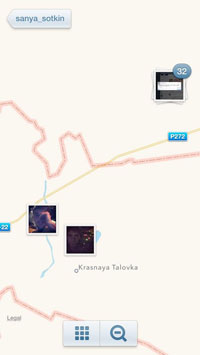
The picture here, incidentally, from the BuzzFeed page, shows the Ukraine-Russia border (the red lines) both above and below the apparent site of the pictures – this is a narrow part of Ukraine sticking eastwards into Russia.

However bullish Putin may be about the presence of his troops in Ukraine, it is unlikely that he will be thrilled to see that one of his soldiers has (presumably inadvertently) produced evidence which simultaneously shows him manning a missile launcher system and pins him to a location in Ukraine. Quite apart from matters of international comity (or at least the illusion of it), it is a weapon of this kind, from somewhere near this place, which blasted Malaysian Airlines Flight 17 out of the sky killing 298 people, including a large number of children.

That kind of crime outstrips any civil or criminal activity you can think of, but there are lessons here for more mundane offences. The eDiscovery lesson, in case that is not clear, is that all sorts of everyday devices capture, retain and publish evidence of time and place.

Apart from being a good illustration of something I bang on about a lot, it ties in with two other things I have seen this week. One is an article on Inside Counsel by David Freskos and Bryan Lee of FTI Technology called Using smart phone location services to help solve investigations.

It opens with a story of a defecting employee whose photographs of his former employer’s manufacturing plant carried GPS coordinates which were easily traced on Google Earth.

The article goes on to make suggestions both for investigators who may rely on such information (if they only remember to look for it) and on corporate policies about the use of such devices.

The second is the product description page for AccessData’s Mobile Phone Examiner PLUS which is in my recent electronic reading pile thanks to a recent tweet from AccessData which emphasises the ease and speed with which MPE+ supports eDiscovery with visualisation tools allowing you to see communication relationships among contacts and graphical data timelines. That page also has a link to an AccessData white paper called The Future of Mobile E-Discovery.

The third is a demonstration I saw this week of real-time collection of social media information – not just historic tweets or Facebook entries but those which are happening in real time. For myself, I don’t care who knows where I am and I am probably tweeting about it anyway. If you are spying on your employers’ warehouse or working on missile launches in occupied territory then you may have cause for concern.

Lawyers engaged in eDiscovery may think of this both positively and negatively – on the one hand, this is evidence which may make or break a case or, at least, bolster or undermine assertions made by a witness as to his or her activities. More negatively, it may be negligence or breach of duty to overlook the possibility of such data existing.

My thanks to tweeter @PME2014 for the pointer to the Ukraine article.

Posted in Litigation Support | Leave a comment

Comparing like with like and keeping eDisclosure fears in proportion

“E-disclosure is about being clever with the way you do document reviews. It’s about picking the right search terms, using a good provider and having a proper hosting platform.”

This sensible quotation, from RPC disputes head Geraldine Elliott, appears in an interesting article in The Lawyer of 28 July headed Special report: eDisclosure – trials and tribulations.

To my eye, the article includes some implied comparisons which paint a misleading picture: the overall cost of using one technology must be compared with the overall cost of using another or of using none, including the cost of time spent or saved; return on investment must include savings and strategic and tactical benefits, not merely expense over the life of a case; a few extreme examples of egregious disclosure failures do not justify disproportionately expensive disclosure exercises in all cases – that was the American way, and we want none of it here.

With one exception – confusing the word “sanctions” (as in “punishment for default”) with the consequences of that default, namely the entry of a default judgment for the sum claimed, I do not really disagree with the components of the article. Strung together, however, the overall impression is perhaps not quite as its separate contributors intended. As it stands, it reinforces the perception that eDisclosure is simply threatening, technical and expensive. It may be all those things, but lawyers who just conclude that new technology is too expensive without looking at it, who omit half the equation when comparing costs, and who read only the cases in which people screwed up, are unlikely to develop a rounded view.

The article includes interviews with people who are engaged in eDisclosure exercises, and includes discussions about the rule changes and case management strictness, and the different ways in which firms are managing electronic disclosure, as well as some references to cases which have not gone well for at least one of the parties.  I focus here on a couple of areas which I would have expressed slightly differently. Continue reading

Posted in Court Rules, CPR, Discovery, eDisclosure, eDiscovery, Electronic disclosure | Leave a comment

Conflicting positions on accessibility of data

Neil Cameron wrote recently about two different aspects of accessibility of data in an article called Update on US land grab for foreign emails. One is the demands made by the courts and authorities of one country (usually the US) in respect of data which lies outside their jurisdiction. The other is the so-called right to be forgotten. I am slow to come to it because I spent much of last week at the Sedona Conference Cross-Border Programme on the same and related subjects. They are simultaneously important and intractable.

As its title implies, the article leads on claims made by the US Government for emails held on Microsoft’s servers in Dublin. Privacy campaigners may claim this subject as their own, but it has much wider commercial implications than privacy. One of the subjects which comes up in the New York Times article to which Neil Cameron refers is the question whether Germany will allow its data to sit on Microsoft’s servers anywhere. This is sub-set of a wider question about the business lost by all US cloud providers as customers world-wide decide against keeping data within reach of US subpoenas as well as their spies (though I think you can take it that the spies have a wider range of investigatory tools at their disposal than the courts).

Neil Cameron was recently invited to give evidence to the House of Lords EU Sub-Committee F on the so-called “right to be forgotten” – he is no enthusiast for the unrealistic posturing of EU courts and politicians whose idealistic vision is uncluttered by any commercial or practical good sense. The second part of his article covers this separate but related topic.

His conclusion that we need “a new kind of global regulatory framework… for controlling electronic commercial and criminal activity on some kind of rational and universally agreeable basis” is obviously right. Before we can aspire to this at a diplomatic level, however, we first need a consensus at a state level within each relevant part of the globe. US spies have interests which do not align with those whose purpose is commercial comity; Chinese trade officials conflict with colleagues who guard Chinese “state secrets; EU privacy campaigners have legitimate fears about the use being made of private data by commercial organisations who themselves say that their expansion (and with it their contribution to the economy) depends on cross-border freedom of information as well as of goods and services.

Don’t hold your breath waiting for a global regulatory framework.

Home

Posted in Data privacy, Data Protection, Discovery, eDiscovery | Leave a comment

Daniel Gold joins Iris Data Services as Sales Engineer Director

I had noticed a couple of well-written and interesting articles on the Iris Data Services blog which I did not link to at the time, in part because no author was identified and I prefer to know whose words I am passing on.

I now know that they are by Daniel Gold, who has recently joined Iris Data Services as Sales Engineer Director. Encouragingly (from my point of view at least) Daniel Gold began his career as a lawyer, which perhaps explains why his articles are not a mere recital of technology points but are rooted in what lawyers want (or should want) to know.

Take for example his article Ending the Era of the Cookie Monster eDiscovery Sales Reps, published on 16 June. Its message lies in the paragraph beginning “Where is the business conversation?” and in the list of high-sounding but essentially meaningless stock phrases from sales reps which precedes it.

I liked also his article of 2 June whose title, What I Love Lucy Can Teach Us about eDiscovery, was guaranteed to catch the eye. Its focus is on two things – the bottlenecks in business processes from chocolate manufacture to eDiscovery, and its emphasis on the role of litigation support staff as case managers and project managers who are “instrumental in advising you on the best course of action to take with the data and working with clients”.

Interestingly, barrister Damian Murphy drew a similar parallel recently when speaking at the IQPC Information Governance and eDiscovery Summit in London. Referring to jobs he had had before becoming a barrister, he said that involvement in ice cream production had been as important as any other experience in learning how to manage eDisclosure projects.

You won’t find many barristers talking like that, just as relatively few sales engineers have a focus on the wider objectives of law firms and their clients.

Posted in Litigation Support | Leave a comment

Letting the punishment fit the crime as Mitchell gives way to Denton

What was over in moments, added a word to the law’s dictionary, led to countless spin-off cases and applications, cost millions in legal fees, ended reputations and, having left its mark, disappeared from the scene?

There is are curious parallels between “Plebgate” and the judgment called “Mitchell”, either of which could be described in this way. The original incident, the only event with a “-gate” suffix which actually involved a gate, was over in seconds; Andrew Mitchell lost his Ministerial job, one policeman went to prison, others were disciplined and a rotten branch of policing was given a long-overdue shaking; at least two libel cases ensued and the whole consequent series of investigations and civil and criminal claims will keep many lawyers in claret for long after we have forgotten both Plebgate and Andrew Mitchell.

It took Lord Dyson a few minutes rather than seconds to deliver the Court of Appeal judgment known as “Mitchell”, and its consequences have been similar to Plebgate. Millions of pounds have been spent since, in complying with the regime which the judgment spawned, in arguments and applications resulting from it, and in bringing claims against lawyers whose every minor default became a cause of dispute. It is suggested that “Mitchell” was the last straw for some solicitors, already hard-pressed to break even. Court lists were flooded with Mitchell-related applications. A spirt of co-operation, or at least of give-and-take, between solicitors, which had always oiled the procedural wheels, disappeared in a new climate in which lawyers felt it their duty to take every point in case they could “Mitchell” their opponents, and cases which could have proceeded toward trial were delayed as the “Mitchell” point was contested; one involved a delay of 46 minutes in serving a list of documents. Continue reading

Posted in Court Rules, CPR, Discovery, eDisclosure, eDiscovery, Electronic disclosure, Jackson Reforms, Lord Justice Jackson | Leave a comment

The UK Human Rights Blog – dispensing with legal advice you don’t like

The UK Human Rights Blog is maintained by barristers at One Crown Office Row. I come across it through the tweets of Adam Wagner.

Many of us have a broadly vague notion that human rights are a good thing and are aware, again in general terms, that David Cameron’s Conservative government takes a different view; it is not clear whether that is an ideological position or merely one which taps into the half-formed prejudices of a sizeable number of voters.

This week’s reshuffle has disposed of Cabinet members who are thought of as “for” human rights and replaced them with those who are in some ways “against”. In the process, Cameron has ditched wise legal heads and filled up the ranks with people whose minimal legal experience and personal ambitions will keep them in line with the government (that is, the party) line.

The position is, of course, more nuanced than that, and there is no better guide to it all than the UK Human Rights Blog. Today’s article by Adam Wagner is called The Tory human rights “car crash”, which explains in clear terms what has happened this week and what its implications are.

Regardless of your view on the UK’s position vis-a-vis “Europe” (that catch-all word which sweeps up so many different things), you cannot but be appalled at a government which replaces senior law officers of the Crown with inexperienced but compliant ones. Adam Wagner compares this with CEOs who sacks the legal team because they did not like their advice.

If (like me) you are easily confused by the various courts and related institutions which lie across the Channel, this recent mea culpa by the Guardian may assist.

Posted in Litigation Support | Leave a comment

Panoramic images of First World War battlefields

An article on Mail Online includes panoramic photographs taken by British cameramen during the Great War. Their primary purpose was to give both the staff and the front-line officers a broad picture of the positions opposite British trenches.

There are a couple of interesting before and after scenes, one showing the contemporary scene at two stages in the war and one comparing a wartime scene with the present-day view.

Posted in Litigation Support | Leave a comment

Nuix webinar on 30 July: Building the Business Case for Information Governance

Information Governance has been defined by the Information Governance Initiative as:


the activities and technologies that organisations employ to maximise the value of their information while minimising associated risks and costs.

That much seems reasonably straightforward. What is rather harder is to articulate a business case for spending money on meeting risks and uncovering benefits which, however easily described, are difficult to calculate.

This is the purpose of a webinar organised by Nuix with the title Building the Business Case for Information Governance which takes place on 30 July at 10 am PT / 1 pm ET / 6 pm BST. This is part of a series of IG-related webinars which I have mentioned before.

The speakers are Julie Colgan, Director of Information Governance Solutions at Nuix, and Brian Tuemmler, Information Governance Program Architect at Nuix.

Registration is here.

Posted in Litigation Support | Leave a comment

FTI Technology on cross-border eDiscovery around the world

Cross-border discovery was a minority interest when I started talking about it several years ago. It has now become a dominant subject as ai growing number of jurisdictions adopt data protection and privacy laws, as international trade increases, as more and more companies have shared ownership across borders and as regulators increasingly look at the global picture, not least of fraud and corruption.

FTI Consulting has feet in all the relevant jurisdictions and has been producing good advisory material, both written and in webinar form in recent months.

One was published in November of last year with the title Lawyers Beware of China’s Thorny Privacy Laws. My original web link to this has expired, and it is good to have another opportunity to uncover it. Written by Richard Kershaw of FTI and Michael Vella of the Shanghai office of Jones Day, this article took us well beyond the easily-made observation that China is very protective of its state secrets.

It explores four different scenarios – personal data on company devices, case-sensitive data on personal devices, the export of financial data to the United States and only then the fact that case data may include state secrets. When collecting data in China, the article says,

nobody knows what the data include until they are reviewed. Thus, counsel needs to implement a due diligence protocol to mitigate the risk of unintentionally violating the State Secrets Law.

A more recent article by Richard Kershaw, published last month, expands on the difficulties in the region. This title is A Catch-22 in Asian eDiscovery which describes the central problem thus:


If organisations provide personal information in response to US and EU subpoenas, they could be confronted with fines and criminal prosecution in many Asian countries. If companies don’t, they could be subject to sanctions in the United States and Europe.

The problem is getting no easier, Richard Kershaw says:

The US government is quite unsympathetic to the bind its investigations can put companies in.

As the article goes on to make clear, the problem is not created solely by US regulators, still less by US litigation, plentiful though that may be. Regulators in Hong Kong and Singapore, the article says, are “becoming quite aggressive” whilst “the Chinese government also is flexing its regulatory muscle”.

Richard Kershaw puts the solutions under three main headings – know the laws, know the technology and be prepared. It is clear from the rest of his article that these steps are merely the starting point for understanding and dealing with Asian eDiscovery in a practical, as well as a lawful, way.

Lastly, for the moment at least, FTI has presented a Global eDiscovery Series of webinars which looked separately at cross-border issues in Latin America, Europe and Asia. I took part in two of them. If you want an easily accessible guide to cross-border eDiscovery issues around the world, this series is a convenient way of getting it.

Posted in Litigation Support | Leave a comment

Port Meadow is now dry enough to walk across

Posted in Litigation Support | Leave a comment

My Q&A with Recommind on eDisclosure, Mitchell and US-UK discovery differences

Nick Patience of Recommind was kind enough to ask me to take part in a series of written Q&A posts on Recommind’s Mind Over Matters blog. They have recently published similar discussions with Patrick Oot of Shook, Hardy & Bacon and of the eDiscovery Institute, and with David Horrigan of 451 Research, so I am in good company. My piece appears here.

The questions reached me shortly after the Court of Appeal’s decision in Denton and two other cases known collectively as “Mitchell 2″. I was in slightly jaundiced mood as a result of all the time and money which has been wasted as a result of the original decision, and it shows in my answers. My own post about Denton and eDisclosure will appear in due course.

I was asked, amongst other things, if there are “any lessons from the US experience with eDiscovery that are instructive for UK lawyers? Yet more jaundice is evident from my reply which includes the comment that I launched the eDisclosure information Project, in part, “to correct the idea that eDiscovery must always be disproportionately expensive in the US style”

Nick Patience, Drew LewisPhil Favro and Jonathan Wiley of Recommind have kindly extracted sentences from the blog post which together provide a good summary of it. They are given in this Storify.

Posted in Litigation Support | Leave a comment

Bringing eDiscovery in house with an AccessData Summation Appliance

I wrote recently and at some length about the fact that corporations are increasingly deciding to take some or all of the eDiscovery function in-house.

Even as I was writing that article, AccessData announced the launch of two tiers of appliance designed to give companies a solution which can be brought in house at once, which is not dependent on the company’s own servers, and which comes with a support package which includes remote implementation, knowledge transfer and other elements needed to minimise the burden on the company’s own support staff.

The Summation Appliance brings the power and functionality of AccessData’s Summation in a ready-to-use package. Alternatively, AccessData offers the Managed, In-House eDiscovery Appliance, a customised and preconfigured server running AccessData’s eDiscovery solution, including legal hold management, data identification and preservation, collections of structured and unstructured sources and web-based early case assessment, as well as Summation for review.

Keith Schrodt of AccessData has described the rationale behind these tools, as well as the appliances themselves in an article called Bring eDiscovery Hardware In-House for More Control, Flexibility and Improved Results. In addition to its own full description, the article has links to product descriptions and some user quotations which serve as references for the product and the its solutions.

Posted in Litigation Support | Leave a comment

Some practical success stories with Equivio Zoom

Equivio Zoom is a package of data tools which embraces several of Equivio’s free-standing technology tools. Near-duplicate detection, email threading and, not least, Equivio’s Relevance predictive coding tool are bundled together in a single suite whose purpose is to suppress redundant data and bring forward the things which matter.

Among many other features, Equivio Zoom has two particular design criteria relevant. One is simplicity of appearance and ease of use – an Equivio Zoom user screen is uncluttered, with the fewest possible options consistent with user control. The other is that predictive coding appears in its proper place as just another tool to be pulled down and used when it is appropriate to do so.

During 2013, Equivio started a programme of education which was designed to be product-neutral and to focus on the concepts, on the practical use and on the benefits of predictive coding / technology-assisted review. One limb of this educational initiative involved missionary initiatives, Equivio’s people going out into corporations and law firms to explain the subject. The other was a series of webinars called Predictive Coding Minus the Hype which broke the subject down into its components and explained them clearly.

Part of this series has been captured in an article by Barclay Blair of the Information Governance Initiative and of ViaLumina LLC and published by Metropolitan Corporate Counsel as an article called Success Stories from Three Years of Predictive Coding.

Barclay Blair took four cases managed over three years by eDiscovery service provider D4 who had rigourously tracked data from its predictive coding cases and refined its predictive coding workflow with each succeeding case. Barclay Blair’s article took four specific cases managed by D4, each slightly different and each illustrating statistically how the use of the predictive coding component of Equivio Zoom produced a good result for the clients.

The four specific cases were described by Barclay Blair as follows:

Case 1: “The Document Dump” (A large-volume, incoming production)

Case 2: “A Merger at Risk – When Speed Matters” (A large-volume, limited-time, second request)

Case 3: “High Cost/Low Merits” (Potentially high discovery costs and low merits)

Case 4: “The Pressure Cooker” (A discovery scope expansion with no change in production deadline)

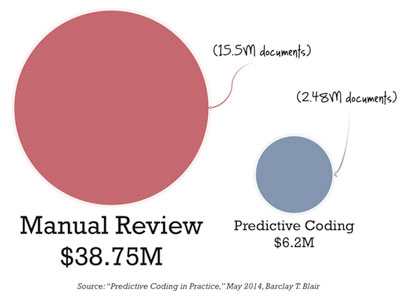
As Barclay Blair says in his introduction, “these case studies not only tell the story of cost savings, but also the strategic value of getting to key data faster.” As always, Barclay Blair illustrates his article with crisp, instantly-comprehensible graphics.

Those who found the early marketing hype off-putting, incomprehensible or both will find in this article a lucid explanation as to how the proper use of this technology saved money.

If you want to read more about predictive coding retrospective case studies, I have written recently about a white paper by Winston & Strawn on the Equivio website called The Tested Effectiveness of Equivio Relevance in Technology Assisted Review which describes that most valuable of comparative studies – different approaches and tools applied to the same data set.

Posted in Litigation Support | Leave a comment

Barclay Blair on the definition of Information Governance

An article by Barclay Blair called Pulling out the red pencil: one more last time on the definition of Information Governance? links to various posts about what IG does and does not mean.

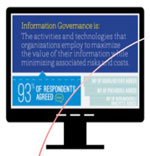
93% of those asked agreed on the definition put forward by the Information Governance Initiative, which was:


The activities and technologies that organisations employ to maximise the value of their information while minimising associated risks and costs.

None of us but Barclay is likely to read all the linked posts, but I particularly commend those by George Parapadakis which are referred to in Barclay’s article.

Posted in Litigation Support | Leave a comment

UBIC wins praise from corporate clients for its forensic tools


The best references come from happy clients, and UBIC is obviously pleased to be able to report that two major pharmaceutical manufacturers have praised the investigations and analysis support solutions in UBIC’s analytics review platform Lit i View.

There is a press release about this here.

I wrote last week (see my article here) about the way legal work, not least eDiscovery work, is moving, either being taken in-house by corporations or being distributed wherever it can be done most efficiently. Here we have evidence that some corporations are taking more control of their own eDiscovery fates.

Posted in Uncategorized | Leave a comment

Technical competence an ethical obligation in eDiscovery


As I have mentioned before, the new Recommind blog is a source of useful ideas on the development of eDiscovery practice.

A recent article by Drew Lewis is called You say you want a revolution in eDiscovery? We’d all love to see the plan. Whilst this is self-consciously a US article (its opening quotation is from Jefferson) it has more universal application because of its messages about things like: 

  • lawyers who “inexplicably argue that their cases do not involve any electronic information” 

  • failures to take the most basic steps to preserve that information 

  • lawyers who do not take the trouble to find out what technology exists which may improve the quality and reduce the time and cost of eDiscovery. 

In the US, ignorance of technology is a breach of an express ethical obligation. In the UK and most other common law jurisdictions we do not feel the need to enshrine every obligation in a set of rules, but few could argue with the idea that lawyers ought to know the best and most cost-effective way of achieving their clients objectives whilst keeping the costs down.

Posted in Uncategorized | Leave a comment

Oxford City Council snoops on its citizens from the air

An article in the Oxford Mail – ‘Spyplane’ above city sparks concern over privacy – reports that Oxford City Council has been hiring an aeroplane to criss-cross the city to gather information about unlawful annexes. The news has sparked concern, not least because the council has given no destruction date for the resulting data and has already thought of at least one collateral purpose for it.

Oxford is one of those councils which recently tried to force taxi drivers to install CCTV equipment to allow constant video monitoring of passengers. Like so many people at the bottom end of the public service pond, they thought nothing either of the cost (all private enterprises are capitalist pigs to a certain kind of public servant) nor about the privacy concerns. I wrote about it – Oxford tramples on privacy with CCTV in taxis – before Oxford City Council was forced to back off.

More recently, it has become clear that Oxford City Council’s planning department is staffed by people who are incompetent even by the low standards of this authority. The construction of some particularly ghastly blocks of flats across the view at the end of a much loved meadow was recommended after an officer’s reading skills were not up to detecting a blatant lie about visibility made by the applicant, the University of Oxford; he also seems to have been bewildered by all those syllables in “environmental impact assessment” so we now have to have one retrospectively.

The dim little pen-pushers who believed that there would be only “glimpses” of these flats are now hiring planes to snoop on Oxford

It is people of this calibre who have now been hiring planes to snoop on council tax payers. This, to me, is the real problem with the erosion of privacy – one can see, perhaps, that MI5 might have a need for such data but when the dumb animals at the lower reaches of public authority can snoop to their hearts’ content, we have gone too far.

Posted in Uncategorized | Leave a comment

Nuix paper – Investigate Workstation 5.2

Nuix has published a paper showcasing the processing power of its Investigate Workstation 5.2 and showing how it helps investigators deal with the growing datasets encountering digital investigations.

There is a link to this paper here.

Posted in Uncategorized | Leave a comment

Mr Justice Flaux takes charge of the Commercial Court

Mr Justice Flaux has been appointed by the Lord Chief Justice as judge in charge of the Commercial Court with effect from 3 July. The media release is here.

Anything I know about him is anecdotal, but anecdote suggests that he is rather more alive to the commercial imperatives of clients and their lawyers than some of his judicial colleagues, knows that “active management” implies something proactive, and knows that technology has moved on a bit since he was a pupil. We shall see.

Posted in Uncategorized | Leave a comment

Lawyers On Demand knows how to appeal

This is about good marketing rather than eDiscovery / eDisclosure.

The business of Lawyers on Demand is matching the temporary requirements of in-house legal departments with the talents of lawyers who disdain the implications of full-time employment and instead offer their services on a short-term or temporary basis.

Lawyers on Demand recently recruited Tim Bratton from his post as General Counsel at the FT. I know him through Twitter and from talks which I have heard him give on how to use social media in support of personal or corporate marketing.

LOD had a certain style in its marketing anyway before Tim Bratton joined, and I don’t think that he is responsible for an initiative which caught my eye last week. It consists of nothing more than a set of Instagram photographs taken by some of the LOD lawyers while working for their clients on-site or remotely. The results can be found here.

There is no high-quality professional photography here, no fancy marketing-speak and none of the polish which marketing departments quite rightly give to most of their output – LOD’s own website is an example of that. All we see are some rough-and-ready pictures of the places in which the LOD lawyers are working. Some of them are conventional enough, showing office blocks or an airport. Others are domestic in every sense of the word, showing gardens or home interiors. There is a dog in one of them, some alpacas in another; we see a comfortable chair and a couple of beaches.

You could write a thousand words of carefully-honed prose to try and convey to potential recruits how nice it would be to work for LOD. These photographs work much better, proving that simple is best.

Posted in Uncategorized | Leave a comment

iCONECT XERA now available on Aquipt MatterPoint Platform

iCONECT, makers of the XERA eDiscovery platform, have reached an agreement with Aquipt to make XERA available on Aquipt’s MatterPoint infrastructure.

eDiscovery platforms, particularly those designed to handle very large volumes of data as XERA is, need an appropriate hardware platform in order to deliver the best results in the fastest time. This arrangement ensures that iCONECT’s clients can easily find suitable infrastructure with the speed and capacity, as well as the resilience and security, which is required.

Not the least of the advantages of this is the ability for users to scale on demand, both as to the infrastructure and for XERA licensing.

There is a press release here.

Posted in Uncategorized | Leave a comment

HP Autonomy web event on 23 July: Meg Whitman – Big Data changes everything

HP Autonomy is giving a web event on 23 July 9:30am PDT at which HP President and CEO Meg Whitman will lead a discussion and Q&A about how Big Data is changing the future of business.

The other speaker is Robert Youngjohns, Executive VP at HP software, and the theme will be how HP software can deliver “collective intelligence” which brings together human information, business data and machine data.

Further information and registration can be found here.

Posted in Litigation Support | Leave a comment

Guidance Software webinar on 16 July: the intersection of privacy, security and eDiscovery

Guidance Software is presenting a webinar on 16 July which considers the balancing act between privacy, security and eDiscovery, not least because data breaches another security failures give rise to criminal sanctions and civil litigation.

There is a growing awareness of the importance of individual privacy, even in the US, at a time when security considerations often seem to trump privacy.

The speakers in this webinar are David Horrigan of 451 Research, an Analyst and Counsel who covers the Information Governance and Compliance aspects, Ed McAndrew, U.S. Attorney’s Office, Assistant U.S. Attorney and Cybercrime Coordinator, whose view is from the government side, and Judi Uttal, Senior Product Marketing Director at Guidance Software.

They will discuss:

  • Historical, cultural and legal backgrounds of data privacy
  • A Federal government perspective on current cybersecurity issues
  • E-discovery in terms of laws, relevant court cases, pertinent security events, and government agency involvement

Registration is here.

Posted in Litigation Support | Leave a comment

FTI Technology offers FCPA Toolkit

However fast you think your litigation will move, an investigation under the Foreign Corrupt Practices Act (FCPA) will probably require even more urgent attention. It will also, potentially, have wider implications than civil litigation, and the penalties for getting it wrong can be severe.A recurring element in FCPA investigations is the need to deal with discovery in multiple jurisdictions, raising serious practical issues when the privacy and data protection regimes in other jurisdictions conflict with the FCPA demands.

To help with this, FTI Technology has assembled an FCPA Toolkit which covers, amongst other things, the best ways to handle discovery in an FCPA context including:

The evolving data privacy regulatory environment in Europe

Key “dos and don’ts” for maintaining data privacy compliance in response to an FCPA investigations

Case study examples shown best practices in international discovery.

You can find FTI’s FCPA Toolkit here.

Posted in Litigation Support | Leave a comment

Direct digital court access for Netherlands citizens

Judge Dory Reiling is a senior judge in Amsterdam and author of Technology for Justice, a book on improving access to justice with information technology.

Here is an article on her blog, also called Technology for Justice, called The eKantonrechter: direct digital court access for citizens describing a system which she and her team have developed to give citizens direct access to the courts by the use of technology.

Judge Reiling one of the judges on a panel which I will be moderating at LawTech Europe Congress 2014 which takes place in Prague from 19 to 21 October. Our subjects will include various aspects of the use of IT for the administration of justice in different jurisdictions.

Posted in Uncategorized | Leave a comment

Take your legal work in, put your legal work out. In, out, in, out, shake it all about

The Hokey Cokey, whose words I bastardise for my title, proves to have national variants, rival sources and alternative meanings, not all of them positive.  You can fight about that among yourselves. All I want from it is the idea that legal work (the work in support of a legal function, I should perhaps say) is heading in two directions. Some companies are taking more in house, others are distributing it. Most will “shake it all about” this year. An article by Xerox Litigation Services puts eDiscovery / eDisclosure software and services into the mix.

Sometimes a batch of related subjects comes at you at about the same time, making it easy to assume that the subject is on everyone’s lips. That may, of course, be a false conclusion derived from the fact that we select our sources to reflect our interests – the websites we visit and the people we follow on Twitter will have been chosen because their interests (though not necessarily their opinions) match our own. Nevertheless, if a subject recurs, there is probably something worth investigating.

A theme which came up recently for me, in different places, was about how companies get their legal work done and how law firms deliver services at a cost which is acceptable to the client whilst giving them a profit. Professor Richard Susskind has long sneered at law firms whose response to downward pressure on fees is simply to knock 5% or 10% off their hourly rates. We have moved beyond that to serious thought, by both companies and law firms, about who should do the work and where it should be done. The answer to these questions may involve thinking afresh about the distribution of work within the company or firm; it may involve collaboration with outsiders who can perform discrete functions in a way which reduces cost whilst maintaining quality.

XeroxMost of the sources which come my way are likely to have an eDiscovery / eDisclosure or litigation context, but the subject obviously goes wider than that. A US article from Xerox Litigation Services and Bryan Cave, whose self-explanatory title is Corporations moving into the eDiscovery drivers’ seat, is my destination, but my route to it goes via UK articles, none of which are specifically focussed on litigation. Like the Hokey Cokey, the ideas turn up in broadly similar form in different countries. We say “Cokey”, they say “Pokey”; we say “eDisclosure”, they say “eDiscovery”; the broad concepts are the same. Continue reading

Posted in Discovery, eDisclosure, eDiscovery, Electronic disclosure, NightOwl Discovery | Leave a comment

Epiq Systems webinar on 9 July: Four steps to successfully migrating legal hold systems

Epiq Systems have a webinar on Wednesday 9 July at 10.00am PDT with the title Four steps to successfully migrating legal hold systems.

As with all software, legal hold systems have developed to meet new standards – standards set by court rules and cases, by greater volumes and higher demands for speed and defensibility. What happens when you have to migrate your legal hold systems to a new system?

The speakers are David Rohde, Senior Director, Consulting Services at Epiq Systems and James FitzGerald, Senior Director, Strategic Partnerships at Exterro. The moderator is Ed Burke, Senior Vice President, Document Review Services of Epiq Systems.

There is more information here, and Registration is here.

Posted in Litigation Support | Leave a comment

US Magistrate Judge John Facciola announces his retirement

US Magistrate Judge John Facciola has announced that he will retire later this year. The eDiscovery world will feel smaller without him. Those of us who believe in the efficient, just and competent management of electronic discovery will be sorry to see him go. Government agencies with broad unfocused discovery requests, and lawyers whose competence does not extend to 21st-century technology will perhaps be less sorry.

I first met him at a round table at the Willard Hotel in Washington in 2007. Quite apart from his invaluable contribution to the discovery discussion, he told us how, many years before, he had watched the wreckers’ ball rumbling up Pennsylvania Avenue on its way to demolish the hotel. A last-minute injunction had saved it. John Facciola is full of such stories; they and the good-humoured way in which he tells them, are the sweetness which make his often fairly sharp medicine go down as he lays into those parties and lawyers who could have made the whole process better but passed up the opportunity.

Facciola1Judge Facciola’s 2009 speech at LegalTech in New York at which he laid into lawyers who were not competent to conduct eDiscovery in an electronic age.

I have told before how IQPC years ago asked for my recommendations for US judges for a panel in London. “Ask Judge Facciola and Judge Grimm” I said, much as one might suggest asking Pavarotti and Domingo to a local singalong. A few days later, IQPC sent me a message – “We have got them. What would you like to do with them?”

Patrick Burke, now at Reed Smith but then with Guidance Software, and I put together a panel involving those two American judicial stars, with HHJ Simon Brown QC and the then Senior Master Whitaker representing the UK. We did it more than once, and it went down very well. I used to write playlets, a form of light entertainment in which Judges sent up themselves and the system with pastiches of eDiscovery opinions and judgments. John Facciola played his parts with good humour and a light touch which might have surprised those who came before him in his court with extravagant demands or badly prepared eDiscovery arguments.

Facciola2

5 judges perform one of my eDiscovery playlets. Judge Facciola is 2nd left

I took part in two events in his company at the tail end of last year, one at the ASU Arkfeld event in Arizona and one with UBIC in Washington. At both of them he combined wisdom withhumour, the velvet glove of mirth masking the iron fist of criticism for those who couldn’t be bothered to get it right – to read the rules, to understand the cases, to get their heads rounUBIC Seminar in Washingtond the technology, and to cooperate. Here’s a link to my report of the UBIC event, much of which is taken up with my account of Judge Facciola’s talk.

I understand that John Facciola will continue to give us the benefit of his wisdom outside the court. I wish him a long and happy retirement and I hope that US discovery practice will live up to the ideals which he set out.

Posted in Discovery, eDiscovery | Tagged | Leave a comment

Nick Rich of Epiq Systems talks about foreign-language eDiscovery in Hong Kong and Asia-Pac

Nick Rich is a consultant with Epiq Systems in London. He was at the InnoXcell Legal Big Data Symposium 2014 held in Hong Kong in March 2014 where he led a live demonstration of audio transcription from Mandarin as part of a panel session about all the implications raised by such languages.

The problem, he observes, begins with collection, but the technology now exists to manage analysis, culling and prioritisation with a view to reducing the amount to be reviewed and to produce audio data in a form which is usable by the court and by opponents.

Posted in Litigation Support, Video | Leave a comment

Jennifer Qian of Epiq Systems talks in Mandarin about non-English eDiscovery in AsiaPac

We asked Jennifer Qian of Epiq Systems in Hong Kong to tell us about how Epiq deals with the difficulties posed by non-English documents when giving electronic discovery in the Asia Pacific region. It made sense to ask her to do so in Mandarin, and this is what she does in this video.

Posted in Litigation Support, Video | Leave a comment

Celeste Kemper of Epiq Systems discusses Hong Kong eDiscovery and non-English language discovery

Celeste Kemper is Director of Document Review Services Asia for Epiq Systems. In this interview, Celeste talks about the imminent eDiscovery Practice Direction for Hong Kong which, she says, meets a long-felt need in the jurisdiction.

Celeste Kemper also talks about Epiq’s handling of foreign language audio, in particular Mandarin, which was the subject of a live demonstration during the event.

Posted in Litigation Support, Video | Leave a comment

Epiq explains multilingual eDiscovery in English and Mandarin

One of the sessions which stood out at the InnoXcell Legal Big Data Symposium 2014 in Hong Kong was a demonstration by Epiq Systems of its ability to handle audio eDiscovery in multiple languages.

With high-wire bravado, Epiq did this live, with passages read out in both English and Mandarin. It worked well, and was certainly different from the usual platform and podium sessions. There is no substitute for showing software in action, and audio is a little more dynamic than mere text.


Celeste Kemper
, Director, Document Review Services Asia for Epiq Systems and Nick Rich, a consultant with Epiq in London, took the lead on this performance.

Afterwards, we took the opportunity to interview each of them. It seemed appropriate also to ask Epiq’s Jennifer Qian to explain the system in Mandarin.

The videos can be found here:

Celeste Kemper

Nick Rich

Jennifer Qian

Posted in Litigation Support | Leave a comment

Public access to the Bar

Here is a good article by Jeremy Hopkins of Riverview Law explaining what is – and is not – implied by recent publicity about barristers qualifying to undertake public access work: Public Access to the Bar – main event or sideshow?

Posted in Uncategorized | Leave a comment

Looking beyond the Gartner Magic Quadrant for eDiscovery Software

Gartner’s annual Magic Quadrant for eDiscovery software was published last week. I am not sure that I am authorised to publish it, but you can find several copies of last year’s version on the web. I wouldn’t worry too much about the differences if I were you.

There are various reasons why I usually avoid writing about the Gartner eDiscovery Magic Quadrant. One is the fact that many of those who sponsor the eDisclosure Information Project appear in it somewhere; it would be invidious for me and rather dull for you if I were to pass on each of their press releases – if I do that with one, I must do it with all. Does a recital of names interest anyone without the detail which you can find in the report or by doing a quick Google search for the report’s name?   Quite apart from anything else, I have a policy of avoiding lists, mainly because it is too easy to leave somebody out; I broke that rule last week and it took a little over ten minutes before a (mock-)hurt reaction came in from the person I had failed to mention.

David Horrigan of 451 Research has written about the Magic Quadrant for Law Technology News and he asked me for a few words. His article is headed Stagnant Magic Quadrant for 2014 E-Discovery,  and I am quoted as being “sceptical” with this:

I am no great enthusiast for lists which purport to rank e-discovery software providers, feeling that even Gartner’s sophisticated model does not do justice to the range of factors which contribute — or which ought to contribute — to the decision-making. Continue reading

Posted in Discovery, E-Discovery Suppliers, eDisclosure, eDiscovery, Electronic disclosure | Leave a comment

Why not simplify civil procedure?

An article in the NLJ called The simple approach by Richard Langley makes the suggestion, obvious to all except the rule-makers, that costs could be reduced by simplifying the CPR.

Posted in Uncategorized | Leave a comment

FTI webinar on 25 June – find facts fast

The focus on eDiscovery process in recent years has somehow obscured the fact that the purpose of electronic discovery / eDisclosure is to find the facts which will determine the strategy and tactics of a case as well as its outcome.

That becomes increasingly expensive to do so using traditional methods, and recent years have seen the development of advanced analytics and workflows designed to find the evidence at proportionate cost.

This is the subject of a webinar by FTI called Find Facts Fast: a how-to guide for smarter eDdiscovery, which will be broadcast on 25 June at 2:00pm EDT.

The speakers are Gareth Evans of Gibson Dunn & Crutcher, and David Grant and JR Jenkins of FTI technology.

You can find more information and registration details here.

Posted in Litigation Support | Leave a comment

Jonathan Maas and Serge Poldi join Huron Legal in London

The last time I wrote about Jonathan Maas, word came back to me that the only words missing were that “He was a devoted husband and father”; what was meant to be a set of compliments apparently read like an obituary. I also omitted that other staple of British obituary – “He did not suffer fools gladly” – which I suspect he would accept, at least in its literal meaning.

All this circumstantial stuff is by way of introduction to the fact that Jonathan Maas has been appointed Senior Director of UK Client Services for Huron Legal in London. At the same time, Serge Poldi has been appointed Director of UK Discovery Operations.

Serge Poldi’s role is the management of daily technology operations and technical leadership. Jonathan Maas will oversee discovery services in the UK and in Europe. The press release is here with further information about the roles.

These appointments show a serious commitment to expanding Huron Legal’s eDiscovery services on this side of the Atlantic. Jonathan has 30 years experience in an industry which is not much older than that and brings a combination of gravitas and a light touch to a business which he knows as well as anyone.

Those who know of Jonathan’s long-running Bong List will know that he has a wide range of interests not limited to those of his work and will be glad to note that he is continuing it at Huron Legal. Send him a message at jmaas@huronconsultinggroup.com to be put on the mailing list.

I don’t think it will be long before we start seeing the effect of these appointments, and I look forward to being part of the initiatives which will follow – I already have been, in fact, having taken part in a Jackson-related event which Huron Legal organised at the Law Society a few weeks ago. I will be writing about that shortly.

Posted in Litigation Support | Leave a comment

Guidance Software webinar today: International eDiscovery – data protection, privacy and cross-border issues

I am the moderator of a Guidance Software /  Inside Counsel webinar taking place today at 2.00pm ET / 11.00pm PT / 19.00 BST with the title International eDiscovery: data protection, privacy and cross-border issues.

I will be joined by Patrick Burke of Reed Smith, Scott Cohen of Winston & Strawn and Chad McManamy of Guidance Software. We will describe the basic elements of non-US data protection, explain how best to resolve the obvious conflict with US eDiscovery demands, and suggest practical ways of minimising the difficulties and the costs of dealing with cross-border eDiscovery.

My first ever cross-border eDiscovery session was done in the company of Patrick Burke many years ago, at a time when most US lawyers were still incredulous at the idea that foreign jurisdictions would not submit willingly to US eDiscovery demands. We have moved on a bit since then, evolving strategies both in-country and in the US courts. The starting point is to understand what the issues are.

The Inside Counsel registration page is here.

Posted in Litigation Support | Leave a comment

AccessData webinar today: Mobile Phone Examiner Plus overview

If lawyers need to understand the range of data (that is, potential evidence) which might be held in a mobile phone or similar device, forensic examiners need to know what tools are available to them to uncover that evidence.

That is the subject of a webinar to be given by AccessData today called MPE+ Overview. Kevin DeLong, Director of Computer Forensics Training at AccessData will demonstrate the latest and most popular features of Mobile Phone Examiner Plus from the basics through to the extreme.

Registration is here.

Posted in Litigation Support | Leave a comment

Nuix Web Review and Analytics, a webinar and the Nuix User Exchange

Much of the talk at Techno Security in Myrtle Beach was about the new Web Review and Analytics tool from Nuix which allows investigators, lawyers, subject matter experts and anyone else who needs it to have secure and compartmentalised access to case data through a web browser.

There is a product information page here which in turn gives access to the Nuix Web Review and Analytics fact sheet.

Nuix is running a webinar on 16 July at 10am PT / 1pm ET which covers Nuix 5.2 and specifically Nuix Director and the Web Review and Analytics. The speakers are Nuix engineers Simon Bayangos and Matthew Geaghan. Registration for the webinar is here.

While on the subject of Nuix, here is Nuix’s page about the Nuix User Exchange 2014 which will take place at Huntington Beach California from 14 to 16 September. This is a three-day educational event which aims to help users to increase their knowledge of Nuix’s software, and to talk to Nuix and to each other.

Last but not least, here is a video with some interviews with enthusiastic delegates at Techno Security. I would have passed it on anyway, but do so particularly because my son William Dale filmed and edited it.

Posted in Litigation Support | Leave a comment

Mark Harrington of Guidance Software talks about the challenges of BYOD for General Counsel

Mark Harrington is Corporate Secretary and General Counsel at Guidance Software. Chris Dale of the eDisclosure Information Project interviewed him at CEIC in Las Vegas about the challenges which Bring Your Own Device – BYOD – gives to General Counsel

BYOD has happened quickly and by stealth, subverting the control which IT and security departments thought they had gained over a company’s information. There is a conflict between the benefits of this and the dangers, not all of which are obvious. People work better with devices which they are used to and which get the job done; on the other hand, questions arise about control and security, about the existence of data for eDiscovery and similar purposes, and for the availability of data as a business asset. Questions like who owns the device and who owns the data arise, as do privacy considerations.

Mark Harrington talks through these points, suggesting how companies should establish policies to help reconcile these conflicts.

Posted in Litigation Support, Video | Leave a comment

UBIC training in Japan for eDiscovery and for law enforcement investigators

Two press releases from UBIC emphasise its commitment to easing the path of those engaged in US eDiscovery and investigations.

The first is aimed at law enforcement investigators in Japan and involves training in the use of UBIC’s Lit i View Xaminer software, a digital forensics tool used by law enforcement to identify and investigate cases of corporate fraud and other illegal activities. The press release about that is here.

The other is a broader training aimed at educating Japanese corporate officers in the practical aspects of dealing with US-style eDiscovery. Discovery is, of course, not exclusively US concept, and Japanese corporations are increasingly faced with it in other jurisdictions as well. Many of the concepts are similar across all common law countries, and Japanese corporations can be at a disadvantage if they do not understand it. That is described in a press release here.

Posted in Litigation Support | Leave a comment

Nuix Information Governance webinar series

Nuix is running a series of webinars about Information Governance.

The first was called The real story of what IG is and why you should be doing it which is now available for On-Demand viewing.

There are three more in the series, called respectively Breaking IG down to enable action, Building the case for IG and Operationalising IG, taking place during June, July and August.

There is more information here about these webinars, including the dates and registration details, here.

The presenters are Julie Colgan, Director of Information Governance Solutions at Nuix and Brian Tuemmier, Information Governance Program Architect at Nuix.

Posted in Litigation Support | Leave a comment

iCONECT honours its partners Avansic and DTI

eDiscovery software providers are increasingly recognising, and publicly, the role which their partners play in giving technical support and other benefits to the users of their software.

I have mentioned Equivio and kCura recently in this context, both of whom have formal designations for those who work with them. iCONECT has a similar programme and has recently given a Platinum Partner award to Avansic and a Silver Partner award to DTI.

As I reported recently, iCONECT has a new version of its XERA review platform out, with enhancements designed to make it easier – and therefore quicker – for reviewers to understand what documents they have and what their significance is.

Posted in Litigation Support | Leave a comment

Information Governance – what it is and why we need it

ZyLAB and the Information Governance Initiative join forces to spread some light about Information Governance in an on-demand webinar.

The Information Governance Initiative is a cross-disciplinary think-tank and consortium dedicated to advancing information governance practices and technologies. It is supported by many of the technology companies whose software and skills transfer easily from electronic discovery into the prior and wider field of information governance.

Screen Shot 2014-06-12 at 22.03.33One of those companies is ZyLAB, whose range has long extended into what is now called information governance, with software solutions designed to help companies manage the data which they possess for positive purposes as well as for the reactive and defensive purposes of dealing with eDiscovery and investigations.

One of the principal architects of the information governance initiative is Barclay Blair of ViaLumina. One of the most highly-regarded speakers on corporate data management is Mary Mack, Enterprise Technology Counsel at ZyLAB. They come together in a recently-broadcast webinar which is now available for download here. Its title is Information Governance: what it is and why we need it, and it gives a first rate overview of this increasingly important subject, and at a practical level. The IGI’s own page about the webinar is here.

Barclay Blair begins by setting up some of the claims for information governance, only to knock them down into practical reality. There is talk, he said, of data as “the new oil” and “a new asset class” and we are told of the great things that data can do for us, with thousands of jobs to be created as companies recognise that 60 to 70% of their data is at best junk and at worst toxic.

All that is true, Barclay says, but his purpose is to examine what he describes as “the disconnect between breathless data talk and reality”. How in practice should companies tackle this data and who should run the project? Continue reading

Posted in Defensible deletion, Discovery, Document Retention, eDisclosure, eDiscovery, Electronic disclosure, Information Governance | Leave a comment

Judge David Harvey, District Court in Auckland NZ

Here is Judge David Harvey, a District Court Judge in Auckland New Zealand, speaking at the InnoXcell Legal Big Data Symposium 2014 held in Hong Kong in March 2014. What he says to camera is a first-rate summary of of what he had said on the judicial panel on the previous evening.

The most important part of this interview is Judge Harvey’s undeniably correct assertion that judges and lawyers must work together in the case management of electronic discovery, each armed with sufficient understanding of the technology – what it does, what it costs, when to use it and what its benefits are – which is available to manage large volumes of documents and data.

There are few judges in common law jurisdictions outside the US who are capable of articulating this with the knowledge and understanding which Judge Harvey brings to it. There are links here to a paper which he presented at the conference

scribd.com/doc/221463957/Reasonable-and-Proportional-Discovery-in-the-Digital-Paradigm-The-Role-of-Lawyers-and-Judges-in-the-Context-of-the-New-Zealand-Discovery-Rules

and to an article which he wrote after it: theitcountreyjustice.wordpress.com/2014/05/01/e-discovery-and-asia-legal-big-data/

Posted in Litigation Support, Video | Leave a comment

Recommind webinar on 19 June: Power and Simplicity in Action

Companies with something new to sell will often labelled it “Pro” or “Advanced” in order to stress its sophistication and modernity.

In a shrewd move, Recommind describes its new Axcelerate 5 as having a “consumer grade interface” which neatly suggests the desirability of screen forms and workflows which are designed to help the everyday user – in this case the lawyer who just wants to get the eDiscovery job done.

Neil Etheridge and Hal Marcus of Recommind are giving a webinar on 19 June at 2:30pm BST / 3:30pm CEST called Power & Simplicity in Action with the tagline “Powerful technology is rarely that simple… Or is it?”.

Registration is here.

Recommind has a new blog as a home for the steady flow of interesting and well-written articles which come from its well-regarded writing team.

Dean Gonsowski, Philip Favro, Drew Lewis and Hal Marcus have been steady contributors. Nick Patience and Alexis Clark contribute from time to time, and the writing team has now been joined by Adam Kuhn.

Recent articles include Q&A discussions with David Horrigan of 451 Research and with Patrick Oot, now at Shook Hardy & Bacon. Other topics covered recently include the interplay between proportionality and predictive coding, the eDiscovery complexities of mobile devices, defensible deletion of useless information and the impact of California’s eDiscovery ethics opinion on in-house counsel.

The whole collection is called Mind over Matters and gives you thoughtful, nonpartisan food for thought in an attractive and readable format.

Posted in Litigation Support | Leave a comment

Iris expands in Chicago and New Orleans

It would be good to keep up with IRIS Data Services, but they move faster than I can write about them.

Iris recently opened a client services office in Chicago offering project management, client support and sales operations for eDiscovery, managed litigation services and document review technologies, including kCura’s Relativity, Relativity Analytics and Relativity Assisted Review. The press release is here.

Meanwhile, at the opposite end of the country, Iris has announced that it has acquired Clarity Litigation Support, a litigation support company with offices in New Orleans and Baton Rouge. The press release about this is here.

Iris has Relativity Orange Level Best in Service designation, awarded to them in April. The relationship with kCura puts in a good position to comment as users on kCura’s new Relativity 8.2. which it does in a helpful highlights guide on the Iris site.

Posted in Litigation Support | Leave a comment

UBIC Washington seminar on 20 June – advanced analytics in investigations and proactive risk management

UBIC has broadened its scope from its original specialist area of Asian language eDiscovery, expanding significantly into the use of behavioural analytics both to identify relevant documents for discovery purposes and to help the identification of conduct likely to give rise to a dispute or investigation.

That is the subject of a seminar in UBIC’s Signature Seminar series, to be held in Washington on 20 June. I enjoyed their one in December (I wrote about it here) and was asked to take part in this one. I am, unfortunately, already committed to an evening event in London on the previous day and it proved impossible to find flights which would allow me to do both.

The full title of the seminar is A Predictive Analytic Approach to Investigations and Regulatory Disputes through Artificial Intelligence – How Sophisticated Software Coupled with Proactive Risk Management Can Identify Hidden Risks and Warn of a Potential Crisis, which needs little elaboration from me. It is described here.

There are two panel sessions, one led by Christina Ayiotis of Georgetown Cybersecurity Law Institute which focuses on reducing costs by anticipating risk, and one called Advanced Analytics for the Legal Profession, led by Paul Starrett, Counsel and Chief Global Risk Officer for UBIC North America.

Other speakers include Bennett Borden of Drinker Biddle (and, of course, of the Information Governance Initiative), the excellent David Shonka, Principal Deputy Counsel at the FTC, and speakers from PWC and Santander bank.

I will be sorry to miss this event, whose subject matter carries us beyond the daily grind of electronic discovery. Registration for the event is here.

Posted in Litigation Support | Leave a comment

All-in-one eDiscovery software plus services model from Xerox Litigation Services

One of the most successful acquisitions in the eDiscovery market has been Xerox’s acquisition of Lateral Data and its Viewpoint eDiscovery platform.

I wrote recently about how Xerox has supplemented that software acquisition by buying the eDiscovery services provider Smart Data. Xerox Litigation Services has followed that with the launch of a new all-in-one pricing model which allows companies and law firms to mix and match the use of Viewpoint software and related services with maximum flexibility. Whilst many companies and firms can predict the typical level of work every year, it is hard to fit the extremes into that – a large number of small matters, for example, or the burst capacity needed when several large matters coincide.

The Xerox mix of on-premises software, custom managed services and comprehensive fully-outsourced managed services brings this flexibility. The new pricing model makes it particularly attractive. The press release is here.

I spoke to Rachel Teisch, VP of marketing at Xerox Litigation Services. She sees the new model as being attractive both to existing clients and to those who have not yet found a comprehensive way of managing diverse eDiscovery needs – “diverse” implying equally a variety of case size, an uneven distribution of work and differing levels of skills.

There are three different subscription options based on anticipated volume. The same version of Viewpoint is available whether it is in the hands of a managed services company or used in-house. Clients may choose to take a processing-only licence, a review-only licence or both together, but within those categories the full range of data management and analytical tools are available, including Viewpoint Assisted Review.

Standardisation on a single product brings more than the opportunity to bring down the cost of software licenses. An overlooked component is the cost of training. Many software providers now claim, and in many cases with good reason, that the software is user-friendly, and Viewpoint is one of these. The ability to bring the same set of skills to case after case represents encourages high quality and represents a good use of a training budget.

The success of the Viewpoint acquisition does not diminish the value of the software and services products which Xerox Litigation Services had developed prior to the acquisition. Its hosted review application OmniX and its technology-assisted review program CategoriX continue to be developed to meet the needs of the client base which Xerox has always had, whilst Viewpoint is taking it into new markets.

Posted in Litigation Support | Leave a comment

The hunter-gatherer phase of eDiscovery

I don’t flatter myself that anyone but my wife and the dog notices if I am away a lot, but you might perhaps have observed that there have been relatively few posts here in the last couple of months. If it is worth recounting briefly where I have been, that is because it may say something about what is happening in the eDiscovery / eDisclosure world rather than because I expect any great interest in what I am doing.

My life is broadly divided between the assimilation of information about eDiscovery / eDisclosure and the dissemination of that information in a form intended to make it a little more palatable than the raw material of press releases, rule changes and judgments. I could, I suppose, do that from my desk, but that means relying on the writing of others as my sources. I prefer to get out there and see it for myself, talking with the people who dirty their hands with eDiscovery, whether as client, lawyer, judge or provider.

If that is my catchment area in one dimension, another lies in the geographical spread of the subject. Having parallel interests in the UK, Hong Kong and the US as well as other places means that I spend a lot of time travelling (I mean I do a lot of flying not, alas, that I have cracked time travel).

Yet a third dimension comes from the fact that the subject keeps widening – regulatory investigations, internal investigations, information governance and cyber security are all both interesting and important alongside eDiscovery.

Ideally, the year would be divided into neat phases, with time between trips to write it all down. The events calendar does not, alas, work like that, and most of it seems to be jammed into April and May. I do not write the thoughtful stuff while I am travelling, partly because I prefer to take the opportunity to talk to people and partly because the mechanics of travel are not conducive to thought.

My passport has gone off to be replaced before it expires in July, so I have the opportunity to test the rival claims of a union spokesperson who claims that redundancies have caused a backlog of applications and a pen-pusher (today backed by the Prime Minister) who says that all is under control. I don’t much mind, since I have no plans to travel until ILTA in Nashville in mid-August.

A long run of trips came to an end last week. The week began and ended with cross-border discovery – moderating a forensics panel in South Carolina on Monday and recording a cross-border webinar from home on Friday. In between, I did the annual LexisNexis disclosure video webinar, in the company of Professor Dominic Regan and Mark Surguy of Eversheds. Having spent a coming-down weekend in a house in a field in Wiltshire, I can now start working my way through the large store of things which have accumulated in Evernote.

The text in Evernote – saved web pages and my own notes – is only a part of what is collected on one of these trips. That feeds the articles on this blog and the shorter industry-related articles on this one, but increasingly the written material is supplemented by videos and photographs. My son William comes with me for many of these trips and we do video interviews as we go. The last event resulted in over 30 GB of media data; this adds considerably to various things – the weight of equipment which we lug around, the work involved in turning the raw media into something usable, and (which is the purpose) the range of things which we can publish. If it slows down the production cycle, that is both inevitable and a small price to pay for diversity of output.

I will in due course write more fully about some of the events which I have attended, but a brief summary gives you some idea of what I come across as I tour the eDiscovery world. This has been a hunter-gatherer phase. The fruits will follow shortly. Continue reading

Posted in Discovery, eDisclosure, eDiscovery, Electronic disclosure | 4 Comments

Cardozo School of Law launches Data Law Initiative

The Benjamin N Cardozo School of Law in New York has launched a new programme offering legal training in information governance, electronic discovery, data privacy, social media law and cyber security. Between them, these subjects cover a wide range of areas which are essential for 21st-century lawyers.

The director of the CDLI will be Professor Patrick Burke, Counsel at Reed Smith LLP. The Associate Director will be Professor Denise Backhouse, a shareholder at Littler Mendelson, whose practice focuses on the discovery, international data privacy and security issues. I have known both of them for a long time and can say with certainty that Cardozo has picked the right people.

US Magistrate Judge John Facciola, a well-known judicial authority on eDiscovery and related matters, has long complained that the training offered at most US Law schools differs very little from what he was taught 45 years ago. The course devised by Cardozo aims to remedy that, at least for those fortunate enough to join the courses.

There is a press release about the initiative here. Patrick Burke and Denise Backhouse are supported by a a 20 strong Board of Advisers; I know 14 of them and can say from personal experience that this is as good a selection of advisers as could be found for a law course whose focus is on practical things.

Here is a video interview which I made with Patrick Burke and Denise Backhouse in February in which they describe the importance of the broader educational initiatives to which they and Cardozo are committed. I will be interested to hear from them how it goes.

Home

Posted in Discovery, eDisclosure, eDiscovery, Electronic disclosure, Information Governance, Litigation | Leave a comment

Menachem Hasofer, a partner in the disputes team at Mayer Brown JSM in Hong Kong

Menachem Hasofer, a partner in the disputes team at Mayer Brown JSM in Hong Kong, was a speaker at the ALM – ILTA  Asia Technology Summit in Hong Kong in March 2014. He took part in a panel discussion about the proposed eDiscovery Practice Direction along with Chris Dale. Here he talks about the proposals, emphasising that what is envisaged is a pilot scheme.

The court, he says, is very keen to tailor an eDiscovery regime to each case and efficiency and proportionality are seen as critical to cases. Cooperation will be expected, and this will involve a significant cultural shift. A simplified version of the UK Electronic Documents Questionnaire will be incorporated into the Practice Direction for use where relevant.

Posted in Litigation Support, Video | Leave a comment

KCura launches Relativity 8.2

kCura has announced the launch of Relativity 8.2, the latest iteration of its extremely successful review and analytics software. As always with kCura, the website sets out clearly what functions justify the tagline “From hold to production and everything in between”, with an overview video and easily-navigable subsections for legal hold, collection, processing, review, analytics and its mobile Binders, as well as information about the platform.

I was at the Relativity Spring Launch in London a few weeks ago to hear CEO Andrew Sieja talk about the new release and about the importance of the UK to kCura’s market. The purpose of the launch, he said, was to show us stuff, to get feedback on it, to allow everyone with a common interest in Relativity to talk amongst themselves, and to give everyone a good time. The evening justified that billing.

There was another aspect of the evening which was impressive. kCura’s Sean Francisco had died a few days earlier aged only 41. kCura is still a company which emphasises its people, both internally and for customer-facing purposes, and Sean Francisco was widely-known and liked. Andrew Sieja said that they had contemplated calling off the event, but reckoned that this was not what Sean Francisco would have wanted. Instead, he showed a video of Sean musing enthusiastically about his work and the company he worked for. Tribute was paid, the right tone set, and we were able to move on to the main business of the evening. It was well done.

Andrew Sieja gave us some statistics – there are 42,500 active cases in Relativity and 94,000 users. 50% of the users are on a version which is no more than six months old. The company now has 402 employees, 146 enterprise clients and 131 channel partners.

The most interesting thing to me is how the company seems to have retained the youthful enthusiasm with which it was founded as it has grown into a market-leading company with international footprint. This is not an easy trick to pull off.

Whilst there, I bumped into Constantine Pappas, with whom I had recorded a webinar a few weeks previously. The webinar was about proportionality in the use of predictive coding. I enjoyed recording it and you can find it on YouTube or on kCura’s dedicated page here.

Posted in Litigation Support | Leave a comment

Epiq Systems now has eDiscovery processing and hosting capability in Canada

I wrote a while back about the launch of Epiq Systems’ eDiscovery review facility in Toronto. Epiq has now followed that with the addition of a processing and hosting facility to meet the growing demand for their software and their technical and consulting services in Canada.

Epiq is hosting a grand reception in Toronto tomorrow, 11 June, at which delegates can see the facility and talk to subject matter experts on the wide range of subjects which Epic is involved in.

Here is a press release about that including details of how to RSVP to this event.

Whilst on the subject of Epiq, here is an article called Essential Tool in the Age of Big Data by Martin Bonney, Director, International Consulting Services at Epiq, about the use of technology-assisted review for big data. The key point lies at the end – TAR is not right for every case, but lawyers whose work involves large volumes of data ought to know what it is and how and when to use it.

Posted in Litigation Support | Leave a comment

Barclay Blair of the Information Governance Initiative

Barclay Blair of ViaLumina is one of the founding founders of the Information Governance Initiative. In this interview, filmed at the InnoXcell Legal Big Data Symposium 2014 in Hong Kong in March 2014, Barclay Blair talks about the role of the Information Governance Initiative in spreading understanding of the value of proper IG in managing data for eDiscovery and other purposes.

As he observes, the US is leads the world in the volume and the scale of its litigation, and a great deal of new and interesting technology has been developed to face that fire. Litigation and related eDiscovery purposes are not the only reason why companies need to control and understand their data.

What he has seen and heard in Hong Kong, Barclay Blair says, suggests that Hong Kong’s position as a global financial centre will encourage early take-up of the principles of information governance.

Posted in Litigation Support, Video | Leave a comment

The stars of eDiscovery take to the silver screen: A Decade of Discovery

Where will you find every starlet who ever removed her clothes for the cameras, every axe-wielding, blood-sucking, teeth-baring monster, every passionate or sighing lover, every type of comic, character, hero and villain, and quite a few federal judges?

The answer, perhaps surprisingly, is in the film database IMDb which now includes an entry for a film called The Decade of Discovery. Its cast list includes at least seven federal judges and several others, like Jason Baron of Drinker Biddle, who have pushed at the frontiers of electronic discovery.

The first American film which I remember seeing at the cinema was How the West Was Won, which my father took us to see on its release in 1962. It covers several decades of the story of America’s expansion, and portrayed ultimate triumph over an endless succession of set-backs and disasters; the only scene I can recall involved a family being carried away downstream on a raft which is, I guess, a pretty good analogy for the pell-mell development of legal processes, lawyer skills and the technical industry which is eDiscovery. Continue reading

Posted in Discovery, eDisclosure, eDiscovery, Electronic disclosure | Leave a comment

UBIC obtains patent in Japan on its predictive coding technology

UBIC’s software has developed well beyond the eDiscovery tools with which it first made its name in Japan and other Asia-Pacific countries. It has maintained and expanded its analytical capability in that field, but also in the wider field of behaviour analytics, using big data to anticipate behaviour and not merely to discover it retrospectively.

The word “predictive” in the usual eDiscovery sense relates to anticipating the coding decisions which a reviewer will make. Increasingly, it is coming to refer to the anticipation of risk from fraud, cartel, compliance and other regulatory matters, and across a wide range of industries and sectors including health, the evaluation of intellectual property and national security.

UBIC’s AI-based technology underlies much of this including its Virtual Data Scientist software and other data analysis tools integrated into its Lit i View® data management and analysis platform. It has recently been granted a patent for this technology in Japan. Chairman and Chief Executive Officer Masahiro Morimoto makes it clear that this is not the end of UBC’s investment in this technology. He said:

We will continue to research and to develop our patented AI-based Predictive Coding technology and, where appropriate, acquire complementary intellectual property in order to expand its application potential.

There is a press release about the Japanese patent here.

Posted in Litigation Support | Leave a comment

Lee Reiber of AccessData – webinar on 30 May – logistics in a mobile forensic world

I mentioned Lee Reiber of AccessData in my post of yesterday called Blurmany and Spain, you and me – the trade-off between convenience and privacy. The context there was the amount of personal data which is carried on one’s mobile devices and the corresponding trove of forensic treasure which can be found by a skilled investigator armed with the right tools.

The problem is one which compounded by the growing importance of BYOD (Bring Your Own Device) in corporate data capture and communication.

Lee Reiber is taking part in a webinar sponsored by AccessData on 30 May. Called The Time, Man-Power and Logistical Solution to a Mobile Forensic World, the webinar explains what is involved when data must be captured from hundreds of devices all over the world.

Registration and further information can be found here.

Posted in Litigation Support | Leave a comment

Jim Kent of Nuix talks about Techno Security in Myrtle Beach

Nuix is host sponsor of Techno Security which takes place in Myrtle Beach South Carolina. Jim Kent is Global Head of Investigations and Security for Nuix. In this brief video, Jim Kent talks about Techno Security, about Nuix’s achievements over the past year, and about training courses available at Myrtle Beach.

If you can’t watch the video, the same talk is available as an audio recording here.

Posted in Litigation Support | Leave a comment

Blurmany and Spain, you and me – the trade-off between convenience and privacy

Loss of privacy is the price we pay for the convenience of Internet and mobile technology. Different countries and different age groups accord varying degrees of value to the one and to the other. Germany and Spain have their own reasons for thinking about the balance more carefully than others. Is it worth doing without Street View because Honecker’s East Germany set neighbours to spy on each other? What, if any, is the relationship between the horrors of the Spanish Civil War, the so-called (and probably illusory) ‘right to be forgotten”, and the Google Spain case? Is there a difference in attitude between the generation above me (which lived through the war) and the one below (which happily surrenders its personal information in exchange for social benefits). What about me – what do I think?

I don’t purport to answer all these questions, but it is worth kicking them around.  If you can’t deduce what “Blurmany” is, the answer lies below.

The use of Google’s Street view in Germany came my way twice recently, once in connection with my own attempts to use it and once through a blog post by someone else which linked back to an old post of mine. The theme is the trade-off between loss of privacy and the benefits derived from data-sharing. The point about Street View is that its burden (the loss of privacy) is asynchronous with the benefit (which generally accrues to someone else).

First, why did I want to look at German Street View? My degree was in history, and I retain an interest in it. I like standing in the place where some historical event took place. In Oxford, where I live, you can still see the notch cut in a column in the University Church which supported the back of the platform on which Thomas Cranmer stood to hear that he would be burnt to death the following day; you can stand where he stood. Charles I escaped from Oxford by riding down the lane where I walk every day; Lawrence went that way also on his way to investigate a mound on Port Meadow (that’s T E Lawrence, not D H btw – they were interested in different kind of mounds). I can’t see a scene from a photograph without wanting to know exactly where it was taken. Continue reading

Posted in Data privacy, Data Protection, Data Security, Discovery, eDisclosure, eDiscovery, Electronic disclosure | Leave a comment

Beth Patterson, Director of Applied Technology at law firm Allens

Beth Patterson, Director of Applied Technology at law firm Allens in Sydney was one of the session moderators at the ALM – ILTA  Asia Technology Summit in Hong Kong in March 2014. in Hong Kong in March. Here she praises the collegiate spirit of an event at which people were willing to share their experiences; there was a lot of knowledge transfer, she says. That had appeared in particular from a panel about the cultural implications of introducing new technology and new working practices into the region.

Beth Patterson had moderated a panel about analytics and predictive coding in Asia.  The use of such technologies, she says, is growing even faster than in the US.

Posted in Litigation Support, Video | Leave a comment

Recommind webinar on 28 May: no more speed bumps – smart reductions, smarter review

The increasing data volumes required for eDiscovery brings more than merely greater volumes to process and review. Each document may bring additional tasks, of which the redaction of parts of documents is a particularly time-consuming one.

Recommind is proud of the intelligent redaction tools built into its Axcelerate 5 as well as of the other analytical tools which have been designed to ease the review process and speed it up.


Neil Etheridge
and Hal Marcus of Recommind are giving a webinar on Wednesday 28 May at 1.00 EST at which they will describe these tools and show how they work. The registration page, which you will find here, includes a 90 second video which covers some of the same ground.

Posted in Litigation Support | Leave a comment

Guidance Software webinar on 28 May – affordable in-house eDiscovery for small and medium-sized organisations

Organisations of all sizes consider whether to bring e-discovery in-house. While most large companies have spent years building and refining their in-house e-discovery approaches, small and medium-sized businesses (SMBs) generally lack legal and IT resources and are put off by the high cost of technology.

However, inside counsel and litigation support are rapidly gaining critical e-discovery skills and e-discovery technology costs are dropping, opening a new window of opportunity for smaller businesses.

This is the subject of a webinar to be presented by Chad McManamy, Assistant General Counsel at Guidance Software, on 28 May at 11.00am PST. Chad will discuss, among other things,

  • The importance of automating litigation hold notifications
  • How IT and Legal can increase efficiencies by adopting technology that consolidates and streamlines the e-discovery process across one platform
  • Reducing hardware costs and IT resources using hosted tools.

Registration for this webinar is here

Posted in Litigation Support | Leave a comment

Equivio webinar on 10 June – How I learned to stop worrying and love predictive coding

Equivio continues its commitment to education with the 8th in its series of webinars with the master title Predictive Coding Minus the Hype.

This next one is called Homage to Dr Strangelove: How I learned to stop worrying and love predictive coding. Its theme is the evaluation of potential cost savings and the effectiveness of predictive coding technology by reference to an exercise conducted by Winston & Strawn – I wrote about that in an article called Equivio Relevance – Winston & Strawn paper on testing the effectiveness of Equivio Relevance and technology-assisted review.

The speakers are Scott Cohen, Director of E-Discovery Support Services for Winston & Strawn LLP and Jon Lavinder, Director, Technology-Assisted Review, Legal Solutions at DTI. The webinar will be moderated by Avi Elkoni, Vice President Regional Sales at Equivio.

Scott Cohen took part at short notice in my cross-border panel at CEIC last week and is as eloquent on predictive coding technology as he is on navigating the difficulties of international eDiscovery.

Registration for this webinar is here.

Past webinars in the series, along with other information, can be found on Equivio’s Resources page. A web site is the shop-window for a company and its products, and Equivio’s website remains a fine advertisement for Equivio’s tools – the subject filter mechanism clearly comes from the same stable as the user-friendly Zoom, whose design criteria included the exclusion of anything not strictly necessary. Decide what you want to see, and whether you are on the web site or in Zoom 3.5, you get there with the fewest possible clicks..

Posted in Litigation Support | Leave a comment

Delivering eDisclosure advice from both sides of the fence: interview with Stephanie Barrett of Navigant

One of the continuing themes in eDisclosure / eDiscovery, in the UK as in the US, is about finding (and then keeping) people with appropriate skills. Wherever they work, eDisclosure people need to have their feet on two sides, one to do with legal procedures – the timelines and deadlines, the formal requirements, the resource management and the control of costs – and one to do with technology. That has its own processes which involve far more than “pushing buttons” (I use that expression because many lawyers use it as shorthand for the whole range of computer and process functions, apparently assuming that this is all you have to do).

eDisclosure (I will stick to the English term) is a new discipline, attracting people from law and from IT as well as from other areas. Legal purists dislike the term “the eDiscovery market”, but it has all the elements of a market: lawyers in corporate legal departments or in law firms have a problem to solve, and a new industry of software and services providers has sprung up to serve them, competing with each other with their differing technologies, their range of support services and, not least, the quality of the people whom they employ.

Part of that competition, as I implied in opening, is that both sides of the divide need to attract the right kind of staff. It is not unusual for people to cross the divide, moving from a software and services provider into a legal department or law firm, or vice versa.

Steph-Profile-Pic-2One such is Stephanie Barrett, who has recently joined Navigant as a managing consultant after seven years of delivering eDisclosure support at a London law firm. What is it like to make that move, I wondered. What are the similarities and differences between the roles? Is there a “dark side” and, if so, which side is it?

Chris Dale: Can you start by telling us what your role is at Navigant?

Stephanie Barrett: My role as a managing consultant at Navigant involves providing project management and consulting support, overseeing each stage of the EDRM model, along with advising on processes to maximise efficiencies and achieve value for our clients. Continue reading

Posted in Discovery, eDisclosure, eDiscovery, Electronic disclosure, Litigation Support | Tagged | Leave a comment

Rob Attoe of Nuix talks about Nuix training opportunities at Techno Security

Rob Attoe is Senior Vice President Investigations, Training and Services at Nuix. Nuix is the primary sponsor of Techno Security, to be held at Myrtle Beach from 1-4 June.

Nuix has always been strong on training, and there is will be no shortage of that at Techno Security as Rob Attoe explains in this interview.

There is an interview with Rob Attoe in Forensic Focus on the same subject. which you can find here.

Posted in Litigation Support, Video | Leave a comment

NightOwl Discovery opens data hosting and review centre in Dublin

One of the subjects which keeps me busy at the moment is cross-border electronic discovery. When I first started talking about it in the US about seven years ago, I was met with disbelief at the idea that people in non-US jurisdictions would decline to obey a discovery order from a US court. The world has moved on since then, and there is a better understanding in the US about the scope and effect of the data protection and privacy laws of the EU and, increasingly, in other jurisdictions.

We are not usually talking of a blanket ban on the movement of all data. The problem, when viewed from a US perspective, is the restrictions on Personally Identifiable Information (PII). The solution lies at three levels: first, a level of understanding as to the implications of this; second, informed assistance from people who understand the implications on how to deal with them; and third (but not least) the ability to host data within the EU and to review it here.

The first step in dealing with PII is to find it before assessing its relevance to the US discovery demands. Only then can one start working sensibly towards explaining the problem to the US court or regulator. That should be done in-country or, in most cases, in another EU country.

It is no small thing to set up a data hosting centre and review facility, which is why there are relatively few of them. Minneapolis-based eDiscovery provider NightOwl Discovery has helped remedy this by opening a data operation centre and review facilities in Dublin.

I met up this week with Nightowl CEO Andrea Wallack and its President Thomas Palladino. Their primary focus is setting up the new centre is to extend the assistance which they can give to global corporate clients in managing cross-border litigation and its privacy implications. It can obviously be used for EU-derived work as well.

The Dublin operations centre will provide secure, high performance data processing, hosting and production capabilities featuring the review and analytics application Relativity. Review management services will include first and second tier relevance coding, issues coding, privilege detection, and privacy information redaction performed by Irish solicitors and managed by NightOwl’s expert review and analytics team. The NightOwl EU operations team will also offer collection and preservation services across the entire EU and direct support for Guidance EnCase® and Symantec Clearwell enterprise deployments.

Also yesterday, I spent time talking to Mr Justice Frank Clarke of the Irish Supreme Court who was one of the judges on my judicial panel at the IQPC Information Governance and eDiscovery Summit. He was interesting (as he always is) on constitutional matters as well as on the efficient management of electronic discovery. Irish law looks to that of England and Wales, from which it was separated by independence in 1923. It continues to look across the Irish Sea for much of its legal development but has, over the years, looked to the US for developments affecting the constitution, there being no direct constitutional parallels with the rest of the UK.

There are all sorts of more immediate reasons why Dublin is a good place to be for multinational corporations, as Google, Apple, LinkedIn and other high-tech US companies have found. It is not just the favourable tax regime and other directly economic benefits, but the presence of a well-educated workforce, an advanced and business-friendly legal system and other less tangible benefits (such as being in beautiful Dublin).

This is an interesting move on the part of NightOwl, and I look forward to hearing how it goes.

Posted in Litigation Support | Leave a comment

Off to Guidance Software’s CEIC in Las Vegas

Guidance Software’s annual big event, CEIC, takes place in Las Vegas from 19 to 22 May. As always, its agenda is packed with thought leadership sessions and hands-on training in cybersecurity, forensics and eDiscovery.

The agenda is packed, with multiple tracks across from Monday to the middle of Thursday. I am taking part in two panels, one (which I am moderating) on cross-border discovery and one which will look at recent developments in eDiscovery rules in the US, the UK and one or two other jurisdictions. The star panel member for both of these sessions is US Magistrate Judge Andrew Peck.

The event is held at Caesars Palace in Las Vegas which will be big enough to hold this event, whose delegate list grows each year. I will report on it in due course.

Posted in Litigation Support | Leave a comment

Nuix the host sponsor at Techno Security and Forensics Investigations Conference

The Techno Security and Forensics Investigations Conference takes place from 1 to 4 June at Myrtle Beach in South Carolina. Nuix is the host sponsor of that event for which more than 1500 delegates have already registered.

The conference will deliver insights from public-sector agency leaders, private-sector insiders and technologists. These experts will explore emerging security trends and exchange real-world strategies for responding to current challenges.

Nuix will deliver formal training classes and hands-on labs for investigation professionals looking to expand their digital forensic and cybersecurity skills. Its own description of the event is here.

I will be there, moderating a cross-border panel at Nuix’s invitation and, with my son William, doing video interviews of some of the participants.

Posted in Litigation Support | Leave a comment

iCONECT webinar on 21 May: demonstration of new features in XERA

iCONECT has been busy adding new features to its well-regarded review platform XERA – here’s a video interview I did with iCONECT’s Ian Campbell at LegalTech in February which described the recent developments and hinted at more to come.

iCONECT is good at its product demonstrations and webinars, and there is one coming up on 21st May at 1:00pm EDT which will give an opportunity to see the new features as well as the existing ones.

The new developments include drag-and-drop foldering and thumbnail view which allows users to preview multiple documents in image format together on the screen and then return to the grid to fine-tune the search results or finish the review. There is a press release here describing the new functionality.

iCONECT is also integrated with Westlaw’s Case Notebook and Magnum from Opus 2, allowing sharing of access to transcripts with a single sign-on.

This is one example of a commitment to practical workflow designed to make the job of lawyers easier. The whole XERA interface is well worth looking at, especially by those whose perception of legal review applications was shaped by an earlier generation of tools. Things have changed, and the results of the XERA development drive over the last two to three years could be what converts you.

Registration for the 21 May webinar is here.

Posted in Litigation Support | Leave a comment

Cicayda’s user interfaces speak for themselves

I do not spend a lot of time looking at applications. This is not because I am not interested – I served my time as a litigation software developer and am fascinated by the leaps which have been made in development tools and in ways to make software friendly to the user – but is a matter of priorities; I am not a user and do not give system selection advice, and there is enough to do covering developments in rules and practices across multiple jurisdictions.

I am interested in how providers market themselves, that is, how they attract attention and persuade potential users to come in through the door. I have written before about how Cicayda achieved this from a standing start, with an attractive website, interesting articles, unbounded energy and a conference, RELEvent, which I much enjoyed attending in Nashville last year. Behind the razzmatazz, however, there is serious development work going on, and I recently had the opportunity of a web demo at the hands of CTO Jason Cox and VP of Knowledge Strategy Marc Jenkins.

If I do not here give you a software review, that is partly because Cicayda’s website is a model of its kind and shows you what you need to see. Its products – fermata legal hold, staccato early case assessment, drone intelligent search and the new Cicayda review (the lower-case styling is theirs) are easily found, well-illustrated and accompanied by video demos which make it superfluous for me to do more than steer you towards them – why read my views when you can see it for yourself?

I will spend a moment, however, on the legal hold product, fermata, partly because it encourages an approach to legal hold which is relevant outside the UK. The non-US eDiscovery / eDisclosure world manages without the box-ticking and bright-line definitions of the US legal hold rules, and contents itself with broad concepts. It has always been the case that potentially relevant documents must be preserved once litigation is in hand, but there is no settled code as to what must be done before that. Practice Direction 31B of 2010 reminded lawyers (in paragraph 7) that they must advise their clients to preserve documents and, in particular, to stop automatic deletion processes. Apart from that, the absence of documents is judged by discretionary factors by which the court considers what has been done (or not done) and decides whether justice can be done in all the circumstances.

Given that, how do you sell in the UK (and other jurisdictions) a tool designed for the excesses (as we see them) of US legal hold requirements?

The answer is that legal hold products like Cicayda’s fermata can be used as generic notification systems – as a managed communication platform for fact-gathering in which the US principles of legal hold can be adapted to the (fairly obvious) requirement to find out what you have got to make sure that nothing is lost. Cicayda’s fermata

is not unique in this – many products have legal hold applications which can be adapted to put people on notice, to identify custodians and gather information from them and to capture the results. Cicayda’s fermata does this particularly well.

My demo also showed the benefits of being light on your feet in development terms. The UK rules include a structured form of information gathering which is the Electronic Documents Questionnaire contained in Practice Direction 31B. During our conversation, I sent this over to Jason Cox. Soon afterwards, he sent me a link allowing me to see how the text of the questionnaire could be incorporated into a notice sent out to potential custodians. For the moment, this is just the raw text of the entire questionnaire; it would not take much, I imagine, to set out the questions in a way which made it easy to capture the answers.

The system can handle reminders, track responses and include body text which may be a mixture of generic text, the lawyers preferred supplements to that generic text, and case-specific text.

Have a look at the website. Have a look in particular at the video for the ECA tool staccato which, by mixing information derived from the data and variable elements added by the user (such as the hourly rate of reviewers and the their estimated document rate per hour) allows you to see in an attractive display what you have got, how much it will cost to manage it, and how many people will be needed for what period. This can be refined by, for example, removing duplicates, filtering by some relevant element, or by applying data or keyword limitations. The resulting query can be exported and shared with others.

A web demo obviates the need for appointments and travel and (a point I make often) means that no lawyer can say that he or she did not have time to consider alternative tools for managing eDiscovery / eDisclosure. Just ask.


Posted in Litigation Support | Leave a comment

AccessData sells Litigation Support Services division to invest in incident resolution

AccessData has announced the sale of its Litigation Support Services division to OmniVere. Funds from the transaction will be used to invest in AccessData’s growing developments in the incident resolution market. AccessData retains ownership of its long-standing Summation eDiscovery software applications, development of which continues as before. OmniVere takes over the hosting, support and services business.

The press release is here.

I spoke to Craig Carpenter, AccessData’s chief marketing officer, who was enthusiastic about the benefits which the sale brings both to AccessData and to its large customer base. AccessData has been following three major development paths in parallel in the past two to three years – the data forensics technology with which it made its name (and mobile forensics in particular), the complete redevelopment of the Summation eDiscovery product set which it acquired from Wolters Kluwer, and the new area of cybersecurity and incident resolution.

Incident resolution is the key and critical concern of any company at the moment and, if it is not, then it should be. AccessData has developed its Continuous Automated Incident Response (CAIR) to serve this market. Offering forensics tools and eDiscovery software as well allows AccessData to meet a broad range of concerns at the top of many board room agendas.

Hosting services, and the provision of related services, form a self-contained entity. It is important to AccessData that its eDiscovery software clients have the best possible service and the new relationship with OmniVere seems a good way of allowing AccessData to focus on development, particularly in incident resolution, whilst keeping its eDiscovery customers happy.

The focus on security issues appear appears clearly from the agenda at the AccessData User Conference, ADUC 2014, taking place this week in Las Vegas. The keynote speaker, as I have said in an earlier article, is Howard Schmidt, former cyber adviser to Presidents Barack Obama and George W Bush, and there is a strong security and forensics element in the agenda and the speaker list.

I will not be there – it clashes with the Information Governance eDiscovery Summit in London. In due course, I hope to speak to OmniVere to find out their plans for the development of the hosting and support business.

Posted in Litigation Support | Leave a comment

Paul Taylor of Consilio

Paul Taylor of Consilio in Hong Kong talks about trends in electronic discovery in Hong Kong and AsiaPac. Instructions are increasingly coming from local companies and businesses as well as from the US, UK and EU. He talks also of language difficulties.

Posted in Litigation Support, Video | Leave a comment

UBIC launches Lit i View ANALYZER for digital forensics

UBIC continues to combine its long-standing eDiscovery software and expertise with a growing range of analytical tools designed to anticipate, as well as to identify behaviour. Lit i View ANALYZER, due for release in the US on 1 June, is built on UBIC’s technologies used in Lit i View® XAMINER, a forensic software program released in September. It combines UBIC’s predictive coding engine with its Central Linkage technology whose focus is on human communications within and between organisations.

The primary market for these tools is US investigative and law enforcement agencies, although the technology will obviously be valuable to anyone who needs to identify behaviour from data.

There is a detailed press release about Lit i View ANALYZER here which describes in detail both UBIC’s AI-based predictive coding technology and its Central Linkage visualisation abilities.

You might also like to look at the Technology section of UBIC’s website which breaks down its expertise betweenLegal Intelligence, Digital Forensics, M&A and Business Intelligence, making it clear that UBIC has moved well beyond the Asian language-based eDiscovery software for which it has hitherto been best known.

Posted in Litigation Support | Leave a comment

Nuix webinar on 28 May – Six pitfalls and opportunities from legal hold to the courtroom

Nuix has long had a relationship with Legal Hold Pro from Zapproved and joins with them to present a webinar on 28 May called Six pitfalls and opportunities from legal hold to the court room.

The webinar will cover:

  • A process for recognizing a trigger event
  • How to accurately scope the hold
  • Creating a culture of compliance
  • Establishing a defensible audit trail
  • Handling new, terminated, and transferred employees
  • Mobile devices & BYOD
  • Ensuring proper communication with IT

If you need any additional incentive to attend this webinar, one of the speakers is Craig Ball who brings the experience of both lawyer and forensic technologist to the subject, as well as the ability to make serious points interestingly and with wit. The other speakers are Daniel Pelc from Verizon, Roxanna Prelo Friedrich from Nuix and Brad Harris from Zapproved Inc.

Registration is here.

Posted in Litigation Support | Leave a comment

Consilio webinar today: Audio review – weighing available approaches

Audio discovery represents an increasingly significant component of many eDiscovery exercises. Whilst audio files are most prevalent in, for example, the regulated financial sector, all kinds of companies now create and keep audio files for various purposes; it is no less discoverable than any other form of data, but raises issues which many companies (and their lawyers) might easily overlook.

Audio files do not merely represent bulk volume; whilst one might, just, glean the essentials from an email by running your eye down it, the equivalent exercise with an audio file necessarily takes as long as the recording. First, of course, you have to find the audio files which are potentially relevant, raising questions about search capability.

There is now a range of technologies which make it unnecessary to deal with audio in this way. eDiscovery provider Consilio has been a leader in the development of eDiscovery workflows which build in the capability to identify and review audio.

There is a webinar this afternoon at 1:00 PM EDT called Audio review: weighing available approaches whose subtitle, Avoiding slow, costly and ineffective outcomes when reviewing audio and multimedia files, accurately sets out the panel’s ambitions.

The discussion will consider case law and regulatory procedures, examine eDiscovery workflows which incorporate audio and multimedia, present the pros and cons of different approaches to audio discovery and explore cost-effective ways to conduct audio review properly.

The panellists are Bennett Borden of Drinker Biddle & Reath (and, of course, of the Information Governance Initiative), Michael Flanagan, General Counsel of Consilio, Todd Mansbridge and Robert Wickstrom who are, respectively, responsible for Product Management and client development at Consilio.

Registration is here.

Posted in Litigation Support | Leave a comment

Webinar on 8 May – ZyLAB and Barclay Blair on Information Governance: why corporations need it

The Information Governance Initiative was founded earlier this year to spread understanding about information governance and to suggest practical ways in which companies can change the way they manage information, assess the risks lying within it, and extract real value from it. I interviewed Barclay Blair, one of the founders of the IGI, in Hong Kong last week and found him eloquent on the reasons why companies must take IG seriously.

ZyLAB is one of the few software companies whose product range spans the whole information management story from creation through storage and deletion and into compliance and eDiscovery. ZylAB is one of the well-known companies who support the work of the Information Governance.

ZyLAB’s Enterprise Technology Counsel, Mary Mack, interviews Barclay Blair in a webinar to be presented on 8 May at 2:00pm EDT. Registration is here.

Posted in Litigation Support | Leave a comment

FTI webinar today on privacy and data protection issues in cross-border discovery

The issues raised by cross-border discovery remain a source of pain and expense to both to those who need to conduct such exercises and to those who face them. They bring all the complexity of any large discovery exercise, with an overlay of legal, practical and technology complexities which can add considerably to the time and expense of the discovery exercise.

I am taking part in a webcast today with Craig Earnshaw from FTI Consulting and Denise Backhouse of Littler. We will describe the problems associated with cross-border discovery and suggest some practical ways of addressing them. The webcast, one on a series being run by FTI on different regions, broadcasts at 2pm EDT / 7.00pm BST today. Registration is here.

Posted in Litigation Support | Leave a comment

ZyLAB’s Mary Mack on predictive coding traps for the unwary

I learn of this too late to urge you to attend, but there are points worth making based on the description of a session being led by Mary Mack, Enterprise Technology Counsel for ZyLAB, at the ACEDS 2014 eDiscovery Conference.

One of the points I consistently stamp on where I can is the suggestion that predictive coding is some kind of “magic”. It undermines the fact that the technology in any decent predictive coding application is firmly based in statistics capable of being validated. No lawyer (the putative user of this technology) is much interested in being replaced by “magic”.

Mary Mack and Bill Spiros (who I bump into in AsiaPac from time to time) expand on this theme in a session called Strategies to avoid predictive coding traps for the unwary. The session is “based on the assumption that predictive coding is neither auto-magic, not all-knowing or autonomous”.

Mary Mack said:

“Machine learning and artificial intelligence for legal applications is our future. It’s a wonderful advance that the judiciary is embracing machine-assisted review in the form of predictive coding. While we steadily move into the second and much less risky generation of predictive coding, there are still traps and pitfalls that are better considered early for mitigation. This session and the session on eDiscovery taboos will expose a few concerns to consider when evaluating predictive coding for specific or portfolio litigation.”

As the use of predictive coding technology advances, the grounds of opposition, originally generalised, have become more focused and specific. It is asserted, for example, that “predictive coding is not faster and more effective than traditional manual review”, and broad assertions are made about the merits of (for example) in-sourcing eDiscovery. When analysed, most of these assertions prove either to have no analysis behind them which is based on fact or to represent special pleading on the part of one side or the other in the debate. There are certainly issues to be discussed, but let’s do that in an objective way.

Mary Mack’s second session at the ACEDS conference examines some of these assertions with a view to encouraging dispassionate and fact-based decision-making.

Posted in Litigation Support | Leave a comment

Identifying opportunities at the second ALM – ILTA Legal Technology Summit in Hong Kong

AsiaTechSummitALM and ILTA brought their second Asia Legal Technology Summit to Hong Kong in March. I make no apology for reporting on this event several weeks after it took place. I went on a long trip to the US almost immediately after it, and UK events have kept me busy since. The output includes photographs and video as well as words, and these take time to process. Besides, these big events have significance which lasts beyond the day itself. As it happens, I am back in Hong Kong this week for another legal technology / eDiscovery event; the fact that Hong Kong can support two such events so close together is itself interesting.

Henry DickerAs with last year, the event was held in the JW Marriott in Hong Kong, one of the more attractive venues for such conferences. Welcoming speeches were made by Henry Dicker, CEO of LegalTech (right), and by Barry Wong of sponsor Consilio (below). Both emphasised the increasing opportunities which Hong Kong offers to those with expertise in electronic discovery and other areas where legal services matter.

Barry WongConsilio, for example, is a global company with offices and data centres in North America, Europe and Asia whose growth in AsiaPac reflects the fact that big clients, wherever their formal corporate headquarters, conduct business everywhere and, increasingly, in Asia. To some extent, the US heritage is valuable, not least because of its business, regulatory and technology leadership; that must be combined, however, with an understanding of local culture and practice and a sensitivity to the fact that US commercial imperialism does not necessarily travel well in undiluted form.

A recurring theme at the conference, therefore, was that business and legal offices in AsiaPac are a) much the same as elsewhere in many ways, b) are different, for all sorts of cultural reasons which are not easy to detect and c) can benefit from the experiments and the learning which has gone on elsewhere. You need feet on the ground as Consilio has, not the occasional parachutist from the US, for this to work. Continue reading

Posted in Consilio, Discovery, eDisclosure, eDiscovery, Electronic disclosure, FTI Technology, Hong Kong, Nuix | Leave a comment

Lea Angelin-Linker of Mayer Brown JSM in Hong Kong

Lea Angelin-Linker is the Customer Services Director for Mayer Brown JSM in Hong Kong. We caught up with her at the ALM-ILTA Asia Technology Summit held in Hong Kong in March 2014. “ILTA is all about collaboration, sharing, and of course meeting your peers”, she says, emphasising that Mayer Brown is very much focussed on knowledge-sharing. Her other concern is security, and these topics come together with devices, and particularly those in which value and risk come together in BYOD – the privately-owned knowledge device which comes to work bringing both good things and bad.

Posted in Litigation Support, Video | Leave a comment

Neil Cameron on Casey Flaherty: can most lawyers use their law firm’s expensive IT properly?

Neil Cameron has been writing about lawyers and technology for ever where “for ever” means “even longer than I have”. When I first started getting into the subject in the ’90s, Neil Cameron was already there, writing articles and giving talks which covered everything from infrastructure and applications to law firm IT strategy. He was the first person I came across who used everyday personal technology as it emerged and correctly anticipated the convergence between the technology and the skills to use it and their application to business practices.

Casey Flaherty is a new arrival on the this scene, causing a stir from his position as in-house counsel by testing and criticising the inability of external lawyers to use the most basic technology efficiently and, as a separate strand, urging eDiscovery providers to come up with a standard format for quoting for their work. I first came across him in San Diego last year and I interviewed him at Cicayda’s RelEvent conference in Nashville last year – the video is here.

Neil Cameron’s article Can most lawyers use their law firm’s expensive IT properly? focuses primarily on Casey Flaherty’s first point. I won’t paraphrase it for you because it is worth reading. I like in particular the reference to “rocket surgery” in a sentence about auto paragraph numbering with its (possibly unintended) implication that lawyers are trying to fix something which is moving too fast for them to get a grip on. Continue reading

Posted in Discovery, eDisclosure, eDiscovery, Electronic disclosure | Tagged , | Leave a comment

Welcome to Navigant as a sponsor of the eDisclosure Information Project

It is a great pleasure to welcome Navigant as the latest sponsor of the eDisclosure Information Project.

Alex_Dustan_Lee_Headshot_200My primary involvement will be with the Legal Technology Solutions practice in London. I have known the UK practice leader, Managing Director Alex Dunstan-Lee (picture  left) for many years – one of the few people on the services side of the eDisclosure market who served his time as a solicitor at a major firm before moving across to the technical support side. His recruitment to this senior position in August last year was an indicator of the importance which Navigant attaches to its Legal Technology Solutions practice in the London market.

Navigant is well-established in the London market, having provided e-disclosure services for nearly 10 years in London.   Alex’s senior team consists of Directors Tanya Gross (joining Alex from his former team) and Jon Marshall (who has transferred from Navigant’s US practice).  Navigant’s UK practice has also made a number of other investments and hires to focus on expanding its e-disclosure consulting capabilities and (importantly) its structured data (non-standard ESI) capabilities.

I also know Jim Vint, another Managing Director in the global Legal Technology Solutions  practice, who leads the Discovery Consulting practice, based in the US. I have as close an interest in US eDiscovery as I do in UK eDisclosure and it will be good to work with a company with both feet firmly planted on each side of the Atlantic. Continue reading

Posted in Discovery, eDisclosure, eDiscovery, Electronic disclosure | Leave a comment

Patrick Burke and Denise Backhouse – teaching practical eDiscovery at the Benjamin Cardozo Law School

Patrick Burke is eDiscovery counsel at Reed Smith. Denise Backhouse is a shareholder at Littler Mendelson, specialising in eDiscovery and in information governance.

The both teach classes at the Benjamin N Cardozo Law School in New York, supplementing the students’ regular curriculum with courses aiming to give them practical knowledge about the legal issues raised by the very large volumes of data which are now the norm.

Relatively few US law schools (and no British ones so far as I am aware) offer this kind of practical teaching. Patrick Burke and Denise
Backhouse emphasise that their purpose is to help equip the students with something extra when they go out and compete in a job market which does not have places for every new entrant.

Posted in Litigation Support, Video | Leave a comment

Henry Dicker of ALM talks about LegalTech Asia Technology Summit 2014

Henry Dicker is Vice President Events and Executive Director of LegalTech,  the ALM company which runs LegalTech in New York and, as of 2013, in Hong Kong.

In this video, Henry Dicker talks with enthusiasm about the Hong Kong show, LegalTech Asia Technology Summit 2014, which had just closed and looks forward to next year.

Posted in Litigation Support, Video | Leave a comment

Chris Dale talks about the LegalTech Asia Technology Summit 2014

In this short video, I talk about the panels which I took part in at the LegalTech Asia Technology Summit at the beginning of March. The Summit was run jointly by ALM and its Education Partner ILTA.

One of those sessions was a discussion with Menachem Hasofer of Mayer Brown JSM about the proposed new Hong Kong eDiscovery practice direction. The other was a discussion about the cultural differences which face departmental leaders in managing staff in the diverse range of countries known collectively as “Asia”.

I end with my view that Hong Kong seems to be re-entering the contest with Singapore for AsiaPac dispute resolution and that either of them competes with London at a time when the UK’s civil litigation process seems set on self-destruction at the hands of an inept Ministry of Justice and over-active senior judges.

Posted in Litigation Support, Video | Leave a comment

Alex Dunstan-Lee of Navigant talks to Chris Dale

Alex Dunstan-Lee, Managing Director at Navigant in London, talks to Chris Dale of the eDisclosure Information Project about the need for eDiscovery / eDisclosure providers to offer some degree of predictability when pricing work for clients.

Posted in Litigation Support, Video | Leave a comment

UBIC seminar in New York: Crossing the Pacific – conducting legal business in Japan and the rest of Asia

UBIC is presenting a seminar on 25th of April from 11:30am to 3:00pm in New York with the title Crossing the Pacific: conducting legal business in Japan and the rest of Asia. This is part of UBIC’s Signature series of seminars – I had the pleasure of taking part in one in Washington at the end of last year.

The lead moderator is Ari Kaplan. Speakers include Masahiro Morimoto, the CEO and founder of UBIC, Jason Baron of Drinker Biddle & Reath and panellists including Denise Backhouse of Littler, John Kapp of Shearman & Sterling, David Horrigan of 451 Research, Patrick Burke of Reed Smith, and Paul Starrett of UBIC (to name only those whom I know).

As I mentioned in a recent post, Masahiro Morimoto has written a book on eDiscovery in Japan to help Japanese clients dealing with US discovery and US companies to understand the challenges and opportunities in Asian language eDiscovery. Signed copies of the book will be given to those who attend the seminar.

There is more information and registration details here.

Posted in Litigation Support | Leave a comment

Recommind launches Perceptiv Derivatives Contract Analysis

Those of us whose focus is on eDiscovery / eDisclosure have seen technology solutions march more or less in step with the growth of data volumes and the expectations of users, courts and regulators. The availability of sophisticated technology may lighten the problem, but it also increases the duty of those who are responsible for eDiscovery – its availability brings an obligation to understand what it does and how it can be used to cut costs whilst remaining defensible, something which recent revisions to the ABA Model Rules of Professional Conduct make explicit.

The eDiscovery focus, however important it may be to those whose job it is, is not necessarily the only or main concern of businesses. In some business sectors, of which the financial and pharmaceutical industries are the most obvious examples, the need to be compliant with growing regulatory control, to be able to prove that compliance, and to be able to produce the documentary evidence demanded by regulators, is a more dominating need.

Beyond that again, there is the more positive requirement on the part of businesses to be able to extract value from the data. That value might appear in terms of the mitigation of risk or by the increase in efficiency by freeing up time for more useful things than finding information; it might also derive from the possibility of making or losing substantial sums because of the state of one’s knowledge about the business.

This appears most forcibly in things like Over-The-Counter (OTC) International Swaps and Derivatives Association (is that) agreements where decisions must be made quickly, where transaction volumes may be high, and where up-to-date knowledge may be critical.

I have no shame in admitting that I do not understand how this market works. I can readily grasp the principle, however, that terms which lie buried in complex agreements are as potentially critical as they are hard to find.

This is the problem addressed by Recommind with its new Perceptiv derivatives contract analysis tool whose function, put as simply as possible, is to extract the key components of such documents and to store them as structured data, with links back to the source document both for reading purposes and to ensure that the most recent version (and the steps on the way to that version) are readily available.

There is an information page about Perceptiv here. Even more useful is the video which you can find here. We are beginning to see good use of video as a marketing tool, but this one is the clearest demonstration possible that I have seen so far of a complex tool.

Posted in Litigation Support | Leave a comment

Nuix webinar: what’s new in Nuix 5.2

A webinar from Nuix covers the key features, methodologies and use cases for the new release, Nuix 5.2. There are three separate editions of this webinar, for North America on 28 April, for EMEA on 30 April and for APAC on 1 May.

The timings and presenters can be seen on this page.

One of the presenters is CTO Steven Stewart. He is about to begin a world tour which will showcase some of the new ideas coming out of Nuix. New features, best practices, customer success stories all feature, as does the opportunity to meet local Nuix staff and partners and other Nuix users in the area.

There is a page about this, including the tour timetable, on this page.

Posted in Litigation Support | Leave a comment

Iris Data Services opens client services office in Nashville

One of the big areas of growth in eDiscovery support is managed litigation services. Litigation departments, whether in law firms or companies, who do not want to buy and manage their own systems nor want to spend time outsourcing to multiple providers, are increasingly turning to companies who will offer a consolidated service of both software and support them.

One of the fastest growing providers of discovery management services is IRIS Data Services. They already have offices in 11 US cities, in Europe, India and China, and have now added a client services office in Nashville.

IRIS offers a range of software solutions, including those from Nuix, Equivio and Relativity from kCura, applying whichever of these front-rank tools is appropriate for the circumstances.

The national office will provide project management, client support and sales operations. The President of Iris, Major Baisden, said in a press release:

“Our new office in Nashville cements our company’s commitment to our clients in the Nashville area. We have experienced tremendous growth in this market and are excited to offer increased local service to firms with growing amounts of complex litigation.  Real, comprehensive consultative services and support are requirements of electronic discovery. This office makes it easier for our clients to centralize all aspects of discovery so they can focus on delivering higher value to their clients.”

In a separate press release, Iris announces that it has made two promotions to VP of Sales. Irvin Marchand and John Stanton take responsibility for sales in the Eastern and Western regions of the US respectively.

Posted in Litigation Support | Leave a comment

Equivio Relevance – Winston & Strawn paper on testing the effectiveness of Equivio Relevance and technology-assisted review

It is not necessarily easy to evaluate the potential cost savings and the effectiveness of new technology. On the whole, eDiscovery exercises are done only once, and it is rarely possible to provide a side-by-side comparison between an exercise using one type of technology and a parallel exercise using another.

Winston & Strawn has been using Equivio Relevance technology – part of Equivio Zoom – for several years. At the request of a large institutional client, it conducted a project which applied Equivio Relevance to a set of documents which had previously been reviewed and coded; they estimated the time and costs required to use technology review over those documents in a defensible manner and compared the results of that process to a human review. The aim, amongst other things, was to conduct predictive coding exercise in the shortest possible time with the least amount of human review.

Winston & Strawn has written a paper about the exercise which is available on the Equivio website here.

Posted in Litigation Support | Leave a comment

InnoXcell Big Data Symposium in Hong Kong on 29-30 April

I will be off shortly to Hong Kong, to take part in the InnoXcell eDiscovery Exchange 2014 at the Conrad Hong Kong on 29th and 30th April.

The event opens with an invitation-only session on the evening of 29th of April with a strong judicial panel talking about eDiscovery Readiness and the Practice Direction. The moderator is Menachem Hasofer of Mayer Brown JSM, with whom I did a panel on the proposed Hong Kong eDiscovery practice direction panel at the recent ALM / ILTA event in Hong Kong. The judges on his panel are Yeong Zee Kin, CIO and Senior Registrar, of the Singapore Supreme Court, Mr. Lung Kim-wan, Deputy Registrar, High Court of Hong Kong and Judge David Harvey of the New Zealand District Court in Auckland.

It will be a particular pleasure to hear Judge Harvey whom I have met only once, briefly in Singapore a few years ago, but whom I know from his many published works, including those on judicial involvement in the management of the discovery. It will be good also to hear from Senior Registrar Yeong Zee Kin as Singapore gradually increases its ambitions in international dispute resolution.

On the morning of 30 April, three of the sponsors of the eDisclosure Information Project compete for delegates’ attention. I am relieved of difficult choices because I am taking part in a panel on in-house legal and compliance led by Patrick Strong of FTI Consulting. That coincides with a session called Legal Technology – the New Breed of Attorneys, led by Paul Taylor of Consilio and Lauren Harper of Simmons & Simmons in London, and with a panel called Big Data Challenges for Cyber Security given by Stuart Clark of Nuix.

That is followed by a session called Audio Discovery: Hear What You’ve Been Missing, led by Celeste Kemper of Epiq Systems in Hong Kong and Nick Rich of Epiq in London. The technology available for dealing with audio evidence is evolving rapidly and it is not just financial institutions who to have to deal with it.

The Information Governance panel discussion includes Barclay Blair of ViaLumina, one of the founders of the Information Governance Initiative. He is a compelling speaker on a subject whose significance is only now beginning to be appreciated by those responsible for eDiscovery.

The breadth of Symantec’s solutions can be seen from the fact that they are simultaneously fielding Alan Watkins on Transparent Predictive Coding and Kerri Le on IT governance and information intelligence. Meanwhile, Menachem Hasofer of Meyer Brown and Dmitri Hubbard of Control Risks will be talking about arbitration and eDisclosure; no one knows how much dispute resolution takes place in Hong Kong, China and Singapore, but it outstrips by a substantial margin the litigation which goes on in the civil courts.

Whilst the surname Dale turns up in cross-border panels in various jurisdictions, the one in the cross-border panel at this conference is not me but Andrew Dale, a partner at Orrick, Herrington and Sutcliffe. His session competes with an information governance roundtable and with a session on Using Software to Manage Big Data led by Steve Couling of kCura.

The end of the day brings further conflicts between interesting sessions. Again, the decision which to attend is made for me by the fact that I am again joining Patrick Strong of FTI Consulting for a panel on eDiscovery Pitfalls for High-Tech Industries, followed by a panel led by Celeste Kemper of Epiq Systems on the Hong Kong Practice Direction and Litigation Best Practices whose panel members include Lung Kim-wan, Deputy Registrar, High Court of Hong Kong and Dominic Wai of Baker & Mckenzie.

Parallel sessions include one by Dean Ward, Head of Enhanced Due Diligence at Thomson Reuters called Due Diligence: Knowing what to know – managing external risk by maximising your information sources, and a session on Investigation Fundamentals with Nuix 5.2.

I will be in Hong Kong for over a week with my son William, hoping to catch up with some of the people we saw on our last trips, looking for video ideas and generally sniffing the increasingly interesting air of this jurisdiction. If you have any interest in Asia-Pac eDiscovery, this is the place to be.

Posted in Litigation Support | Leave a comment