
 The 9th Annual Information Governance and eDiscovery Summit takes place at the Marriott Hotel in Grosvenor Square, London on 13 to 15 May. I have been attending this event since its foundation – it is the biggest in the UK discovery calendar and one which always brings a good mixture of topical, practical and interesting sessions.
You can download the Agenda here for the Pre-Conference Workshops, or see the summaries of Day 1 and Day 2. The 13 May workshops, include one on Managing cross-border eDiscovery projects led by Drew Macaulay of Consilio. There was not much appetite for this topic in the UK a couple of years ago compared with the all-consuming (and wholly understandable) concern about it in the US. That has changed, partly because of the NSA/Snowden revelations and the reaction to it in formal circles in the EU, and partly because we all have an enhanced understanding of the issues at a personal level. Drew Macaulay is good on this subject, largely as result of having been involved in many cross-border collections.
The Day One Agenda opens with a Keynote panel on regulatory enforcement and expectations. The undoubted star of last year’s regulatory panel was Allison Stanton, Director of eDiscovery, FOIA and Records at the US DOJ, and she is opening the show this year.
Information governance gets an early showing with a panel on Developing an effective and actionable programme given by Richard Kessler and Jamie Brown of UBS AG. Jamie Brown was on my cross-border panel at the recent ASU–Arkfeld event in Phoenix and will certainly fulfil the “practical” obligation implied by the title.
Craig Earnshaw of FTI Consulting leads a panel called It’s not just about email any more with Matthew Ward of Barclays Investment Bank and Paul De Gruchy of RBS. As overall volumes go up, email declines as a relative to other sources like chat rooms, instant messaging and audio. Whilst this is most critical in financial services, it applies to every discovery exercise.
The trenchant Tom Spencer, Senior Counsel, Product Litigation at GlaxoSmithKline will talk about managing risk in the context of recent enforcement activities.
The fallout from Mitchell, and the focus on early stages of litigation, are covered in a panel which I am moderating called From Inception to CMC: proportionality and finding what really matters. My panel consists of Major Baisden of IRIS Data Services, together with Vince Neicho of Allen & Overy and Matthew Davis of Hogan Lovells, who know as much as there is to know about the practical implications of eDisclosure in the post-Jackson, post-Mitchell era.
The Day 2 Agenda opens with Professor Richard Susskind whose keynote talk is called Looking Back, Looking Forward: how technology has completely redefined in-house legal process. Redefining it is one thing; having it accepted and rolled out in practice is usually something which follows a few years after Susskind has predicted it, at least for those who are still around the benefit.
I am moderating the judicial panel which, as always when I get the chance to influence programs, talks about Best Practices in other jurisdictions. As so often, I am extremely fortunate in my panel members – Chief US Magistrate Judge Elizabeth Laporte of the US District Court, Northern District of California, the Honourable Mr Justice Frank Clark of the Supreme Court of Ireland and former Senior Master Steven Whitaker will cover judicial expectations which transcend jurisdictional differences.
We have Bob Lewis of Barclays and Wayne Micklethwaite of Vodafone talking under the title Making discovery a repeatable business process – Groundhog Day is fine in movies, but it is an expensive way to meet urgent eDiscovery demands. Drew Macaulay of Consilio talks about effective cost control in litigation and regulatory investigations whilst barrister Damian Murphy of Indicium Chambers emphasises the litigation value of eDisclosure.
Tom Spencer closes the show with a session called Managing eDiscovery Costs: The Jackson Reforms and their implications for corporations. His session last year generated much reaction from the floor, much of it from lawyers unused to hearing inside counsel publicly setting expectations in this context.
This is as good a mix of subjects and speakers as one could hope for. Those who attend will get more than the views of panels and speakers: you can expect a decent gathering of people whose problems are the same as yours, together with a large array of providers – this is a good opportunity to see many solutions in one room.

 I am taking part in a lunchtime discussion forum hosted by
  Xerox has acquired eDiscovery service provider Smart Data to extend the reach of the
  Recommind
 eDiscovery / eDisclosure software has marched in step with the growth of data. From data we seek information and knowledge, and from information we want insight. We want it fast, in order to inform strategic and tactical decisions about the case or the investigation.

 At one level, the words “data migration” have a simple meaning – the moving of data from one place to another. This may be something straightforward like retiring a server and moving its contents to another. The data might be moved to the cloud. Mobile workers will want (we hope) to transfer data which they have collected or created on remote devices. At a more complex level, a merger or acquisition generates the need to move hold data collections from one company’s resources to another.
 We see an interesting range of technology approaches to eDiscovery in two recent articles by or about Eddie Sheehy, Global CEO of
 I am, as always, looking forward to attending
 The draft amendments to the Federal Rules of Civil Procedure attracted over 2000 comments leading, as one would hope, to some amendments.
 One of the strengths of
 I am just back from the San Francisco instance of the
 A narrow view of eDiscovery eDisclosure is that it is a reactive task prompted by litigation, by a regulatory investigation, or by the need to conduct an internal inquiry into suspected misconduct.
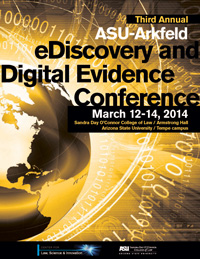 The Third Annual ASU-Arkfeld eDiscovery and Digital Evidence Conference takes place from 12-14 March at the Sandra Day O’Connor College of Law, Arizona State University, Tempe, Arizona.
  My co-panellists were a mixture of experts in statistics and lawyers whose daily work involved the use of technology assisted review. I elected to talk about the requirements of the rules (both the US rules and those of England and Wales) which require parties to be proportionate in all that they do.
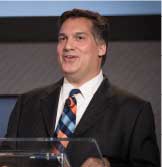 This subject deserves expansion, and kCura has organised a webinar at which kCura’s Constantine Pappas (who moderated the Chicago panel – picture left) and I will discuss proportionality in the context of technology assisted review.









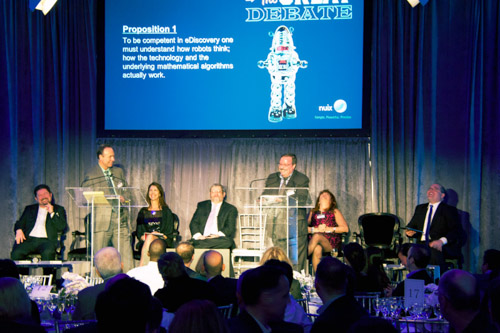















 A welcome new addition to the eDiscovery blogosphere (now that “blogosphere” has been mentioned in an English judgment, I suppose it is all right to use it) is one called Flipping the Gorilla by Marc Jenkins, VP Knowledge Strategy at

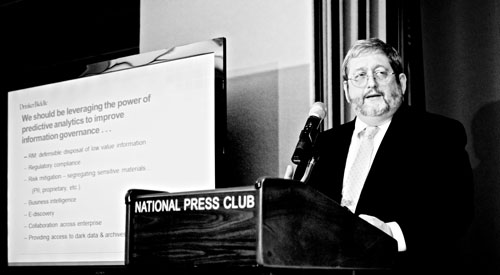


 Investment bank Jefferies Group has taken
  The US Federal Trade Commission has wide responsibilities which include the protection of customers’ data privacy rights. Its Division of Privacy and Identity Protection is stepping up its monitoring and enforcement activities, and
 eDisclosure Information Project