Keeping informed on information about informaton

It is getting hard to keep up. The various aspects of information and justice which I write about are developing faster than I can put quill to keyboard.

I wrote my piece An information war at the week-end and updated it when the video emerged of the policeman beating up a woman at the G20 demonstration before posting it today. This morning’s Times carries a piece to the same effect as my article’s comments about protesters turning the tables on Big Brother state, using information as their weapon. There is also an article in the Times today about policemen invoking the Terrorism Act against a man who photographed them in a park (they have been given some re-education on the subject), one about the Damian Green raid (an over-reaction, apparently, according to the Parliamentary Report of yesterday – you don’t say?), and one about the further fall-out from the Damian McBride affair, with questions being asked about searching e-mails to trace the other recipients of the offending messages. Meanwhile, the European Commission has started legal proceedings against the UK for breach of its obligations to enforce EU data privacy laws.

Pretty well every topic I wrote about has therefore been updated by events. Meanwhile, I have seen a headline about Switzerland signing up to safe harbor, a judge has written in the Times today (as I have here) about the Woolf reforms, and there is a Legal IT conference coming up in Montreal which deserves a write-up. Oh, and there is some work to do as well as all this writing.

Some, at least, of all this will warrant further comment. Mr Justice Jackson, as he then was, referred to the issues in the Wembley Stadium case as being like the Lernean Hydra. That, as I am sure you all know, was a hideous creature which would emerge from its murky swamps and terrorise the people. Every time Hercules struck off a head, two more would grow in its place, so the Hydra was a bit like our civil service (and the murky swamps increasingly a metaphor for Downing Street, come to think of it). As I look at all these multiplying stories around the world which warrant reporting, the Hydra analogy comes to mind. I will try to keep up.

Home

Posted in Data privacy, Data Protection, EU, EU Safe Harbor, Litigation Support, Lord Justice Jackson | Leave a comment

An information war – making connections between privacy, liberty, policing, law and government

An American e-discovery site put up a link last week to a video showing police brutality. It is not just me, then, who sees connections between apparently diverse aspects of justice. Privacy and the right to go about your business are fast being eroded in Britain. There is a civil war looming, and information will be its weapons. Lawyers and judges will be in the middle of the battlefield.

Gabe’s Guide to the e-discovery universe, an American site dedicated, as this one is, to developments in electronic discovery, put up a link a few days ago to a YouTube video showing a fight at a football stadium in an unidentified country. A man runs across the pitch waving a banner; a squad of policemen bring him down, and one is seen repeatedly punching the already captive protester. The spectators flood the pitch and attack the police, who retreat. The compact between rulers and ruled, which (given their respective numbers) depends on public acceptance of the right of the rulers to impose law and order, has broken down.

We are heading in that direction in Britain. Policemen behave like that because ministers encourage them to think that they and the government which they represent are above the law. A few days ago, a British policeman brutally assaulted a middle-aged man as he walked home from work. The man died a few minutes later. At a memorial protest about that death, another policeman, his identification number deliberately obscured, struck a small woman across the face with a heavily-gloved hand and then thoughtfully and deliberately hit her legs with a telescopic baton. The government and decent policemen (the majority) are as appalled as the rest of us, but it is the government which has created the climate in which a policeman thinks this is the right way to behave. Several elements, tenuously linked to each other, bring us to this. Continue reading

Posted in Data privacy, Data Protection, EU | Leave a comment

Have the Woolf reforms worked?

An article in the Times of 9 April had the title Have the Woolf reforms worked? Written by Lawrence West QC, it makes an uncompromising start with the assertion in the first paragraph that “the reforms — known as the Civil Procedure Rules (CPR) — have been a disaster for the civil justice system”. The right to access to justice is “illusory” and, judged by this standard, “the CPR have been an abject failure”.

West quotes some figures in support of his view that the number of civil actions in the year after 1999 “plummeted as if pushed off a cliff”. The statistical evidence is supported by this more anecdotal statement:

“Before the CPR, the corridor outside Court 12 in the Royal Courts of Justice, the Bear Garden and the Master’s Corridor heaved with lawyers and their clients waiting hearings. Those places have been wastelands ever since.”

You can guess at my support for this viewpoint from the fact that I long ago chose to give the title “The Empty Bear Garden” to my keynote speech for the 8 June Ark Group e-disclosure conference Practical Guidelines to e-Disclosure Management. The Bear Garden is a space in the RCJ at which several corridors, staircases and doors intersect. It has become a gauge of court activity, like a cardiac monitor in a hospital drama. A cardiac monitor makes a noise, however, when it is flat-lining. Continue reading

Posted in Access to Justice, Case Management, Court Rules, Courts, CPR, Early Case Assessment, eDisclosure, eDisclosure Conferences, eDiscovery, Electronic disclosure, Lord Justice Jackson | Leave a comment

Confounding the expectations of a cynical audience

Susan Boyle, the unlikely-looking star of Britain’s Got Talent, reminds us that first impressions may mislead. You do not know how good something can be unless you see – or, in this case, hear – it. Your cynicism as to e-disclosure, like the judges’ expectations of Miss Boyle, may be founded on some wrong assumptions

It is nearly impossible to sell me something which I did not intend to buy anyway. I am almost immune to impulse buying and am brusque to the point of rudeness with anyone who tries to interest me in something which I did not already have a fixed intention to buy. This, I am told, makes me embarrassing company in New York shops where they simply cannot leave you alone – my son saw one assistant making frantic gestures to head off another who was about to bend my ear with his unsolicited drivel because she had just witnessed me biting the head off the last one who interrupted my train of thought. I hang up on cold-callers who do not deliver a compelling message in ten seconds (sorry all you Indian scanning and coding salesmen) and try and avoid going into my bank now that every cashier is on commission if they manage to sell me something.

This attitude dates from the time when I was IT partner at a large firm of solicitors. Every bloody salesman in London would ring me up just to see if I had changed my mind since the last time I told him to sod off. I know what you are selling, I would say, and as and when I want something like it, I know where to find you. That is not bad training for being on the other side of the fence, where my role now is try and persuade lawyers at least to take a look at the sort of things which litigation applications can do. Lawyers are cynical about attempts to impress them; they think they know what to expect from a demonstration; they are pretty sure that they are not interested and that they will not be made any more so when the salesman opens his mouth. Continue reading

Posted in Discovery, E-Discovery Suppliers, eDisclosure, eDiscovery, Electronic disclosure, Litigation, Litigation Support | Leave a comment

Distinguishing workplace spying from data collection

It is usually possible to reconcile employees’ legitimate privacy concerns and a company’s equally legitimate rights and obligations to collect data if you go about it properly. A story in Der Spiegel shows what happens when you get it wrong. The story does at least give an opportunity to explain the difference between spy software and data collection.

As its name implies, the e-Disclosure Information Project, which I run, exists to spread knowledge and understanding about the collection and use of electronic documents. My primary focus is on the common law countries (mainly the UK and US) which require discovery of documents in litigation, but the increase in the powers of regulators brings the same issues to countries which do not have that litigation obligation. The area where mainland EU principles collide with US discovery is in relation to privacy and data protection matters. I come across these subjects mainly in the context of trying to explain to Americans what the concepts mean, why they matter rather more to Europeans than to them, and how proper regard to privacy is not necessarily incompatible with an adequate collection of data if they take the trouble to understand both the legislation and the underlying concerns which drive the legislation. Continue reading

Posted in Data privacy, Data Protection, E-Discovery Suppliers, eDiscovery, Forensic data collections, Guidance Software, Regulatory investigation | Leave a comment

Taking the Administrative Courts to the regions

The Times of 9 April carried an interview with Sir Anthony May, President of the Queen’s Bench Division. Its title London-centric? We are taking power to the people conveys the gist of the article. The Administrative Court is to soon to open in Birmingham, Cardiff, Leeds and Manchester.

The Administrative Court handles a wide range of cases with a public law element – immigration and asylum matters, claims against central and local government and against regulatory bodies, as well as certain child care and prisoners’ rights cases. Setting up regional centres has obvious merit from the court’s own point of view – it has become grossly overburdened with, at one point, files stacked in cases in the corridor and a long waiting list of applications awaiting allocation to a judge. There are obvious advantages too from the applicants’ perspective – many of the claims, by their nature, are made by people who cannot afford the additional costs incurred in travelling to London, quite apart from the fact that claims involving, say, a local authority and one of its residents are better heard close to where they both come from. Continue reading

Posted in Access to Justice, Civil justice, Courts, HM Courts Service | Leave a comment

Autonomy appoints Robert Webb QC as non-executive chairman

Autonomy Corporation Plc has appointed Robert Webb QC as its Non-Executive Chairman with effect from 1 May 2009.

Robert Webb was General Counsel at British Airways from 1998 until recently. He practised at the Bar from 1971, becoming Queen’s Counsel, Head of Chambers at 5 Bell Yard and a Crown Court Recorder. He holds a range of other posts, including non-executive directorships at the BBC and the London Stock Exchange. Autonomy’s CEO, Dr Mike Lynch, said of him that “his experience in litigation, regulatory and compliance issues is directly relevant to our current commercial focus”.

The appointment is a reminder that Autonomy is a British company in origin, with dual headquarters in Cambridge and in San Francisco. Those of us whose focus is on the relatively narrow world of litigation and regulation may also overlook the fact that this is only one of the areas in which Autonomy’s enterprise search applications are used by corporations and government departments and agencies.

One of my former partners used to instruct him often, mainly on aviation matters, and his name is familiar from that as well as from his high-profile role at BA. His twenty five years at the Commercial Bar followed by a broad range of roles in industry make him a good choice for his new role at Autonomy.

Home

Posted in E-Discovery Suppliers | Leave a comment

Welcome to FTI Technology as a sponsor of the e-Disclosure Information Project

It is very good to welcome FTI Technology as a sponsor of the e-Disclosure Information Project. FTI Technology is a segment of FTI Consulting, Inc., a global business advisory firm, and brings immense resources to bear on the acquisitions and the software development needed to produce a world-class platform for disclosure / discovery.

As usual, I see no point in copy-typing or edit-pasting the perfectly good prose of a well-written press release, and refer you to FTI’s announcement of 27 January 2009 which sets out succinctly what FTI have done with their two flagship electronic discovery acquisitions Attenex and Ringtail Legal. Put shortly, they have integrated the advanced analysis, clustering, rapid review and graphical visualisation strengths of Attenex and the review, redaction and production capabilities of Ringtail.

In layman’s terms (since, as I say, you can read the formal descriptions for yourself) Attenex ploughs through large (very large if that is what you have) data collections, and helps identify material you either want to discard or to review, serving it up in batches. The clustering and visualisation tools allow quick overviews in a form which allows the reviewer to drill down to document level if necessary and to make decisions which both carry through into the detailed review stage and inform decisions about subsequent batches of documents. Ringtail Legal allows you move straight on to the detailed review without having to move the data between applications. Continue reading

Posted in Australian courts, Courts, Discovery, E-Discovery Suppliers, Early Case Assessment, eDisclosure, eDiscovery, Electronic disclosure, Ernst & Young, Litigation Support, Regulatory investigation | Leave a comment

KordaMentha picks EnCase from Guidance Software for Australian eDiscovery

Like sport and so much else, the idea of proving a legal case by discovery of documents is an old English concept which was adopted wherever the English had a hand in establishing a system of law. America kept it when it dumped our tea, our taxes and our King. Australia adopted it with the same enthusiasm as it adopted cricket. A couple of weeks ago, Hong Kong was host to both the Rugby Sevens and our Senior Master Whitaker talking about UK disclosure developments. Discovery is central to Canadian litigation, and Master Whitaker is due to speak about it in Singapore later in the year.

Three things unite all these countries apart from their common law heritage. The problems raised by electronic disclosure are the same everywhere; those of us involved in developing rules and best practices around the world all speak to each other; and there is a handful of suppliers whose applications are used wherever electronic data must be collected and handled for litigation or for regulatory investigation. The resulting cross-fertilisation has obvious benefits – what works in one place will probably work in another, and if an approach tried in one country is seen to have failed, then it is as well to know about it before another jurisdiction goes down the same track. The things I talk about in Birmingham or Bristol are informed by what I Iearn in Sydney or New York, and it would perhaps surprise UK judges and lawyers to know how much interest there is in those places in what happens in the UK. Continue reading

Posted in Australian courts, Case Management, Court Rules, Courts, CPR, Discovery, E-Discovery Suppliers, Early Case Assessment, eDisclosure, eDiscovery, Electronic disclosure, Forensic data collections, FRCP, Guidance Software, Litigation, Litigation Support, Regulatory investigation | Leave a comment

Electronic Working Pilot Scheme

I have not had the chance to read it yet, but Practice Direction (Electronic Working Pilot Scheme) supplementing rule 5.5 of the Civil Procedure Rules 1998 provides for a pilot scheme by which, in the circumstances set out in the practice direction, proceedings may be started and all subsequent steps may be taken electronically (“Electronic Working”).

The pilot runs from 1 April to 31 March 2010, applies to claims started on or after 1st April 2009, and will operate in the Admiralty, Commercial and London Mercantile Courts of the High Court at the Royal Courts of Justice, with the possibility of extending the operation of the pilot scheme to other courts.

This looks one of the more interesting developments since the CPR was launched, when the electronic filing functions now being piloted were (or so it seemed) muddled in the official mind with the very different concept of electronic disclosure of documents between parties under Part 31 CPR.

More when I have had the chnace to read it properly.

Home

Posted in Litigation Support | Leave a comment

NERDI and ClearGuideAutoKrolLexFTios

The e-discovery 2.0 blog scored an exclusive with a recent post. Under the heading Government Launches Bold New Recovery Effort, it reported the nationalisation of the US electronic discovery industry. A new authority, the National Electronic Discovery Institute (NERDI) was apparently set up with a new portal at EDiscovery.gov with effect from 1 April. In response, the Socha-Gelbmann Top 5 has consolidated under the name ClearGuideAutoKrolLexFTios.

It is faintly disturbing that this could easily be read from top to bottom without a blink. Tom Lehrer famously said that the award of the Nobel Peace Prize to Henry Kissinger made satire obsolete.  How can a mere spoof compete with the daily news at the moment? How about “Home Secretary claims 88p bath plug and her family’s porn viewing from taxpayer”? That particular (true) item is rivalled only by one yet more risible from a while back: “Brown appoints Jacquie Smith as Home Secretary”.  How funny is that? (not very, actually, if you value liberty, privacy and the right to sleep soundly at night, but that is for another article). Continue reading

Posted in Litigation Support | Leave a comment

Discovering inspiration from heroes of the past

My primary topic, electronic discovery or electronic disclosure, is a sub-set of a wider subject – more than one wider subject, indeed. It is important as a matter of simple business efficiency; it is critical to the subject of access to justice, which matters as much to large corporations as it does to ordinary individuals; and it is fascinating (to me anyway) as an example of technology being applied to move the world on. It is not the pure science – my Grade 9 in Physics with Chemistry O Level was well-deserved – but the conjunction of human endeavour and technology being applied to practical problems which interests me. I may describe some of the e-disclosure applications as “near-magical in their capabilities”, but I stress also that the most important technology lies between your ears.

I have had a couple of days away. If what you come here for is undiluted e-disclosure then you will have to wait – there are posts coming up on subjects as narrow and varied as TREC and search technology, on privacy and German works councils, on Special Masters and on other e-discovery topics. Today concerns wider matters, although the theme – that you can do almost anything if you really want to and have the tools to do it – applies as much to managing litigation as it did to the esoteric examples which have come my way in the past few days. Continue reading

Posted in Litigation Support | Leave a comment

Welcome to Legal Inc as e-Disclosure Information Project sponsor

I am delighted to welcome Legal Inc as a sponsor of the e-Disclosure Information Project, joining a group which is increasingly representative of the full range of e-disclosure suppliers and service providers.

Legal Inc was set up by Lisa Burton and Dipak Patel. Lisa is a law graduate and Dipak brought technical expertise, the two elements needed to bring technology to lawyers. Legal Inc describes itself as a “full-service one-stop shop” in the field of litigation support. That means that they can take on the whole or any part of a litigation support, e-disclosure and information management project for law firms or corporate clients, working with specialist partners for those things which they do not do themselves.

I see little point in doing a précis of Legal Inc’s services when their web site does that perfectly well for itself (which is not, I should say, true of all the players in this market). Take the litigation support link and skim the Overview | Challenges | Approaches | Benefits pages for a pretty good idea of what Legal Inc offers. Continue reading

Posted in Andrew Haslam, CaseLogistix, Clearwell, E-Discovery Suppliers, eDisclosure, eDisclosure Conferences, Electronic disclosure, FTI Technology, IQPC, Litigation Support | Leave a comment

Catching up with KPMG

Part of the function of the e-Disclosure Information Project is to keep up with what the providers of software and services are doing. Given my emphasis on the human aspects of this business (which recurs in this blog and elsewhere in the form of questions like “Would you trust them with your client’s data? Do you like them?”) it is important to keep in touch by going in to see providers or welcoming them out here in Oxford. Since I neither buy nor directly recommend anything, these sessions are free of sales pitches, save in the subliminal and low-key sense that there is a mutual interest in sharing information.

I always seem to have a backlog, both of outstanding invitations and of writing about them. That reflects the balance between things I do directly for the Project’s sponsors, the wider objective informational aspects, the range of material which has to be read from the various jurisdictions in which discovery takes place, and the fact that there is always a conference organiser bullying for a set of slides.

KPMG comes to mind every day for the wholly obscure reason that my coffee cup sits on a tile which was the 1993 Christmas present from KPMG Forensic Accounting. It is functional as a mat, albeit that it shows a 1994 calendar. Like KPMG itself, it can claim longevity in a market which is full of new companies, staffed by people who were still at school in 1994, and in which corporate freebies have a marketing life of about ten minutes. I must have been on their mailing list on the strength of accounting negligence claims which I had run as a litigation partner (including JEB Fasteners v Marks Bloom in 1984 and Al Saudi Banque v Clarke Pixley in 1990, both still cited). Continue reading

Posted in Attenex, Case Management, Clearwell, Commercial Court, CPR, E-Discovery Suppliers, Early Case Assessment, eDisclosure, eDiscovery, Electronic disclosure, FTI Technology, KPMG, Litigation, Litigation Support, Part 31 CPR, Regulatory investigation | Leave a comment

Explaining the Procrustean Bed

My post Zander sees his Woolf CPR predictions fulfilled refers you to an article by Michael Zander QC.

As an aside, a generation deprived of a classical education may be puzzled by Zander’s reference to a “Procrustean bed”, as I admit I was when I first saw it in a footnote to the old Rules of the Supreme Court. Lord Donaldson had used the expression in relation to the size of appeal bundles. I have to say I assumed in my ignorance that this was a geological metaphor. What he meant was that it was not necessary to pad out the bundles to the recommended size, nor omit necessary pages to meet the suggested size. The reference was to the apparently genial host Procrustes, who would invite passers-by to lie on his bed. He would then stretch them or amputate their limbs as required to fulfill his boast that his bed was just the right size for everyone.

One commentator refers to Procrustes drily as “the ancient champion of enforced conformity”. We do not, of course, want such precise conformity from our judges, ancient or not, but some degree of consistency would be nice, at least in respect of disclosure orders. We do not need the same answer every time, but the right answer, a proportionate answer, based on information provided by the parties “at the earliest practical date, if possible at the first Case Management Conference”.

The quotation comes from Paragraph 2A.2 of the Practice Direction to Part 31 CPR. That involves the exercise of informed discretion. Reading the damn thing and applying its provisions is not, however, discretionary.

Home

Posted in Case Management, Court Rules, CPR, eDisclosure, Electronic disclosure, Judges, Part 31 CPR | Leave a comment

Zander sees his Woolf CPR predictions justified

Michael Zander QC, now Emeritus Professor at the LSE, was a forthright and eloquent critic of the Woolf reforms which led to the Civil Procedure Rules in 1999. Few took much notice of his predictions, least of all Lord Woolf. I was amongst the vast majority who ignored him, won over I think in retrospect, by Woolf’s eloquence and industrious decency in tackling the twin evils of delay and cost.

It was a shock to open the rather large new rule book and discover that all Woolf’s emphasis on the role of technology – particularly in respect of disclosure – had been reduced to a single reference to the word in the overriding objective. I also recall a sense of growing unease on seeing the sum total of the new burdens which fell on practitioners at the early stages of a case – each of them had been widely debated in the run-up to the final version of the rules, but seeing them altogether simply did not square with the fact that relatively few cases went to trial anyway. How could it be right to impose on every party to every case a set of duties and obligations designed to reduce a burden which was irrelevant to most cases even under the old rules? Continue reading

Posted in Access to Justice, Case Management, Civil justice, Court Rules, CPR, Discovery, Early Case Assessment, eDisclosure, eDiscovery, Electronic disclosure, Judges, Litigation, Litigation costs, Litigation Support, Mediation and ADR, Part 31 CPR | Leave a comment

Podcast summarises Equivio benefits

I recorded a podcast last week with Warwick Sharp, Vice President of Marketing and Business Development at Equivio. It is available from Equivio’s home page. I know there is no great technology involved in podcasts, and I might be expected to be jaded about technology anyway having been immersed in it since the dawn of time (that is, the mid-1980s) but I still think it remarkable that I can sit in Oxford,talking to Warwick in Israel via a US telephone meeting system controlled by an organiser in London (Enterprise Technology Management) and that we can be listening to the results ten minutes later.

If I am impressed by some basic telephony and recording, then what to make of Equivio itself? Some of the technology in this market does relatively simple things which are hard to explain. It is dead easy to explain what Equivio does, but one cannot begin to think how it achieves it. Does that matter? Not a lot, frankly, as long as you can satisfy yourself as to the results. Equivio has very quickly gained many very satisfied users. Continue reading

Posted in Discovery, E-Discovery Suppliers, eDisclosure, eDiscovery, Electronic disclosure, Equivio | Leave a comment

Free e-disclosure podcast from CPDCast

I recorded a podcast last week with James Sheedy of CPDCast. You can listen to it for free and solicitors, barristers and ILEX member can get CPD points for doing so. There is a note at the bottom of this post explaining how to access the podcast.

I have to say that I prefer an audience I can see to a microphone in a padded cell. From the audience perspective, however, there is obvious benefit in having talks like this delivered to their desks and downloadable to an MP3 player, although they don’t then see the slides with which I usually illustrate the subject. I have been asked to do more of these, including a longer series covering the full range of topics – more on this when we have advanced our plans.

What was interesting for me was that James Sheedy composed the questions after some (impressively fast and thorough) research of the subject from scratch. Although much of the ground covered was inevitably the same as that which I devise for myself, the outsider’s perspective helps to bring out aspects which I do not necessarily think of. One of his questions, for example, was predicated on the assumption that the lawyer starts with a room full of paper. The challenge is to persuade people to investigate a purely electronic solution BEFORE existing electronic sources are turned into paper at vast expense in printing and copying. Continue reading

Posted in Case Management, Court Rules, CPR, eDisclosure, eDiscovery, Electronic disclosure, Litigation, Litigation Support | Leave a comment

The FSA swoops on the unprepared

The American Museum of Natural History in New York contains many tableaux – scenes of animals and man in various stages of early development. My son and I spent an afternoon in there when LegalTech had ended and I found that I recognised many familar types from the litigation world amongst the figures, most obviously (too obviously perhaps) the dinosaurs of whom I wrote in LegalTech lessons from extinct species.

I have now been through the photographs which I took with half an eye on their value as illustrations to this commentary. You may expect to see pictures of walruses and buffalo who look like judges,  primitive men for whom technology meant flints and whose idea of co-operation involved spears and clubs (you know who I mean,  all you who use discovery / disclosure as a bludgeon) and, of course, dinosaurs. Continue reading

Posted in eDiscovery, Electronic disclosure, LegalTech, Litigation Readiness, Litigation Support, Regulatory investigation | Leave a comment

Blame Brown and be frightened of the FSA says Regulator Sants

Hector Sants, Chief Executive of the FSA, made two strong speeches last week. In one he blamed Gordon Brown for his contribution to the economic crisis. In the other he warned of a tough new attitude to regulation which ought to focus minds somewhat.

“It is quiet out there. Too quiet”. I am not sure whence I get this expression, with its intimation of pending violent attack. It could have been in one of those novels of war or Empire which I read as a child – about Hornblower or Richard Hannay or, later, of Flashman; it might have come from one of the old war films, with John Mills peering across the trenches, or scanning an empty sea or sky for the threatening Hun; perhaps it was in a Western, as John Wayne’s instincts told him that a cloud of arrows could be expected anytime soon. These stories often include a powerful but evil figure whose outward success conceals a past which is uncovered in the closing chapter or the last reel. His reputation might, for example, have depended on an alleged “economic miracle” which is shown to have been a sham, bringing misery for millions as it fails.

Sants quotationThis sense that something is about to happen has been hanging over those whose business involves litigation and regulatory or internal investigations. The battle analogy is an apt one. Some of the units have been fighting hard since the economic “war” began; others have seen their numbers thinned out as they wait for the coming conflict. As in all the most gripping war stories, the attack is expected on more than one front.

One of those is litigation. The lull in the UK has lasted for ten long years. The CPR achieved its object of persuading parties out of the court system not, as was intended, by encouraging parties down the flower-strewn path to mediation but by making it too expensive to litigate. There is no one baddy here, but several: we can blame the government for its neglect of civil justice and its contempt for that admirable principle of “access to justice” which it mouthed even as it hiked court fees and cut Legal Aid; we can suggest that the rules and those who administer them have paid excessive attention to encouraging settlement and too little to the basic mechanics of case management; we can point to lawyers whose disdain for cutting the hours spent has been obscured by complaints about the rates per hour; not least we can point to clients who produce sow’s ear data and whine about the cost of turning it into silk purse evidence. Continue reading

Posted in Litigation Support | Leave a comment

Autonomy finalises Interwoven acquisition

An overnight press release confirms that Autonomy’s acquisition of Interwoven has been finalised. It has been understandably difficult to get any useful comment out of either of them (I have tried) whilst the transaction was awaiting the formal approvals necessary to close it.

For those who have invested in Interwoven’s content management applications, it will be reassuring to read that “Autonomy is committed to the on-going development and support of Interwoven’s products and solutions in line with all currently published Interwoven roadmaps.”

What interests my readers is the hosted document review platform Discovery Mining, which Interwoven itself only acquired during 2008. Of this, Anthony Bettencourt, CEO of Autonomy Interwoven, says:

For Interwoven’s Discovery Mining customers, Autonomy offers the most complete EDRM solution on a single technology platform…. We will bring together the best aspects of Discovery Mining and Zantaz Introspect to meet your current and future processing, review and production needs. Autonomy has 6 data centers with 6,000 servers, and Discovery Mining will now become our West Coast processing center while Boston will remain our East Coast processing center.

That tells us little about actual development of the highly-regarded Discovery Mining application. My informal understanding (which makes logical sense) is that Autonomy’s IDOL engine will be put under Discovery Mining. It is not really clear whether we will see the convergence of Introspect and Discovery Mining into a single product or whether the two applications will be differentiated and aimed at different markets. It would not be surprising if long-term decisions like this have yet to be made.

Home

Posted in Discovery, E-Discovery Suppliers, eDisclosure, eDiscovery, Electronic disclosure | Leave a comment

The growing importance of metadata preservation in eDiscovery

If UK lawyers do not share the US enthusiasm about the preservation, collection and use of metadata, that is in part because they are not clear what it is and how it might be used. A forthcoming webinar will be a painless way to find out.

Guidance Software is hosting a webinar on Tuesday 24 March called The growing importance of metadata preservation in eDiscovery. As the developers of EnCase eDiscovery, whose function is the collection across corporate networks of discoverable documents and data, Guidance has an obvious interest in the metadata – data about data – which lies in and around the documents which may become evidence. Continue reading

Posted in Case Management, CaseLogistix, Commercial Court, Court Rules, CPR, Discovery, E-Discovery Suppliers, eDisclosure, eDiscovery, Electronic disclosure, Forensic data collections, FRCP, Guidance Software, Litigation costs, Litigation Support | Leave a comment

How TREC can help you evaluate e-discovery investments

H5 and Clearwell Systems are giving a webinar on 19 March about TREC Legal Track’s practical application in evaluating and assessing search and review methods. Why should we in the UK pay attention?

There is a danger in talking to UK audiences about the higher end of US thinking on information retrieval as it applies to litigation. That word “discovery” (which we abandoned ten years ago for no obvious – or, at least, for no good – reason) serves as a flag which says to UK litigators that it is about someone else’s problem. Other assumptions follow – that the output of such thinking will be academic rather than relevant to everyday life, the volumes will be beyond imagining, the language will be impenetrable and so on.

Certainly, there are some more basic problems for UK practitioners. What is this Practice Direction to Part 31 which the judge in Digicel (St Lucia) v Cable & Wireless banged on about? Oh, I see, they say: big case, foreign business, two counsel on each side instructed by major firms – nothing to do with me then. Now, tell me how I get all these e-mails printed quickly so I can start reading them?

Nevertheless, it is no bad thing to make yourself aware of the thinking in US circles. It is not that we will be in two years where they are now, but that if we watch what they do, we may avoid altogether the worst excesses of US electronic discovery. Continue reading

Posted in Clearwell, Discovery, E-Discovery Suppliers, eDisclosure, eDiscovery, Electronic disclosure, H5, Litigation, Litigation costs, Litigation Support | Leave a comment

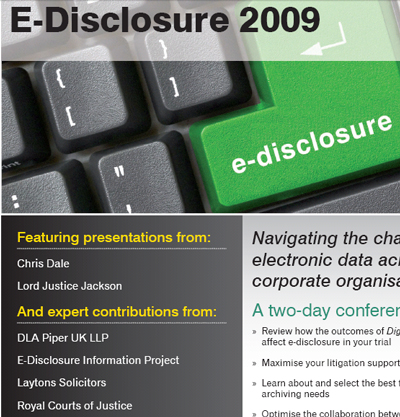
Ark Group Conference 8-9 June 2009

The brochure came out today for Ark Group’s e-Disclosure conference taking place in the Ibis Hotel, Earls Court, London on 8-9 June.

The main attraction is Lord Justice Jackson who will be presenting a review of the litigation costs working paper which he is spending 2009 working on. He will be talking about his investigation into cases of all sizes, looking at the costs in all the Specialist Courts (that is, the Commercial Court, Technology & Construction Court, the Mercantile Courts etc) and discussing the limitations in the present system which have been raised by others in the course of his review.

Ark London 2009 Continue reading

Posted in Access to Justice, Case Management, Commercial Court, Court Rules, Courts, CPR, Document Retention, eDisclosure, eDisclosure Conferences, Electronic disclosure, Litigation, Litigation costs, Litigation Support, Lord Justice Jackson, Mediation and ADR, Mercantile Courts, Part 31 CPR | Leave a comment

Law Society Seminar – Disclosure – the risks after Hedrich

I spoke yesterday at a seminar organised by the Law Society and sponsored by Legal Inc and Millnet. The theme was as foreshadowed in my article Law Society Disclosure Seminar in London and was implicit in the name I gave it: Disclosure – the risks after Hedrich.

The title referred to Disclosure rather than e-Disclosure because the electronic side to this subject is servant to the primary obligation to give disclosure of documents under Part 31 CPR. It referred to Hedrich because although the solicitors in Hedrich v Standard Bank London were found not to have been negligent, and beat off the wasted costs application brought against them, I am not sure I would count it much of a victory to have had to come off the record in mid-trial and then go all the way to the Court of Appeal to fight off the claim that my failure to spot my clients’ disclosure failings had caused loss (and how) to the other party. Continue reading

Posted in Case Management, Court Rules, CPR, E-Discovery Suppliers, eDisclosure, Electronic disclosure, Judges, Law Society, Litigation, Litigation Support, Millnet | Leave a comment

Guidance Software Q4 results – a guide to the wider market?

Guidance Software, Inc., which is amongst the sponsors of the e-Disclosure Information Project, has posted Q4 2008 results which are its best quarter’s results in its history, with revenue of $25.2 million. CEO Victor Limongelli was on bullish form in an analysts’ discussion, whilst retaining a sense of caution wholly appropriate to the uncertainty of the times.

Guidance’s results may be a straw in the wind, an indicator of the way things are going. I say that because its market is up at the front of the process which ends in a discovery exercise, a regulatory inquiry or an internal investigation. If you are in mid-case, then you need a review application. If you are starting down that trail, you are collecting data, probably with Guidance’s forensic tools. If you are a large company which thinks you are going to face a need for collections in the near future, then you are buying Guidance’s EnCase eDiscovery or something else whose purpose is anticipatory rather than merely reactive. The report to which I point you above sets out the numbers of Q4 sales relative to previous periods, as well as the interesting statistic that Guidance taught 25% more students how to use its products in 2008 than in 2007. Continue reading

Posted in Discovery, E-Discovery Suppliers, eDisclosure, eDiscovery, Electronic disclosure, Guidance Software, Litigation Readiness | Leave a comment

Law Society Disclosure Seminar in London

I am presenting a two hour seminar in London next Monday 9 March under the auspices of the Law Society.

Sponsored by Legal Inc and Millnet, both well-known suppliers of electronic disclosure solutions, this is a nuts-and-bolts review of everything from cases to rules, from a survey of the problems to a look at solutions, from points of detail to a review of the wider context. It includes a look at some applications.

The title of the seminar is Disclosure – the risks after Hedrich. Most of it is about electronic disclosure, but that is because most documents now in existence were created electronically, still exist electronically and therefore ought to be disclosed electronically – that is, their electronic existence should be disclosed even if it is not practical or cost-effective to handle or exchange them electronically. Continue reading

Posted in E-Discovery Suppliers, eDisclosure, Electronic disclosure, Law Society, Litigation, Litigation Support, Millnet, Part 31 CPR | Leave a comment

As the sun sinks slowly in the West we say farewell to LegalTech – or do we?

You are all too young to remember the clichéd ending to those American travel documentaries which always ended with the sun sinking slowly in the West. So am I, despite being old enough to remember telexes and carbon paper as the must-have office equipment. The expression lives on, in the UK at least, because of the Peter Sellers parody “Balham – Gateway to the South”, which itself dates from 1964 – a cliché kept alive by a parody which is itself too old for most to remember.

Sunset over New York

My photograph was taken on the Queensboro Bridge as we left LegalTech for JFK this year, made possible by the generous windows of the large black limousine which Nigel Murray had commandeered at a good rate with a degree of resource doubtless acquired in his army years. This combination of clichés, parodies, sunsets, New York and LegalTech was brought to mind by a slight sense in some quarters that this Leviathan of a show may have had its day. Continue reading

Posted in Discovery, E-Discovery Suppliers, eDisclosure, eDisclosure Conferences, eDiscovery, Electronic disclosure, Legal Technology, LegalTech, Litigation Support | Leave a comment

Light relief at LegalTech

I occasionally like, at the end of the week, to write about things which are not directly related to e-discovery or are, at least, aimed at the lighter side. Charles Christian has saved me the trouble this week with an article which reproduces a photograph of mine taken at Legal Inc’s panel at LegalTech, which he moderated. Jolly sporting of him in the circumstances, I would say.

He also links to a page of photographs which I took at the same session in which I supplement my report on what was actually covered with what might have been said instead.

The captions will not necessarily be meaningful to all. You need to read my report on the session to understand why the whole panel might decide simultaneously to look the other way. The picture of a man apparently telling an after-dinner joke about a solicitor being unable to find documents on a CD means a little more if you know both that Hedrich v Standard Bank London involved exactly that level of technical competence and that Sanjay Bhandari of Ernst & Young’s Forensic e-Disclosure team Services considered a career as a stand-up comedian before opting for the law.  The two gentlemen dominating the doorway are Brian Stuart and Tyrone Edward of E&Y.

This kind of hyperlink tennis – me pointing you to an article by Charles which refers to an article by me about him – does not mean I have run out of things to say. I just like a break every now and then, as no doubt you do.

I was in fact going to write a piece called I never see the sodding kerb till its way too late – about Bat out of Hell, MeatLoaf’s elegiac commentary on the fate of the lawyers in the Fannie Mae Litigation and Hedrich, with a side-note on Mondegreens – but that can wait.

Home

Posted in E-Discovery Suppliers, eDisclosure, eDiscovery, Ernst & Young, Litigation Support | Leave a comment

Autonomy panel at LegalTech points to proactive clients – and lawyers

Panel sessions at LegalTech and other conferences combine the best of all worlds so far as I am concerned. The burden is distributed – the moderator has to have a plan and the ability to herd the speakers through it, and those on the panel have to have an agreement as to who is going to cover what, but you don’t have to prepare slides a month in advance nor stand alone under the spotlight hoping that the words sound as good live as they did four weeks ago in the seclusion of your office.

There is enough structure but also room for spontaneity as the discussion takes turns which were not on the formal agenda and, as long as the moderator is good enough to haul you back to the advertised programme, they can be fun to do – assuming, of course, that your fellow-panellists  have something useful to say.

There was no problem on that score with the two panels which I did for Autonomy at LegalTech in New York earlier this month. The programme was the same for both of them. Carter Hopkins, in-house counsel at McAfee, and I were on both of them, but the third player in one was Florinda Baldridge, Global head of Litigation Support at Fulbright & Jaworski and at the other was Laurie Weiss, co-head of Fulbright’s E-Discovery and Information Management Practice Group. Deborah Baron, VP Legal & Compliance at Autonomy, Inc. was the able moderator. Continue reading

Posted in Discovery, Document Retention, E-Discovery Suppliers, Early Case Assessment, eDisclosure, eDisclosure Conferences, eDiscovery, EDRM, Electronic disclosure, LegalTech, Litigation, Litigation costs, Litigation Readiness, Litigation Support, Regulatory investigation | Leave a comment

Trilantic panel explores international e-Discovery initiatives at LegalTech

Not much changes at LegalTech from year to year. Sure, the trends come and go – “the move to the left”, Twitter, and “Please look at my CV” being this year’s big things – but for the most part, the same booths, the same faces and the same routines turn up every year.

One discernible change, however, is the interest in what is happening in other jurisdictions. “Abroad” does not rank high in US consciousness. We mocked George Bush when he asked a Welsh singer which state Wales was in, but most Americans, I think, would just wonder why anyone would care which state Wales is in. Sarah Palin thought Africa was a country, but no-one seemed seriously to question whether her foreign experience – a fly-by of some US bases, a refuelling stop in Ireland and a holiday in Mexico  – was adequate for a vice-presidential candidate. In the e-discovery world, most Americans see Europe as a cross between a modest museum and a commercial colony full of obstructive civil servants obsessed with data privacy. For years, the value of the dollar and a terror of terror kept them all at home.

You do not see this until you go to the US. Most of the Americans I know well have a well-rounded world view but that, I now realise, is because I meet most of them outside the US – they self-classify themselves as people who know of the world outside America because that is where I come across them. The insular ones – including, unfortunately, those who make political and commercial policy – stay at home. This matters because the US is still the commercial powerhouse of the world – no-one in America cares, frankly, what Gordon Brown thinks about America, but it does matter what America knows, or thinks it knows, about the rest of the world. Continue reading

Posted in Data privacy, Discovery, E-Discovery Suppliers, eDisclosure, eDisclosure Conferences, eDiscovery, eDiscovery Tools, Electronic disclosure, LegalTech, Litigation Support, Trilantic | Leave a comment

Legal Inc panel at LegalTech lives up to its billing

Litigation support providers from the relatively small UK market  made a good showing at LegalTech in New York this year. Amongst them was Legal Inc who hosted a panel of luminaries moderated by Charles Christian of Legal Technology Insider. LTi now has an American Edition, compounding the sense that the UK has something to contribute to the US legal technology scene.

The Legal Inc panel consisted of Sanjay Bhandari of Ernst & Young, Matthew Davis of Lovells and Andrew Haslam of Legal Inc, with the US represented by Peter Cladouhos of Paul, Hastings, Janofsky & Walker LLP.

The advertised purpose of the panel was to draw attention to some of the pitfalls and dangers inherent within electronic disclosure that can ensnare the un-prepared, and to explain how preparing for, and meeting the demands of, electronic disclosure can be scaled for large, mid-sized and even small organisations. The UK has some relevant case law at last and that, coupled with a planned EDD questionnaire  and increased judicial interest in the time- and costs-savings, suggests that the ability to handle documents and data electronically is permeating down to smaller organisations and more everyday cases.

Legal Inc Panel at LegalTech

Lisa Burton of Legal Inc introduces the Panel

Peter Cladouhos, Sanjay Bhandari, Matt Davis, Andrew Haslam, Charles Christian Continue reading

Posted in Andrew Haslam, Attenex, Case Management, Court Rules, Courts, CPR, Discovery, Document Retention, E-Discovery Suppliers, eDisclosure, eDisclosure Conferences, eDiscovery, Electronic disclosure, Ernst & Young, FRCP, LegalTech, Litigation Readiness | Leave a comment

E-Disclosure Taster Menu in Bristol

I went down to Bristol last week with a group of electronic disclosure suppliers at the invitation of the Western Chancery & Commercial Bar Association. The aim, as in Birmingham last year, was not just to talk about electronic disclosure, but to illustrate it by showing and describing a range of applications and services

Bristol used to be Britain’s second city. In the 18th Century it grew prosperous on the triangular trade which took cloth and iron goods to Africa, slaves to America and tobacco, and sugar and rum back to Bristol. In 1841 the Great Western Railway connected it to London and, in an early example of joined-up commerce, you could travel on GWR trains and GWR ships from London to New York. Its relative prosperity declined as other places boomed and as different industries – ship-building, tobacco, cotton – had their heyday and fell away. There is more industry in the region than one sees from the M4 – I flew over the Severn Estuary on my way in from New York at dawn a couple of weeks ago and noted the miles of industrial zones from Avonmouth Docks down towards Bristol.

All that industry, together with property-related work from the West – Bristol is the first place of any size as you come up from Cornwall or out of Wales – has supported the growth of a strong legal and professional services business. Every other legal magazine in the late 1980s seemed to profile Bristol. Its population of around 400,000 makes it now Britain’s tenth city preceded by London, Birmingham, Leeds, Glasgow, Sheffield, Bradford, Liverpool, Edinburgh and Manchester. It can take as little as 90 minutes to get to London by train.  There are some large barristers’ chambers in Bristol and one does not get the impression that work is in short supply. Bristol is one of ten cities in Britain with a Mercantile Court, that is, a court with a specialist commercial list and judge or judges ticketed to hear mercantile cases.

All very interesting you may say, but this site is meant to be an information resource on electronic disclosure, not a local history, travel guide or Chamber of Commerce directory. Indeed, but disclosure comes with litigation; litigation follows industry and business; and the ability to win commercial litigation work from any region depends on the quality of local law firms and chambers, and on their ability to stop the work from heading to London. It ought to be possible, in fact, for the combination of legal skills, good transport links and an efficient Mercantile Court not just to stem the flow to London but to reverse it. The sixty or so barristers and solicitors who turned out to listen to us presumably want to draw work into their region. Continue reading

Posted in CaseMap, Court Rules, Courts, CPR, E-Discovery Suppliers, Early Case Assessment, eDisclosure, EDRM, Electronic disclosure, Equivio, Forensic data collections, FoxData, Judges, LexisNexis, Litigation, Litigation costs, Litigation Readiness, Litigation Support, Mercantile Courts, Part 31 CPR, Trilantic | Leave a comment

Mediation – not about just settlement but just about settlement

Professor Dame Hazel Genn QC has launched a stinging attack on the downgrading of civil justice and the promotion of mediation at the expense of the civil litigation system. ADR is a worthy parallel remedy but government promoted it more as a means of saving money than as an extension of access to justice. The courts system has been run down and some of the rules changes have succeeded only in driving litigants out of the system

The original and primary purpose of this Commentary is to draw attention to the formal obligations of parties and judges in respect of disclosure under the Civil Procedure Rules, to the problems it causes, and to the solutions available to meet it. Important though that is as a component of cost in litigation, you cannot really look at one such element in isolation. The management of disclosure is a sub-set of case management generally. Case management is a component of what makes justice accessible. Access to justice is a fundamental right in society and it is amongst the primary duties of government to provide and foster it. One of the reasons why I watch and report on what is said by US Magistrate Judge John Facciola, both in his court and outside it, is that he has the same strong sense that his specialist subject – which is the same as mine – is but a part of a wider set of issues.

Dame Hazel Genn QC is professor of socio-legal studies at UCL. Her December speech attacking the decline of civil justice is pithily written up by Joshua Rozenberg in his article Dame Hazel Genn warns of downgrading of civil justice. I see no point in repeating him when you can read for yourself his summary of what has been said (by others as well as Dame Hazel) about the role of government, the implications of Halsey and the retrospective views of Lord Woolf’s reforms. Continue reading

Posted in Access to Justice, Case Management, Civil justice, Court Rules, Electronic disclosure, Judges, Litigation, Litigation costs | Leave a comment

Judge Facciola LegalTech messages are for UK as well as US lawyers

There was something almost surreal about the discovery that the LegalTech organisers had failed to record US Magistrate Judge John Facciola’s keynote speech, given that Facciola regularly delivers Opinions castigating parties either for faulty decisions about technology or for technological incompetence. Did someone decide “Nah. It’s only that Italian guy – let’s not bother” or did someone press the wrong button on the tape recorder? Whatever the cause, it is a pity. The speech, like many of John Facciola’s Opinions, should be compulsory listening for lawyers and judges, and as much on the UK side of the Atlantic as on his.

The speech was introduced by Neil Aresty of Legal Computer Solutions, Inc. Aresty made reference to the “Christmas Eve decision” in Covad Communications v Revonet. A paragraph from that decision will suffice to set the scene and to show why Judge Facciola strikes a chord in the UK. Speaking of an archaic form of document request which ignored the last 40 years of technological development, he said:

“While I have considered a similar provision in depth once before, I see no need to repeat that metaphysical exercise here because it is a waste of judicial resources to continue to split hairs on an issue that should disappear when lawyers start abiding by their obligations under the amended Federal Rules and talk to each other about the form of production. I would much prefer to carry out my duties in accordance with Rule 1, which provides that the rules “should be construed and administered to secure the just, speedy, and inexpensive determination of every action and proceeding.” Continue reading

Posted in Access to Justice, Case Management, Civil justice, Court Rules, Courts, CPR, Discovery, E-Discovery Suppliers, Early Case Assessment, eDisclosure, eDisclosure Conferences, eDiscovery, Electronic disclosure, FRCP, Judges, LegalTech, Litigation, Litigation costs, Litigation Support | Leave a comment

Collections trainees seek Guidance on civil e-discovery

One of the benefits of being linked to the companies who sponsor the e-Disclosure Information Project is the opportunity to talk to those who work for them. These are the people who are out meeting with and working with the users, both lawyers and corporate clients, and it is in part from these conversations that I keep in touch with what is happening. They may, flatteringly enough, have called me to ask for my view, but I generally get as much as I give in these discussions. Continue reading

Posted in Court Rules, Courts, CPR, Discovery, Document Retention, E-Discovery Suppliers, eDisclosure, eDiscovery, Electronic disclosure, Forensic data collections, FRCP, Guidance Software, Litigation, Regulatory investigation | Leave a comment

Parallel views from across the Atlantic

The respected e-discovery commentator Tom O’Connor has published his initial report on LegalTech on his blog, with the title The Big Takeaway from LegalTech New York. His patch in the US e-discovery scene roughly parallels mine in the UK. We did a panel together at LegalTech (see How safe is safe harbor?) and we are both involved with e-Disclosure Information Project sponsor Anacomp/CaseLogistix.

Tom’s main theme is the growing realisation of the importance of the clients’ data at the left hand (information management) end of the EDRM diagram, and the links between content management and electronic discovery. His comment is actually about the lack of such realisation by lawyers, despite the fact that clients and suppliers are moving there fast – Autonomy’s pending acquisition of Interwoven is clearly founded in part on this realisation.

Tom rightly ties this assessment of the lawyers’ slowness to grasp the point to Judge Facciola’s speech, which remarked on the stubborn refusal of lawyers to accept that technology must be understood by those who purport to conduct litigation. I will shortly put up my own report of Judge Facciola’s speech.

The key, in the US and in the UK, is education. Clients, courts and justice itself are badly served for as long as lawyers refuse to accept that handling electronic documents requires a modicum of knowledge about the subject.

Home

Posted in CaseLogistix, Civil justice, Discovery, Document Retention, E-Discovery Suppliers, eDisclosure, LegalTech | Leave a comment

Kazeon to host judicial e-discovery webinar

I have yet to write up the tremendous speech made by US Magistrate Judge John Facciola at LegalTech in New York last week. My excuse, if such be needed, is that it contained so much of importance to anyone practising in any common law civil jurisdiction that it will take some time to capture what he said. For some unaccountable reason, the organisers failed to record it, making it the more important to write it up.

The influence of a judicial perspective on any aspect of case management is not to be under-rated, and this applies more to electronic discovery than to anything else. One of the issues we have in the UK, for example, is one of consistency of outcome – parties do not know what to expect from the judge and so cannot negotiate about the scope of disclosure within a known framework.

US judges are more willing to discuss publicly what they expect from parties, probabaly because they are taught about it and have more exposure to it than UK judges. Kazeon, who provide software and services for corporations, legal services providers and law firms to search for, retrieve and analyse data, has a webinar coming up at which the speakers include two judges. Continue reading

Posted in Case Management, Discovery, Document Retention, E-Discovery Suppliers, eDisclosure, eDisclosure Conferences, eDiscovery, EDRM, Electronic disclosure, LegalTech, Litigation Readiness, Litigation Support | Leave a comment

Hanzo Archives show web archiving at LegalTech

So, you have got your mind round this “move to the left” bit they were all talking about at LegalTech and you are clear about the importance of information management, the first stage of the EDRM diagram as a start-point (the obvious start-point if you think about it) for the collection of documents and data for litigation or for facing a regulatory investigation.

You have your custodians sorted, know how you will manage your Microsoft Office documents, may even have got your mind round the HR and accounting databases. Sorted then, ready for anything, bring it on.

The chances are that you have missed one big thing – the corporate web site and intranet. Unlike, say, individual Word files, each part of a web site depends on others. Unlike your HR or accounting database it probably lacks the tools to check its own integrity, which may depend on elements beyond your control. It probably changed frequently, with no thought as to preservation of the replaced pages, still less the ever-changing content of any database which was the source of the components of the pages. Yet your web site was customer-facing, possibly included pricing or terms of contract, and could be vital evidence in any dispute or investigation. If you think that just copying it all onto a backup tape from time to time is the answer, have a go at restoring your last backup – if, indeed you ever made one.

That is the selling message of Hanzo Archives, whose Mark Middleton came to see me in Oxford a little while back after attending a conference at which I was speaking. I came across him again at LegalTech in NewYork last week, apparently happy that he had attracted attention even in the gloomy corner of the Hilton’s third floor which had been allocated to Hanzo Archives. His observations on what he learned from the booth’s visitors are on Hanzo Archives’ blog.

It is always good to see a British company carrying initiatives to the US, as well as to mainland Europe. It will be interesting to find out how much of the LegalTech interest converts into something more.

Home

Posted in Discovery, Document Retention, eDisclosure, eDisclosure Conferences, eDiscovery, EDRM, Electronic disclosure, LegalTech, Litigation Readiness, Regulatory investigation, Web Sites and Blogs | Leave a comment

How safe is safe harbor?

I spoke on safe harbor on a panel at LegalTech sponsored and led by LDSI. Does it give as much protection as its proponents aver? Why is Europe so concerned about data privacy anyway?

It is a beguiling expression, safe harbor. You picture small boats rocking gently in the sunlight behind a stout sea wall whilst the storms rage beyond. Your precious cargo of data shipped from Spain or Italy is protected from the threatening clouds marked “SEC” and “IRS” and can be processed and reviewed in peace by your trusty crew. European data controllers can sleep peacefully at night confident that they are protected from marauding information commissioners and angry data subjects.

Safe harbor

Such is the appeal of the expression “safe harbor” that America started using it simultaneously for more than one completely different concept. One is the registration mechanism thrashed out between the European Commission and the US Department of Commerce in 2000 to mitigate the commercial impact for US companies of the EU Directive 95/46/EU of 1995 on the Processing of Personal Data. Another protects ISPs from copyright infringements by their users. The expression also occurs in Evidence Rule 510 to do with waiver of privilege. This article relates to data privacy. Continue reading

Posted in Brussels, Data privacy, Data Protection, Discovery, Document Retention, E-Discovery Suppliers, eDisclosure, eDisclosure Conferences, eDiscovery, Electronic disclosure, EU, EU Safe Harbor, LegalTech | Leave a comment

LegalTech lessons for lawyers from extinct species

Only one practising UK commercial lawyer came to LegalTech in New York. Recession hit the litigation support industry before our eyes. One of the recurring themes there was that the clients are taking discovery in house.  Down the road we saw some other extinct species

As if LegalTech itself were not enough, Sunday, my first full day back from New York, lasted for 24 hours, thanks to disrupted sleep patterns, a full InBox and a five hour meeting discussing potential discovery developments in Australia and AsiaPac.

You know better by now, I think, than to expect a dutiful account of LegalTech. You get from me little in the way of faithful reports of worthy sessions, no deep market analysis, no breathless interviews with industry leaders. Others, I know, sit on the special pews reserved for bloggers and have their reports filed before the speaker has made it to the bar. I got to few sessions, although I did turn up, I think, to all those I was booked to speak at. There is no shortage of industry leaders to talk to – you bump into CEOs in corridors or go up to their eyries above cloud level at the Warwick Hotel – but journalistic scoops are not really my style and I am content to wait for the press releases. I am into broader sweeps than the last big sale or the next major release. Continue reading

Posted in Case Management, Court Rules, CPR, Data privacy, Discovery, Document Retention, E-Discovery Suppliers, Early Case Assessment, eDisclosure, eDisclosure Conferences, eDiscovery, Electronic disclosure, FRCP, LegalTech, Litigation, Litigation costs, Litigation Readiness, Litigation Support | Leave a comment

Discovery Practice Note issued in Australia

The Chief Justice of the Federal Court of Australia yesterday gave effect to the long-awaited Practice Note No 17 – The use of technology in the management of discovery and the conduct of litigation.

Those of us involved in drafting the proposed new Technology Questionnaire and draft Practice Direction in the UK have been keen to keep up with parallel initiatives in the Common Law jurisdictions. and particularly Australia and Canada.

The timing of its final release is good and bad from my point of view – good in that I am due to speak on a panel at LegalTech in New York next week about international initiatives in electronic discovery, and bad in that I have enough to do to be ready for tomorrow’s flight without exciting new developments to read up.

Fortunately, one of my co-speakers on that panel is Jo Sherman who was heavily involved in the drafting of the Practice Note, so I can leave it to her to cover it. I will read it on the plane and cover it in more detail shortly.

My thanks to Geoffrey Lambert of KordaMentha in Melbourne and to Seamus Byrne who each sent me a link to the Practice Note within hours of its promulgation.

Home

Posted in Australian courts, Case Management, Court Rules, Courts, Discovery, eDisclosure, eDisclosure Conferences, eDiscovery, Electronic disclosure, LegalTech, Litigation, Litigation costs, Litigation Support | Leave a comment

Legal Technology Awards 2009

I went to the Legal Technology Awards last night at the kind invitation of Nigel Murray of Trilantic. Nigel disappointingly, turned up in black tie and not the lycra cycling gear which we had hoped to see (read Murray to cycle across the Channel if you find this reference obscure).

Trilantic emerged as Highly Commended in the category Electronic Disclosure Support / Service Provider of the year in this, its third year of being short-listed. The category winners were Merrill Legal Solutions. Continue reading

Posted in E-Discovery Suppliers, eDisclosure, eDiscovery, Electronic disclosure, Legal Technology, Trilantic | Leave a comment

Welcome to Equivio as new Project sponsor

I am delighted to welcome Equivio as a new sponsor of the e-Disclosure Information Project. As I wrote in November (see New integration and new web site for Equivio) I met CEO Amir Milo at the Masters Conference in Washington. Equivio’s name was already a familiar one, but that meeting and a subsequent read-through of Equivio’s web site emphasised why Equivio is subliminally omnipresent in the data management world.

If, as I do, you spend your time explaining to lawyers, judges and corporates why technology must be used to reduce vast volumes of data and documents to manageable proportions, you learn three basic propositions – rely on illuminating snapshots not lengthy explanations, focus on the things which equate directly to the user’s own functions, and emphasise the benefits of using technology and not just the risks of not doing so. Equivio’s web site does just that, crisply and clearly. Continue reading

Posted in CaseLogistix, Discovery, DocuMatrix, Document Retention, E-Discovery Suppliers, eDisclosure, eDisclosure Conferences, eDiscovery, Electronic disclosure, Epiq Systems, Equivio, KCura, LegalTech, Litigation, Litigation costs, Litigation Readiness, Litigation Support, Masters Conference | Leave a comment

OutIndex releases E-Discovery engine

OutIndex, the electronic discovery software company has added another string to its bow with the release of three Microsoft .NET components to allow others to build their own e-discovery applications.

Between them, the three components provide the tools for extracting metadata, searching data and printing electronic documents and e-mail messages to .TIFF or .PDF. These are the same primary components as those which OutIndex uses in its main processing system. OutIndex’s increasingly informative web site includes a page on its E-Discovery Engine as well as the rest of its widely-scaled product range, from its flagship application OutIndex E-Discovery down to its desk-top application eDiscoveryXpress for in-house processing. Continue reading

Posted in Data privacy, Data Protection, Discovery, E-Discovery Suppliers, eDisclosure, eDiscovery, Electronic disclosure, EU, EU Safe Harbor, LegalTech, Litigation Support | Leave a comment

Jackson sets out some litigation costs issues

A thoughtful article by Simon Davis and Simon James of Clifford Chance has appeared on the Lexology site. A purist might quibble about its title – Jackson’s dilemma – or how to cut the cost of litigation – on the grounds that Lord Justice Jackson faces nothing so simple as a choice between one alternative and another, as the article itself makes clear.

It touches on several of the factors which Jackson will want to cover. On the pure costs side, the “loser pays” principle, costs-shifting, contingency fees and CFAs, and champerty (or “trafficking in litigation” as the article puts it)  will have to be considered. Continue reading

Posted in Access to Justice, Case Management, Civil justice, Court Rules, Courts, CPR, Discovery, eDisclosure, eDiscovery, Electronic disclosure, Litigation, Litigation costs, Litigation Support, Lord Justice Jackson | Leave a comment

Plenty to write about but no time to write

I had a patch recently when I had no time to write for a few days. Someone sent me a message, not exactly complaining, but making it clear that my apparent dereliction of duty had been noticed. It is not in fact a duty, or does not feel like one, and there is no shortage of things to write about. There is plenty else going on as well, however, and I cannot simultaneously do things and write about them.

Besides, the subject-matter of the article which sat at the top of the blog for a few days warranted the extra exposure before the next one took its place. It is called Fannie Mae – be careful what you agree to with e-discovery orders and concerned the lawyer in the US Fannie Mae litigation who agreed on behalf of his clients to discovery obligations which cost them $6 million (9% of their turnover). His clients were not even a party to the litigation. The outcome ought to suggest to any lawyer involved in disclosure applications that it might be helpful to scope a project before committing your clients to it. It is a suggestion as useful in the Birmingham Mercantile Court as in Washington D.C. Continue reading

Posted in Case Management, Civil justice, Court Rules, CPR, Discovery, E-Discovery Suppliers, eDisclosure, eDisclosure Conferences, eDiscovery, Electronic disclosure, Law Society, LegalTech, Litigation, Litigation costs, Millnet | Leave a comment

Murray to cycle across the Channel

We have certain expectations of people based on what we have seen or heard of them in the past. Mention a name and you can picture a context. Take Nigel Murray of Trilantic, for example. What comes to mind? Sitting expansively in a bar with a beer in hand, going outside every so often for a cigarette. That is what he was doing when I saw him last night, anyway, much as he has done for the 15 years or so that I have known him. I did once see him run, but that was across a pavement to a cab in the rain, so barely counts as an exception to the general rule.

Seeing someone out of context is a shock to the system, like finding whisky in your teacup or seeing a judge in a lap-dancing club – possible but unlikely, you would think. How about Nigel Murray cycling 350 miles across Northern France over five days in May?  Sounds barely credible somehow. Continue reading

Posted in Litigation Support | Leave a comment

Autonomy to buy Interwoven

I am not much into instant journalism, but it is nevertheless good to be able to report on the big stories as they happen. Just my luck, then, to be stuck on a train with a day full of back-to-back meetings ahead of me when my InBox started filling up with messages about Autonomy’s agreement to acquire Interwoven.

Both are sponsors of the e-Disclosure Information Project, and both are big players in the legal information world for reasons well beyond their respective interests in litigation discovery – Autonomy owns the review platform Introspect and Interwoven acquired Discovery Mining last year – but much of the combined 20,000 user base involves wider information management, not least in law firms – Interwoven alone has 1,200 large law firm customers. Continue reading

Posted in Discovery, E-Discovery Suppliers, Early Case Assessment, eDisclosure, eDiscovery, Electronic disclosure, Litigation, Litigation Support, Regulatory investigation | Leave a comment

LegalTech event updates

I have updated my list of LegalTech events which involve a UK supplier, a UK speaker or are otherwise of interest.

I see that I am now down to speak on four panels on Tuesday, one for LDSI, two for Autonomy and one for Trilantic.

More will follow as session organisers update their session information.

Home

Posted in Litigation Support | Leave a comment

Taking a short cut to Manhattan

This morning’s newspaper has dramatic photographs of the ditched US Airways plane floating in the Hudson River in New York – just what you want to see a few days before you set off for New York by air.

The plane hit the water just by 47th Street, the very street where my hotel is booked. One would not wish a plane crash on anyone, but if it had to happen, where better than just at the end of the street where you are staying?

It would obviously be very cold, and slightly tiresome to lose all one’s luggage, but BA will probably lose the luggage anyway. I would be spared the long wait in the immigration hall and the taxi flog from JFK to Manhattan. Quite what the hotel would make of it I am not sure if one appeared at the door dripping wet and without any bags. Just hope the credit card still works.

Home

Posted in Litigation Support | Leave a comment

Fannie Mae – be careful what you agree to with e-discovery orders

The American Fannie Mae case shows what can happen if a lawyer unskilled in electronic disclosure agrees to something which is beyond his skills and knowledge. UK judges may baulk at questioning an advocate’s expertise, but they have an absolute right to ensure that all the facts are in front of them before endorsing agreements which may affect the case as a whole

American cases involving large sums of money tend to be ignored in the UK on both those grounds – being American and seeming always to involve millions. We can hope that the outcome of the recent decision of the US Court of Appeals for the District for Columbia in In re Fannie Mae Securities Litigation will never be paralleled here (indeed one hopes much the same for America), but it does nevertheless have warnings for lawyers engaged in discovery disputes in the UK. Continue reading

Posted in Case Management, Courts, Discovery, eDisclosure, eDiscovery, Electronic disclosure, Litigation, Litigation costs, Part 31 CPR | Leave a comment

Lights still on at Canary Wharf

You can just see from this photograph taken yesterday that the boilers are still working at Canary Wharf and that public transport – the brightly-lit train running across the bottom of the picture – is still functioning more or less (“functioning more or less”  being as good as it got even in the boom years).

Canary Wharf

You can read this how you like really – that the City looks much as it always did despite everything, or that this is an echo of that famous photograph of  St Paul’s in the Blitz, or that London is a harsh, grey shadow of its former self. It feels pretty busy to me.

Home

Posted in Litigation Support | Leave a comment

US Visa Waiver Program goes electronic with ESTA

UK visitors to LegalTech in February should be aware of a change to the method of applying for authorisation under the US Visa Waiver Programme. The familiar old green form, completing which used to fill up some of the time spent queueing in the immigration hall, has been replaced as of 12 January by an electronic system called Electronic System for Travel Authorization or ESTA. Continue reading

Posted in eDisclosure, eDisclosure Conferences, LegalTech | Leave a comment

Go to LegalTech 2009 in New York

Last year, I wrote articles after each of LegalTech in New York and ILTA in Dallas, lamenting the fact that almost no UK law firms were represented at the two most informative events on the subject of e-Discovery / e-Disclosure.

I thought it might be more helpful this year if I promoted the events in advance rather than in retrospect. LegalTech takes place in New York from 2 to 4 February. There are two pages on my web site which aim to persuade UK lawyers that it would be a good idea to go.

One simply advocates just that. The other is a list of events, many given or sponsored by UK suppliers, which I think ought to be of particular interest this year.

More will follow on this site, including some practical information about getting there and making the most of it. If you have any questions about going to LegalTech, please do not hesitate to contact me.

Home

Posted in Discovery, eDisclosure, eDisclosure Conferences, eDiscovery, Electronic disclosure, ILTA, LegalTech | Leave a comment

Welcome to LDSI as sponsor

You will have noticed a new logo on these pages as LDSI joins the list of sponsors of the e-Disclosure Information Project.

LDSI is a full-service provider of a wide range of solutions for handling documents for litigation, regulatory and similar purposes. It has featured before in these pages following my visits to its New York and London operations, both of which impressed with their attention to the secure progress of documents from first arrival through to delivery to the client, and to the support on offer thereafter. Continue reading

Posted in Discovery, E-Discovery Suppliers, eDisclosure, eDiscovery, Electronic disclosure, Litigation costs, Litigation Support | Leave a comment

Epiq opens in Brussels

Epiq Systems, Inc. have opened an office in Brussels to provide support for clients involved in pan-European and global litigation and regulatory investigations. Epiq is best known for its DocuMatrix review platform and for corporate insolvency, as well as for litigation work.

An Epiq team will be permanently based in Brussels which, as International Managing Director Greg Wildisen put it, is “in the heart of the European Union and alongside policy-making institutions”. Continue reading

Posted in Brussels, Discovery, DocuMatrix, E-Discovery Suppliers, eDisclosure, eDiscovery, Electronic disclosure, Epiq Systems, EU, Litigation, Litigation Support, Regulatory investigation | Leave a comment

Autonomy CEO named Entrepreneur of the Year

Mike Lynch, CEO of Autonomy, has been named Entrepreneur of the Year by the UK’s Management Today in its Top 100 Entrepreneurs 2009 list.

The ranking takes account of a wide range of historic and projected factors – not just obvious ones like turnover and profitability, but headcount (how much work do they create for others?), geographic spread and gender split.

Autonomy’s strength lies in unstructured information and meaning-based technologies. Electronic discovery, review and production for litigation and regulatory investigation are amongst the uses for their applications, notably Aungate Investigator Early Case Assessment (ECA) and the Introspect review application. Autonomy are sponsors of the e-Disclosure Information Project. Continue reading

Posted in Discovery, E-Discovery Suppliers, Early Case Assessment, eDisclosure, eDiscovery, Electronic disclosure | Leave a comment

SCL meeting – Civil Litigation Costs Review

Lord Justice Jackson is conducting a year-long review into the costs of civil litigation at the request of the Master of the Rolls. His terms of reference require him to undertake a fundamental review of the rules and principles governing the costs of civil litigation and to make recommendations in order to promote access to justice at proportionate cost.

There is an open meeting of the Society for Computers & Law on Tuesday 13 January at Lovells to discuss the SCL’s submission to the review – see the background and event details on the SCL web site.

The review is intended to be wide-ranging and a correspondingly broad range of views is hoped-for.

Home

Posted in Access to Justice, Civil justice, Litigation, Litigation costs, Lord Justice Jackson | Leave a comment

SCL Summary of Digicel v Cable & Wireless

I have written much about the Digicel case Digicel (St. Lucia) Ltd v Cable & Wireless Plc [2008] EWHC 2522 (Ch) but delayed writing a summary of the actual judgment because I knew that barrister Clive Freedman was doing so. His article appears on the SCL web site with the title One Search or Two? and I commend it as a succinct report by a knowledgeable commentator.

Clive refers to a working party which is preparing a Technology Questionnaire but modestly omits to mention that he is a member of it, as I am. Our remit extends beyond the Questionnaire and on to a new Practice Direction which, when added to Digicel and the yet more recent Abela judgment, will ensure that judges and practitioners will no longer be able to ignore the disclosure rules as they relate to electronic documents. Continue reading

Posted in Case Management, Court Rules, Courts, CPR, Discovery, eDisclosure, eDiscovery, Electronic disclosure, Litigation, Litigation costs | Leave a comment

Why is electronic disclosure like ice-hockey?

Like ice-hockey, e-disclosure requires some equipment and some skills. You don’t need to be a genius, merely competent, and you can delegate the technical skills to others. You are on thin ice if you approach litigation in 2009 without the resources to play the game properly

Those who come and see me here in Oxford generally get taken on a route-march round Port Meadow with the dog. Ideas and thinking seem to come more easily out there than around tables, in conferences or at bars, which are the more conventional venues for discussion.

The Meadow varies with the climate: sometimes it is a green, grassy field, sometimes a dusty prairie, often a large inland sea. Today it is an ice-rink, with people playing ice-hockey on it.

Ice hockey on Port Meadow, Oxford
Continue reading

Posted in Discovery, eDisclosure, eDiscovery, Electronic disclosure, Legal Technology, Litigation, Litigation costs, Litigation Support | Leave a comment

Identify early and co-operate in 2009

As I sign off for Christmas, I would like to thank all those who have sponsored, supported or in any other way encouraged the e-Disclosure Information Project in 2008 and wish you all a Merry Christmas and a Happy New Year.

It is only a month since I did a round up to cover the Project’s first birthday. Since then, we have had yet a third new e-disclosure case in the UK, Abela v Hammonds, and LDSI has joined the sponsors.

There is already a great deal planned for next year: the conference diary is filling up; my Law Society seminar tour will take up again; there should be a good UK showing at LegalTech in New York; there are plans afoot for co-operation with US, Australian and Canadian judges, rule makers and thought leaders with, I hope; a visit to each of these countries in March/April; there is a Technology Questionnaire to launch and a Practice Direction to draft; I hope to repeat in other UK cities the talk we gave in Birmingham at which we showed judges, barristers and solicitors some of the applications which are used in electronic disclosure; Vince Neicho of Allen & Overy and I are plotting an e-disclosure conference on our own model; with the Project format now established, I am looking forward to yet more interaction with its sponsors; as well as going to see and speak to people on their own patches in the UK and abroad, I hope to entice more visitors to come to Oxford and kick ideas around on Port Meadow, as I have done several times this year. Continue reading

Posted in Australian courts, Case Management, Civil justice, Commercial Court, Court Rules, Courts, CPR, Discovery, E-Discovery Suppliers, Early Case Assessment, eDisclosure, eDisclosure Conferences, eDiscovery, Electronic disclosure, FRCP, Litigation, Litigation costs | Leave a comment

US-EU wars over privacy and discovery

Americans who do not sympathise with EU notions of private information need to learn some European history and to understand how the UK government’s erosion of personal liberty makes us cling to such privacy as we have left

I am obliged to the US site Gabe’s Guide for a pointer to an article in the National Law Journal about the clash between EU privacy and data protection laws and US e-discovery. The Gabe’s post is illustrated by a photograph of a big sign saying “Road Block Ahead” which echoes something I have said elsewhere: that whilst EU privacy is merely a bump in the road to EU lawyers – something else to identify and deal with – it can be a complete bar to US lawyers fighting in US courts (see Foreign collections need more than just big feet).

The US courts seem to us somewhat contemptuous of European notions of privacy, and their attitude is aptly described as “the second worst form of US imperialism”. I wrote about this in an article called Whose discovery rules would you rather break? in which I said that one US judge’s approach – perfectly proper by his own court’s rules – could be taken to mean that the “cheese-eating surrender monkeys could stuff their regulations up their blue and white striped blousons so far as his court was concerned”. You hardly need the  backing of the EU data protection laws to want to stymie an  attitude like that. Continue reading

Posted in Data privacy, Data Protection, eDisclosure, eDiscovery, Litigation Support | Leave a comment

Mancia: interest in US being interested in them

A growing theme on this site which will get more important in 2009 is that electronic discovery in the US is getting to be of more interest to us in the UK. This is not because the English courts are getting more involved in e-disclosure (they are, but that is not why we are paying more attention to the US). The new interest derives from US Opinions which have wider and more universal messages than hitherto.

Americans can pound each other to bits over “spoliation” and “defensibility” and we could not be more bored. Nor do we really want to be told how to do it at a judicial level (but we love the technology, thanks). That is in part because there is a growing appreciation that we have some pretty good rules of our own if only anyone would use them, as judges are beginning to – see Digicel, and Abela ( the links are to articles of mine about these English cases). Continue reading

Posted in Australian courts, Case Management, Civil justice, Court Rules, Courts, CPR, Discovery, eDisclosure, eDisclosure Conferences, eDiscovery, Electronic disclosure, FRCP, Judges, LegalTech, Litigation, Litigation costs | Leave a comment

Audio recordings of SCL e-disclosure seminar

My article Electronic Disclosure: Meeting the Challenge was a report of a seminar presented by the Society for Computers & Law in October. Janet Lambert, Christine Gabitass and I were the speakers under the chairmanship of Clive Freedman.

The sessions were recorded and are available on the SCL web site. Listening to them entitles you to 2.30 CPD hours provided that you can answer some questions at the end.

Given that the Hedrich, Digicel and Abela cases have all been reported since then, some of you may find this a painless way of finding out what the courts expect from you.

Home

Posted in Case Management, Court Rules, Courts, CPR, eDisclosure, eDisclosure Conferences, eDiscovery, Electronic disclosure, Judges, Litigation, Litigation costs, Part 31 CPR | Leave a comment

SCL Predictions 2009

Computers & Law, the web site and magazine of the Society for Computers & Law always collect predictions at this time of the year from some of those who work at the intersection of law and computing.

One of mine has come good already, and the old year has yet to expire. I said that Digicel v Cable & Wireless “will have an immediate effect on case management of disclosure”. I reported yesterday (see Getting expert search evidence in front of the court) that the judge in Abela v Hammonds made an order which, like Digicel, required parties to co-operate as to the scope of the electronic sources to be reviewed. Digicel was expressly referred to.

My other predictions related to the wider use of early case assessment applications, the growing understanding that solicitors need to get to know some providers of e-disclosure services, proper use of the Practice Direction to Part 31 CPR and the prospect of clients taking some of their e-disclosure work in house.

These appear on the third page of the 2009 Predictions. See also the first and second pages. Continue reading

Posted in Case Management, Court Rules, Courts, CPR, E-Discovery Suppliers, eDisclosure, eDiscovery, Electronic disclosure | Leave a comment

Mancia – US discovery lessons for UK lawyers

Many UK lawyers and judges affect disdain for the American way of litigating and, in particular, for the way US lawyers handle electronic documents. The UK lawyers’ perception that e-disclosure is all very expensive not only confuses cause and effect – it is the existence of the documents which is the primary problem – but blinds them to the constructive criticism which many US lawyers and judges make of their own practice. The problems and most of the (largely US) technical solutions are the same. A look at the similarities in current US thinking might inform our own approach.

The recurring theme in this area in the UK at the moment is the need for two things – getting more and better information about one’s own clients’ documents and a more co-operative approach to working out how to manage disclosure so that the pursuit of justice is not buried by the costs of trying to achieve it. The main stumbling block here is ignorance – there is plenty of expensive gamesmanship being played, but much of the money thrown away is wasted because practitioners know little about the rules and less about the technology. Continue reading

Posted in Case Management, Court Rules, Courts, CPR, Discovery, eDisclosure, eDiscovery, Electronic disclosure, FRCP, Judges, Litigation, Litigation costs | Leave a comment

A takeaway of Digicel tips

The old cliches are the best, and it is fair to say that English judgments about the case management of electronic disclosure are like London buses at the moment. After years with hardly any any reported cases, we have had Hedrich, Digicel and now Abela in quick succession. I am sure that decisions about the scope of electronic disclosure are being made every week, but it is the reporting which is new. The reports in turn give rise to commentary.

The Solicitors Journal carries an article about Digicel by Alex Dunstan-Lee of KPMG Forensic and Ed Sautter of Mayer Brown, both well-known on the subject of e-disclosure. The conclusions they draw from the judgment – (i) gather as much information as possible about the data in question; and (ii) enter into a detailed dialogue with the opposing party regarding that information – are as short an encapsulation as one needs from this case. Both are obligations set out in the rules and in the Practice Direction to Part 31 CPR. Both seem pretty obviously the right thing to do anyway. Continue reading

Posted in Case Management, Court Rules, Courts, E-Discovery Suppliers, eDisclosure, eDiscovery, Electronic disclosure, Judges, KPMG, Litigation, Litigation Support | Leave a comment

Legal Inc and Andrew Haslam to work together

Litigation services provider Legal Inc has linked up with e-disclosure consultant Andrew Haslam of Allvision. Andrew Haslam will work on the design and delivery of disclosure services and projects and will provide strategic consultancy and business development advice.

Both are well thought-of in the litigation services market – Legal Inc won the 2008 Electronic Disclosure support/service provider category of the Legal Technology Awards and Andrew Haslam is one of the UK’s most experienced electronic disclosure consultants. The deal makes him available to Legal Inc for one day per week. Continue reading

Posted in Andrew Haslam, E-Discovery Suppliers, eDisclosure, eDiscovery, Electronic disclosure, Law Society, Millnet | Leave a comment

Getting expert search evidence in front of the court

Yet another important new UK case on electronic disclosure, Abela v Hammonds, reaches me whilst I am listening to a US webinar about searching. The theme of both is knowledge, understanding and expertise – and co-operation to arrive at a proportionate solution

Men famously do not multitask well, but there is too much going on in e-disclosure at the moment to do things in neat sequential steps. I found myself this morning listening to a US webinar on the courts’ requirements for searches for electronic evidence whilst simultaneously reading a new 70 page English judgment on the same topic. This article is not a deeply considered report of either of them, but the coincidence and commonality is worth capturing. Continue reading

Posted in Case Management, Court Rules, Courts, CPR, Discovery, E-Discovery Suppliers, eDisclosure, eDiscovery, Electronic disclosure, FRCP, H5, Judges, Litigation, Litigation costs, Litigation Support | Leave a comment

Australian judgment served via Facebook

Lawyers in Australia have served a default judgment on borrowers by sending it via Facebook. The Supreme Court of Australian Capital Territory gave leave for service to be effected in this way because the borrowers had left their last-known address. There was enough information on the Facebook accounts to satisfy the court that the addressees were the right people. Continue reading

Posted in Australian courts, Case Management, Court Rules, Courts, CPR, Legal Technology, Litigation, Litigation Support | Leave a comment

Is Hedrich more important than Digicel for e-disclosure?

A cigarette packet carries the warning that smoking can kill you. Solicitors’ standard terms of business should carry a warning that litigation can cost you. For litigation is an inherently risky business: there are no certain winners; and very often even the fruits of success are never recovered. This is just such a case. The moral is caveat litigator.

This is the opening paragraph of Lord Justice Ward’s judgment in Hedrich v Standard Bank London Ltd [2008] EWCA Civ 905. It is not only the litigating parties who get a strong caveat from this case. Solicitors may conclude that the hairs-breadth which preserved the Claimant’s solicitors from a large wasted costs order in that case might justify a closer understanding of their obligations as to electronic disclosure.

I have not seen it, but the current edition of Civil Procedure News, which comes with the White Book Service, apparently has four headings on the front. One is “Standard disclosure of electronic documents”. The Hedrich and Digicel cases are reported in the “In brief” section, and Digicel is covered in the detail section. I wonder if we might come to see, over time, that Hedrich is the more significant of the two cases. Continue reading

Posted in Case Management, Court Rules, Courts, CPR, Discovery, eDisclosure, eDiscovery, Electronic disclosure, Litigation, Litigation costs | Leave a comment

An Epiq Christmas Party

Christmas parties are a bit thin on the ground this year. To judge by the many reports in the business press of party cancellations, doing without them seems either to be a sign that the petty cash box is empty or an empty gesture designed to show that the company is in tune with the grey zeitgeist.

You get none of that nonsense from Epiq Systems. Leaving empty gestures to the Government and bucking the zeitgeist, Epiq held a party at the City Golf Club. Continue reading

Posted in Discovery, DocuMatrix, E-Discovery Suppliers, eDisclosure, Electronic disclosure, Epiq Systems, Litigation Support | Leave a comment

Webinar: Benchmarking E-Discovery Methods

The webinar anticipated in this post has now taken place. My report on it, and its fortuitous coincidence with a new UK case,  can be found in my post Getting expert evidence in front of the court which also includes a link to the recorded webinar.

H5, the San Francisco company specialising in information retrieval for litigation, investigations and related information management, are giving a webinar on Wednesday 10 December at 1-2 p.m Eastern / 10-11 a.m Pacific time. The full title is Finding a better way to search: Benchmarking E-Discovery Methods.

The premise for the webinar is that lawyers are looking for ways to meet their discovery obligations quickly, cost-effectively and with minimal risk, whilst judges are attaching increasing importance to the way in which searches are conducted – not just the technology but the related sciences of e.g. linguistics and statistics. The perceived importance of this lies in the often-quoted assertion by US Magistrate Judge John Facciola in US v O’Keefe that Given this complexity, for lawyers and judges to dare opine that a certain search term or terms would be more likely to produce information than the terms that were used is truly to go where angels fear to tread. Continue reading

Posted in Case Management, Court Rules, Courts, CPR, Discovery, E-Discovery Suppliers, eDisclosure, eDisclosure Conferences, eDiscovery, Electronic disclosure, FRCP, Litigation, Litigation costs, Litigation Support, Masters Conference | Leave a comment

Reviewing the Commercial Court Recommendations

The risk that contentious work might shift to arbitration or to other jurisdictions such as Germany is reason enough for us to fight to keep it here. The Commercial Court Long Trials Recommendations may have had too wide a focus. Attention to the costs of disclosure, with help from a new generation of Early Case Assessment tools and a pooling of ideas with Australia and Canada may be the next step

On 2 December, the City of London Law Society considered the impact of the Commercial Court Long Trials Recommendations at an open meeting held at Freshfields. I usually go to any such events but had not picked up that it was happening – not the only thing I was in the dark about on that day, since someone drilled through a mains cable at breakfast-time and I was without power till far into the night. I would at least have kept warm if I had gone to the meeting. I am grateful to Mark Surguy of Pinsent Masons in Birmingham for a summary of what was said. Continue reading

Posted in Australian courts, Case Management, Civil justice, Commercial Court, Court Rules, Courts, CPR, Discovery, E-Discovery Suppliers, eDisclosure, eDiscovery, Electronic disclosure, FRCP, Judges, Litigation, Litigation costs, Litigation Support, Outsourcing, Part 31 CPR | Leave a comment

Ignorance of mainstream technology may cost you

Internet telephony, like litigation technology, is now accessible and affordable. Ignoring VOIP merely passes up the chance to cut your telephone bill. Ignoring litigation technology may cost you rather more. The problems, and the solutions, are the same everywhere

A male who bought his first PC shortly after they first came on the market and who has been a software developer might be regarded with some suspicion when he tries to induce others to use technology. You could look at it the other way, of course, and reckon that if someone imbued with office computer technology since its infancy still finds some of it near-magical in its power, then it might be worth a look.

This was brought to mind by two phone calls I received in close succession across midnight on Saturday. At that time of night it is the middle of the day in West Coast America and early morning in Victoria, Australia. My first call was from Browning Marean of DLA Piper US LLP in San Diego and the second was from Geoffrey Lambert of KordaMentha in Melbourne. Both were by VOIP (Voice Over Internet Protocol) and the total of two hours’ crystal-clear conversation with opposite corners of the world cost none of us anything. Continue reading

Posted in Australian courts, Case Management, Court Rules, Courts, CPR, Discovery, E-Discovery Suppliers, eDisclosure, eDiscovery, Electronic disclosure, FRCP, Legal Technology, Litigation, Litigation costs, Litigation Support, Part 31 CPR | Leave a comment

The revolutionary consequences of Digicel

The importance of Digicel v Cable & Wireless lies not in any new law and still less in allocating blame for the outcome. We cannot predict its consequences but what matters is that everyone now knows about the Practice Direction to Part 31 CPR

Zhou Enlai, first Premier of the People’s Republic of China, when asked to assess the importance of the French Revolution, famously replied that it was “too early to say”. Similarly, I do not feel in any great rush to say what the long-term effect will be of Digicel (St Lucia) Ltd v Cable and Wireless plc [2008] EWHC 2522 (Ch), [2008] All ER (D) 226 (Oct), Chancery Division, Morgan J., 23 October 2008 (thanks to ignorant politicians and the damage caused by trendy educationalists, it is probably necessary to explain for the benefit of anyone under 40 that the French Revolution began in 1789 and that Zhou Enlai died in 1976). Continue reading

Posted in Case Management, Court Rules, CPR, eDisclosure, eDisclosure Conferences, eDiscovery, Electronic disclosure, Litigation, Litigation costs, Litigation Support, Part 31 CPR | Leave a comment

E-Disclosure Information Project first birthday

November marks the first anniversary of what became the E-Disclosure Information Project. It did not have that name when I ran a half-day training session for judges in Birmingham last November but it was effectively launched with that event. This Commentary began a year or so earlier.

That first session was made possible by generous support from forensic collections expert FoxData whose Ian Manning has continued to back what I do, by turning out to speak and with useful information and introductions as well as financially. Tyrone Edward, now at Ernst & Young Forensic Technology & Discovery Services, made the suggestion for a business model which has allowed me to spend substantially all my time on spreading information about electronic disclosure. The Project is sponsored by the companies whose logos appear here, but on the basis that it is independent and product-agnostic.

The main outputs from the e-Disclosure Information Project are what I write here and on my website, and conferences. There are 228 posts on this site. None of them are simple regurgitations of press releases – PRs are invaluable sources of hard information, but I am more interested in the context and the implications of a software or services initiative than in the bare words of a press release. Continue reading

Posted in CaseLogistix, CaseMap, Civil justice, Court Rules, Courts, CPR, Discovery, DocuMatrix, Document Retention, E-Discovery Suppliers, eDisclosure, eDisclosure Conferences, eDiscovery, Electronic disclosure, Epiq Systems, Ernst & Young, Forensic data collections, FoxData, Guidance Software, ILTA, Legal Technology, LegalTech, LexisNexis, Litigation, Litigation costs, Masters Conference, Part 31 CPR, SEO, Trilantic, Web Sites and Blogs | Leave a comment

Getting new recruits into electronic disclosure

Despite having apparently been misunderstood when speaking about the subject, I remain enthusiastic to encourage more people, and especially women, into electronic disclosure. Recession may be a good time to gain experience in a new and growing area.

You know that sinking feeling. Between you and where you want to go is a small group of people. There is something threatening about them which makes you imagine the baseball bat or knuckle-duster. One of the few tangible signs of New Labour’s commitment to equalities is that these days they are as likely to be girls as boys.

I thought of this as I tried to get to the table where the milk jug stood after speaking at last week’s West LegalWorks e-disclosure conference. Two women stood in my way. Why, one of them asked, had I implied that women were no good at technology? I did nothing of the sort, I said, cowering and raising my arm to ward off the expected blows. My aim was the opposite. I had been hoping to encourage more women into a business which very much needs new blood, and which could do with more women on the supplier and technical side, not least because a high proportion of the lawyers engaged in disclosure were women. The last thing I remember, as I sank to the carpet, was vowing never to raise that subject off the cuff again. Continue reading

Posted in Discovery, E-Discovery Suppliers, eDisclosure, eDisclosure Conferences, eDiscovery, Electronic disclosure, Ernst & Young, Litigation Support | Leave a comment

What exactly is it that you do?

A career devoted to court rules and electronic documents is not an instant turn-on for dinner party conversation. The subjects are, however, important ones for businesses beyond those which actually work in litigation, and the rate of change is increasing

What exactly is it that you do? Like all of us, I get asked this question from time to time by people who are outside the world of law and technology. It is much easier for those of you who read this. If, whatever your gender, you say you are a litigation solicitor, then doubtless people gaze on you with that same awestruck admiration which was formerly reserved for chaps on leave from the trenches. If you are a supplier and say that you work at the cutting edge of information technology then you are up there with rocket scientists – they do not understand, but they know it matters. Barristers are assumed to have mighty brains and Ciceronian eloquence. If you are a judge, then you are met with equal deference whether you are a part-time Deputy Recorder or sit in the Court of Appeal.

When they ask me, my answer usually elicits a perfectly understandable look of blank incomprehension. “I speak and write about the disclosure of electronic documents for litigation” I say. “Will you excuse me?” they reply. “I’ve got to go and see a man about a dog” or some such transparent excuse to get away. Continue reading

Posted in Case Management, Court Rules, Courts, CPR, Discovery, Document Retention, E-Discovery Suppliers, eDisclosure, eDisclosure Conferences, eDiscovery, Electronic disclosure, Judges, Legal Technology, Litigation, Litigation costs, Litigation Readiness, Litigation Support, Millnet | Leave a comment

Autonomy Early Case Assessment at the Ritz

Most of my speaking engagements are of the nuts-and-bolts, cradle-to-grave variety where I speak for a couple of hours about the issues raised by electronic documents and about how proper use of the Civil Procedure Rules, coupled with an understanding of the available technology solutions, should give parties and the courts the means to arrive at answers which are proportionate to the case.

People can read the rules for themselves once pointed in the right direction. The technology, and the problems which it addresses, need a more visual approach, and I am increasingly getting the opportunity to use snippets of visual displays from specific products to illustrate generic points. The aim is not to try and display the whole range of solutions from the left hand side of the EDRM diagram to the right, but to use a picture to say a thousand words about a sub-set of it, to shine a torch into a previously dark corner in the hope that it illuminates the wider picture.

As a change from these points of detail, I am sometimes asked to speak about the broader context, to give a kind of “state of the nation” talk which pulls together some of the threads. One such opportunity arose last week when Autonomy invited me to be the guest speaker at a lunch at the Ritz. Continue reading

Posted in Case Management, Court Rules, Courts, CPR, Discovery, Document Retention, E-Discovery Suppliers, eDisclosure, eDiscovery, EDRM, Electronic disclosure, Litigation, Litigation costs, Litigation Readiness, Litigation Support, Part 31 CPR | Leave a comment

LexisNexis and LDM joint venture

LexisNexis and LDM Global were hosts at a party on 6 November at the Andaz Hotel at Liverpool Street. The occasion was a link-up between them which brings together LDM’s role as a provider of a wide range of legal technology services and LexisNexis’ Hosted FYI.

The Andaz Hotel proved to be the former Great Eastern Hotel, which I remembered as a place of decaying plasterwork and dark corridors, selling curled sandwiches from under plastic domes or board-like plaice and soggy chips. It is now a cool destination, with dark walls hung with eye-catching pictures, glass tables and some extremely decent food and drink. My recollection of it, I realised, dates back to 1962, so a few changes might have been expected.

There are no marks for originality when describing a supplier’s products, and unless their own descriptions are top-heavy with hyperbole (in which case I remove it) it is easiest simply to pass on what they say about themselves. LexisNexis’ own description of Hosted FYI is as straight up-and-down as you can want – it delivers comprehensive data management know-how, online review and disaster recovery for law firms, corporations and government agencies. Hosted FYI is a secure, centralised, multi-user web review solution for processing, storing, retrieving, analysing, reviewing, redacting and sharing disclosure documents and Concordance databases quickly and easily. Continue reading

Posted in Case Management, Courts, E-Discovery Suppliers, eDisclosure, eDiscovery, Electronic disclosure, LexisNexis, Litigation, Litigation Support, Part 31 CPR | Leave a comment

Electronic Disclosure: Meeting the Challenge

This was the title of a seminar presented by the Society of Computers & Law on 20 October when our hosts were Barlow Lyde & Gilbert. The Chairman was barrister Clive Freedman and the speakers were Janet Lambert, a partner in Barlows’ Reinsurance and International Risk Team, Christine Gabitass, Technology in Practice Analyst at Latham & Watkins, and me. Continue reading

Posted in Case Management, Court Rules, Courts, CPR, Discovery, eDisclosure, eDiscovery, Electronic disclosure, Litigation Support | Leave a comment

New integration and new web site for Equivio

Equivio has reached the enviable position of being synonymous with de-duplication and data redundancy. It is not that no-one else does it, but Equivio specialises in it and has moved outwards from that specialist niche into the business functions which need it, whilst extending its reach into near-duplicates and e-mail thread technology.

I met CEO Amir Milo at the Masters Conference in Washington, and enjoyed my discussion with him. He implied that there was news in the pipeline, and a press release has duly turned up today. The item of most interest to me is that Epiq Systems have integrated Equivio e-mail threading into DocuMatrix. The Epiq web site has more details including the explanation that this enhancement (which is not the only one in Epiq’s latest upgrade) shows emails in the context of a conversation and highlights the “inclusive”, the last e-mail in a series which contains the complete text of previous messages in the thread. Continue reading

Posted in Discovery, DocuMatrix, E-Discovery Suppliers, eDisclosure, eDiscovery, Electronic disclosure, Epiq Systems, Equivio, Litigation, Litigation Support | Leave a comment

Job cuts at the Legal Services Commission

The Government’s commitment to access to justice is so important that it even warrants capital letters – it is Access to Justice, no less, which, as I noted in another post recently, must mean that it is an “initiative” (or possibly even an Initiative).

New Labour Initiatives come in two flavours – those whose life-span is the time it takes to publish the press release, and those on which vast sums are lavished before they are quietly ditched a few months later. We can expect to see few of the latter in these hard times but plenty of the former – look at the Department of Health web site, for example, whose Recent Stories page begins with the proud assertion that “A week rarely passes by without the Department making a major announcement”. Can we have some health care as well? we might ask. Continue reading

Posted in Access to Justice, Civil justice, Litigation, Litigation costs | Leave a comment

Companies in dark over litigation costs

Companies in dark over litigation costs is the title of an article on the Financial Times web site today (login required). It tells of an Ipsos Mori survey commissioned by Addleshaw Goddard.

The survey’s subject-matter was more specific than the title implies. The state of unawareness refers not to the costs themselves but to the litigation funding tools available to help, such as after the event insurance.

76% identified costs as their top concern (what bothered the rest, one wonders?) but only 10% seemed to know about the possibility of third party funding and only 2% had actually used it. Continue reading

Posted in Discovery, Document Retention, eDisclosure, eDiscovery, Electronic disclosure, Litigation, Litigation costs, Litigation Readiness | Leave a comment

Jackson and CJC focus on costs models

Lord Justice Jackson’s review of litigation costs will presumably cover a wide range of subjects from rules and procedures, to the actual practice in the courts, to the better use of technology, to training matters and beyond.

One of the most important and complex areas will be the various ways by which litigation is funded – contingency fees, costs-capping, and costs-shifting all have policy implications beyond the specifics of the actual arrangements made with parties. An interesting development is after-the-event insurance which is attracting interest and which raises issues of its own.

An article on the Lawyer web site this morning Jackson LJ drafted in to investigate litigation costs 10 years after Woolf mainly concerns this aspect, reporting that Lord Justice Jackson has already been to see Bob Musgrove, Chief Executive of the Civil Justice Council. The CJC has a strong focus on the subject, with a report on the contingency fees model due out shortly.

The Lawyer article includes a summary of other reviews and studies on the broad topic of litigation fees and costs.

My thanks to Jonathan Maas of DLA Piper UK LLP for drawing my attention to this article within two hours of its publication. It is extremely helpful to be tipped off about wider sources.

Home

Posted in Court Rules, CPR, Litigation, Litigation costs, Lord Justice Jackson | Leave a comment

Birmingham Law Society e-disclosure seminar

A collections expert, a data archive specialist, a commercial barrister and a judge took a Birmingham audience – the second audience there in three weeks – through the stages of data handling, from organising it on the clients’ server, through its collection, and on to its use in court. I was the warm-up act

Freshly returned (well, reasonably fresh, anyway) from electronic discovery conferences in Australia and the US, I was back in Birmingham on 23 October for an e-disclosure seminar organised by Birmingham Law Society. One of the speakers in Sydney, Geoffrey Lambert of KordaMentha, had referred in his session to the “Birmingham initiative” which suggests that we are making some impression. This was the second well-attended seminar in the city in three weeks, following the one at St Philips Chambers at the beginning of October. Continue reading

Posted in Case Management, CaseMap, Court Rules, Courts, CPR, Document Retention, E-Discovery Suppliers, eDisclosure, eDiscovery, Electronic disclosure, LexisNexis, Litigation, Litigation Readiness, Litigation Support, Part 31 CPR | Leave a comment

Terms of reference of litigation costs review

The Terms of Reference for Lord Justice Jackson’s review of costs have now been published. The stated objective – “To carry out an independent review of the rules and principles governing the costs of civil litigation and to make recommendations in order to promote access to justice at proportionate cost” is as wide as one could hope for.

See my article on the review Lord Justice Jackson to head litigation costs review.

Home

Posted in Case Management, Courts, Litigation, Litigation costs, Lord Justice Jackson | Leave a comment

Judgment in Digicel (St Lucia) v Cable & Wireless

I wrote about this case on the basis of a short summary of the judgment – see Case law at last on scope of reasonable search. In summary, I described it as important not because it made any new law or clarified any rule, but because it showed judicial involvement in applying a perfectly clear set of rules to the practical problems of assessing proportionality.

The full judgment is now on BAILLII. I am grateful to Peg Duncan, a member of the Steering Committee and the Editorial Board of Sedona Conference Working Group 7 (Sedona Canada), for spotting it before I did and drawing it to my attention. We are, I think, seeing a new phase of international co-operation on this subject as we all face the same concerns about the costs of electronic discovery / disclosure. Canada has been one of the more forward sources of thinking on the subject.

The terms of reference of Lord Justice Jackson’s review of civil costs specifically include comparing the costs regime in England & Wales with those of other jurisdictions. Canada is likely to be one of them.

A glance at the Digicel judgment shows that it covers more aspects than the brief summary which I used for my first report. More will follow on this.

Home

Posted in Case Management, Court Rules, Courts, CPR, Discovery, eDisclosure, eDiscovery, Electronic disclosure, Litigation, Litigation costs, Litigation Support | Leave a comment

How to build and validate effective keyword filters

The use of keywords to cut through large volumes of data is a vital skill. A webcast next week focuses on how time and costs can be saved by the effective use of keywords.

If I had a couple of hours to spare to write it, and thought that you had time to read it, I could do an essay on the value of an informed and intelligent use of keywords as a tool to find the documents which matter and (just as importantly) to cull those which do not. I could refer to the express mandate for their use in the UK Civil Procedure Rules (Practice Direction to Rule 31 CPR, Paragraph 2A.5) which may surprise many UK lawyers (as indeed does the very existence of the Practice Direction in some cases). I might refer to Lord Justice Jackson’s forthcoming inquiry into litigation costs and to the need to acquire skills to reduce them. I could recite the recent US cases in which keywords were critical. I could cover some of the arguments which are deployed for and against keywords as a means of targeting data.

I have a train to catch, so I will leave all that for another day. Fortunately, there is an opportunity next week to hear about some at least of these subjects from an expert. Continue reading

Posted in Discovery, E-Discovery Suppliers, eDisclosure, Electronic disclosure, Litigation Support, Part 31 CPR | Leave a comment

Catching up with CaseLogistix

Products and suppliers have taken a back seat in this blog whilst wider issues and travelling have taken most of my time. Anacomp’s CaseLogistix has been busy, with a new paper on the discovery of audio files. It has a new blog as well

The e-Disclosure Information Project began with a narrow focus both as to subject-matter and as to geography – a handful of UK Civil Procedure Rules and their application in courts in Birmingham and London. It quickly became clear that lack of information about the problems raised by electronic documents, and the solutions available to solve them, was as big a problem as the rules and procedure, which led me to a mission to draw attention to them. That quickly acquired an international dimension, because both problems and solutions are the same everywhere and it made sense to tap into the thinking in other jurisdictions. More recently, recession has brought a darker – and more urgent – tone to what I write and talk about. Within the last few days, we have had the first reported case on the management of electronic disclosure and the announcement of a government-inspired (but judge-led) inquiry into the costs of litigation with its parallel implications for both access to justice and hard economics. Continue reading

Posted in CaseLogistix, Court Rules, CPR, Discovery, Document Retention, E-Discovery Suppliers, eDisclosure, eDiscovery, Electronic disclosure, Litigation Readiness | Leave a comment

Guidance Software launches Real eDiscovery

Guidance Software has produced the first edition of a new quarterly magazine called Real eDiscovery. The costs and risks of compliance with the demands of litigation discovery and regulatory investigations were going up the corporate agenda even before the recession struck, and Guidance is well-placed to help large organisations take some of that cost in house as they – government departments, corporates and law enforcement agencies alike – struggle make or repel the claims and investigations which recession brings.

EnCase eDiscovery is a platform used within organisations to collect data across the network in a systematised, repeatable way. If, as seems almost certain, demands for evidence increase several-fold over the coming months, the argument for taking this process in house increases correspondingly – put simply, the investment in the software and the skills will be recovered more quickly if there are more demands for data to be collected. Continue reading

Posted in Discovery, Document Retention, E-Discovery Suppliers, eDisclosure, eDiscovery, Electronic disclosure, Forensic data collections, Guidance Software, Litigation, Part 31 CPR | Leave a comment

Getting disclosure information out of SharePoint

I was interviewed last week by one of the big computer magazines about the ever more ubiquitous Sharepoint – Microsoft Office SharePoint Server (MOSS) to give it its full name. The context, unsurprisingly given my own area of practice, was the implications for SharePoint users of the need to produce documents and data from SharePoint to meet the demands of litigation or of regulators.

It is some time since I used SharePoint. My experience, however, is enough to tell me that it is superb at ingesting and distributing information, and substantially less so for finding it and getting it out again.

I do not mean, of course that you cannot find material in SharePoint – that is very much part of its function. Its indexing and retrieval tools, however, are geared to its primary function of production, sharing and distribution of information about set topics, often across multiple servers and jurisdictions. The very ease with which data can be distributed widely militates against the strict control which is expected – or which ought to be expected – of a document retention policy and all the other ideals of information governance within organisations. Continue reading

Posted in Court Rules, CPR, Disclosure Statement, Discovery, Document Retention, E-Discovery Suppliers, eDisclosure, eDiscovery, Electronic disclosure, Litigation, Litigation Readiness, Litigation Support, Part 31 CPR | Leave a comment

Lord Justice Jackson to head litigation costs review

The Master of the Rolls, Sir Anthony Clarke, has appointed Lord Justice Jackson to head a committee to review the costs of civil litigation.

The appointment apparently follows a meeting between Sir Anthony Clarke and Bridget Prentice, Parliamentary Under Secretary of State at the Ministry of Justice. Bridget Prentice’s specific responsibilities include access to justice (or, rather, Access to Justice, the capitals presumably denoting a Government “initiative” rather than merely a statement of the right of every citizen).

There is as yet nothing on the Ministry of Justice web site about this, but a Legal Week report says that the review will begin in January and report in December 2009. Lord Justice Jackson will be assisted by a small team of assessors drawn from the judiciary, the legal profession and, interestingly, an economist. Continue reading

Posted in Case Management, Civil justice, Commercial Court, Court Rules, Courts, CPR, Discovery, Document Retention, E-Discovery Suppliers, eDisclosure, eDiscovery, Electronic disclosure, Legal Technology, Litigation, Litigation Readiness, Litigation Support, Lord Justice Jackson, Ministry of Justice | Leave a comment

Speaking and listening in Australia

Sydney feels familiar from the moment you step off the plane. It is not just its culture, language and architecture which makes you feel at home – its law, its information management issues, the remedies available to judges and the suppliers are the same or similar

Several decades ago, I lived and taught in Kenya on what was then not called a “gap year”. The gap was not optional in those days for those intending to go to Oxford or Cambridge.  I had until September to occupy, and arranged to spend the interval at a remote up-country school near Nyeri.

There was a boy amongst us who could see English parallels everywhere – you would be standing on a mud road looking up a valley of tea plantations at the mist hanging over the snowy peak of Mount Kenya and he would say “Just like the Lake District”. I have half a recollection that he compared a part of Nairobi to his native Croydon. This obsession with the similarities became slightly annoying for one whose pleasure derived from the geographical and cultural differences. In fact, although Kenya had become independent only ten years previously, pretty well every outward trace of colonial rule had been extirpated. The first signs of the new colonialism of the multinational existed in the form of a new Hilton Hotel.

I thought of this as I came in to Sydney over Botany Bay, whose sewage farm, oil refinery and container terminal jarred somewhat against my mental picture of Captain Cook picking daffodils beside gleaming sands. The first sign you see, over the starboard wing before your wheels touch the ground, are the yellow arches of McDonalds. One’s expectations of finding anything very different from Oxford or Washington diminish accordingly. Continue reading

Posted in Australian courts, Case Management, CaseMap, Court Rules, Courts, CPR, Disclosure Statement, Discovery, Document Retention, E-Discovery Suppliers, eDisclosure, eDisclosure Conferences, eDiscovery, Electronic disclosure, Epiq Systems, Guidance Software, KPMG, Kroll, LexisNexis, Litigation, Litigation Readiness, Litigation Support | Leave a comment

Betting on certainties in the information war

The odds on gaining improved information management from the recession are better than those on offer for Peter Mandelson’s resignation before the next election. The war to tame the information needed for litigation and regulation, like other wars, will breed new tactics and technologies

My article What will recession do for civil justice?, which I published last Friday, brought together subjects as diverse as the agricultural depression of the 1870s and Peter Mandelson’s attachment to rich foreigners, in the context of leadership and the role of judges in the recovery which will come from the attrition of recession. My theme was that as lawyers and judges sort through the wreckage of the old economy, there may be an opportunity for business practices to take a leap forward. Specifically, I suggested that the time and expense of handling the litigation which has suddenly become a non-optional part of corporate strategy might prompt companies to reappraise how they manage the information whose volumes will prove the biggest single source of expense in litigation. The courts will have a hand in shaping how important that seems next time round. Continue reading

Posted in Case Management, Civil justice, Court Rules, CPR, Document Retention, Legal Technology, Litigation, Litigation Readiness, Litigation Support, Part 31 CPR | Leave a comment

Birmingham barristers see e-disclosure applications

A seminar in Birmingham allowed an audience of lawyers to see some of the applications used to handle electronic disclosure topped and tailed by some explanation of the litigation context. It was not just a trade show but a visual way to convey that the solutions are gaining on the problem

The e-Disclosure Information Project originated in Birmingham when Mark Surguy of Pinsent Masons introduced me last summer to HHJ Simon Brown QC, a designated Mercantile Judge at the Birmingham Civil Justice Centre. We brought it back there at the beginning of October when Edward Pepperall, a commercial barrister at St Philips Chambers, arranged for the Midland Chancery & Commercial Bar Association to invite us to give a reprise of a talk he had heard us give to solicitors a few months ago.

Ed Pepperall’s reasoning was that barristers are increasingly getting involved in the procedural aspects of Case Management Conferences. Birmingham may be ahead of other places because the judges there are known to practice the “active management” which the overriding objective requires and in which the parties are expected to take their part. The Commercial Court Guide, on which the Mercantile Court Guides are based, emphasises that the CMC is not just the old summons for directions. Judge Brown says of the CMC that is a “business meeting”.

If barristers are engaged at the CMC then they need to be aware – preferably well before they go in, and not just in the corridor outside – what the court will expect them to cover. Hands up all those who know about the obligation to discuss electronic sources of documents in Paragraph 2A.2 of the Practice Direction to Part 31 CPR. I thought not. What about Digicel (St Lucia) v Cable & Wireless? We did not mention that, because it had not been heard then. It has now, and we can expect many more orders requiring parties to discuss their sources and to take difficulties or disagreements to the judge. Continue reading

Posted in Case Management, CaseMap, Court Rules, Courts, CPR, Disclosure Statement, Discovery, DocuMatrix, E-Discovery Suppliers, eDisclosure, eDiscovery, EDRM, Electronic disclosure, Epiq Systems, FoxData, Judges, LexisNexis, Litigation, Litigation Readiness, Litigation Support, Part 31 CPR, Trilantic | Leave a comment

Case law at last on scope of reasonable search

We at last have a reported case on the scope of a reasonable search for electronic documents and on the duty of parties to co-operate. You do not need case law to validate a clear rule, but Digicel (St Lucia) Ltd v Cable & Wireless has wider implications than its facts suggest, if only in terms of spreading awareness of the rules.

I was once discussing with the US General Counsel of a multinational company the points which distinguish the CPR requirements on disclosure from those of the US Federal Rules of Civil Procedure. The specific subject was the scope of the search which is required, and I was explaining that our obligations under Rule 31.7 CPR were defined by broad notions of proportionality for which the rules provided a set of factors, whose weight was ultimately a matter for the court’s discretion if the parties could not agree. Continue reading

Posted in Case Management, Court Rules, Courts, CPR, Disclosure Statement, Discovery, eDisclosure, eDiscovery, Electronic disclosure, FRCP, Judges | Leave a comment