A representative selection of sessions at the IQPC London Information Governance and eDisclosure Summit

I avoid lists, on the whole. Apart from the fact that one can sense the readers bleeding away, there is always the risk of omitting somebody or something, or of appearing to give an unintended priority to one thing rather than another.

Big conferences raise particular issues. There is no point in itemising every event – I might as well simply refer you to the published agenda. Perhaps I should refer only to those panels in which I am personally involved, but that seems a trifle egocentric.  I might limit the selection to those companies with whom I have a personal or business connection, but that potentially omits reference to a major player on a significant subject. Is my role simply to promote those who are good enough to sponsor what I do, or does that undermine the objectivity which is, I hope, what keeps the readership and the Twitter followers rising?

Looking through the programme for IQPC’s Information Governance and eDisclosure Summit, taking place in London this week, I can reconcile these various conflicts by reliance on the fact that the sponsors of the eDisclosure Information Project are representative of the broader range of providers, and that the subjects which they cover give a correspondingly representative picture of what matters in a UK-centric picture of electronic disclosure. Continue reading

Posted in Access to Justice, Consilio, Discovery, eDisclosure, eDiscovery, Electronic disclosure, FTI Technology, KCura, Recommind, Symantec, ZyLAB | Leave a comment

DOJ eDiscovery Director speaking in London this week

Amongst the many interesting contributors to the IQPC Information Governance and eDisclosure Summit taking place in London from 14 to 16 May is Allison Stanton, Director of eDiscovery, FOIA and Records for the Civil Division of the US Department of Justice. She is taking part in a keynote panel about regulatory obligations, enforcement priorities and expectations along with Dean Gonsowski of Recommind and Keith Foggon of the Financial Conduct Authority (I don’t usually link to the web sites of government agencies, but this one is new and you might want to see what they do).

Allison Stanton is a reason on her own for attending this event, far and away the most interesting and lucid speaker on this subject from any regulator. She has been interviewed by Metropolitan Corporate Counsel, something I missed when it was published in February. Here is a link to their article DOJ Director Talks About Investigations and eDiscovery Technology.

The most interesting section in the interview is the one about costs, in which Allison Stanton makes it clear that whilst the DOJ’s primary driver is its “core mission to protect the American public”,  it is willing to listen to companies who are able to explain “in nuts-and-bolts terms” the costs and burdens which they anticipate in complying with a regulatory demand. One would not mistake anything she says as implying that the DOJ will compromise on its core mission, but the invitation is there to open discussions around cost and burden. Continue reading

Posted in CPR, Discovery, eDisclosure, eDiscovery, Electronic disclosure, KCura, Recommind | Leave a comment

A packed agenda at the Information Governance and eDiscovery Strategy Exchange in San Diego

I wrote last September about the Information Governance and eDiscovery Strategy Exchange in Washington, commenting on the fact that an all-British team based in London had managed to run an extremely successful eDiscovery conference in the home of eDiscovery. The observation was not made out of national pride, or its reverse – I do not care who runs conferences as long as the content is good, the audiences come, and they give me plenty to do and a comfortable room. It was not intended, either, as implying any shortcomings in the other US conferences which I attend and enjoy. It just seemed remarkable that the Brits a) think of doing it at all and b) pull it off.

The same team has done it again, this time in San Diego, whence I have just returned. The content was even better than in Washington and the audience, if my anecdotal evidence is representative, felt they got good value from it. I certainly did. I was one of three chairmen – Christina Ayiotis of the George Washington University and Browning Marean of DLA Piper US were the others; I also moderated three sessions, one on metrics, one on in-sourcing and out-sourcing and the judicial panel, and took part in one on global data privacy regulations. I can’t complain at the variety.

How though, do you write up an event whose program was so packed with useful sessions? My first draft of this post said that I would not try, not least because the turnaround time between that event and the next one (to say nothing of the one after that) is too short to try and do justice to it all. When I finished dictating, I found that I had done it anyway, at least in summary form. Continue reading

Posted in Discovery, eDisclosure, eDiscovery, Electronic disclosure | Leave a comment

Chris Dale interviews Joel Tobias of CYFOR

I interview Joel Tobias, Managing Director of forensics and electronic disclosure company CYFOR at its head office in Bury near Manchester. The interview covers CYFOR’s growth – it began as a one-man forensics company 11 years ago and has now grown to employ 30 people covering forensic collections and investigations for a range of purposes – criminal, investigative and regulatory – and the electronic disclosure and litigation support services.

Chris Dale interviews Joel Tobias of CYFOR from Chris Dale on Vimeo.

Posted in Litigation Support, Video | Leave a comment

Xerox Litigation Services on managing eDiscovery costs with managed review

An article called Managing E-Discovery Costs with Managed Review by Rachel Teisch on the Xerox Litigation Services blog shows that the subject of managing eDiscovery costs played as big a part at the Carmel Valley eDiscovery Retreat as it did at the Information Governance and eDiscovery Strategy Exchange which I attended in San Diego.

Our focus, as I am sure was also the case at the Carmel event, was on predicting costs, not least by reference to historical data of previous cases, and on comparing different ways of achieving the objective. One of the panels which I moderated in San Diego, for example,  compared a largely in-sourced approach with an out-sourced one.

Rachel Teisch’s article looks at out-sourcing review, and in particular at managed document review by a provider (of which Xerox Litigation Services is one) which marries the appropriate technology with managed review, with both elements in the same hands.

The article stresses that “managed review should not be mistaken as an invitation to abdicate complete control over the review process”. It is an important point to make.  Most lawyers, I think, appreciate that they remain liable for the outcome of the review, whoever actually does it. What is easily missed is that out-sourced review, in the hands of a company like Xerox Litigation Services, is not a “fire and forget” delegation of work but an entirely cooperative exercise over which the lawyers retain complete control; the many merits of managed review, apart from transparency and predictability of cost, is that it leaves the lawyers to focus on the strategy and tactics and on supervisory control of the review, without the burden of day-to-day management of the people.

The predictability point is likely to become increasingly significant in England and Wales following the introduction of new rules on 1 April which provide for estimates of disclosure costs and, in some cases, formal budgets. Providers of managed review services are well used to predicting costs – they have to do it with every job they take on.

Is managed document review right for your next case? You don’t know unless you a) ask one or more providers for an estimate and b) can calculate the costs of doing it any other way. Since you can now expect case manageing judges, at least in England and Wales, to cross-question you about the options, it would be as well to start doing the sums now. Clients in any jurisdiction will be coming to expect that comparsion to be offered as a matter of course.

Posted in Litigation Support | Leave a comment

EMC SourceOne on BYOD and the protection of personal data

Bring your own device (BYOD) was one of the many subjects covered at the Information Governance and eDiscovery Strategy Exchange in San Diego where we heard from two corporations who are developing policies aimed at reconciling the benefits of allowing employees to use their own devices with the security, eDiscovery and other risks which that brings.

One of the speakers referred to the data privacy implications which arise in the EU and other jurisdictions which are more concerned about the use and misuse of personal data than is the case in the US. There was not time to explore this but now Jim Shook of EMC has done just that with an article on EMC SourceOne insider headed Archiving to help solve BYOD.

Jim Shook refers to guidance published by the UK’s information Commissioner’s office which sets out the policies which ought to be in place within corporations, not merely to protect themselves but to minimise the possibility of breaches of the law relating to personal data. Jim draws attention to the archiving possibilities relating to such of the BYOD content as can be stored centrally.

Where it is possible to protect data and to stay within the rules by this or any other means then the potential consequences of failing to do so are proportionately increased – if keeping a single central repository of data could have been done then it should have been done, and courts and regulators are unlikely to be sympathetic to those who failed to make use of such facilities. As Jim Shook says, this is a “solid best practice” wherever you are located.

One of the points made at the San Diego panel was that much of the data on many devices may only be replicated to its owner’s other devices, both as a licensing matter and in practice. Companies need to be alert to the difference between data which is, and data which is not, capable of being archived centrally as well as to the distinction between company and private information.

Posted in Litigation Support | Leave a comment

Craig Ball on Nuix Proof Finder and smaller cases

I have written more than once about Proof Finder, the version of the Nuix processing technology which can still be bought for $100, all of which goes to a charity involved in child literacy.

Armed with a copy of Proof Finder, lawyers and investigators can process up to 15 GB per matter.  In an article called Proof Finder: Touch the Monolith, Craig Ball draws attention, as he has done several times before, to the enormous benefits which this gives to lawyers managing smaller cases (not that 15 GB is exactly small, as Craig Ball observes).

I point you to the article mainly for the summary list of sample functions which can be performed in Proof Finder and for the story Craig tells of a case in which he encouraged his opponent to get a copy of Proof Finder in order to try and resolve disagreements which had arisen about culling and search. “We got more of the documents we sought and far less junk”, he says, which ought to be enough for most people.

The other point which Craig makes is that Proof Finder is ideal for lawyers who need to “peek” at the evidence in the way one did in the days when the client brought in a folder of documents for an initial assessment. These days, the shortest and smallest collection of documents requires more than flicking through the pages, and Craig argues eloquently that Proof Finder is a means of getting this which is accessible to everyone.

Why not get a copy now and see for yourself?

Posted in Litigation Support | Leave a comment

Andrew Haslam’s eDisclosure Systems Buyers Guide

UK eDisclosure consultant Andrew Haslam of Allvision has published version 1.2 of his eDisclosure Systems Buyers Guide in conjunction with Charles Christian’s Legal IT Insider. It is available to download here.

I am often asked “Which software / provider is best for me”, a question which I am disqualified from answering for two reasons, the first too obvious to mention and the second because one can only properly address that question by undertaking a detailed question-and-answer exercise about the firm, its skill set and its cases.

Andrew Haslam’s guide gives a jump-start to this, and I commend it to every litigation department facing a case management conference in which eDisclosure will play any part. Since 1 April 2013, that means you.

Posted in Litigation Support | Leave a comment

Huron Legal’s Nigel Murray rides again for Help for Heroes

I was in a US airport earlier this week (don’t ask me which – they all look the same after a while) and heard an announcement about facilities available for US service people – somewhere to sit and eat, with a place for children and other comforts. It was delivered in that rather sonorous tone which Americans use for everything from state funerals to insurance advertisements (think Sam the Eagle as voiced by Frank Oz), and ended with the words “We salute you”. That, coupled with things like preferential queuing arrangements for service people, reminded me that the US is more overtly appreciative than the British of those who come home. We demonstrate immense respect for those who die – my home county, Oxfordshire, is where the bodies are brought to, and hundreds turn out to greet them – but successive UK governments have not been good to those who have been wounded while fighting for their country.

Those who know Nigel Murray of Huron Legal (that is, almost anyone engaged in eDisclosure/eDiscovery) will know that he surprised us all some years ago by putting his less-than-sylph-like frame through a rigourous training routine as preparation for a long cycle ride in support of the charity Help for Heroes, whose mission is to support those who are injured in body or mind whilst on active service. Continue reading

Posted in Discovery, eDisclosure, eDiscovery, Electronic disclosure, Huron Legal | Leave a comment

New Law Journal – Jackson articles by HHJ Simon Brown QC and Dominic Regan

The NLJ is publishing an excellent series of articles about the Jackson reforms. They now have another in the series of Costs Budgeting articles by HHJ Simon Brown QC, this one called Costs budgeting: Proportionality is trumps. The index to the whole series is here.

Meanwhile, an article called Dominic Regan reflects on the reform of disclosure (again) brings further thoughts from Professor Dominic Regan on the costs of eDisclosure as they are now to be managed by the court.

Home

Posted in CPR, Discovery, eDisclosure, eDiscovery, Electronic disclosure, Jackson Reforms | Leave a comment

Ron Friedmann interviews David Horrigan of 451 Research

A quick pointer to a video interview in which Ron Friedmann, a consultant with Fireman & Company and author of the popular blog “Strategic Legal Technology”, chats with David Horrigan, an attorney and analyst with 451 Research.

Their subject is Putting the e-discovery ecosystem in perspective,
something David Horrigan (with whom I am doing a panel next week) is
extremely eloquent about. Subjects covered include predictive cosing,
information governance, social media and BYOD plus the overriding
question as to how we get senior people within organisations to focus on
these things.

Posted in Uncategorized | Leave a comment

Bloomberg Law video interview with Richard Susskind – With radical changes, law firms can beat recession

This short YouTube video from Bloomberg Law is an interview with Professor Richard Susskind which encapsulates much of the message from his recent book Tomorrow’s Lawyers.

The key message concerns the future of lawyers as much as law.
Richard Susskind emphasises that different skills will be needed, but
says both that these are skills which lawyers could (and by implication
should) acquire and that they offer career opportunities which are
potentially both challenging and remunerative.

If this video whets your appetite, Richard Susskind’s book is available here. He is a keynote speaker at the Information Governance and eDisclosure Summit in London on 14 to 16 May, for which seats can still be obtained.

Posted in Uncategorized | Leave a comment

US eDiscovery articles in brief

Consistent with my condensing approach to current events, I give a brief summary of some of the US articles which have ended up in my Evernote store while my attention has been on the roll-out of the Jackson reforms. Rule changes and predictive coding remain at the top of the agenda. The best service I can do is simply to point to some of them.

Judge Peck’s refusal to recuse in Da Silva Moore remains after appeal

The title of this LTN article, Judge Peck’s Refusal to Recuse in ‘Da Silva Moore’ Remains After Appeal says all you need to know. A crisp opinion from the US Court of Appeals finally disposes of the recusal sideshow to the predictive coding sideshow, leaving the parties free at last to focus on the merits of the case. The LTN article helpfully includes links to some of the articles which told the story as it unfolded.

How good is your predictive coding poker face?

A two-part article by Matthew Nelson of Symantec introduces segments of video in which Maura Grossman, Craig Ball, Ralph Losey and Matthew Nelson discuss various aspects of the use of predictive coding by reference to a poker game. The articles are called How Good is Your Predictive Coding Poker Face? Part One and Part Two. These are authoritative speakers and this is an interesting way of serving up some of the issues and recommending approaches to them.

Technology assisted review: unlocking the black box

A helpful article by Randall Burrows of Xerox Litigation Services is headed The next step for technology assisted review: unlocking the black box. Its subtitle, A step-by-step approach to establishing a more defensible methodology, is fulfilled by a straightforward guide to the support which a lawyer can bring to bear on the validation of his or her approach to the use of technology assisted review and, by implication, to challenging the approach taken by opponents. Continue reading

Posted in Catalyst, Discovery, eDisclosure, eDiscovery, Electronic disclosure, Guidance Software, Symantec | Leave a comment

An optimistic article about eDisclosure post-Jackson – and a less sanguine one

Georgina Squire of the London Litigation Solicitors Association has written a concise and practical guide to eDisclosure under the new rules, which has been published in the New Law Journal. It is called A brighter future? (not the first, I think, with that title on this subject, but the message is an important one) and it emphasises the need for early attention to scope, for discussions aimed at narrowing the arguments, and for focus on what really matters.

I don’t agree with all of it – the sentence The new disclosure rules are a significant departure from the previous approach of “leaving no stone unturned” ignores the fact that that expression comes from two cases (Digicel v Cable & Wireless citing Nichia v Argos) in which looking under every stone was expressly disapproved of. The new rules are not a “significant departure” from that approach but a reinforcement of it.

That apart, this is a good article, worth reading by those who are facing their first CMC since the rules came in.

Meanwhile, Richard Harrison of Laytons, one of the more thoughtful of the litigation lawyers who actually have to do this stuff, has set down his view of Precedent H and the context in which it is to be used. His article, on the SCL website, is called Cost Management and Budgeting: the Absurdities of Precedent H and has as its opening sub-heading The need for scepticism. Continue reading

Posted in Court Rules, CPR, Discovery, eDisclosure, eDiscovery, Electronic disclosure, Jackson Reforms, Litigation | Leave a comment

A different view of legal careers – If I knew then…

Although Legal Cheek bills itself as a source of “irreverent legal news” it has been running a rather good series called If I knew then… which invites lawyers who have been successful in their fields to say how they got there.

The ones which have interested me (perhaps because the writers are people whom I know, at least in the sense that I follow them on Twitter) are Seán Jones QC with The unacknowledged truth about advocacy is that it is a sales job, and the anonymous in-house lawyer Legal Bizzle with Say no to drugs, kids and become a commercial lawyer instead, both of which display a degree of self-awareness which lawyers are thought to lack.

Many things prevent good people from contemplating a career in the law; some are hard practical things like the expense, but there is also a feeling that lawyers are all cut from the same privileged, cushy cloth. The government is making much of this perception at the moment and lawyers are not, frankly, making a very good fist of rebutting the standard assumptions. The same applies to entry into the profession, and articles like these display a different side.

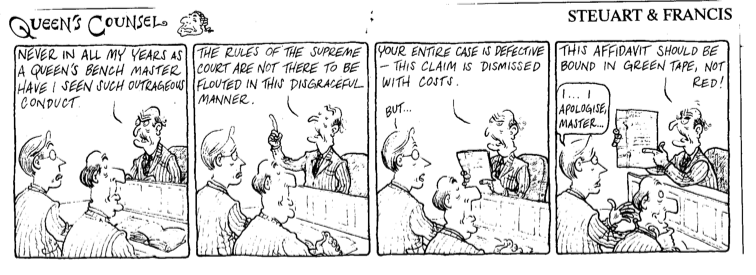
You might also like the contribution from Tim Strong, a litigation partner at Taylor Wessing.  He tells of a judge whose procedural focus seemed to be on the proper way to bind pages together. Tim’s story reminded me of my favourite legal cartoon (from Steuart & Francis in the Times, years ago):

Angry Master

One hopes that case managing judges have more important things to worry about these days.

Home

Posted in Lawyers | 4 Comments

UK judges and predictive coding – open to any proportionate suggestion

Charles Christian’s Legal IT Insider has been hosting a discussion about the likely reaction of case managing judges to the proposed use of technology like predictive coding. The starting point is a thoughtful article by Drew Lewis, eDiscovery Counsel of Recommind called Best case scenario – the impact of the Jackson reforms, and Andrew Haslam, Jonathan Maas of Ernst & Young and I have joined in with comments.

However close becomes the alignment of the procedural rules in the US and in England and Wales, I suspect that we in the UK will never really get our heads round the US idea that one needs judicial blessing (from some court, somewhere) before doing anything new or different. We are not talking here of formal precedent, but of day-to-day case management of the kind which is rarely reported in England and Wales anyway.

The problem with phrases like “courts in the UK are currently not open to predictive coding”, apart from being wrong, is that they have the potential to stifle imaginative approaches to bringing costs within the bounds of proportionality. The courts are “open” to any suggestion which achieves this and one must jump on any assertion which might become a self-fulfilling prophecy.

The new rules are to some extent a clean sheet, and give opportunity for the right kind of lawyer and the right kind of judge to set the tone. The 1999 case management rules provided that the court could “take any other step or make any other order for the purpose of managing the case and furthering the overriding objective”. If the court can make any order, you can seek any order; if your suggestions point to the most proportionate approach of managing the case, then the court will not be inhibited by the absence of a case report approving of the method.

It is worth drawing attention to the point made by Jonathan Maas – your enthusiasm for agreeing timescales, as well as budgets, is no substitute for knowing what you are talking about. Vince Neicho of Allen & Overy emphasised at Epiq’s recent costs seminar that it is necessary for all interested parties (in the wider sense of the word “interested”, and including the client) to be involved in the discussions which go through into court-approved timetables.

On the same subject, The Lawyer has published an article by Jim Kent of Nuix called Is predictive coding the answer to reducing the costs of eDisclosure? which takes you through the practical steps in using this kind of technology in a manner relevant to UK proceedings.

Home

Posted in Discovery, eDisclosure, eDiscovery, Electronic disclosure, Nuix, Predictive Coding, Recommind, Technology Assisted Review | Leave a comment

Cost budget revisions unlikely

I have already referred  (in my article on Epiq’s costs seminar) to Murray & Anor v Neil Dowlman Architecture. There is a good commentary on that on Outlaw.com called Cost budget revisions to fix mistakes unlikely to be allowed, says judge which you may find helpful.

I have mentioned also Dominic Regan’s article The end of late chopping and changing on the same subject.

Distinguish between amending a budget because the facts have changed and getting the budget wrong in the first place.

Home

Posted in Discovery, eDisclosure, eDiscovery, Electronic disclosure, Epiq Systems | Leave a comment

Good Practice Guide to eDiscovery in Ireland

Irish civil litigation requires discovery and therefore electronic discovery. An informal group called The eDiscovery Group of Ireland has been working for some time on a Good Practice Guide to Electronic Discovery in Ireland, and Version 1.0 was published recently. The members of the Group are listed on page 2 of the Guide.

This is an interesting jurisdiction with all to play for. Mr Justice Frank Clarke, with whom I have the occasional pleasure of doing panels and interviews, does not understate it in the opening line of his forward which reads “It can, I think, be said that Ireland has been late in addressing eDiscovery.”

The important point, he says, is that “the costs associated with complying with disclosure obligations… do not become a barrier on access to justice”. That message can now be heard in every relevant jurisdiction.

I would have gone to the  launch of the guide had I not been engaged in a conference elsewhere. I will come back to this.

Home

Posted in Discovery, eDisclosure, eDiscovery, Electronic disclosure, Ireland | 1 Comment

The destruction of Justice and Criminal Legal Aid

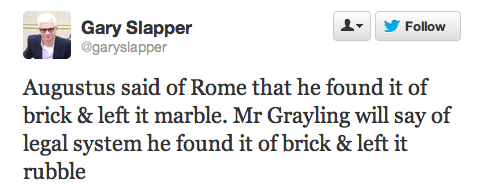
Whilst we have been worrying about the MoJ’s botched implementation of the Civil Procedure Rules, the Justice Minister Chris Grayling (known as Failing Grayling and not merely because he is a Lord Chancellor without legal qualification) has been quietly but speedily demolishing the criminal justice system.

Slapper on Grayling and Augustus

It is not an area which directly affects me – but then, of course, no one knows what might happen to any of us tomorrow which might make us grateful for a functioning and independent legal defence system, to say nothing of a fair prosecution system.

I am writing about it, slowly and painfully, because it seems to me that we have one opportunity only to prevent Grayling’s demolition. It is slow and painful because it is not my area, and I am more comfortable writing about things I know about.

We do, however, need to hear from those who are NOT directly affected by Grayling’s plans, partly because those who are affected are easily accused of special pleading, partly because they seem to be the only interest group in the world with worse PR management than the government, partly because we never know when fate may bring any of us within the maw of the criminal justice monster – but mainly because what is proposed is just wrong.

Home

Posted in Access to Justice | Leave a comment

CPR, CMC, WTF …. and OCD: eDiscovery stories keep rolling in

I have a stream of short articles coming. This is just some background noise.

I observed in a tweet last week that I had overlooked the Twitter presence of an interesting legal software development company, Neota Logic. “Might be because you are OCD about eDiscovery” came the prompt response.  Although I immediately admitted the charge (or “accepted the compliment”), eDiscovery / eDisclosure is how I earn my living and one need not be obsessive, compulsive or disordered if there is a happy coincidence between the things which interest you and the things which put bread on the table. I call it good fortune myself.

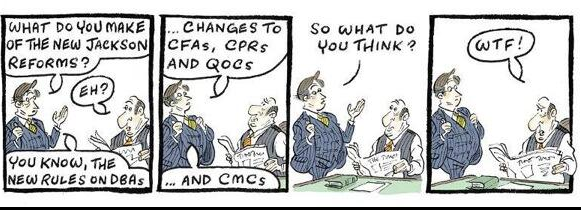
The OCD suggestion gives us another set of initials to add to those nicely caught by this Times law cartoon.

Alphabet soup

The genius, as well as the authorship, of these cartoons is hereby acknowledged. You can find more here.

There has been quite a lot of it about recently; a high volume of mainstream eDiscovery stuff as well as other aspects of legal practice and justice has given me a long list of things to write about. I have three weeks of conferences coming up, with two in the US bracketing one in London, and it would be good to be shot of some of it before that begins.

A series of relatively short posts follows this one. With that done, I can turn to the the conference preparations and other things which comprise the rest of the pile in front of me.

Jackson – the phoney war

First, however, what has been keeping me busy? Directly or indirectly, the answer to that is “Jackson”. Despite 18 months of thinking time, those responsible for launching the new rules managed to make a complete hash of it. This is not necessarily the fault of the rank and file members of the Rule Committee whose work we are lucky to have (and I don’t say that just because I was at school with one of them and am on friendly terms with another). They were set a near-impossible task by the decision to amalgamate all the changes into one amending act – one can see the tidiness of this in statutory terms, and one can see also that some elements depend on others, but it does impose an immense burden on those charged with the drafting, to say nothing of weight on those who implement and those who must obey the rules.

It was unfortunate that the launch of the rules coincided with other developments which have nothing to do with them, including a brutal attack on Legal Aid and a mindless hacking at the front-line staff in the court and at the Ministry of Justice budgets generally. Continue reading

Posted in Consilio, CY4OR, Discovery, eDisclosure, eDiscovery, Electronic disclosure, Huron Legal, Jackson Reforms, Thomson Reuters, ZyLAB | Leave a comment

Epiq Systems seminar focuses on the new Costs Management rules

Epiq Systems held an extremely informative seminar on the new costs regime earlier this week. You will find at the end of this post a link to the video made on the day with the strong recommendation that you watch it.

“The thing about Dominic Regan”, somebody once said to me, “is that nearly everything comes down to costs to him”. It was meant as a compliment, and reflected the fact that much of the Civil Procedure Rules, of the case law which exists around it, and of the strategy of litigation, runs sooner or later into questions of costs. There are, of course, litigants for whom expense is no issue, cases which must be fought at any price, and large sections of the rules which regulate aspects of procedure to which costs have no direct relevance. The justice which is set squarely in the opening section of the overriding objective, however, is no justice at all if parties cannot afford it;  Lord Justice Jackson’s remit, however widely drawn, was driven by the need to control costs, and the rule changes which are named after him largely reflect that.

EpiqPanel

Professor Dominic Regan was one of four expert panellists at a seminar organised by technology provider Epiq Systems in London this week. The others were Master Colin Campbell of the Senior Courts Costs Office, costs expert Michael Bacon and Allen & Overy litigation support manager Vince Neicho.  The room was packed, and if much of the focus was on eDisclosure, the panel ranged across the wider implications of the new costs regime. The session was led by Epiq’s Saida Joseph. Continue reading

Posted in CPR, Discovery, eDisclosure, eDiscovery, Electronic disclosure, Epiq Systems, Litigation | Leave a comment

Being on top of EDiscovery metrics means you can’t be pushed around

I took part in a webinar yesterday organised by Consilio whose theme was the metrics of eDisclosure / eDiscovery with particular reference to the budgets and cost estimates now required in UK civil litigation. The star turn in the webinar was Marla Bergman of Goldman Sachs whom I came across whilst moderating a panel in Washington last year.

I will point you to the recording when it is published, but there is one point made by both Marla and me which I am keen to emphasise. The need to present costs estimates is primarily a rules-driven requirement. It has two other benefits, however, which are nothing to do with the demands of any court or judge. Clients quite like the idea that their lawyers are on top of the prospective costs of this most expensive component of litigation. As a quite separate matter, the lawyer who is armed with information about the different ways of tackling the problem and the costs of doing so has a significant tactical advantage over less well-informed opponents.

Marla Bergman said of this that “you can’t be pushed around” when disputes arise about the scope or method of giving discovery / disclosure. If one wanted a single message from this webinar, this was it.

As I say, I will point you to the recording in due course.

Posted in Litigation Support | Leave a comment

Apersee updates its webinar schedule with Nuix and AccessData

Apersee, run by George Socha and Tom Gelbmann, has updated its list of forthcoming webinars.

These include one on 28 May called Don’t Get Left Behind – eDiscovery is for Everyone, with Martin Audet of Nuix and William Hamilton, a partner at Quarles and Brady and Dean of the Department of eDiscovery at Bryan University.

It is followed by one on 30 May called Mobile Discovery and iOS. The presenters are Gail Gottehrer, Partner at Axinn Veltrop & Harkrider and Lee Reiber, Global Director of Mobile Forensics, AccessData.

George Socha and Tom Gelbmann are taking part in both. My experience as participant in their webinars is that they are lively and informal as well as educational.

Posted in Litigation Support | Leave a comment

Discussing eDisclosure round the table at the Brewery

The fact that we enjoyed ourselves at the TGCI eDisclosure event in London did not make it any less of a serious forum for discussion. The round-table format, the complete absence of PowerPoint slides, and the invitation to delegates to interrupt as they wished made it an extremely lively and useful exercise.

There are a limited number of ways in which you can organise conferences and seminars aimed at dispensing information and promoting discussion about eDisclosure / eDiscovery. The conventional approach, a series of lectures and panels delivered from a podium or platform to delegates in rows of chairs, is ideal in many ways, particularly when the intention is dispensing information from the few to the many – that is what delegates generally expect, and I am told by someone who organises events across many different sectors that lawyers are not particularly interested in alternative formats – even government delegates look for more imaginative approaches.

I am not being critical here – I have no quarrel with the conventional approach and am rarely an enthusiastic participant in those events where you are divided into tables and given a whiteboard, a set of scenarios and some poor sap who must report back to the conference.  One approach I do like, which we are seeing more often, is the “led discussion” where we get down from our platforms, pull our seats into a circle and talk around a subject at the behest of a nominated group leader. Continue reading

Posted in CPR, Discovery, eDisclosure, eDiscovery, Electronic disclosure, Guidance Software, Huron Legal, Nuix | Leave a comment

Jackson events next week with Epiq and Consilio and guides from Judge Brown, Dominic Regan and Kerry Underwood

A tweet last week compared the first few days of the new case and costs management regime with 1939 – the reference was not intended to evoke anything belligerent but that period of uneasy calm known as the Phoney War which followed the formal declarations. We all know that something momentous is happening to those involved in civil proceedings, but until we start getting reports of case management conferences and feedback from the front line (to continue the war analogy) we cannot really tell how it will all play out at a practical level.

For the most part, I have stuck to straightforward recitals of what the rules say, reckoning that the MoJ’s botched launch of the amendments has so obscured the position that people are grateful simply to be pointed to the key provisions – as another tweet said, the MoJ was going to celebrate with a party at a brewery, but could not find anyone to organise it. At a conference this week, I offered delegates the choice between a summary of what the rules say and an analysis of their implications; they went for the summary, leaving it to Senior Master Whitaker to delve more deeply into what the changes mean for practitioners and clients at a later session.

It is worth pointing you to some of the events and articles which get more deeply into the implications.

Events from Epiq Systems and Consilio

epiq_110I have already written about a seminar which Epiq Systems is running on Tuesday 23 April at 8:30am at 60 Cannon Street. Its title is Costs changes to the Civil Procedure Rules: join the debate, and the speakers are Master Colin Campbell, Senior Costs Judge, Michael Bacon, costs lawyer, Vince Neicho, Litigation Support Manager, Allen & Overy and Professor Dominic Regan, adviser to Lord Justice Jackson on costs budgeting. The focus is on the pre-estimates of eDisclosure costs which are required whether or not costs management has been ordered (an important point this, for those confused by the cost management exemptions), on keeping costs down by the use of technology and outsourced review, and on the crossover between the new costs regime and clients’ demands for more imaginative costs structures – the predictability and transparency required by the courts is, of course, much the same as  a client wants from its lawyers anyway. Registration for this event is here.

Consilio A First Advantage CompanyOn Wednesday 24 April  Consilio is producing a webinar called The eDisclosure Shakeup: CPR 31.5 with Marla Bergman of Goldman Sachs, Garry Bernstein of Consilio and me. As I have written here, the focus is on the value of metrics in approaching costs estimates – if you  keep information about past cases (or work with someone who does) then the apparently daunting task of estimating costs so early in the proceedings becomes more feasible. No one (not me, anyway) is saying that it is easy, and many cases will buck all known trends; nevertheless, there is commonality in the components of cases which, if captured, can the used to inform future decisions. Registration for this event is here. Continue reading

Posted in Consilio, Court Rules, Discovery, eDisclosure, eDiscovery, Electronic disclosure, Epiq Systems | Leave a comment

Jackson and eDisclosure with Hobs Legal Docs in Manchester

On Thursday, I joined Terry Harrison of Hobs Legal Docs to give a talk on the eDisclosure aspects of the Jackson reforms at a seminar hosted by The Royal Bank Of Scotland in Manchester.

My real interest in this subject is the opportunity which the rule changes give to law firms and their clients not just to control costs but to make litigation more attractive as a business endeavour. Those who know the rules and who are ready and able to express proportionality arguments in a way which legitimately reduces the volumes of data (“legitimately” meaning in a way which is consistent with professional duty to court and clients) can not only win clients but put themselves in a position to influence the management of the case.

The desultory manner in which the Ministry of Justice has rolled out the Jackson updates has obscured the clear lines laid down by Lord Justice Jackson, requiring me to spend my time trying to clarify what the rules actually say rather than to focus on how they can be used to strategic and tactical advantage. An hour is not long enough to cover it all, and I was pleased to get a message via Twitter afterwards from someone who was present who said that he would like to hear the rest of the story. I will be happy to oblige if asked. Continue reading

Posted in CPR, eDisclosure, eDiscovery | Leave a comment

Podcast with Xerox Litigation Services – what law departments should expect from the UK CPR Amendments

I recently recorded a podcast with Rachel Teisch of Xerox Litigation Services whose purpose was to describe briefly the recent changes to the UK Civil Procedure Rules as they relate to case management and eDisclosure.

The aim was to give law departments, both within corporates and at external law firms, a summary of what to expect and how they might prepare for the new regime. There is a summary here of what we said, together with a link to the podcast itself. The focus is on anticipating the scope, the possible methods and the expense of giving eDisclosure and on the options which face legal departments and external litigation teams. These include broad choices such as that between keeping work in house or sharing the weight with third party experts.

Whilst writing about Xerox, I draw attention to their new LinkedIn group called E-Discovery Talk by Xerox which invites you to share thoughts and expertise on timely topics and trends and to participate in the dialogue.

Posted in Litigation Support | Leave a comment

CY4OR takes Nuix for large-scale digital investigations and eDisclosure

By chance, I was on my way to Bury, near Manchester, to visit digital investigations and eDisclosure company CY4OR when the news broke of its partnership with Nuix. The press release is here.

The visit to CY4OR had been long arranged – the purpose was a video interview with managing director Joel Tobias as well as an opportunity to catch up with what CY4OR has been doing. The Nuix story gave me the opportunity to ask Joel what he expects from CY4OR’s software partners. His reply will appear in the video in due course, but he gave me a specific example.

CY4OR was using Nuix for a  processing job so large that CY4OR urgently needed to reinforce its already substantial (and recently upgraded) infrastructure. Nuix Europe MD Jim Kent arranged for the delivery that day of a suitably-specified server, enabling CY4OR to get through the job in minimum time. The end-client probably neither knows nor cares who is to be thanked when things go smoothly, any more than it cares who is to blame when they do not. This kind of support helps keep everyone looking good, and brings the client back.

I will bring you more about this partnership in due course.

Posted in Litigation Support | Leave a comment

Consilio webinar on 24 April: the eDisclosure shakeup: CPR 31.5 and the value of metrics

A webinar which I am doing with Consilio on 24 April will focus on some of the positive aspects of the new UK Civil Procedure Rules relating to case management and disclosure. The panel includes Marla Bergman, VP, Assistant General Counsel, Legal and Internal Audit at Goldman Sachs and the moderator is Garry Bernstein, Director of Consilio in London.

Like all new rules, Rule 31.5 and the case management structure of which it is part, bring new duties including increased obligations to know about electronic sources of information, to discuss them with opponents and, most significantly, to estimate the costs of disclosure – this is a freestanding disclosure obligation, independent of the costs management regime.

Many lawyers, so one judge has predicted, will have “sweaty palms” at the thought of estimating costs; another has predicted “blood on the floor” when parties seek to vary their budgets. One person’s burden, however, is another person’s opportunity.

What if you were the lawyer who was on top of the numbers – who knows how to estimate costs, who keeps metrics from past cases, and who has an open line to providers who can quickly provide transparent predictions about the costs of alternative approaches?  That may inform not only your strategy but your tactics, in the sense that opponents and courts are more likely to be swayed by arguments from someone who clearly knows what he or she is talking about. Furthermore, the rules do not merely permit  or encourage arguments about proportionality, but positively require them.

Much of my thinking about  eDisclosure metrics, and their value in the right hands, comes from a panel which I moderated in Washington last year for Legal IQ at which Marla Bergman was my star panellist. She was eloquent on the value of keeping statistics from past cases to inform decision-making in present one, and it is easy to see how this applies to the obligations under Rule 31.5 to argue both about the scope of disclosure and about the method of doing it.

Registration is here.

Posted in Litigation Support | Leave a comment

eDiscovery Europe prepares for second Prague event in October 2013

One of the more interesting conferences which I attended last year was LawTech Europe Congress in Prague. It was the first eDiscovery conference organised in the region, and was exciting as much as for its potential as for its content.

I will write more about this in due course, but meanwhile draw your attention to the  press release announcing preparations for the 2013 event which will this year occupy two days, 21 and 22 of October.

Posted in Litigation Support | Leave a comment

Nuix and the Global Offshore Money Maze – tools and skills go beyond conventional eDiscovery

Whilst this story has Nuix software as its inspiration, the point is a wider one – where do you start when you don’t know where to start on a large collection of data? A combination of software and shoe leather may be needed. And the software and skills may open doors to new practice areas.

I have been focusing on the impact of the Jackson reforms in England and Wales, but the big eDiscovery story of the month has involved a rather different application of a discovery tools and techniques.  The focus on court rules and on technology and processes can easily blind us to the importance of data as evidence. Evidence matters (or should matter) as much to investigative journalists as it does to lawyers, and the same technology can be used by both.

The International Consortium of Investigative Journalists (ICIJ) was given anonymously a hard drive containing 260 GB of data including more than 2 million e-mails, as well as Word documents, databases and spreadsheets – as broad a mix of source types as one will find anywhere.  Many eDiscovery exercises begin with the question “What have we got here?” –  an important point, often overlooked by those who ask simplistically “Why are we don’t just use Google for eDiscovery search”. You need something rather different to investigate this kind of volume of mixed data when you have no idea what it is all about.

The ICIJ turned to Nuix, who provided software licences free of charge to enable investigation of the data. That turned out to include the biggest collection of leaked data in the history of journalism, all relating to financial arrangements of the kind which the rich and powerful use to keep their assets and transactions hidden from view. Government officials, wealthy corporations and individuals, banks and offshore tax advisers all featured, and much more prominently than they would hope.

You can read about it in an article by Nuix CEO Eddie Sheehy called Nuix the Obvious Choice for ICIJ “Global Offshore Money Maze” Investigation which includes a graphical display of the complex webs of interaction which the Nuix software flushed out.  You might also be interested in an article called Aussie Software Ferrets Out Hidden Money. The ICIJ’s own telling of the story is called Secret Files Expose Offshore’s Global Impact. Continue reading

Posted in Discovery, eDisclosure, eDiscovery, Electronic disclosure, Nuix | Leave a comment

The Ghost of Legal Services Yet to Come – a Futurist tells of things that may be

LegalTech Asia Technology Summit opened in Hong Kong with a thought-provoking keynote from futurist Rohit Talwar. Don’t be put off by that “futurist`” label – UK solicitors (and even barristers) get something to think about from talks like this. I pick out the themes and points which are relevant to lawyers now. The Scrooge parallel, I should stress, is mine not Rohit Talwar’s.

gocytc“Before I draw nearer to that stone to which you point,” said Scrooge, “answer me one question. Are these the shadows of the things that will be, or are they shadows of things that may be, only?”

Still the Ghost pointed downward to the grave by which it stood.

“Men’s courses will foreshadow certain ends, to which, if persevered in, they must lead,” said Scrooge. “But if the courses be departed from, the ends will change. Say it is thus with what you show me!”

Scrooge’s story is, as we know, one of redemption, and futurist Rohit Talwar, keynote speaker at LegalTech Asia Technology Summit in Hong Kong at the beginning of March, was rather too jolly to make an authentic Ghost of Christmas Yet to Come. Nevertheless, his message might well make lawyers think of the grave which persuades Scrooge to change his ways or, more positively, think of ways to modify their practices to meet a changing future.

“We have got to see past the current turmoil or lock ourselves into our history”, he said, and his reference to “current turmoil” related as much to the daily rushing around with what is on our desks as to the wider economic scene.

“These futurists are all very interesting, but I want to know what my firm should do now”. This is the common cry of those who attend talks by those who anticipate business trends. I do not particularly like the label “futurist” because it somehow implies too much science and not enough flesh and blood, but that is how Rohit Talwar describes himself, and there was certainly more than enough of the human in his talk. I occasionally meet an equivalent perception myself – because I live in Oxford and have a grey beard, it is somehow assumed that I am “academic”, and “academic” carries the implicit connotation of  separation from the real world. My focus is in fact very much on commercial futures.  What Rohit Talwar has to say, as with Richard Susskind, has implications for law firms now.

Rohit Talwar packed a lot into his 90 minutes. I must be selective in what I report, sticking to those things which have obvious relevance to eDiscovery and to the business processes needed, both by law firms and by their clients, to elevate eDiscovery beyond being a plod through the rules or (which is just as bad) being a mechanical set of tasks with little apparent relevance either to evidence and law or to business objectives. Continue reading

Posted in CPR, Discovery, eDisclosure, eDiscovery, Electronic disclosure, Litigation | Leave a comment

Send three and fourpence, going to a dance – muddled messages from the MoJ

It is fitting that an article about confused messages should have to start with an explanation of its title. Only those who are old and British will know that pre-decimalisation currency consisted of pounds, shillings and pence, written as £. s. d. “Three and fourpence” was three shillings and four pence (written as 3/4) and was equivalent to about 17p in new money.

The (possibly apocryphal) story goes that a Great War front line commander sent a message back from the trenches “Send reinforcements, going to advance” which reached HQ as “Send three and fourpence, going to a dance”. It comes to mind as we watch the UK Ministry of Justice, and those responsible for the mechanics of rule-making, convert Sir Rupert Jackson’s crisp and urgent message about case management and costs control into a confused jumble. The front-line troops are the case managing judges and the lawyers who are trying to work out what they are supposed to be doing to comply with a regime whose implications, they know, include fierce enforcement provisions. At the time of writing, the enforcement provisions in Rule 3.9 have (just) been published, but the new eDisclosure rules have not. You can therefore, theoretically at least, be punished for non-compliance with rules which you cannot easily find.

The Jackson reforms have attracted a great deal of comment, much of it from people who know what they are talking about in their various specialist subjects; we have also heard a lot from people who are less knowledgeable, from some who conflate a range of changes (including those to Legal Aid) under the label “Jackson”, and from some whose position is like that of the early 20th Century judge who said “Reform! Don’t we have problems enough already?”. Continue reading

Posted in CPR, Discovery, eDisclosure, eDiscovery, Electronic disclosure, Jackson Reforms, Judges | Leave a comment

A clear message from the Master of the Rolls about CPR enforcement

You might perhaps be forgiven for thinking that the case management parts of the Civil Procedure amendments won’t really affect you. It is not just that their launch has been confused, to use a charitable term; those who came through the 1999 launch of the CPR found the courts willing to accept excuses for non-compliance thanks to a (largely unspoken) idea that the interests of justice required leniency in the face of “mere” procedural defects.

This is one of the points addressed by Lord Dyson, Master of the Rolls, in a speech delivered on 22 March to the District Judges Annual Seminar.  The amendments, it is clear, do more than introduce specific procedural requirements; the change of culture from the post-1999 world – “the new philosophy” he calls it – which was the focus of the MR’s speech lies in this sentence:

“Tough rules but lax application; tough rules but a culture of toleration; and lax application and toleration are all fatal to the new philosophy”.

What Lord Dyson calls the “Mark II overriding objective” includes an express reference to “proportionate cost”. Proportionality has, in theory at least, underpinned the rules since 1999. In the context of disclosure, the narrow definition of a disclosable document, the restraints on the duty of search, and the reminder, in two important cases, that parties are not required to look under every stone, are all part of this. It is equally the case that the existing rules expect compliance, yet we now have a new Rule 3.9 which addresses (and not in a good way, some would say) relief from “any sanction imposed for a failure to comply with any rule, practice direction or court order”. Continue reading

Posted in CPR, Discovery, eDisclosure, eDiscovery, Electronic disclosure, Jackson Reforms | Leave a comment

ZyLAB webinar on 10 April: Bridging the gap between legal and IT: working together in eDiscovery

I am taking part in a webinar with ZyLAB on 10 April. The title is Bridging the gap between legal and IT: working together in eDiscovery.

I will be there to talk about  increased efficiency and reduced
organisational risk, and will throw in my corollary message – that there
are benefits here as well, both for organisations and for the
individuals who grab the chance to focus the attention on the uses and
value of data as well as its risks and costs.

ZyLAB’s Johannes Scholtes will explain how technology can help both the lawyers and the the IT professionals. The wonderful Mary Mack will keep control as moderator.

The webinar is broadcast live at 11.30am EST. Registration is here.

Posted in Litigation Support | Leave a comment

Reminder: London eDisclosure conference on 17-18 April

The first case management conferences affected by the new eDisclosure obligations will take place on 16 April. Lawyers will have had the required discussions with opponents and will have filed reports about the anticipated scope of and cost electronic disclosure. Or perhaps they will have tried to get by without – we have been left in no doubt, as various articles from me and others have emphasised, that judges will be enforcing the rules and that relief from sanctions will be given only sparingly.

The roll-out of the new rules has been shambolic, judicial training almost certainly inadequate, and confusion will be widespread. It will all settle down in time, no doubt.

It seems a good week to organise a conference aimed at intelligent and positive discussion about eDisclosure generally and about its management, at a time when we face not just new procedural obligations but what the Master of the Rolls has called “the underlying philosophy of the Jackson reforms”.

We have just the thing for you, called eDiscovery for the Corporate Market, taking place in London on 17 and 18 April. The event is not a series of lectures but a set of round-table discussions, each led by moderators whose aim is to share their own knowledge, to identify points of concern, and arrive at constructive ways of surviving and thriving in the new environment.

Registration is free for members of corporate and law firm departments with some responsibility for eDisclosure, whether as a technical or as a legal matter. It would be good, too, to see some barristers, since they will be in the front line when the judges start throwing things, and might be glad of a shield in the form of ready arguments based on considered preparation.

We will also be covering the software tools and methods available to help, equipping you to talk with apparent confidence about predictive coding and managed review when the subject comes up – or, indeed, to initiate the discussion yourself.

Do please pass on this link to anyone who might benefit from attendance.

Posted in Litigation Support | Leave a comment

Appointments and awards at Consilio, Huron Legal and UBIC

I do not keep track of all the moves, appointments and awards within
the worldwide eDiscovery / eDisclosure market, but it is helpful
occasionally to collect a few together to help remind us that there is a
thriving industry here.

Drew Macaulay (LinkedIn profile here) has been appointed managing director at Consilio
in London. He has been Director of Business Development over a period
in which Consilio (under its former name First Advantage Litigation
Consulting) has considerably expanded its business in Europe and the UK.
He also earns the ultimate accolade (from me, anyway) of being a good
bloke.  if that is a peculiarly English compliment, I am sure that
others will catch my drift.

Huron Legal has expanded its legal process outsourcing activities by the appointment of Jeff Catanzaro (press release here)  as a managing director focused on various aspects of LPO including contract management and intellectual property.

The South Asian Bar Association (“SABA”) of Northern California has given an award to Mukesh Advani (press release here), who is on the Advisory Board of UBIC North America, Inc. in recognition of the support and encouragement he has given to SABA over the last 20 years.

Posted in Uncategorized | Leave a comment

Comfortable apathy for anyone? Some Jackson case management and costs management commentary

I am working on some material to add to the Resources section of my web site about the case management and costs management aspects of Jackson. There is, as you would expect, a great deal of comment flying around at the moment and I take this opportunity to point you to some of them.

LexisNexis has just published a sub-site devoted to the subject called LexisNexis on Jackson.  In addition to providing links to the main formal documents (as I did recently) it carries four videos designed to show what happens when you fail to prepare for or cooperate with the other side in relation to cost budgeting before the CMC.

The participants are HHJ Simon Brown QC, who did so much on the Birmingham costs pilot, and two solicitors who took part in the pilot, Mark Surguy of Eversheds and Martino Giaquinto of Mills & Reeve. This is an excellent and easily-assimilated way of understanding the implications of the new regime, and an extremely useful supplement to reading the rules themselves (don’t forget to do that).

An article published today in the Law Society Gazette is headed Judges “ill-prepared” for Jackson and presents a pessimistic view of what parties can expect given the paucity of the training given to case managing judges. I take a rather different view. Continue reading

Posted in Discovery, eDisclosure, eDiscovery, Electronic disclosure, Huron Legal, Jackson Reforms, LexisNexis | Leave a comment

Small and medium-sized cases have electronic documents too

Three articles come my way at once, connected by the theme that electronic documents raise management issues in small and medium-size cases and not only in the large ones which tend to hog the limelight. One of the articles comes from the UK and the other two from the US; the principles apply everywhere.

Bringing Babel to the lawyers

The UK article is from Charles Holloway at Millnet and is called Nimrod. The chap allegedly responsible for commissioning the Tower of Babel could serve as the introduction to several eDisclosure / eDiscovery parallels. Charles Holloway refers, subliminally at least, to two of them. One is the launch of the new civil procedure rules, where the clear message intended by Lord Justice Jackson has been undermined by a confused delivery which resembles a site instruction at Babel: we have costs management, heavily qualified by ad hoc exemptions yet still promoted as the default –  picture a Greek writing instructions in Babylonian for the benefit of a Latin-speaking project manager to pass on to a Hebrew workforce in Gaelic and you can easily see the relevance of Babel to the rule makers.

We don’t need Babylonian, Latin, Hebrew, Gaelic and the rest to confuse the UK eDisclosure landscape, because we have American. Much of the marketing style, as well as the language, comes direct from the US, and it needs more than a dictionary to convert US eDiscovery concepts into terms which matter to the lawyers who are the potential buyers of eDiscovery software and solutions in the UK. I have done my bit over the years to reduce the language of fear and scale which characterises US eDiscovery marketing, full of talk of terabytes, sanctions, legal holds, requests, privilege logs and all those other things which make US discovery so disproportionately expensive. You cannot wholly blame the marketing people, whose language reflects the reality of the problem they are attempting to solve – in the US. Continue reading

Posted in Discovery, eDisclosure, eDiscovery, Electronic disclosure, iCONECT, Jackson Reforms, Nuix | Leave a comment

Reminder: Recommind seminar on Jackson Reforms at St Paul’s on 27 March

Here’s a reminder of a seminar to be given by Recommind at St Paul’s Cathedral on 27 March – next Wednesday – at 8.30am. Speakers include Senior Master WhitakerMark Surguy of Eversheds and Vince Neicho of Allen & Overy, as well as me.

I wrote about it here and registration is here.

We will bring you up to date on the development of the rules, the practical implications of new obligations which are only days away, and the tools and technology which help to control the time and cost of the work which will result as court management of electronic disclosure takes effect.

Posted in Litigation Support | Leave a comment

Patrick Burke joins Reed Smith’s Records and EDiscovery (RED) Group

Reed Smith has recruited Patrick Burke as Counsel in its Records and EDiscovery (RED) Group. It is not perhaps a coincidence that I wrote about Reed Smith recently in an article called Reed Smith: 6 reasons to Insource Litigation Support
– I would love to be able to write more about law firm eDiscovery
expertise, but few of them seem to have much to say. That does not imply
any lack of expertise, merely that few of them have woken up to the
marketing potential of this skill-set. Thanks to its RED Group, Reed
Smith has plenty to say. Their press release about Patrick Burke’s appointment is an example.

Looking back, I see I also wrote about Reed Smith last April in an article called Reed Smith chooses Equivio Zoom for Predictive Coding and Analytics and Relativity for Review, and I subsequently spoke to David Cohen,
head of the RED Group. From him I learned that the firm does more than
make a profit from its eDiscovery group – they win work and new clients
with it. That message now forms part of my talks to lawyers, an antidote
to the fear-inducing catalogue of rules, new responsibilities and
sanctions which necessarily bulks large in any talk on the subject.

Patrick Burke was one of the first people I came across when I made
my first forays into US eDiscovery in 2007. He was Assistant General
Counsel at Guidance Software,
and we have done countless panels and webinars, made videos, and
written papers together since then, in the US, in the UK and in mainland
Europe. There are not many US eDiscovery people who have bothered to
understand the differences between jurisdictions, but Patrick has, and
it shows.

Law firm litigation departments face a number of alternative business
models who want to eat their lunch. They include the clients
themselves, providers of technology and managed review services, and the
big consulting firms. One of the factors which differentiate the latter
from law firms is their willingness to employ people with a range of
skills, including technical skills. One of the many things which Patrick
Burke will bring to Reed Smith as he goes back into litigation practice
is a deep eDiscovery knowledge, specifically in relation to
identification, collection and legal hold which are amongst Guidance
Software’s specialist areas, and on topics like cross-border discovery.

Guidance Software has invited Patrick and me to take part in a cross-border panel at CEIC 2013 in Orlando. I hope that I will have the opportunity of working with him on other things in his new career at Reed Smith.

Posted in Uncategorized | Leave a comment

Symantec defensible deletion webinar on 27 March

The full title of this webinar is Protecting Your ESI Blindside: Why a “Defensible Deletion” Offense is the Best Information Governance Defense.

It is a deliberately paradoxical title, implying that a positive and proactive attack on useless data is your best defence against eDiscovery sanctions, eDiscovery failures and excessive eDiscovery expense.

It is only relatively recently (with some exceptions) that courts have considered it necessary or helpful to enquire into a party’s records-keeping. It becomes increasingly material for them to do so, partly to test assertions as to the existence or otherwise of allegedly relevant documents and partly to assess the credibility of proportionality arguments.

The panel consists of The Honorable James C. Francis IV, U.S. District Court, Southern District of New York, Anne Kershaw, Founder and Senior Attorney, A. Kershaw Attorneys & Consultants, and Philip Favro, Discovery Counsel, Symantec

You should not, of course, need a judge to tell you that you can delete some at least of the stuff you keep. It is perhaps comforting, however, to hear it from a judge and one, furthermore, who is a leading authority on eDiscovery.

Among Anne Kershaw’s many contributions to this field is an article which she wrote long before the term “defensible deletion” reached common use, urging just that as a way of mitigating eDiscovery cost and risk.

This webinar takes place on Wednesday 27 March at 2pm ET | 11am PT. Registration is here.

Posted in Litigation Support | Leave a comment

kCura publishes Relativity Assisted Review case study from Millnet

One of the easy predictions for 2013 was that we would begin to see case studies, or at least anecdotes, about the use of technology assisted review. These are, of course, more valuable than any number of assertions  in marketing department brochures.

The most recent is UK-based and comes from the use by UK eDiscovery solutions provider Millnet of kCura‘s Relativity Assisted Review. kCura’s introduction is here and the case study itself is here. The things to focus on (apart from the £80,000 saving) are the table of statistics and the description of the methods used to cross-check the software’s conclusions.

It should be of particular interest to those who bang on about “black boxes” as a substitute for actually trying to understand technology assisted review or as a shelter against the certainty that clients will certainly want to know about savings of this order. Case managing judges, too, will expect to be told about the range of technology available to reduce costs, and in cases much smaller than the one in the case study.

Posted in Litigation Support | Leave a comment

Jackson eDisclosure seminar in Manchester on 11 April with me and Hobs Legal Docs

I gave a talk in Manchester last year in the company of Terry Harrison of Hobs Legal Docs. Our subject then was the pending Jackson reforms, and we got a good audience both for the seminar and for a rather good post-event gathering in a nearby pub.

Jackson is now with us, and a repeat visit is in order. I am presenting a talk on the eDisclosure aspects of Jackson in conjunction with Hobs Legal Docs and The Royal Bank of Scotland on 11 April at 6.00pm for 6.30pm at the RBS offices at 1 Spinningfields Square, Manchester M3 3AP.

Apart from a summary of the rules themselves – some of which have been obscured by the appallingly inept roll-out of the final version – the themes will be two-fold: the tools and techniques which will be needed to face the new regime, and the benefits which will ensue for those who get on top of the subject and in a practical way.

The invitation is here with details of time and venue. Register by email to amanda.foster@hobslegaldocs.com or by calling 0161 228 330.

Posted in Litigation Support | Leave a comment

Epiq Portal 2.0 gives real-time project information to legal teams

Epiq Systems brought out Epiq Portal 2.0 as LegalTech began. There is a lot of noise around then, however, and I generally prefer to let the dust settle before picking up on announcements. The press release is here.

The growth in data under management for eDiscovery purposes (and Epiq is reporting increased caseloads) brings with it an increasing reporting obligation on the part of those responsible for discovery exercises. It is not just that there are more cases: deadlines, whether imposed by court or regulator or expected by the client, require administrators and lawyers to know where they have got to on each case, not least so that exceptions and delays can be flagged and resources diverted to where they are most needed.

We are going to need this kind of management, and particularly the reporting which comes with it, as England & Wales moves into a new age of court-led case management. The old saying about not being able to manage what you can’t measure is not so much a business mantra as a statement of the obvious, and lawyers who can go into a CMC armed with this kind of information are better able to manage expectations and justify proposed timelines and extensions.

That is helpful anyway, whatever your jurisdiction and whatever the context – it can never hurt to be able to give a regulator sensible predictions about volumes and timelines.

Posted in Litigation Support | Leave a comment

Another legislative shambles as Britain steps towards state control of the press – and the web

I have been leafing through my copy of Roget’s Thesaurus in search of a synonym for “shambles” – I have used that word rather a lot recently in connection with the publication (and immediate amendment) of the Civil Procedure (Amendment) Act 2013, and it would be good to find a different word for the shabby political deal which resulted in agreement in the middle of Sunday night on state regulation of the press and, as now appears, of pretty well anyone who comments on current affairs. (But probably not – see articles linked to from my post scriptum last paragraph).

If I am not yet sure what it means, I am not alone. Its targets are those who:

(a) make broadcasts…

(b) publish, for circulation anywhere in England or Wales, a newspaper, magazine or periodical (or online content associated with a newspaper, magazine or periodical), a substantial proportion of which consists of news of, or opinion and discussion about, current affairs;

(c) in the course of a business, publish content on a website, a substantial proportion of which consists of news of, or opinion and discussion about, current affairs in England and Wales.

The upshot, whatever its proponents say, is a statute-backed regulator of press comment.  It resulted from a political deal in which David Cameron was effectively outflanked by Ed Miliband, whose prime driver seems to have been putting one over on Cameron rather than any conviction. Nick Clegg’s conduct reminded us of the cartoon which appeared at the time when the coalition was being stitched together – a door bearing a notice reading “Knock three times and ask for Nikki” as he offered himself to the highest bidder. Continue reading

Posted in Discovery, eDisclosure, eDiscovery, Electronic disclosure | Leave a comment

With Guidance Software at CEIC 2013 in Orlando – 19 to 22 May

The agenda has now been published for CEIC 2013, the conference for cyber security, eDiscovery and digital investigations led by Guidance Software, which this year takes place in Orlando between 19 and 22 May.

The agenda is available as a full schedule and as a list view. The latter helpfully allows you to untick session types which are not of interest, making it easy to pick out relevant ones – no small thing in a programme which runs from Sunday to Wednesday.

I am involved in a cross-border panel with Bryant Bell of Guidance Software and with Patrick Burke, formerly Assistant General Counsel at Guidance and now Counsel at Reed Smith LLP.

I am also  involved in a panel called Effective Information Management and Cost-Effective eDiscovery Processes. There are plenty of other interesting things going on. This conference gets bigger every year, which is why it has moved to Rosen Shingle Creek in Orlando. It attracts a very broad range of people, mixing the technical with the practical with the legal in a way which few other conferences do, to say nothing of a first class context for networking and social events.

You can register for CEIC here.

Posted in Litigation Support | Leave a comment

IQPC survey – industry reaction to the Jackson reforms

IQPC’s 8th Annual Information Governance & eDisclosure Summit 2013 
takes place in London from 14 to 16 May. One of the obvious areas for
discussion is the impact of the Jackson reforms on the eDisclosure
aspects of case management.

IQPC has put together a survey designed to get a better understanding
of the reaction of lawyers and their clients to the reforms. Those who
participate will be sent a summary report based on the findings. The
names of survey respondents will not be published.

Access the survey here.

Posted in Uncategorized | Leave a comment

Challenges to meet and not just threats in the Jackson reforms

A senior clinical negligence barrister suggests that we think positively about the Jackson reforms.

Shortly after the UK Bribery Act passed into law, I took part in a London panel about its implications. At the Q&A session at the end, a solicitor launched into a diatribe about the Act which I interrupted rather roughly. The time for consultation had passed, I said, and the Act had passed into law; there was no point in whining about it or suggesting that things might have been done differently; the object of the panel and its Q&A session was to focus on how to deal with it.

An article by clinical negligence barrister Nigel Poole QC makes similar points about the Jackson reforms and, indeed, draws attention to potential benefits from the changes. His article is headed Singapore Spring – Clinical Negligence Litigation after 1 April 2013, but it has interest beyond that specific area of practice. The Singapore reference is to Lord Justice Jackson’s enthusiasm for the case management regime in that jurisdiction. There had been much grumbling, Jackson said, when the new rules started to bite, but lawyers had come not merely to accept them but to find more work as litigation became more efficient and affordable. Nigel Poole summarises this with the sentence “if the courts give lawyers and experts the hurry up, that might just be good for clients.” Continue reading

Posted in CPR, Discovery, eDisclosure, eDiscovery, Electronic disclosure, Jackson Reforms, Litigation | Leave a comment

ZyLAB webinar on 21 March: Privacy and Data Protection in eDiscovery

Collecting data in multiple jurisdictions is hard enough anyway for all sorts of practical reasons. One of the most expensive implications arises from the privacy and data protection rules which, despite common principles, can raise different issues in each jurisdiction.

Ken Rashbaum is a specialist in cross-border information governance. He is taking part in a webinar organised by ZyLAB and moderated by the excellent Mary Mack taking place on 21 March at 12:00pm Eastern. ZyLAB’s Johannes Scholtes will show how technology can help mitigate the legal risks.

Registration is here.

Posted in Litigation Support | Leave a comment

UBIC allies with NextGen to develop audio analytic solutions

eDiscovery provider UBIC has announced a strategic alliance with NextGen for the joint development of audio analytics solutions for forensic investigations and eDiscovery.

Like everything else, our telephone conversations are increasingly being recorded, and not just in the context of financial dealings and other areas where such recordings are a regulatory requirement. There has grown a curious convention that every company you speak to gives notice that it is recording your call “for training purposes”.  They lie, of course – the primary purpose for collecting the information is to have evidence of what was said. By some curious paradox, these often tend to be the sort of companies which we don’t trust much anyway – banks, mobile phone providers, insurers etc – and their recordings are potentially discoverable at our demand in litigation by or against such companies.

The forensic analysis of audio is at an early stage – whilst the recordings are no different in kind to other “documents” for discovery purposes, they raise different issues, not least of proportionality given at the time it can take to process the information.

That is the purpose behind UBIC’s development plans in this area. There is more information here.

Posted in Litigation Support | Leave a comment

Huron: What eDiscovery Teams Need to Know About Social Media and the Cloud

My involvement with Huron Consulting is mainly with Huron Legal’s eDiscovery practice. As a group, of course, Huron Consulting gives advice on a wide range of matters to professional firms.

One of those is the use by law firms of social media for their own marketing and business purposes in addition to the eDiscovery

implications both for themselves and for their clients.

Huron is presenting a webinar on 19 March at 12:00pm EST with the title What every eDiscovery Team Needs to Know About Social Media and the Cloud which covers the practical, compliance and policy aspects of using social media as well as the eDiscovery implications.

The speakers are Vincent M. Catanzaro, Senior Counsel, Global Discovery Manager, DuPont Legal, The Hon. Joseph A. Dickson, U.S. Magistrate Judge, U.S. District Court for the District of New Jersey and Gilbert S. Keteltas, Partner, Baker & Hostetler LLP. The moderator is James G Mitchell of Huron.

There is more information about the event here, together with instructions on how to register.

Posted in Litigation Support | Leave a comment

Guidance Software webinar on 19 March: Top Advantages of Integrated Legal Review

Guidance Software is giving a webinar on 19 March at 11am PDT with the title Top Advantages of Integrated Legal Review.

Corporations and law firms cannot complain about the range of choices which they face job by job and as a matter of policy across all jobs. Amongst the broad choices is that between having, on the one hand, the opportunity to put the data in the tool of choice at each stage in the process and, on the other hand, the benefits of keeping all the data in one hand throughout its life.

Guidance Software  does not only deal with identification, collection and legal hold, the areas in which it made its name. It also owns an integrated review tool following its acquisition of CaseCentral. This webinar explores the benefits of integration, covering the following points:

  • Cost reduction through the ability to leverage prior work across multiple matters
  • Faster resolution through analytics and faceted search
  • Elimination of redundant reviews and consistent exclusion of privileged documents through the use of a centralized legal repository

The presenters are Mark Besser, Director of Field Services, Guidance Software and Bryant Bell, Senior Product Marketing Manager, Guidance Software.

The registration page is here.

Posted in Litigation Support | Leave a comment

Reminder: Recommind London party tonight

A quick reminder that Recommind invites law firm associates and litigation support people to their city club drinks, pool and networking party tonight.

The venue is Eight Bank Members Club at Eight Bank, Change Alley London, EC3V 3ND from 6.00pm.

RSVP here.

Posted in Litigation Support | Leave a comment

The definitive version of the CPR amendments – definitive for this week anyway

The launch of the Amendments to the Civil Procedure Rules has been a shambles, and court users can be forgiven for confusion. We needed decisive leadership at this point, something consistent with the attitude which case managing judges are now supposed to be taking towards those who do not follow the rules. If the execution matches the launch, then we have months of chaos ahead of us. This is not what Lord Justice Jackson intended, and it almost certainly would not have happened if he had not been taken off the scene by illness.

We now have the latest formal amendments to the amendments to the rules, so let’s catch them before they are in turn amended. My focus, here as everywhere else, is on case management as it applies to electronic disclosure and as to the costs estimates which have survived the successful bid for exemptions from the intended new costs management regime (I think perhaps the judges who rebelled against cost management overlooked the quite separate requirement for eDisclosure estimates).

The formal rules and practice directions relevant to case management and eDisclosure are given below, both the current ones and the amendments. Until 1 April, the Rules in force are the 59th Update. Be aware at that the time of writing, CPR internal links to PDs 31A and 31B are to old versions (that is, they have “old” in their urls). The links below are to versions not marked “old”, which I found via Google (as one does). I have not proof-read the one against the other; neither would yet reflect any 1 April updates.

This index is solely to material on the Ministry of Justice site. More follows.

Continue reading

Posted in Court Rules, CPR, Discovery, eDisclosure, eDiscovery, Electronic disclosure, Litigation | Leave a comment

Find Facts Fast: Nuix predictive coding webinar with Apersee on 21 March

Nuix joins forces with Apersee to give a webinar called Unlocking Predictive Coding to Find Facts Fast on 21 March at 1:00pm Central.

The subject is the use of analytical tools and techniques to find facts from documents by first defensively reducing the number of documents requiring manual review. If cost is an obvious driver, so too is the ability to find facts quickly including, perhaps, those which you did not know you needed.

The speakers are Stephen Stewart,  Chief Technology Officer, Nuix, Daniel Regard, Managing Director and CEO of iDS, and George Socha of Apersee; the Moderator is Tom Gelbmann of Apersee.

The registration page is here.

Posted in Litigation Support | Leave a comment

Epiq Systems seminar on 23 April – the costs implications of the CPR amendments

Compliance with the Civil Procedure Rules, old or new, is the least which should be expected of those who practice litigation. The new CPR regime of eDisclosure reports, active management and penalties for non-compliance brings implications which extend beyond mere compliance and into the management of law firm litigation departments and their relationship with their clients, not least as to fee arrangements.

eDisclosure consulting and technology provider Epiq Systems is holding a seminar on 23 April at 8:30am at 60 Cannon Street, London EC4N 6NP with the title Costs changes to the Civil Procedure Rules: Join the debate which aims to go beyond the bare recital of the rules. The advertised questions to be addressed include:

  • What strategies can practitioners use to alleviate scrutiny on costs by the courts?
  • Has traditional linear document review become an impractical extravagance?
  • Will the rule change encourage in-house counsel to require more imaginative costs structures from their law firms?
  • What is the court’s attitude to technology and outsourced review as a means of costs management?

The speakers are:

Master Colin Campbell, Senior Costs Judge

Michael Bacon, costs lawyer

Vince Neicho, Litigation Support Manager, Allen & Overy

Professor Dominic Regan, adviser to Lord Justice Jackson on costs budgeting

Epiq’s invitation is extended to those in law firms and companies with responsibility for commissioning and undertaking civil litigation work under the new rules.

The registration form is here.

Posted in Litigation Support | Leave a comment

eDiscovery Journal on real experience with social media archiving – and my own real-life example

An article on eDiscovery Journal by Barry Murphy called A Real Experience With Social Media Archiving draws attention to the difficulty of finding empirical evidence about social media collection and preservation. There is not much of it about, although pretty well everyone seems to agree that this is the next source of information which is not only potentially discoverable but which holds risk and benefit in equal measure.

Barry Murphy refers to some providers of social media collection / preservation / archiving. You might like to arrange for a demonstration from one of them, if only to find out what you may be missing – as in completely overlooking – in terms of evidence.

Finding evidence is what matters to the eDiscovery / eDisclosure people who form the bulk of my readership. There are other and more positive reasons for needing to keep on top of social media interaction. As an example from my own experience, I have a long-running difficulty with my mobile phone provider.  My only too large sample of its support staff suggests that the prime qualifications for working there are indifference, stupidity and lack of customer empathy in equal measure. I vented my frustration on Twitter yesterday and the company – or at least its Twitter support people – replied.

One of my tweets read “If you have someone of at least average IQ, willing to read old notes and take ownership of the problem you could save 3 contracts”. The reply reads  “If you need us we can see this to a resolution for you”.

If I were responsible for support at this outfit I would cherish this means of bypassing the deadheads on front-line support. I would by now have traced this complaint to the relevant support record and set someone intelligent to the task of solving the problem. It would be possible to turn this very public complaint into an equally public piece of good publicity. You cannot do that if you do not have some means of tracking, capturing and following up the social media interactions.

Posted in Litigation Support | Leave a comment

General Counsel Institute eDisclosure Conference in London 17-18 April

I am one of four chairmen at a conference run by Today’s General Counsel Institute and called eDisclosure for the Corporate Market “The Exchange”. The others are Browning Marean  of DLA Piper US, George Socha of EDRM fame and David Kessler, an eDiscovery partner at Fulbright & Jaworski.

The event is aimed at corporate counsel and their staff, and its format is rather different from most such conferences. With a few exceptions, instead of platform talks and panels, we have round-table discussions led by moderators with eDisclosure experience in law firms, companies and providers as well as the judiciary in the form of Senior Master Whitaker.

The list of Moderators is here and here is the Agenda.

The format is one which has been very well received in the US, focusing less on didactic pronouncements and more on client objectives. Regular readers of this site will be aware that, whilst I do not downplay the burdens and risks of electronic disclosure, I am more interested in how one can use the rules for positive reasons and on the increasing overlap between the courts’ objectives and those of the clients. Continue reading

Posted in Court Rules, CPR, Discovery, eDisclosure, eDiscovery, Electronic disclosure | Leave a comment

My interview with Richard Susskind – Tomorrow’s Lawyers and eDisclosure

Professor Richard Susskind is the keynote speaker at the Information Governance and eDisclosure Summit taking place in London on 14-16 May 2013. His new book, Tomorrow’s Lawyers, has just been published, summarising in 160 very readable pages Richard Susskind’s picture of the legal world as it will be, not just in the foreseeable future, but very soon.

Writing about it recently, I said:

[Susskind’s] broader predictions, effectively signalling the end of the traditional law firm model, have always seemed reliable but distant, something on the horizon which lawyers might hope not to reach before retirement. My sense on finishing Tomorrow’s Lawyers is that we can now see the waves crashing on the rocks. We have reached the horizon.

IQPC invited me to interview Richard Susskind as part of the background material to their May summit. The resulting podcast can be found here. It is as succinct a summary as you could want, both of the broader legal picture covered by the book and of the information governance and eDisclosure context of the summit.

The new case management rules, taking effect on 1 April, aim not merely to reduce the costs of litigation but to make them more transparent and predictable. The objective is not to be met merely by shaving a few Pounds off the hourly rate or by some vague commitment to greater efficiency. We need to work very differently and, in some cases, to question whether all of the work needs to be done at all.

What the court expects through the new rules in this regard is, and not entirely coincidentally, exactly what the clients expect from their lawyers. Will clients object to the up-front investigations about the scope, risks, benefits and costs of their prospective litigation, or will they see that project management, budgeting and progress reporting is exactly what they expect in any other part of commercial life? Will judges adapt to the new regime, which depends very much on their willingness to take up the burden of “active management” which the rules have long required of them anyway? Can litigation be both affordable to clients and profitable for the lawyers?

We touch on all these things in this interview and, as I said in closing it, I would have been happy to keep the discussion going for much longer than the 33 minutes which we allowed ourselves. I commend it to you and hope that we will see you at the London Lancaster Hotel at in May. The event registration page is here. If you want to know more about the podcast, contact Helen Winsor at IQPC.

Home

Posted in Discovery, eDisclosure, eDiscovery, Electronic disclosure | Tagged | Leave a comment

Links to eDiscovery content in the Legal IQ Resource Library

I wrote recently about Legal IQ’s Information Governance and eDiscovery Strategy Exchange taking place in San Diego between 5 and 7 May 2013. I referred in that article to the expanding and useful Resource Library which Legal IQ is building up and thought it might be helpful if I gathered together some of the items which are of particular interest to those who follow developments in eDiscovery / eDisclosure.

There are a lot to choose from and, if my primary selection of them which appears here is mainly of those in which I took part, that is unsurprising –  if I am asked to take part in an interview, it is probably because I am known to be interested in the subject-matter and there is (I very much hope) a reasonably close match between the things which  I write about and the things which you come here to read about.

In each of the interviews below – one audio recording and the rest on video – I am the one asking the questions and  a judge is giving the answers. Two of them are not interviews but are other resources worth your time. They all date from the end of last summer, but the issues remain topical ones.

Ireland’s Mr Justice Frank Clarke discusses the latest developments of judicial management and eDisclosure in the Courts of Ireland http://bit.ly/YFX9t

eDiscovery issues of our time privilege, preservation, proportionality: Presentation by the US Magistrate Judge Andrew Peck, Southern District of New York http://bit.ly/Z5TyoV

Interview with US Magistrate Judge James Francis, Southern District of New York,  discussing cross-border litigation and data privacy http://bit.ly/Vhk1Sx

Interview with US Magistrate Judge Andrew Peck on recent US developments http://bit.ly/148C90n

The Global Information Governance & eDiscovery eBook: Analysis priorities and key challenges facing the Information Governance & eDiscovery industry http://bit.ly/VSYNtd

Home

Posted in Discovery, eDisclosure, eDiscovery, Electronic disclosure | Leave a comment

Recommind to host a night of pool, drinks and fun in London on 14 March

Recommind has organised a networking and social event for law firm associates and litigation support teams. It is advertised as “a night of pool, drinks and fun!” and takes place at Eight Bank, Change Alley, London EC3V, 3ND, starting at 6pm.

Recommind does this sort of thing well. Space is limited, and invitations can be obtained by completing the registration form here.

Posted in Litigation Support | Leave a comment

Epiq Systems on the importance of audio in eDiscovery

An article  called The Power of Sound by Martin Bonney and Deborah Blaxell of Epiq Systems, and published in The Lawyer (it is at page 26 here), makes it clear  both that sound recordings have moved to the mainstream in eDiscovery / eDisclosure and that technology is evolving rapidly to deal with them.

The article makes the point that one can sit people down to listen to recordings and be reasonably sure that they will capture anything of importance. The fact is, as the article observes, it will almost never be proportionate to manage audio files in this way when it can take up to four hours to transcribe one hour of audio.

Most of the article is taken up with helpful descriptions of the context and of the rapidly advancing technology in what remains a new area. The passage to which I would draw your attention specifically comes right at the end when the authors stress the need for “a considered and well-thought-out plan and consideration of the available options”

The new  procedural rules taking effect on 1 April in England and Wales require parties to understand, to discuss and to make proportionate proposals for the management of their electronic evidence. What that last paragraph reminds us is that managing audio is not something to be done on the fly. Even if the audio material lacks some of the complexity referred to in the article – foreign languages, for example – substantial amounts of time will have to be set aside to handle it.

As with everything else to be disclosed, it is important not merely to be able to say what exists, but to be able to give an assessment of its potential importance and of the time likely to be needed to deal with the recorded material – the elements of proportionality. That requires early attention to it so that its implications can be discussed along with the other material.

Posted in Litigation Support | Leave a comment

AccessData User Conference in Las Vegas 23 to 25 April

AccessData, provider of solutions for digital forensics, litigation support, eDiscovery and cyber security, is holding its big annual AccessData User Conference in Las Vegas from 23 to 25 April. The venue is the Aria,  and those who have stayed there before will know that the technology tone is set even in the bedrooms, where curtains, blinds, audio and everything else is controlled from a tablet-type device on the wall.

The keynote speaker this year is Dan Abrams, who, amongst other things, is legal analyst for ABC News. The conference brings more than 36 hands-on training labs from leading instructors in cybersecurity, computer forensics, e-discovery, and litigation support and serves as a forum for knowledge sharing and networking through a variety of thought leadership lectures from real-world experts.

Attendees of ADUC will have the option to attend preparation classes for SCE (Summation Certified Enduser), ACE (AccessData Certified Examiner) or AME (AccessData Mobile Examiner) with all three associated exams offered at the conference.  In addition, attendees can earn 22 CPE credits and a number of CLE credits during the event.

Registration for ADUC 2013 can be made here.

Posted in Litigation Support | Leave a comment

iCONECT launches new website with BP oil spill success story

The fact that I rather liked its old website does not prevent me from appreciating iCONECT’s smart new site which launched this week. There is a reason why most websites follow a common form, to do with intuitive navigation, and it is quite difficult to come up with something which is attractive and different whilst still making it easy for the user to get to the parts you want them to see. iCONECT has managed it – an extension, perhaps, of the navigation expertise which it bring to its XERA platform.

By happy chance, the launch of the new site coincides with a story about iCONECT’s involvement in the BP oil spill case. Avansic: eDiscovery and Digital Forensics, one of iCONECT’s hosting providers, was chosen as the Plaintiff’s Steering Committee’s eDiscovery litigation support consultants and iCONECT was selected as the best software solution for the extremely large and complex eDiscovery exercise.

Vivian Tero of IDC has written a Buyer Case Study which looks at the requirements of the plaintiffs and at the reasons why iCONECT was chosen to provide the platform. This is a succinct summary, not a full requirements document, and is the more valuable for it.  It is not every day that one has to face the complexity of litigation on this scale, but the principles set out in Vivian Tero’s paper apply to more everyday cases. You can access the paper via the story here.

Posted in Litigation Support | Leave a comment

UBIC establishes R&D centre to incubate the technology for legal strategy and litigation support

eDiscovery and litigation support are largely reactive disciplines, providing firefighting solutions to problems which have been triggered by a dispute or by alleged non-compliance with regulatory duties. We are beginning to see a focus on information governance, part of which is designed to anticipate and minimise potential eDiscovery problems (I say “part” because information governance has wider ambitions than this).

In an interesting move, international litigation support provider UBIC has announced that it is setting up a research and development centre to focus on the application of advanced technology to the anticipation and reduction of business risks. The aim is to bring together the disciplines of behavioural science and information science to provide companies with solutions to anticipate, prevent and respond to risk.

The new centre will be established in Tokyo and is due to begin operations in March 2013.

There is a press release with more details here.

Posted in Litigation Support | Leave a comment

Recommind seminar on Jackson Reforms at St Paul’s on 27 March

eDiscovery and predictive coding software provider Recommind  is giving a seminar with the title 360 degrees on the  Jackson Reforms on 27 March at 8:30am in St Paul’s Cathedral.

The speakers include Senior Master Whitaker, Mark Surguy of Eversheds and me, and the session will be chaired by Nick Patience of Recommind. You can register here.

The timing is good, since the case management and disclosure elements of the Jackson reforms, along with the rest, take effect on 1 April.

As extra incentive, should you need it, the seminar will be followed by a complimentary 30 minute private tour of St Paul’s Cathedral, including access to areas not usually seen on a standard tour.

BBC’s Question Time was broadcast from St Paul’s recently. As usual, I did not get to the end (I have a finite capacity for idiots burbling tosh) but I gather that the closing credits included “Set design: Sir Christopher Wren”.  The beauty of the place provides a second reason for attending this session which will, I think, be worth attending for it own sake.

St Paul’s photograph by Chris Dale

Posted in Litigation Support | Leave a comment

Jackson implementation overview from Kerry Underwood

Lord Justice Jackson’s review of litigation costs covered very much more than the case management and eDisclosure components which are, inevitably, my primary focus.  As with any major reforms, there are winners and losers or those who see themselves as such.  The range of the reforms is immensely wide and one can accept some parts while rejecting others.

I have enough to bite off in my own small sphere, and support, more or less without qualification, Lord Justice Jackson’s ambitions to control the scope, the method and the cost of disclosure. Like everybody else, I deplore the manner in which these reforms have been rolled out, something which cannot be attributed to Jackson himself. We will all have detailed observations on the minutiae of the budget proposals, but the detail has been rather lost in the late, incoherent and damaging launch.

Kerry Underwood ranges across the whole field covered by Jackson and has produced a comprehensive survey headed Jackson implementation overview – with all the links. You can get the flavour of it from his opening paragraphs which include the following:

The programme of implementation and announcements is shambolic.

Few observers now doubt that this will be the most chaotic period in legal costs and funding since the concept of legal costs was codified in the Statute of Westminster 1275.

The senior judiciary, according to the ever-reliable Professor Dominic Regan “despair of the shambles surrounding Jackson implementation”.

You do not have to agree with all Kerry Underwood’s conclusions to be clear that you will not find a more comprehensive critique anywhere.

Posted in Litigation Support | Leave a comment

eDiscovery trends – Nigel Murray of Huron Legal

Doug Austin has been interviewing various  eDiscovery / eDisclosure industry leaders for his eDiscovery Daily Blog. The most recent interview is with Nigel Murray, managing director at Huron Legal in London.

One of the recurring themes in Nigel’s analysis is the importance of the human element in applying technology to technology assisted review. Huron itself has recently launched what it calls Integrated Analytics which combines the skills of analytics specialists with lawyers and database administrators, provided as an outsourced service to companies and their lawyers.

Another subject, no less important for being unsurprising, is the management of company data to head off eDiscovery / eDisclosure costs, amongst other benefits.

The third  element which Nigel covers is information security, and specifically security within law firms. We are hearing much more this year already about corporate fears that their data is at risk when it passes into the hands of their lawyers – and we get this not just from companies themselves, but by report from the hackers who seemed to see law firms as a soft touch.

Posted in Litigation Support | Leave a comment

Consilio taking part in anti corruption / compliance best practice workshop in Munich 5 and 6 March

Michael Becker of Consilio is taking part in a workshop called Best practice 2013 – Anti corruption / compliance taking place at the Charles Hotel in Munich on 5 and 6 March.

The notice about this is, unsurprisingly, in German, so I will not attempt a summary. You will find it here.

Posted in Litigation Support | Leave a comment

Andrew Haslam reports on LegalTech 2013 – making the most of IT

UK eDisclosure/eDiscovery consultant Andrew Haslam of Allvision annually produces a report on LegalTech drawing on the views of a wide range of people to supplement his own reactions.

His article LegalTech 2013–  making the most of IT has now appeared on Legal IT Insider. You will not find a more comprehensive review anywhere of both the show itself and of the subjects which came up.

Posted in Litigation Support | Leave a comment

Jackson-empowered judges ready for the new regime – and its benefits as well as its burdens

An article by Rachel Rothwell in The Law Society Gazette shows that there are some judges who will be making good use of the case management powers given to them by Jackson, and reminds us that there are potential benefits as well as some fairly onerous duties ahead.

You may have observed that I have been less than complimentary about the introduction of the Civil Procedure (Amendments) Act 2013 which crawled onto the statute book a few days ago only to be amended immediately.

Having waited breathlessly for the definitive version and then rushed to produce a summary of it, I have now had to edit my post to reflect the changes, and have written an article, sarcastic even by my standards, about judicial reluctance to get involved in costs management.

Put succinctly, a judge who purports to impose proportionality without having some idea of the costs which are about to be incurred – it is the “about to be” bit which matters here – is looking at only half the story. Proportionality is like a seesaw in multiple dimensions – it has the objective (of clients as well as court) on one side and the costs on the other; it has quality and completeness on one side and costs on the other; it has risk (in the sense of oversight or omission) on one side and costs on the other. To abrogate responsibility for budgets seems to me to be a dereliction of duty. Continue reading

Posted in Court Rules, CPR, Discovery, eDisclosure, eDiscovery, Electronic disclosure, Jackson Reforms | Leave a comment

Epiq Systems expands in Asia and recruits in Japan

Epiq Systems,
provider of managed technology and services for lawyers
internationally, has been in Hong Kong since 2009. From last year, it
has offered document review services in Hong Kong in addition to the
range of technology and consulting solutions which it has always
provided there.

It has now taken its expansion one significant step further by
opening an office in Tokyo, Japan offering the full range of eDiscovery
services including consulting, forensics, collections, processing and
hosting. It  is also establishing a document review facility in Tokyo
providing Japanese and other foreign language support.

A step like this, even for an established Asia-Pacific player, needs
strong leadership, and Epiq have found it. It has appointed Scott Warren
as General Manager for the new Japanese operation, bringing to Epiq his
20 years of experience in the legal, corporate and eDiscovery sectors
in Japan.

I met Scott Warren on my first trip to Sydney some years ago and see
him on most of my visits to the region. If I had been told that Epiq had
found themselves a major player and been asked to guess his name, I
would probably have come up with Scott.

Greg Wildisen, International Managing Director at
Epiq said “From the establishment of our Hong Kong office four years ago
to the opening of the document review services centre there last year,
the operation has continued to grow at a rapid pace. Expansion into
Japan this year demonstrates our commitment to providing our clients
with international support to facilitate secure, compliant, cross-border
data transactions and disclosure projects.”

The press release is here. I will be seeing Epiq on my trip to Hong Kong next week for the LegalTech Asia Technology Summit
and look forward to hearing more about its plans for the region.
Exciting times ahead, I think, and for all those offering eDiscovery
services in the region.

Posted in Uncategorized | Leave a comment

Consilio’s Adam Pollitt to speak on cross-border privacy and data laws at ACEDS conference

Consilio, until recently called First Advantage Litigation Consulting, is taking part in ACEDS’ Third Annual eDiscovery Conference and Exhibition between 28 February and 2 March in Hollywood, FL.

Adam Pollitt, Senior Vice President Client Services for Consilio in Frankfurt, is taking part in a panel called “Crossing Borders, But Not Boundaries — Navigating Other Nations’ Privacy and Data Laws to Get the Evidence You Need”. Two words matter there – evidence and need – in contrast to all those cross-border eDiscovery exercises which, driven by opponents, courts, regulators and fear of oversight, often seem to overlook that what is required is evidence and that you don’t need everything.

It is a measure of Consilio’s commitment to mainland Europe that Adam Pollitt has moved from the US to this senior position in Frankfurt. He leads the company’s global project management team and has been influential in the development and deployment of new services and technology. His expertise in eDiscovery and litigation support includes electronic evidence recovery, database design, and the application of technology to complex litigation, antitrust matters and investigations, including the internal investigation of corporate corruption at Siemens, one of the largest eDiscovery projects in history.

There is a press release here.

Posted in Litigation Support | Leave a comment

Use of technology-assisted review and costs-shifting in US patent case has UK parallels

One of the main differences between the Federal Rules of Civil Procedure and the Civil Procedure Rules of England and Wales is that England and Wales is a costs-shifting jurisdiction by default. That means that the winner can expect to get a significant contribution to litigation costs from the loser. This, theoretically at least, acts as a brake on unnecessary expenditure because all parties have a contingent interest in the others’ costs.

Much of the focus of Lord Justice Jackson’s reforms has been on quantifying and controlling the recoverable costs – parties can spend what they like (as long as they do not run up unnecessary costs for opponents) but are limited in what they can recover if they win. Although the budgetary constraints envisaged by Lord Justice Jackson have been emasculated in part by judges reluctant to sully their hands with questions of costs, eDisclosure costs remain subject to tight control, with parties required to cooperate to limit the scope of disclosure, to agree the tools and techniques to be used and to estimate the costs of managing disclosure (see my recent article Costs management shambles defies parody but case management still has teeth on this).

The US has a more ambivalent approach to costs-shifting, with variations between states and a distinction drawn between lawyer fees and eDiscovery costs.  Judge Grimm suggested at Georgetown that we may see moves towards codification of the rules in a way which will put more parties at risk of having to pay their opponents’ costs, including (I assume) eDiscovery costs. Continue reading

Posted in Clearwell, CPR, Discovery, eDisclosure, eDiscovery, Electronic disclosure, H5, Symantec | Leave a comment

Free registration at LegalTech Asia Technology Summit

AsiaTechnologySummitAnyone at a law firm can apply for a free delegate ticket to the LegalTech Asia Technology Summit, taking place in Hong Kong on March 4–5.  If you work in legal technology anywhere in the Asia-Pacific then you will want to be there.

The faculty list is here, and this is the agenda. Both are broadly-based, as one would expect from a joint ILTA and ALM venture, covering information management, data privacy, project management, emerging technologies and a wide range of other subjects of importance to those practising law in the region.

I am involved in two sessions. On Day One I am moderating a panel on data privacy laws with Scott Thiel, Foreign Regional Consultant for DLA Piper Hong Kong and Richard Williams of Deloitte, both of whom have extensive hands-on and practical experience of dealing with data privacy. My role, apart from making sure that we contain this enormous topic within 90 minutes, is to talk about the changing relationship between the US and other jurisdictions, including the EU as well as AsiaPac.

I am also involved in the first session on Day 2 on a panel whose title is Asia and eDiscovery – Unlocking the Mystery. My co-panellists are Jonathan Crompton of Dechert, Torsten Duwenhorst of Ernst & Young and Browning Marean of DLA Piper US. This is billed as a “Primer on the why, when and how of eDiscovery” and has the express intention of encouraging discussion with the participants on “their pain-points and curiosities”.

I wrote about Hong Kong in my article A Hong Kong eDiscovery snapshot in the company of Epiq Systems. Civil litigation suffers from what might politely be called “a growing lack of interest” on the part of Hong Kong judges. That is no impediment to eDiscovery growth in a region where arbitration and other forms of dispute resolution is growing and where different concepts of data privacy is a serious brake on trade, particularly with China. eDiscovery is more than a business process and legal in this context, but an important component in international business.

This is not just an eDiscovery show, as I have said. I am very much looking forward to being there on what, I suspect, will not be my only Asia-Pacific trip this year. As I said in opening, entry is free to those from law firms – register here.

Home

Posted in Discovery, eDisclosure, eDiscovery, Electronic disclosure | Leave a comment

Information Governance and eDiscovery Strategy Exchange – San Diego in May

I have just booked my flight for Legal IQ’s 2013 Information Governance and eDiscovery Strategy Exchange, to be held in San Diego between 5 and 7 May 2013.  This is produced by the same UK-based team as ran the Washington Exchange last September which drew no fewer than three complimentary articles from me herehere and here – the latter drawing attention to a series of video clips in which the Washington participants, including sponsors, spoke very highly of the event which they had just attended.

You can see from the agenda for the May event and speaker list that no relevant subject is omitted, and that there is every sign that this event will be as good as the Washington one.

I am involved in three panels, all on subjects dear to my heart. The first is billed as a Fireside chat: Metrics and is a discussion between me and Marla Bergman, Vice President, Associate General Counsel, Legal and Regulatory Proceedings at Goldman Sachs. The idea for this originated from a panel which I moderated last year at which Marla Bergman described how she keeps metrics of every aspect of every case. That this gives her the ability to assess and control the budgets of future cases is reasonably obvious; what it adds, she says, is the tactical and strategic benefits vis-à-vis opponents and the court which come from being so obviously on top of the numbers.  If you want to argue about proportionality, you must do so from a position which clearly sets cost against benefit. Continue reading

Posted in Discovery, eDisclosure, eDiscovery, Electronic disclosure, Information Governance | Leave a comment

ZyLAB appoints Simon Maguire as UK Sales Director

EDiscovery and information management technology provider ZyLAB has announced the appointment of Simon Maguire as Sales Director for ZyLAB UK. The press release is here.

I recently spent an afternoon with him at ZyLAB UK’s new offices in Bracknell and came away convinced that the ambitions expressed in the press release – bringing on new customers, ensuring satisfaction of existing customers and defining and executing a UK business strategy – were amply achievable in his hands.

ZyLAB has just won a major contract for the provision of its software to a US regulator, enhancing its position as a provider of major installations In the face of strong competition and a rigourous selection process. The software embraces information governance through to every stage of eDiscovery / eDisclosure. Simon Maguire takes up his position at a good time both for him and for ZyLAB.

Posted in Litigation Support | Leave a comment

kCura webinar on 28 February: Dr David Grossman on computer assisted review

This is a reminder of the webinar to be presented by kCura on 28 February at 11 AM CST at which Dr David Grossman, Adjunct Professor of Computer Science at the Illinois Institute of Technology, will conduct an interactive discussion on the statistical validation of relativity assisted review and on the statistics involved in a computer-assisted review workflow.

You may be interested in my article about this called Applying Science to the Validation of Technology Assisted Review and to Dr Grossman’s paper Measuring and Validating the Effectiveness of Relativity Assisted Review.

Registration details for the webinar can be found here.

Posted in Litigation Support | Leave a comment

kCura sets date for Relativity Fest 2013

kCura’s annual user conference, Relativity Fest, offers hands-on labs, breakout sessions and practical knowledge which delegates can use immediately.

This year’s Relativity Fest takes place in Chicago between 6 and 8 October. The announcement is here, and more details will be published soon. Save the date.

Posted in Litigation Support | Leave a comment

Jason Baron to lead DESI V on standards for using predictive coding in Rome on 14 June

The use of predictive coding and other machine learning algorithms in eDiscovery is a very practical and commercial application of advanced and sophisticated search technology whose use requires the development of best practice standards. No one does this better than Jason Baron, who, with others, has brought a serious level of scientific and academic study to the practical problems faced by courts and lawyers in managing eDiscovery / eDisclosure in a way which is simultaneously cost-effective and defensible.

The latest in a series of DESI (Discovery of Electronically Stored Information) workshops will take place in Rome on 14 July 2013. Jason Baron will be joined by Jack G. Conrad of Thomson Reuters, Switzerland, Dave Lewis, David D. Lewis Consulting, USA, Debra Logan, Gartner Research, UK, Douglas W. Oard, University of Maryland, USA and Fabrizio Sebastiani, Istituto di Scienza e Tecnologia dell’Informazione, Italy

I very much hope to be there, as an observer rather than a participant.

There is more information here. Contact Jason Baron (jason dot baron at nara dot gov) direct for further information.

Posted in Litigation Support | Leave a comment

Guidance Software webinar on 26 February: EnCase Forensic v7: the Best Practice in Digital Investigations

Guidance Software is presenting a webinar on 26 February with the title EnCase Forensic v7: the Best Practice in Digital Investigations.

The webinar covers significant new features of EnCase Forensic, including faster and Prioritized Processing, smartphone acquisition, enhanced search functions, and streamlined reporting templates.

Those attending will learn how to:

  • Work using best practices in forensic investigations
  • Prepare your hash library
  • Set evidence, cache, and backup options
  • Add evidence, including evidence from smartphones and tablets
  • Select reporting templates
  • Process evidence

Further information and registration details can be found here. Other forthcoming Guidance Software webinars are listed here.

Posted in Litigation Support | Leave a comment

Gary MacFadden surveys the Information Governance landscape at LegalTech

I have learned by now that there is no point in attempting a wide-ranging summary of the themes and players at LegalTech because Gary MacFadden will do a much more comprehensive job of it than the rest of us put together. I bumped into him ten yards into my first foray into the exhibit hall and decided I would learn much more by talking to him than by any amount of wandering the floors.

His summary duly appeared on his Parity Research blog, with the title Information Governance Reshaping eDiscovery Landscape: A Major Theme at LegalTech 2013. He helpfully includes links to round-ups  by others, leaving me free to cherry-pick a few subjects which matter most to me.

His report is long, but there are no wasted words in it and I will not trouble you with a summary. The last part of it is a list of providers who caught Gary’s eye as he strode round the floors, which serves as a snapshot of  many of the main players.

The picture above, incidentally, is a miniature of Gary MacFadden’s “IG Landscape Super Quadrant” which is explained in his article.

Posted in Litigation Support | Leave a comment

FTI webinar on 6 March: Trends that Will Change eDiscovery (and What to Do About Them Now)

I wrote recently (see FTI Report – Advice from Counsel by Ari Kaplan: Trends that will change E-Discovery) about the Advice from Counsel study written by Ari Kaplan in conjunction with FTI Technology whose strength is to bring qualitative and anecdotal views to supplement the mere numbers which one gets from many reports.

Ari Kaplan is one of the speakers at a webcast to be given by FTI Technology on Wednesday 6 March at 10:00am PT / 1:00pm ET. The other participants are Renee Meisel, Legal Director at Dell Inc. and Mike Kinnaman, Senior Managing Director a FTI Technology.

The title is Trends that Will Change eDiscovery (and What to Do About Them Now) and the discussion topics include the adoption of predictive coding, the issues raised by Bring Your Own Device (BYOD) and (most interesting from my point of view) the calculation of eDiscovery costs. The speakers look ahead as far as 2015, armed with the background information from those at Fortune 1000 companies who, as I said in my article, are engaged now in the matters which will be the subject of case reports by 2015.

You can register for this webcast here.

Posted in Litigation Support | Leave a comment

FTI webinar on 27 February: The Legal Implications of E-Discovery in the Cloud

Every organisation ought to have a cloud strategy, even if that strategy is to (try and) ignore the promise and the challenges of the cloud. One ought to have some idea of the differences between a public and a private cloud, and to understand the main legal considerations of moving to the cloud, including data privacy, secure access and who is responsible for your ESI.

FTI Technology has a webinar on this subject on 27 February at 10am PT / 1pm ET, with the title The Legal Implications of E-Discovery in the Cloud. The speakers are David Horrigan of 451 Research, Caroline Sweeney, Director of Practice Group Technology Services at Dorsey & Whitney, and Joel Jacob, Principal Product Manager at FTI Technology; the moderator is JR Jenkins, Director, Product Marketing at FTI Technology.

A team of this calibre is well able to cover this ground and to give practical guidance to those whose business involves (or perhaps should involve) moving data to the cloud or advising those who are doing so.

Registration is here.

Posted in Litigation Support | Leave a comment

Free registration at LegalTech Asia Technology Summit

The proper link to this post is here.

Posted in Litigation Support | Leave a comment

Equivio to give educational seminar on predictive coding on 5 March in Washington DC

Equivio is well known for its analytical solutions for eDiscovery. Its overarching product, Equivio Zoom, bundles together tools for  near-duplicate detection, e-mail threading and predictive coding, together with its new product, Equivio Themes, which allows identification of thematic links between documents.

Its predictive coding tool, Equivio Relevance, is one of the best-known in the market, and is accompanied by a clarity of explanation which is not found at every provider of predictive coding tools.

Equivio recently ran a full-day educational seminar on the essentials of predictive coding in New York. The reaction of delegates was such that a second such seminar has now been organised for 5 March in Washington DC. The agenda consists of sessions delivered by industry leaders in eDiscovery as well as Equivio subject matter experts, and covers the following topics:

  • High-level overview of classification technologies and concepts for both lawyers and technologists
  • Use case scenarios, including early case assessment, culling, prioritized review, and quality assurance for review
  • Basic statistical concepts used in predictive coding, including richness, recall and precision
  • Guidelines for a predictive coding engagement, reviewing a standard process flow for managing predictive coding projects
  • How to select a predictive coding tool for your organization, covering a baseline set of expectations and criteria for the evaluation of predictive coding applications

Predictive coding raises challenges both at the conceptual level and in the detail of its use. Those new to the whole idea may accept its many benefits in principle without a clear understanding of how it is to be used; those with some experience can benefit from more detailed knowledge of the concepts, processes and workflows which are available to administrators and users.

This is an invitation-only event – there is more information about it here. If you are interested in attending, contact Equivio’s Warwick Sharp by e-mail to info@Equivio.com

Posted in Litigation Support | Leave a comment

AccessData webinar on 5 March: MPE plus: innovation in Mobile Device Forensics

AccessData’s Mobile Phone Examiner Plus (MPE+)
is designed to help lawyers and investigators recover evidence from mobile devices such as iPhones and iPods and from Android devices, and it enables the recovery of data from LinkedIn, Twitter, Facebook and many other sources of critical evidence.

Cases can be won or lost on user data, on deleted call logs, SMS messages and other often overlooked sources of data.

AccessData  is presenting a webinar called Using MPE+ for Smart Device Application Analysis on 5 March at 11am CST. You can register for this event here.

There is a list of all forthcoming AccessData webinars here.

Posted in Litigation Support | Leave a comment

Costs management shambles defies parody but case management still has teeth

So, what is the overall effect of the implementation of the new Civil Procedure Rules in so far as they relate to case management, eDisclosure and budgets? Oh, I was hoping that you would tell me.

During last week, I started writing a parody, equating judicial reactions to dangerous modern concepts like budgetary control to the reaction of the peers, known as the “Backwoodsmen”, who showed no interest in the legislative process until Lloyd George threatened their very existence in the second General Election of 1910. At that point, they turned up at Westminster in their ancient tweeds, promising to “die in the last ditch” (thus their alternate name, the “Ditchers”) to defend the old ways. Tom Lehrer famously said that satire became obsolete when Henry Kissinger was awarded the Nobel peace prize. I now feel much the same about writing a parody about judicial reactions to modern commercial practices.

Someone yesterday said on Twitter that she had been embarrassed about her inability to understand it all until she realised that everyone else was similarly at a loss.

Put briefly, the long awaited Jackson reforms, whose outline has been known for nearly two years, did not go before Parliament until last week, when they were approved. They take effect on 1 April. One amendment had been agreed even before that approval, relating to costs incurred prior to the new regime. What emerged this week was evidence of a judicial rebellion resulting in agreement “on further reflection” to exempt the Chancery Division, the Technology and Construction Court and the Mercantile Courts from the strict budget obligations, an exemption which applied already to the Commercial Court and the Admiralty Court. It appears that their Lordships in the other divisions were worried that they might lose business to the exempt courts. The whole thing was rather reminiscent of the way in which one supermarket chain objects to the grant of planning permission to another on grounds which are dressed up as being objective but which amount to a kind of protectionism.

I will write more fully about all this when the dust has settled. For the moment, those who are interested might like to run their eyes over the following:

The amending legislation itself

My article extracting those parts of the rules of specific relevance to eDisclosure and case management

A much more comprehensive article by Kerry Underwood called Costs Management Orders Including the new CPR which, like my article, predates the latest developments

A litigationfutures article by Neil Rose called Major widening of costs management exemption for commercial cases.

A note (its formal status is unclear and it is just called “this document” signed by the President of the Queen’s Bench Division and the Chancellor of the High Court setting out, and purporting to explain, the extent of the backtracking.
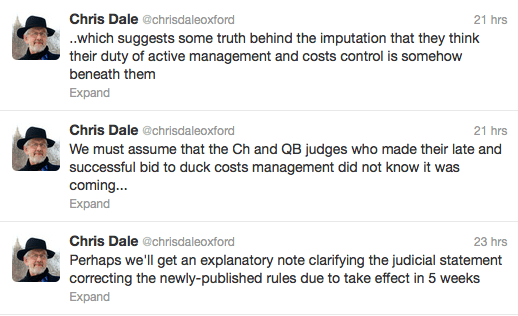
Screen Shot 2013-02-22 at 12.10.39

The problem, apart from the overriding sense of utter shambles, is that amending statutes can be confusing enough with their necessary cross-references, removals, additions and replacements. The “document” with its extended exemptions, its side-reference to a £2 million ceiling which appears (don’t ask me) either to claw back part of the exemption or to qualify the original position (I assume in fact that it relates to the surviving cases in the QBD), and its conclusion that “it is envisaged that costs management orders would be made in all cases except where there is good reason not to do so” leaves me unwilling to express a definitive view on what applies where.

Let’s be clear on this though:

There is no change to the provisions relating to pre-CMC exchange of information, and about attempts to reach agreement on the scope and on the method of giving disclosure.

These include an obligation to estimate the costs of disclosure – it is not clear whether their Lordships overlooked this in their scrabble to be relieved of budgetary considerations, but I see nothing in the amending “document” which affects this.

We can expect to see strict enforcement of the obligations – so far as I can see, the judges have no room to wriggle on this. As it happens, I am not in favour of over-strict enforcement of these provisions, recognising that many will face genuine difficulty in the first few months. That, however, is what the rules say, and a judge really has no alternative but to take a strict line.

Being objective about this, the judges are not the only ones with doubts about budgets. Many lawyers involved in big commercial cases think them irrelevant and others appeared to accept that the whole idea is beyond them. Well, if they can work out which cases, at what level of claim, can properly be taken to which Division, then they can duck that part of the problem for the moment. I do not myself see what is so special about litigation that it should be exempt from the normal principles of commercial risk assessment, but the Ditchers and Backwoodsmen have carried the day for the moment. Let’s see what happens as we spend another two years trying to take a proper stab at the subject. With any luck, we will see some key retirements over that period.

As always, I am more interested in the benefits rather than the burdens. Clients will like the idea that costs are being controlled, not least the costs of opponents which they might themselves have to pick up one day. Lawyers who can show that they are on top of budgets and metrics put themselves in a position both to win clients and to impress their opponents into settlement by their grip of the new rules, their understanding of the implications, and their knowledge of the “tools and techniques” (as Practice Direction 31B puts it).

As I say, I will write more about this in due course.

Home

Posted in Court Rules, CPR, Discovery, eDisclosure, eDiscovery, Electronic disclosure, Jackson Reforms, Litigation | Leave a comment

Huron Legal hosts post-LegalTech discussion in London

Nigel Murray, managing director of Huron Legal in London, was the host this week of a discussion and dinner at the Cavalry and Guards club whose purpose was a roundup of LegalTech from a UK perspective. This has become a fairly regular event and a good opportunity for those who went to LegalTech to report back to those who were unable to be there.

The UK contingent at Legaltech was smaller than usual this year. There seems to be no consistent reason why regular attenders gave it a miss: budgetary constraints provide an obvious answer; there may be a sense that the format has little to offer to non-US people (I do not agree, merely surmise that others might think so);  anecdote suggests that there is a lot of work on at the moment which, coupled with the shortage of experienced  people, may mean that the regulars could not be spared for a week away.  It would be fair to say that LegalTech showed little interest in us this year – so far as I could see, the Integreon panel in which I participated with kCura (on the Jackson reforms)  and UBIC‘s cross-border session were the only ones which paid any attention to the world beyond US borders.

Nigel Murray, Andrew Haslam of Allvision and I were the only ones present at the Huron evening who had been at LegalTech. Andrew Haslam had with him the draft of his usual roundup article which will appear shortly. Nigel identified some key themes and the rest of us kicked them about. Continue reading

Posted in AccessData, Discovery, eDisclosure, eDiscovery, Electronic disclosure, Huron Legal | Leave a comment

Preservation and proportionality on the agenda for US litigation

There is a lot going on in the eDiscovery / eDisclosure world at the moment, what with new Civil Procedure Rules in England and Wales, and with products, appointments and webinars to write about and conferences to plan for.

There has also been a stream of interesting articles which are worth passing on. I would normally seek to add some value with commentary of my own rather than merely give you hyperlinks, but they come thick and fast, and it seems better to pass them your way whilst they are topical rather than wait for an opportunity to expand on them. Besides, the articles in question have plenty of meat of their own and I do you no great service by adding more.

The subject is pending revisions to the Federal Rules of Civil Procedure, a subject which I have already covered in an article called A new definition of relevance in US eDiscovery? which was itself based on an article by Ralph Losey called Georgetown Part 2: New Rules are Coming! There was a curious lull after that, with relatively few US commentators seizing on two points in particular which seemed to me of significance – the proposed express incorporation of proportionality into Rule 26(b)(1) and planned amendments to Rule 37(e) which aim to clarify the “safe harbor” from sanctions where documents are deleted as a result of a “routine, good faith operation” of computer systems.

The problem (or one of the problems) with these areas is the lack of precision implicit in both. Preservation decisions turn on the “reasonable anticipation” of litigation, and anything involving the word “reasonable” involves a degree of subjectivity. Where a client is contemplating a voluntary but irrevocable decision such as the deletion of data, the average lawyer will err on the side of caution in circumstances where severe sanctions may be invoked against the client.  The present wording of Rule 37(e) gives too much scope for “average” lawyers to take refuge in the safe course which urges clients to keep everything “just in case”. “Just in case of what?” the clients might ask. There are circumstances which will clearly warrant sanctions; there are those which equally clearly do not; there are grey areas. The lawyer’s job is to discriminate between them where too many simply give the risk-free advice to keep everything (and take a fee for giving it). Continue reading

Posted in Discovery, eDisclosure, eDiscovery, Electronic disclosure, FRCP, Symantec | Leave a comment

ZyLAB webinar today: the Dark Side of Big Data

One of the more encouraging trends during 2012 was the growing focus on getting to the root of the data problem instead of merely addressing eDiscovery / eDisclosure problems as they arose.

This in turn brings a focus on the value of data in parallel with the perception that it is simply a source of compliance and eDiscovery risk. Deleting unnecessary data in a defensible way addresses both of these issues.

This is the subject of a webinar to be given today, 14 February, at 4:00 PM Central European Time. The participants are John Payton, Legal Counsel for Phillips International and Johannes Scholtes, Chief Strategy Officer at ZyLAB.

There is more information and a registration page here.

Posted in Litigation Support | Leave a comment

Consilio is the new name of First Advantage Litigation Consulting

The eDiscovery software and services company formerly known as First Advantage Litigation Consulting is now called Consilio, the culmination of a year of acquisition, growth, senior appointments, technology developments and brand presence. There is more information about the change of name here.

The company has seen a much expanded presence in Europe and Hong Kong as well as in the US. The acquisition last year of multilingual review company DLR Legal took the company into an area of activity which (as I have said constantly in the last year) represents the future of eDiscovery review.

Technology developments have included an emphasis on the workflow associated with audio, bringing that growing data source into the company’s proprietary software Global RPM alongside more traditional data forms.  We have seen a new web site, Blog and Twitter presence.  A new name and brand is a logical extension of this very visible growth.

Consilio’s CEO Andy Macdonald said “The name Consilio highlights the importance of ‘consulting’ from our former name, and reinforces our focus on providing creative, flexible solutions to our client’s global eDiscovery challenges. We believe Consilio best represents who we are and what we believe in – superior project management, broad global reach, problem solving expertise, and a team-based approach to client support”.

Here is Consilio’s eDiscovery page. They do much else besides, and there are links from this page to other technology solutions and consulting services.

Posted in Litigation Support | Leave a comment

The Civil Procedure (Amendment) Rules 2013 relating to disclosure and case management

This post has been amended to take account of the alterations announced AFTER the Civil Procedure (Amendment) Rules had been approved by Parliament. If that part of this post which relates to costs management has lost some clarity as a result, I would not be a bit surprised. We wait for the whole lot – statute, the “document” which announced the results of “further reflection”, the amended Rule and Practice Direction 3D. Then no doubt we will start seeing some case law as parties and courts try and work it all out.

Note that the case management provisions relating to Disclosure remain intact; they include a duty to estimate the costs of giving Disclosure. Note also that the “document” giving notice of the amendment ends as follows:

Subject to the limited exceptions which will be dealt with in the direction, it is envisaged that costs management orders would be made in all cases except where there is good reason not to do so. Even when the exceptions in the rule and the direction apply, the use of costs management should always be considered

See my article Costs management shambles defies parody but case management still has teeth.

The Civil Procedure (Amendment) Rules were published yesterday. They cover a wide range of matters, all to take effect on 1 April (subject to certain specific transitional provisions relating to discrete sections).

I give below the parts of most interest to those concerned with disclosure, case management and budgets. It is notoriously difficult to copy sections from statutes, particularly amending statutes, partly because their effect can be obscured by the (wholly necessary) cross-references to existing sections and other changes, and partly because of the “clever” way that text editors seek to renumber paragraphs and sub-paragraphs once divorced from the structure of their source.

Section 4

Insert the words “at proportionate cost” into the definition of the Overriding objective in Rule 1.1 and “enforcing compliance with rules, practice directions and orders” as an additional part of the description of the court’s duty in Rule 1.2.

The latter obviously creates no new duty for lawyers or judges (those practising in civil courts are expected to know the rules and practice them; it is gross incompetence not to, as HHJ Simon Brown QC reminded us in Earles v Barclays), but signals a new toughness with defaulters.

Section 5

Active management taken to a new level:

The court may contact the parties from time to time in order to monitor compliance with directions. The parties must respond promptly to any such enquiries from the court. Continue reading

Posted in Costs Management, Court Rules, CPR, Discovery, eDisclosure, eDiscovery, Electronic disclosure, Litigation, Litigation Budgets | Leave a comment

Welcome to UBIC as new sponsor of the eDisclosure Information Project

Ubic-logoIt is a pleasure to welcome UBIC as a new sponsor of the eDisclosure Information Project. Theirs is a name which I have known about for some time, but it was only at LegalTech that I had the opportunity of meeting them, thanks to the indefatigable Sasha Hefler of Strategic Brands on Fire, who knows everyone and who introduced me to Marketing and Business Developer Manager Sunil Mudunuri.

Although UBIC began work in eDiscovery as a Japanese company specialising in the languages of the region, it is also a mainstream player in US eDiscovery. Its client list includes NEC, Panasonic and Ricoh all of whom, with many other Asia-Pacific companies, have eDiscovery requirements which cross borders, particularly to the US.

The traffic passes the other way as well, as corporations in the US and in Europe are increasingly involved in the Asia-Pacific region with its language issues and diverse data protection and privacy regimes.  If you can handle those, then you can certainly handle the implications of purely domestic US eDiscovery, earning UBIC a place as a Visionary in Gartner’s 2012 Magic Quadrant for eDiscovery. Continue reading

Posted in Cross-border eDiscovery, Discovery, eDisclosure, eDiscovery, Electronic disclosure, UBIC | Leave a comment

FTI Report – Advice from Counsel by Ari Kaplan: Trends that will change E-Discovery

As it did last year, FTI Technology has commissioned a study by Ari Kaplan called Advice from Counsel Trends that Will Change E-Discovery (and What to Do About Them Now). This is based on interviews with 30 inside counsel with the aim of identifying the most Important forthcoming trends and seeking their guidance as to what is required to face the changes.  It makes sense, does it not, if you sell software and services, to find out what your client-base expects – they are, after all, in the front line, and are simultaneously the canaries in the mine and the influencers, able both to predict forthcoming changes and to identify what is needed to meet them.

Ari Kaplan’s reports tends to be among the more influential published during a year – I found myself quoting from his 2012 survey all the way through last year. It would be odd if, having commissioned the survey, FTI do not take notice of its findings, and there is indeed a close connection between the feedback received from inside counsel and the recent developments in FTI’s software and service offerings. The messages, however, apply more widely than to a single provider. Continue reading

Posted in Discovery, eDisclosure, eDiscovery, Electronic disclosure, FTI Technology, RingTail | Tagged | Leave a comment

Blog posts on eDiscovery | eDisclosure in January 2013

Here is a list of the 58 blog posts published in January 2013 on my Commentary Blog and Updates Blog. They got 9,464 page views between them.

As mentioned in a recent post, the web site has been smartened up a little as part of a general review. Some old material has gone and there will be new sections, not least about the Jackson Reforms, shortly (seeing the final form of the rules would be a a good start).

A spate of post-LegalTech posts is on its way, spread across the next few days. Continue reading

Posted in AccessData, Discovery, eDisclosure, eDiscovery, Electronic disclosure, Epiq Systems, Equivio, First Advantage, Guidance Software, iCONECT, KCura, Millnet, Nuix, Recommind, Symantec, ZyLAB | Leave a comment

Nuix launches Luminate to shed light on information governance

This is my third start at writing about the launch of the Nuix information governance platform Luminate. The results of the first two attempts may turn up in due course in an essay on good marketing or on the importance of information governance or, perhaps, both at once. The role of this site is to give short factual accounts of things of interest in eDiscovery / eDisclosure – a subject, verb, object  approach instead of elegantly-turned sentences conveying thoughtful commentary.

So:

Nuix launched Luminate

Perhaps we can add a little detail:

Nuix launched its information governance platform Luminate at LegalTech 2013

It warrants a bit more than that:

Information management software company Nuix launched its new information governance product Luminate at a well-judged and packed event at LegalTech 2013

Last go:

At an event which showed that its marketing skills match its software development skills, information management software company Nuix launched its interesting new information governance application Luminate at an enjoyable and interesting event at LegalTech 2013

That’s more like it.  In less than 13 years, Nuix has moved from being a small forensic software company through eDiscovery software provider and on into the deeper waters of information governance. They have achieved this, not merely by producing solutions which companies want to buy, but by taking a strong lead in promoting thought about the subject and in bringing together those who can articulate useful contributions to the discussions.

The Nuix Luminate web page is here, with a brief description of the four stages of information governance which it helps manage – to understand and prioritise, to analyse and review, to act and enable and to maintain and leverage. The objectives (and Nuix is good at retaining a focus on client objectives) is are to reduce costs, to mitigate risk, to maintain compliance and, not least, to extract value from the data which survives the deletion of irrelevant material.  There are links from this page to more detailed sections about archive search, defensible deletion and intelligent migration.

So much for the product, what about the event? The centrepiece was an engaging talk by Barclay Blair of ViaLumina. Barclay took as a parallel the governance of New York City at the beginning of the Twentieth century. The city, he said, had no budget; this is not the same as having no money – there was no formal means of identifying actual spend, still less prospective expense, or of raising funds against preallocated targets. Things got done, but resources – and opportunities – were wasted.  Proper planning only became possible once data had been collated and turned into management information, including the prediction of future costs. You can deduce for yourself how this parallel works through into companies which have no means of using the data which accumulates with every project and with every day.

Companies may well be able to identify the direct and tangible costs of maintaining servers and software and of employing people to look after them; they might even (though few seem to do this) keep track of the costs associated with giving eDiscovery from the growing volumes of data. What they can never track are the lost opportunities derived from the inability to extract value from such of their data as is actually useful.

Barclay Blair has written a White Paper for Nuix covering  this ground and called The Total Cost of Owning Unstructured Information which introduces new ideas such as Full Cost Accounting for Information, the Information Calorie, and Information Cap and Trade which are designed to help organisations think about and manage their unstructured information.

Nuix has also produced a paper called Reducing the Costs of eDiscovery from Collection to Court which focuses as much on information advantages in litigation as on the usual subject of the avoidance of risk.

 The event itself had as trailers the clever Beans video and Nuix’s inspired move in recruiting Deborah Baron as Chief Marketing Officer. Luminate was not the only new product launched in that week – Nuix 4.2 is out as well. That is an awful lot to bite off in one week. How do you pitch the launch?

It is easy enough to buy the outward trappings of a big launch – take some big space at the top of the Mandarin Oriental Hotel, serve good food and drink, lay on a first-rate speaker, invite the right people and do some clever things with the lighting. Nuix did all that, but without excess, and their secret – and this is extremely difficult  when a company is growing this fast – is to pull off such a big event whilst making your invited guests feel part of the Nuix “family”. That Nuix managed this, is a tribute to Marketing Director Carolyn Betts and her team. There are some photographs here which include one of me with Nuix’s US CEO Mark Chardack.

I am in danger of lapsing back into my riff on the subject of successful marketing which I promised to cover separately. Nuix’s primary secret, obviously, lies in its technology and in its marketing. It lies also, however, in a comment made to me by a Nuix employee during the evening: “I’m really proud to work for this company”, he said. If CEO Eddie Sheehy can maintain that amongst his staff as the company grows yet further, Nuix will continue to succeed.


Posted in Litigation Support | Leave a comment

kCura “Ask the Doctor” webinar with Dr David Grossman on 28 February

My recent article Applying science to the validation of technology assisted review attracted a gratifying amount of attention. It was based around a paper called Measuring and Validating the Effectiveness of Relativity Assisted Review by Dr David Grossman, an Adjunct Professor of Computer Science at the Illinois Institute of Technology.

On 28 February, Dr Grossman will take part in a webinar at which attendees will have an interactive opportunity to connect with Dr Grossman in a Q&A focusing on the statistics at work in a computer-assisted review workflow.

Further details and the registration form can be found here.

Posted in Litigation Support | Leave a comment