
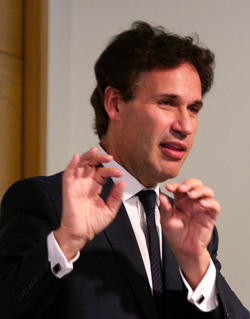
Professor Richard Susskind was the keynote speaker at Lawtech Camp London. If his message was familiar to many of us, it bears repeating, certainly in relation to litigation, as the times catch up with his predictions. There is a good report on the Legal Futures site called “More for less”, liberalisation and technology: Susskind lays out vision of the future which leaves me free to focus on the points most relevant to litigation.
Predictors of the future, especially in a business context, are used to the reaction “That’s all very well, but what do I do now?” They get lumped together with those who confidently predict the end of the world or environmental apocalypse – even those who accept that change must come see the threats as both far off and too big to grapple with; besides, they have businesses to run, stuff on their desks right now and calls to return. The future can wait.
Room for optimism
Well, in a litigation context, the future predicted by Richard Susskind is here. It is by no means a future of inescapable doom – he protested mildly when I once compared him with the lugubrious Scotsman Private Fraser from Dad’s Army whose catchline was “We’re all doomed”. Richard points to the question mark at the end of the title of his book The End of Lawyers? and to his continuing emphasis on the opportunities which are there for those who are ready to take them. It would be fair to say that I am becoming increasingly optimistic – we have yet to see much movement from the general body of law firms, but three broad developments give tangible form to a parallel world which lawyers can either join or ignore; these are:
- The introduction of new court rules around the world which focus on the objectives of clients and courts rather than the plodding proceeding-with-the-procedures approach which has served lawyers so well in the past.
- The growing realisation by clients that the savings achieved by shaving a bit off their lawyers’ hourly rates are as nothing compared with the benefits of information governance and of taking control of at least part of the process for themselves, working with lawyers but also with others.
- Improvements not just in technology but in the services which wrap around the technology, including outsourced managed document review.
That question mark in Richard Susskind’s book title implies that those lawyers who are willing to adapt their service offerings to this new world will have new work to do including their share of new types of task. For the rest, in litigation anyway, Private Fraser has words for you.
The components of the litigation task
The Susskind point which has most relevance for litigation lawyers is the idea that most legal tasks can be broken down into components, each of which can potentially be placed in other and multiple hands. Quite apart from the diversity of providers, most of these tasks can be handled in more than one way. When I qualified, and until relatively recently, there was really only one way of dealing with discovery / disclosure, and only a lawyer could do it. Now, whilst the lawyer remains responsible to client, opponents and court, there are many different ways of dealing with the task and with the components of the task, using a mixture of the client’s own resources, third-party providers of services, and technology. At the same time, the rules in many jurisdictions, including England and Wales, increasingly require predictability and transparency both in the way discovery is given and in the costs of doing it. It is not a coincidence that most clients want this as well.
This is not the same as saying that the cheapest course must always be followed; equally, it is not to be addressed merely by cutting hourly rates. It is not enough, Susskind said at Lawtech Camp London, to make some redundancies and wait for the good times to come back. Most lawyers’ alternative fee proposals, when properly examined, amount to no more than a discount of say 10% of their old fee rates. Meanwhile, clients are building up their in-house counsel teams, and long-term technology changes disrupt old practices. “The Internet is changing everything” Susskind said, “why not for lawyers?”
Lawyers’ attitude to technology amounts, he said, to “irrational rejectionism”. At a time when IBM’s Watson is solving problems, not just delivering information, when Google can predict flu epidemics and your fridge can order food, clients are seeing their disputes being dealt with “two years later, in a wooden courtroom, by people speaking a language they do not understand”. There are new jobs for lawyers out there, mostly for people with multiple skills and with training in more than one discipline. Meanwhile, law schools are turning out people who are ill-prepared for today, still less for tomorrow.
That last paragraph, I know, will look implausibly futuristic, even to those lawyers who can accept that the old ways are gone and that business models must change. It is not within our control to decide what law schools teach, we cannot change court procedures, still less court infrastructure, and fancy technology is no substitute for proper legal advice. What possible relevance lies in Watson and your fridge?
The technology point is easily dealt with. Just go and look open-mindedly at some of the latest tools, not just predictive coding, but the full range of functions offered by modern litigation technology. The functions are just building blocks. The fridge’s ability to detect that you are low on essential stocks and to place an order for them won’t plan your meals or cook a delicious supper, but it removes tedious and time-consuming preconditions for getting the job done. A great deal of eDiscovery similarly involves “tedious and time-consuming preconditions for getting the job done”. You need to understand what the functions are before you can consider the benefits, that is, the reduction of unnecessary time and cost and (don’t overlook this) the improved quality of both the work-product and of the life spent producing it.
What are solicitors uniquely qualified to do?
The key element of Richard Susskind’s talk, so far as I was concerned, was this question: what are solicitors uniquely qualified to do? The litigation process, he said, has nine basic components – document review, litigation support, legal research, project management, eDisclosure, strategy, tactics, negotiation and advocacy. Which of those cannot be done, he asked, by others – by one of the big consulting companies or by multiple specialists who may include those with legal skills (barristers, for example) without being solicitors gathered in firms? Tactics and strategy, he suggested, to which one might add negotiation; then again, one might ask what makes a solicitor uniquely qualified even for these things – see my article Epiq Systems London judicial panel points to future of technology-assisted review for a discussion on the potential room for barristers here.
When Richard Susskind first started talking about disintermediation – the potential for solicitors to be left out of legal processes – he was relatively muted on the subject of litigation. I once asked him why, after a particularly good speech which he gave in Leeds which barely mentioned litigation, and his answer then was that the clients were not much interested relative to other improvements which they wanted from their solicitors. If that was true then, it certainly is not true now. As I said in opening this post, the clients now have alternatives both from their own resources and from alternative business models providing components of the eDisclosure / eDiscovery process. The future has arrived. Solicitors can choose to be a part of it, not just to defend their traditional patches but to create new sources of work, or they can ignore it.
Doom deferred?
Some readers may be puzzled by my reference to Private Fraser and Dad’s Army. Although Richard Susskind’s message to lawyers offers hope as well as gloom, and is far from being a curse on the profession, some of Fraser’s ghost stories do have relevance beyond the shared Scottish ancestry of the speakers. The best one (you can find it on YouTube) is about the long-delayed effect of a curse laid 50 years before on one of Fraser’s friends.
Pike: Did the curse come true, Mr Fraser?
Fraser: Aye, son, it did. He died. Last year. He was 86.
Don’t bank on getting the breathing-space which was afforded to Fraser’s friend in the story. Susskind’s future is here.


 eDisclosure Information Project