
I am just back from a week in Hong Kong whose primary purpose was to speak at an ediscovery conference, with a couple of other meetings thrown in. I did three panels in one afternoon and a fourth the following day, and I have three speaking sessions coming up this week, so this post is a kind of palate-cleanser in between, more about the discovery of Hong Kong than about ediscovery in Hong Kong. If you like your ediscovery reading to be undiluted forensics, case law and search strategy, then skip this post and wait for my more formal account. There will be some overlap, no doubt, but this is travelogue not subject-matter learning – I put that in right at the top to head off the Tweeter who mischievously sub-titled my last post as being from his new blog “My Summer Vacation”. Lucky me, I say, to be able to take my holidays in the up-and-coming ediscovery hot-spots just when a big conference is taking place. I am already on record as suggesting that the Australia – Singapore – Hong Kong axis is the next place for ediscovery growth, so some of you may value the introduction anyway for that reason – and I have just fielded a message asking about the place for precisely that reason.
 One of the features of this trip was that my wife, Mary Ann, was able to come with me. This conference, for a change, was not in her university term and I had gaps on each side of it. For once I had both time and incentive to see something of the place as well as perform my duties and mix with the likeable caravanserai of ediscovery people who gather at these events. That is all pure pleasure for me anyway, but I have a bad habit when on my own of treating hotel rooms as an annex to my office, and of snacking in Starbucks. We ate in everything from a Chinese greasy spoon to the tea room at the Peninsula Hotel, where a band plays in the gallery and you expect to see Noel Coward or Harry Flashman at the next table (although Flashman’s visit to Hong Kong in 1860 en route to the Second Opium War preceded the opening of the Peninsula by 68 years).
The British have form in bringing things to the Far East which are not native to either culture but which quickly become a habit. The general pattern is that the commercial market sees a requirement but the authorities are unhelpful and slow to see the need for change. An aggressive and persistent campaign is needed to persuade the rule-makers to recognise that the world has moved on and that they will be left behind if they do not adopt new commercial practices. I am talking, of course, of the First Opium War (1839 to 1842) which resulted in the Treaty of Nanking, the cession of Hong Kong Island to the British, and the opening up of China to international trade. You perhaps thought that I meant something else.
 When I go somewhere new, I like to get an impression of the whole before looking at the detail. You do that in Hong Kong either by going up to the Peak or down to the water. We went down to Causeway Bay where they still fire at 12.00 the gun referred to in Noel Coward’s Mad Dogs and Englishmen:
In Hong Kong, they strike a gong, and fire off a noonday gun.
To reprimand each inmate, who’s in late.
From there you can see across to Kowloon, the New Territories, and the mountains beyond in mainland China. To your left is the main business district, Central, and beyond it, across the Channel, the island of Lantau where the new Chek Lap Kok Airport is. Out of sight behind Kowloon is Victoria Harbour with its constant stream of heavily-stacked container ships, whose undoubted utility does not make up for the lost gracefulness of the steamships and clippers of earlier eras. There is a distinct loss of grace also in the hideous,  windowless pink building which houses the Hong Kong Cultural Centre and blocks the view of and from the elegant Peninsula Hotel – an eloquent illustration both of a cultural clash and of the lack of sentimentality which keeps Hong Kong in a state of permanent redevelopment.
Sentiment, in the sense of attachment to beautiful things long gone, comes to mind when you look to your right where the old Tai Pak Airport lies awaiting redevelopment. There was nothing attractive about Tai Pak itself, but it was a flying boat station between the wars, and you can picture those elegant Imperial Airways Short Empires touching down in the channel. Legend has it that the RAF bulldozed its Spitfires into the sea when their retirement coincided with the land reclamation needed for the 1955 extension of Tai Pak’s runways out into the sea.
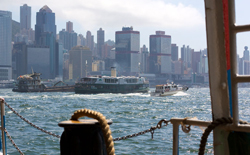 To get the reverse view, you take one of the green and white ferries which cross quickly and efficiently between Hong Kong and Kowloon, so that you can see the crowd of tall buildings opposite. There was a Rowan Atkinson sketch of many years ago (7 April 1980 if precision is your thing) in which Atkinson’s Cortina tipped onto its nose as he affixed the last of many badges and lights onto its front. The 30-year-old memory came back to me as I looked across to Hong Kong Island. Only the weight of the Peak, one thinks, holds the island horizontal; one day, a builder will place the brick which tips the whole thing over. The paint has barely dried on a building, it seems, before it is torn down to be replaced by something newer, shinier and taller.

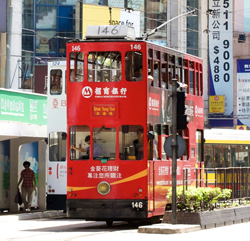 Not everything is brand new. The ferry on which we crossed to Kowloon was built in 1965. We came across an immaculately preserved Dennis fire engine of 1940. The trams on the streets were nearly identical to the one in the wartime section of the Hong Kong History Museum. What is most striking is the contrasts which appear at every turn, between old and new, richness and poverty, good taste and appalling vulgarity. Here is a motor showroom with more expensive marques than you would see in Park Lane; just round the corner is a dark alley packed with stalls selling the most appalling tat. Massive shopping centres filled with every brand name you could never afford lie next to streets full of stuff you would never want. I loved it.
Patriot and part-time borderline xenophobe though I am, Hong Kong’s public realm puts Britain to shame. The dropping of litter is an offence punishable by a serious fine; so it is in Britain, but in Hong Kong there are litter bins every few yards which are emptied eight times a day and cleaned at least once. Perhaps as we begin to winkle useless bureaucrats out of their offices, we could re-employ them to do something useful like this. The biggest contrast lies in public transport which, in Britain, falls either on incompetent public bodies like Transport for London or on private enterprises whose focus is on shareholder value and the directors’ bonuses rather than the passengers (and who are no less incompetent with it). The Hong Kong underground system, the MTR, is clean, efficient and cheap. Best of all, the announcements are in clear, unaccented English; not the least of the absurdities of our undiscriminating discrimination laws is that the inability to speak English is not a bar to employment as an announcer. If you prefer to travel over-ground, clearly-marked trams or buses appear every few minutes. Taxis are plentiful and cheap and, packed though the roads are, the traffic systems seem to work, in contrast to the schemes devised by that deeply stupid type, the British highways officer, who sees his function as screwing up the traffic flow.
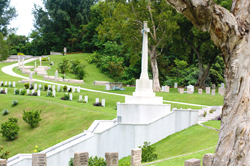
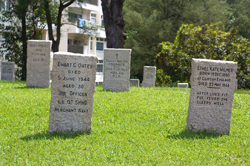 Some of these themes – efficient transport, occasional xenophobia and the replacement of old buildings – came together on our second day when we went to Stanley, a small coastal town on the south side of the island. A bus marked for Stanley drew away as soon as we sat down; Stanley is the site of the civilian internment camp after the Japanese invasion; it is also the new home of Murray House which was transported stone by stone from Hong Kong Central and re-erected here so that a tower block could be built in its place. Our first stop was the military cemetery which was reopened in 1941 after nearly 80 years’ disuse. There, on a steep well-tended plot, stands Sir Reginald Blomfield’s familiar Cross of Sacrifice – familiar in the sense that one of its three variants is found in any place where British war dead are commemorated, including my school. The graves and memorials are mixed in type – curious rounded graves from before 1866, roughly engraved headstones put up by fellow prisoners of the dead, the classic headstones of the War Graves Commission, and an impressive and touching memorial to the many Chinese who died on the British side.
 Stanley was the scene of the final fighting in Hong Kong. The Japanese celebrated their victory there, as they did in the city, by murder and rape in the hospital. The internment camp occupied a school and existing prison and was the scene of unnecessary hardship caused as much by neglect as by deliberate cruelty. Starvation rations and the Japanese contempt for basic rights were only the start: on 29 October 1943 seven civilians were executed on Stanley beach for possession of a radio; on 16 January 1945, a US plane bombed a prison bungalow, apparently mistaking it for a ship out in the bay; the Chief Manager of HSBC, Sir Vandeleur Grayburn, died of malnutrition in the camp; the graves include that of a 75 year old grandmother, whose grandson’s death is also recorded on her headstone. Military cemeteries are sad enough places when the only occupants are combatants killed in action.
My source of information about the camp, incidentally, is a short book by Hong Kong historian Geoffrey Charles Emerson called Hong Kong internment, 1942 to 1945: life in the Japanese civilian camp at Stanley, which is available in part from Google books. If there is any light relief to be found in it, and there is not much, it lies in the report of a Japanese notice about relationships between inmates. It read:
It has come to our notice that immorality is taking place on the roofs of the camp blocks in the evenings. This will cease, except between married couples and good friends
What is it about this which brings a wry smile even amidst such horrors? Is it the characterisation of sex within marriage as “immorality”, or is it the rather broad exemption in respect of “good friends”?

 You need a drink after something like that and Murray House, moved from Hong Kong Central in 1999 to make way for the new Bank of China Building, seemed the place to go. We were somewhat bemused to find that it was called King Ludwig, named for the builder of Schloss Neuschwanstein and other exotic castles of Bavaria. Even Mad Ludwig, fantasist that he was, would be puzzled to find an entirely Bavarian shrine in a former British colonial military building overlooking the South China Sea. You will criticise me, perhaps, for even noticing that I am sitting in a German bar overlooking a beach where Japanese soldiers executed seven Britons – move on, comity of nations, sins of the fathers, we are all friends now, you will say. So do I, but I am an historian, and those dawn murders took place only ten years before I was born. If you airbrush your history to suit the conventions of later times, you dishonour the dead and will learn nothing for the future.
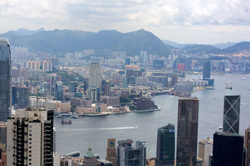
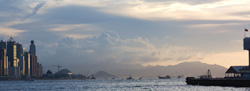
 After that, the conference largely took over my time and I will write about that separately. Random recollections stay with me: the attendant hovering in the Gents at the Mandarin Oriental Hotel (where Epiq Systems hosted an excellent dinner) who passed me a towel and took it from me when I had finished, leaving me thankful that he had left the rest for me to accomplish alone; the Peak Tram and the views from the top; the first-rate Hong Kong Museum of History; the junk silhouetted against the setting sun on our last ferry trip; not least, a flight home which began with a pass across brightly-lit Hong Kong in the dark and ended at dawn with the whole of East Anglia from Orford to the Wash clearly visible below. All that, and a conference which left me optimistic that we can make real progress in Hong Kong. What more can one ask for?


 eDisclosure Information Project